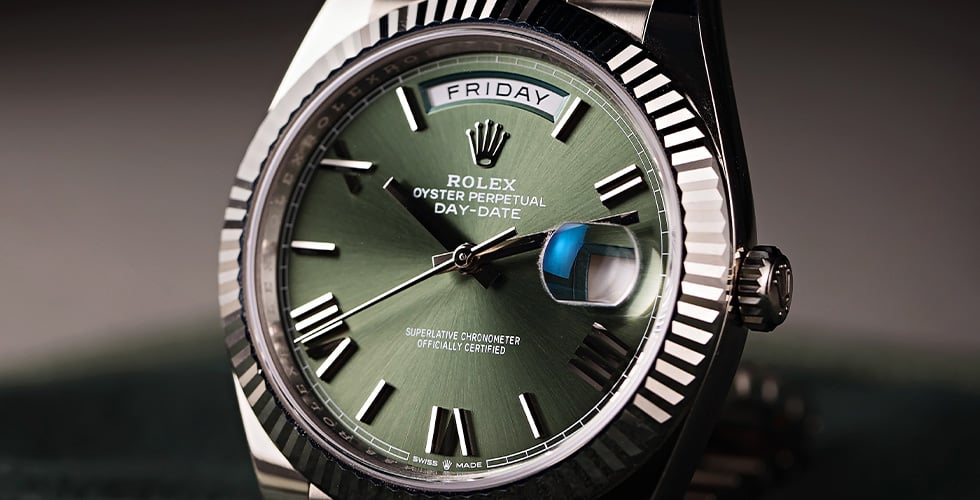
When the Rolex Daytona was introduced in 1963, the watch took its name from Florida’s famous Daytona International Speedway, one of the most celebrated racetracks in America. Yet the iconic Swiss watchmaker reportedly considered another legendary racing circuit before settling on Daytona: Le Mans. More than sixty years later, the association seems fitting. Le Mans has become the ultimate test of endurance, precision, and reliability: the very qualities Rolex has celebrated throughout its history.
From June 10–14, 2026, the world’s greatest endurance race returns to the Circuit de la Sarthe in Le Mans, France. First run in 1923, the 24 Hours of Le Mans was conceived not as a test of outright speed, but of durability, reliability, and engineering excellence. Manufacturers were tasked with building cars capable of sustaining performance for an entire day and night, i.e. 24 hours, a demanding proposition in the early decades of motoring and one that remains challenging today. Over the course of more than a century, Le Mans has evolved into the ultimate automotive proving ground and one of the most prestigious events in all of motorsport.
Rolex and Le Mans: A Partnership Defined by Time
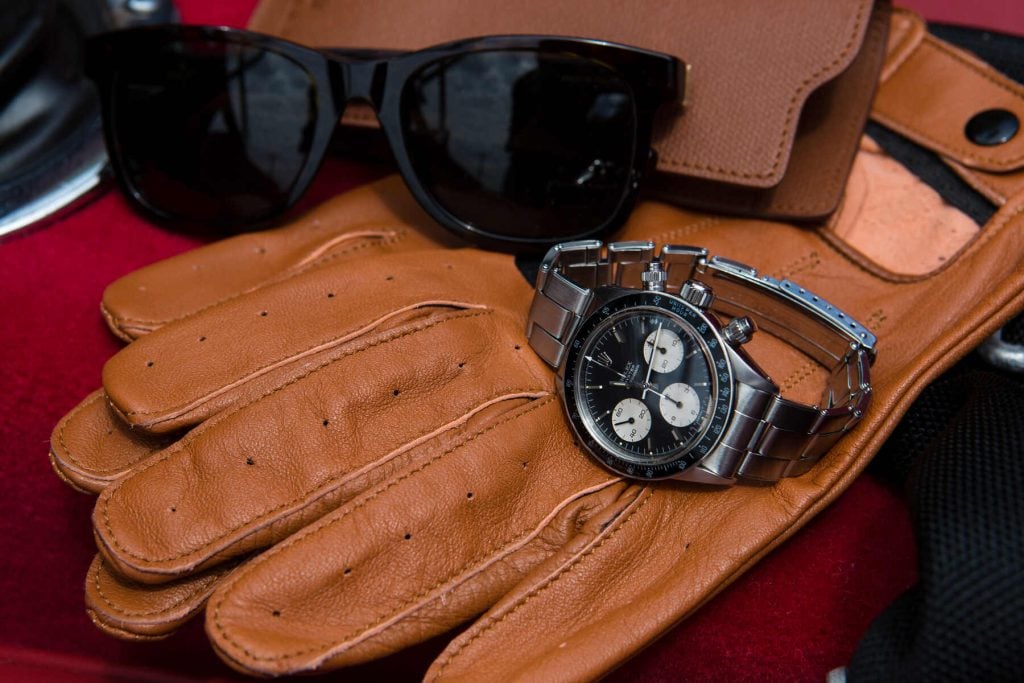
Rolex’s relationship with the race extends far beyond shared values. In 2001 Rolex became the Official Timepiece of the Le Mans, and overall winners received a specially engraved Rolex Daytona alongside one of motorsport’s most coveted trophies. Few sporting contests are governed more completely by time. Every lap, pit stop, fuel strategy, tire change, and driver rotation is measured against the clock.
Why the Daytona Belongs at the Track
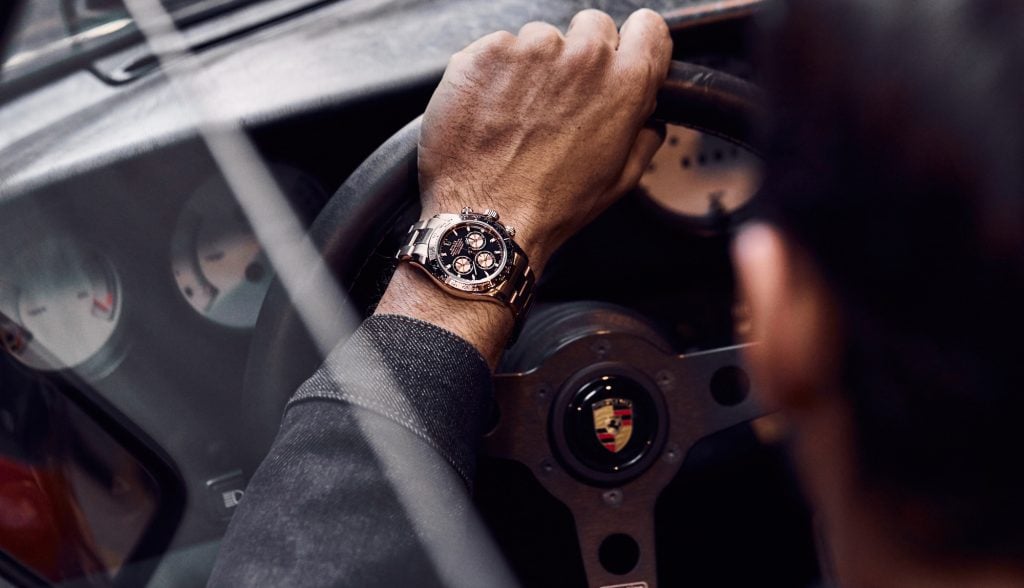
Introduced during the golden age of motorsport, the Daytona is Rolex’s tool watch designed specifically for racing. Its chronograph allows drivers to measure elapsed time, while its tachymeter bezel can be used to calculate average speed over a known distance. Long before telemetry systems, sophisticated timing software, and digital dashboards became commonplace, those functions provided practical utility at the track. While the Rolex Daytona has evolved into one of the world’s most coveted luxury watches, its appeal remains rooted in authentic motorsport heritage.
No manufacturer occupies a more romantic place in automotive competition than Ferrari. For generations, the Italian marque has represented speed, beauty, and competitive achievement at the highest level. Ferrari arrives at Le Mans in 2026 as the defending champion after securing victory in 2025 with the No. 83 AF Corse Ferrari 499P. The victory marked Ferrari’s third consecutive overall triumph since returning to top-level prototype competition and established the marque as the favorite heading into this year’s race.
Ferrari, Daytona, and the Shared Language of Performance

The connection between Ferrari and the Daytona is hard to miss. Both are icons of their respective worlds. Both combine engineering excellence with enduring desirability. And both have transcended their original purpose to become symbols of performance, achievement, and motorsport culture. If Ferrari is the perfect automotive companion to a Rolex Daytona, there is no more fitting stage for the pairing than Le Mans.
Since its debut in 1963, the Daytona has evolved through several distinct generations. Early manually wound references established the model’s identity, including the exotic-dial variants later associated with the actor and racing driver Paul Newman, who famously finished second overall at Le Mans in 1979. The Rolex Zenith Daytona watches of 1988 introduced automatic winding, while Rolex’s fully in-house movement arrived in 2000. The ceramic-bezel generation followed in 2016, and in 2023, Rolex further strengthened the model’s connection to endurance racing with the launch of the Rolex Daytona Le Mans, a special edition celebrating both the race and the chronograph’s 60th anniversary.
The Evolution of the Rolex Daytona

Le Mans is often decided by the accumulation of small advantages and costly mistakes. A well-timed pit stop, a reliable car, or a disciplined strategy can prove just as important as outright speed over the course of twenty-four hours. That pursuit of sustained excellence explains why Rolex and Le Mans remain such a natural pairing. “Both Rolex and Le Mans celebrate precision, reliability, and endurance,” notes Paul Altieri, Founder and CEO of Bob’s Watches. “And both recognize that greatness is built over time rather than achieved in an instant.”
Why Le Mans Still Matters to Rolex

More than a century after the first 24 Hours of Le Mans, the race remains one of the purest tests of performance in the world. Cars may be faster, timing systems more advanced, and strategies more sophisticated, but the essence of the event has not changed. Le Mans still rewards endurance, precision, discipline, and the ability to perform under pressure for longer than anyone else.
That is why the connection of Rolex to the race feels so natural. The Daytona was born from motorsport, but its lasting appeal comes from the same qualities that define Le Mans itself: mechanical excellence, measured performance, and achievement earned over time. Whether on the wrist of a winning driver, in the paddock, or among collectors who appreciate the model’s racing heritage, the Rolex Daytona remains one of the most fitting watches for the world’s greatest endurance race.