
The Zenith Daytona is one of the most collectible chronographs in the world. Produced between 1988 and 2000, this generation of the Rolex Cosmograph Daytona was powered by the Caliber 4030, a self-winding engine based on the legendary Zenith El Primero 400. Rolex took the base caliber and performed over 200 modifications to bring it in line with the brand’s rigorous Superlative Chronometer standards. The result was a watch that redefined what the Daytona could be, transforming it from a slow seller into one of the most coveted timepieces ever made.
For collectors and enthusiasts alike, the Zenith Daytona marks a major turning point in the Cosmograph’s history. It was the first time the Rolex Daytona ran on an automatic movement, and the modifications Rolex applied to the El Primero created something entirely new. This guide takes a closer look at the Zenith Daytona, covering the history of the Rolex-Zenith partnership, the technical details of the Caliber 4030, and a few practical tips for identifying these watches by their dials.
Key Takeaways
- The Origin: Rolex used the Zenith El Primero 400 as the foundation for its first automatic Daytona.
- The Caliber 4030: Rolex made over 200 modifications to the Zenith base, including removing the date function and reducing the beat rate.
- Production Era: Zenith Daytona models (Reference 165xx series) were manufactured from 1988 to 2000.
- Collectability: Dial variations like the “Inverted 6” and “Patrizzi” dials make certain Zenith Daytona models extremely valuable on the secondary market.
The Zenith Daytona’s significance really comes down to the movement. This generation introduced a larger 40mm case, crown guards, and a sapphire crystal, but the biggest shift was the move from manual-wind Valjoux calibers to the automatic Zenith-based Caliber 4030.
The History of the Zenith Daytona (1988 to 2000)

Before the Zenith era, the Rolex Daytona relied on manually wound Valjoux-based movements. During the 1970s and 1980s, the watch struggled commercially. Manual winding felt outdated as automatic movements became the industry standard, and the quartz crisis was reshaping the entire Swiss watch landscape. Rolex needed a reliable, high-performance automatic chronograph caliber, but developing one entirely in-house was a complex and time-consuming process. The solution came from across the Swiss Alps.
Zenith had developed the El Primero in 1969, one of the first automatic chronograph movements ever produced. Its high-frequency design, beating at 36,000 vibrations per hour, made it capable of measuring time to a tenth of a second. After surviving near destruction during the quartz crisis (the story goes that a Zenith watchmaker secretly hid the original tooling and plans), the El Primero was reintroduced in the mid-1980s. It was, at that time, arguably the finest automatic chronograph caliber available, and it caught Rolex’s attention.
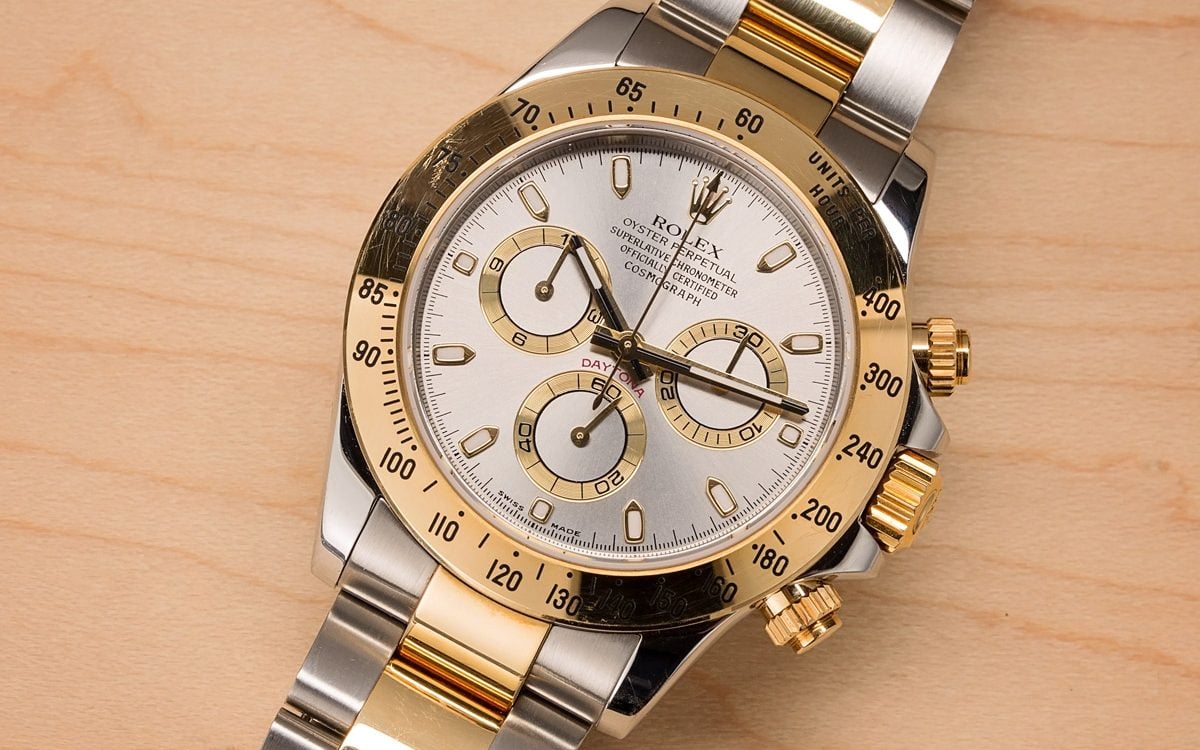
Rolex redesigned the Daytona in 1988, with a heavily modified El Primero 400 at its core. The new collection included the Ref. 16520 in stainless steel, the Ref. 16523 in steel and gold, and the Ref. 16528 in 18k yellow gold. Additional gold models on leather straps, the Ref. 16518 and Ref. 16519, followed. Upgrades included a 40mm Oyster case with screw-down pushers, sapphire crystal, and the design template that still defines the Daytona today. It was an instant success, and for the first time in the model’s history, Rolex dealers had waiting lists for the Cosmograph.
Inside the Zenith Daytona: El Primero 400 vs. Rolex Caliber 4030
It’s called the Zenith Daytona because of the movement inside. Rolex didn’t simply drop the El Primero into the Daytona case and call it a day. The brand’s engineers stripped the movement down to its mainplate and rebuilt it to meet Rolex’s own performance and durability standards. By the time they finished, fewer than half of the original Zenith El Primero components remained. The resulting caliber, designated the 4030, was different enough from the base movement to justify its own reference number.
The 200+ Modifications
The single most significant change was reducing the beat rate from 36,000 vibrations per hour (vph) down to 28,800 vph. The El Primero’s high frequency was a selling point for Zenith, allowing it to measure time in tenths of a second, but Rolex had different priorities. A lower frequency meant less friction and wear on the movement’s components, which translated into longer service intervals and improved long-term reliability. It also brought the Daytona in line with the rest of Rolex’s lineup, which universally operates at 28,800 vph.
Beyond the frequency change, Rolex removed the date function entirely. The dial is cleaner and more focused on its chronograph purpose. The original flat hairspring was replaced with a Breguet overcoil, a curved spring design that promotes more consistent timekeeping across different positions. Rolex also gave the movement with a larger, free-sprung Glucydur balance wheel paired with the brand’s proprietary Microstella regulation system, the same technology used across all Rolex movements at the time. The escapement was essentially replaced wholesale. All of these changes, along with dozens of smaller refinements to the rotor, lower plate, and shock protection, allowed Rolex to increase the power reserve from approximately 42 hours on the base El Primero to around 52 hours on the finished Caliber 4030.
Comparison Table
| Feature | Zenith El Primero 400 (Base) | Rolex Caliber 4030 (Modified) |
| Vibrations Per Hour | 36,000 vph | 28,800 vph |
| Date Window | Yes | No |
| Hairspring | Flat | Breguet Overcoil |
| Jewels | 31 | 31 |
| Power Reserve | Approx. 42 hours | Approx. 52 hours |
| Balance Wheel | Standard | Free-sprung Glucydur with Microstella |
| Certification | Standard Chronometer | Superlative Chronometer (COSC) |
How to Spot a Zenith Daytona

One of the most common questions among buyers and collectors is how to spot a Zenith Daytona at a glance. The good news is that there’s a couple of visual differences between the Zenith-era models and the later in-house versions. Familiarizing yourself with the key details makes it easy to tell them apart without ever opening the case back.
Zenith Daytona Reference Numbers
All Zenith-era Daytonas have five-digit reference numbers in the 165xx series. These are the core models that were produced during the 1988 to 2000 production window.
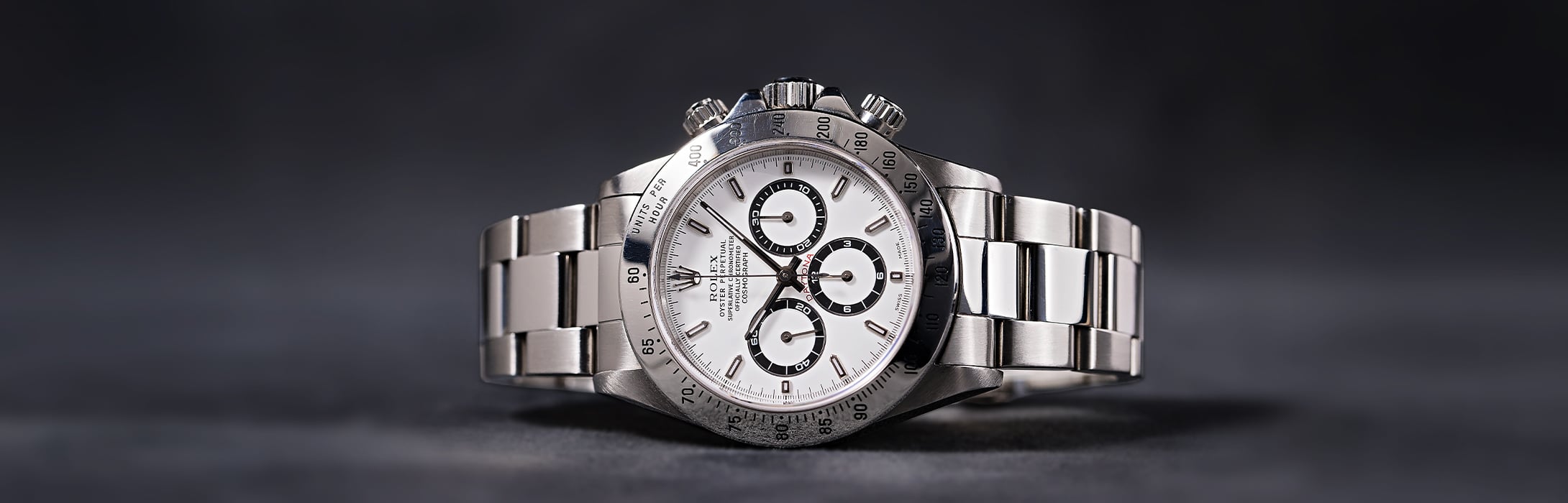
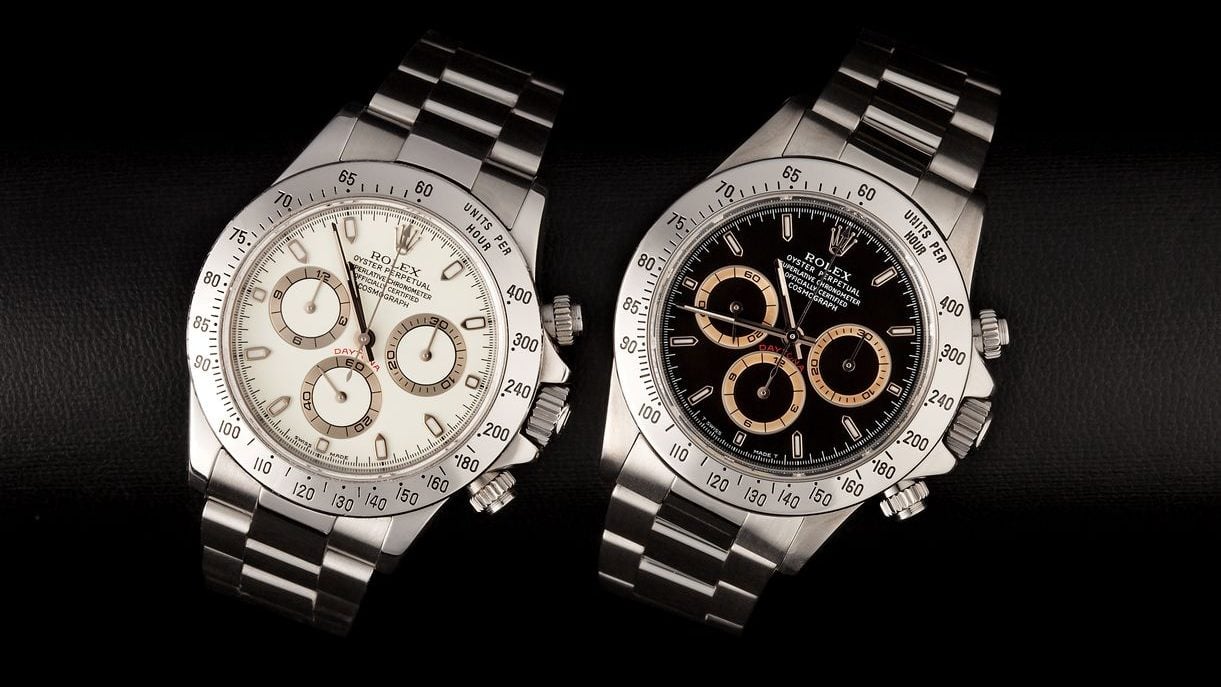
- Ref. 16520: Stainless steel. This is the most iconic and widely collected Zenith Daytona. It came with either a black or white dial and was the entry point into the Daytona line.
- Ref. 16523: Two-tone, featuring a combination of stainless steel and 18k yellow gold.
- Ref. 16528: Full 18k yellow gold case and bracelet.
- Ref. 16518 and 16519: Gold models on leather straps rather than metal bracelets.
What to Look For on the Dial
The fastest way to identify a Zenith Daytona without opening the case back is to look at the sub-dial layout. On all Zenith-powered Daytona models, the running seconds sub-dial sits at 9 o’clock, the 30-minute counter is at 3 o’clock, and the 12-hour counter is at 6 o’clock. When Rolex introduced the in-house Caliber 4130 in 2000, the running seconds moved to 6 o’clock and the 12-hour counter shifted to 9 o’clock. If you see running seconds at 9, you are looking at a Zenith Daytona.
There’s a few dial variations as well. Early production Zenith Daytonas (often categorized as Mark I through Mark IV) feature what is known as the “Inverted 6,” where the numeral 6 on the 12-hour recorder sub-dial appears upside down. This small detail has become a significant marker for identifying early production runs and commands a premium on the secondary market. Other variations include differences in text spacing on the dial. Some early models display four lines of text, while later versions have five lines. There is also the rare “Floating Cosmograph” configuration, where the word COSMOGRAPH appears separated from the rest of the dial text, sitting higher on the face.
Collector Favorites: The Patrizzi Dial and Rarity
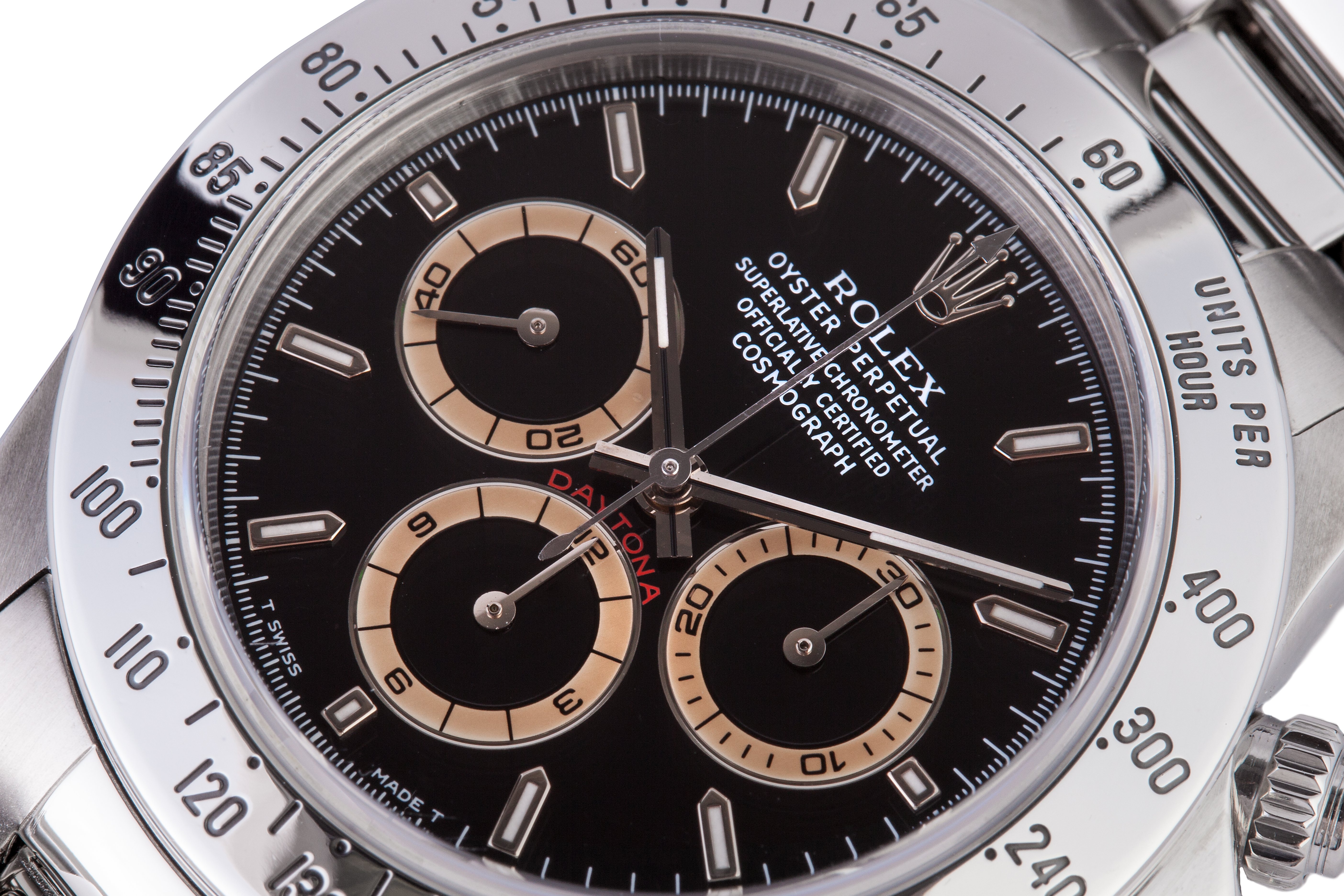
Patrizzi dial Zenith Daytonas are particularly collectible. The name comes from Osvaldo Patrizzi, founder of the Antiquorum auction house, who first identified the phenomenon when selling a collection of Rolex watches in the mid-2000s. On certain black-dial Ref. 16520 models produced between roughly 1994 and 1998 (primarily S, N, T, and W serial numbers), Rolex used an organic varnish called Zapon to protect the silver outer rings of the sub-dials. Over time, the lacquer reacted with UV light and oxygen, causing those silver rings to oxidize and turn varying shades of brown, from warm caramel to deep chocolate.
What makes the Patrizzi effect so appealing to collectors is that the color change is progressive and never stabilizes. Every Patrizzi dial looks slightly different depending on its age and exposure, making each example one of a kind. In the world of Rolex collecting, that kind of uniqueness carries some serious weight. Black-dial Mark IV and Mark V models with pronounced Patrizzi toning regularly sell for double or more compared to equivalent white-dial examples of the same reference. This is an imperfection that Rolex never intended. But it has become one of the defining features of the Zenith Daytona collecting niche.
The Zenith Daytona as a whole occupies what collectors often call the “neo-vintage” luxury watch category. These watches fall somewhere between the true vintage Valjoux-era Daytonas and the modern in-house models. Their 12-year production run was relatively short by Rolex standards, and as the bridge between two very different eras of the Cosmograph’s history, they carry a significance that goes beyond their mechanical specs alone.
Zenith Daytona vs. In-House Daytona
When Rolex retired the Caliber 4030 in 2000, it introduced the Caliber 4130. At the time, it was the brand’s first fully in-house automatic chronograph movement. The 4130 was a ground-up redesign. It featured a vertical clutch system instead of the horizontal (lateral) clutch used in the 4030, which eliminated the slight jump of the chronograph seconds hand when starting or stopping the timer. Rolex also bumped the power reserve significantly, from 52 hours up to 72 hours, and gave it a Parachrom hairspring for improved resistance to shocks and magnetic fields.
From a pure engineering standpoint, the Caliber 4130 is the more advanced movement. It uses fewer total components (around 201 parts, roughly 20% fewer than the El Primero base), which makes it easier and less expensive to service. It also added a hacking seconds hand, allowing owners to set the time to the exact second.
That said, the collector market doesn’t always follow the spec sheet. While the 4130 is technically superior by most measurable standards, the Zenith-era Daytona models are often more collectible due to their historical significance, shorter production window, and the cross-brand story behind the movement. The 4030 comes from a time when even Rolex relied on outside expertise to achieve what it wanted. That chapter of the Daytona’s evolution has a charm that pure in-house production cannot replicate. The Zenith Daytona means owning a piece of the story that turned the Cosmograph into a cultural icon.
The Enduring Legacy of the Zenith Daytona
The Zenith Daytona is still very much a cornerstone of the watch collecting world. It marks the moment when Rolex committed to the automatic chronograph and, in doing so, took a sport watch that had been commercially underperforming and turned it into the most desired chronograph on the planet. With Zenith’s high-beat architecture and Rolex’s relentless focus on durability and precision, it’s both mechanically impressive and historically significant. The Caliber 4030 is not just a movement. It is the heart of the watch that saved the Daytona from obscurity.
Zenith-era Daytonas continue to draw strong interest from collectors. Some hunt for rare Inverted 6 dials, others look for Patrizzi examples with deep brown sub-dial rings, while late-production stainless steel ref. 16520 models remain popular as well. Limited supply and sustained demand have made the Caliber 4030 generation one of the most collectible Daytona eras.