Tissot
- Home
- Tissot
Tissot watches represent 170 years of Swiss watchmaking excellence at prices that won't empty your wallet. Founded in 1853 in Le Locle, Switzerland, Tissot has built its reputation on delivering genuine Swiss movements, quality materials, and innovative designs at accessible price points, typically ranging from $300 to $2,500. Whether you prefer the vintage-inspired PRX collection, the sports-focused Seastar lineup, or the elegant Gentleman series, Tissot has a luxury watch for every wrist and occasion. The brand sits under the Swatch Group umbrella alongside OMEGA and Longines, which means they benefit from shared technology and manufacturing expertise while maintaining competitive pricing. At Bob's Watches, you'll find authenticated pre-owned Tissot timepieces that deliver Swiss craftsmanship without the premium markup, backed by our rigorous inspection process and lifetime trade-in guarantee. ... read more



Tissot strikes an ideal balance in today’s watch market. It's Swiss made, uses quality movements, and won't cost you a down payment on a car. The brand has been around since 1853, making it one of the oldest continuous watchmakers in Switzerland, and they've spent those 170+ years figuring out how to make solid timepieces without charging Rolex money. Throughout Tissot watch's history, the brand has introduced numerous groundbreaking features, such as the first mass-produced pocket watch, the first dual time-zone pocket watch, and the first anti-magnetic watch. They have ETA movements (often modified with Powermatic 80 technology for 80-hour power reserves), sapphire crystals, and thoughtful design at prices that typically start around $300 and rarely exceed $2,000 new.
What makes Tissot particularly interesting is their willingness to experiment. They've created everything from the T-Touch with its touch-sensitive sapphire crystal to the PRX, a 1970s-inspired integrated bracelet watch that's become one of the hottest models under $1,000. They're official timekeepers for NBA, MotoGP, and cycling events, which means their chronographs actually get used in professional sports timing. Whether you're after a dress watch, dive watch, chronograph, or something with complications, Tissot probably makes a version that'll work for your needs and budget.
History of Tissot
Founded in 1853 in Le Locle, Switzerland, by Charles-Félicien Tissot and his son Charles-Émile, Tissot began as an assembly shop (comptoir d'établissage) that quickly found global success. They established a massive market in the Russian Empire by 1858, supplying watches to the Tsar’s court for decades until the 1917 revolution. The brand built its technical reputation early, launching the first mass-produced pocket watch in 1853 and debuting the world’s first anti-magnetic wristwatch in 1930 to combat interference from modern electronics.
A pivotal 1930 merger with OMEGA formed the SSIH group, a strategic alliance that allowed Tissot to dominate the mid-market while OMEGA focused on the luxury sector. In 1983, Tissot joined what is now the Swatch Group, leading to a period of bold experimentation that produced the plastic Astrolon (1971), the granite-cased RockWatch (1985), and the tactile T-Touch (1999). Today, Tissot is a high-volume leader in the Swiss industry and serves as the official timekeeper for major sports leagues like the NBA and MotoGP.
Pricing Trends & Market Report
Tissot watches hold their value reasonably well in the pre-owned market, typically retaining 40-70% of retail price depending on things like model, condition and demand. The brand's accessible retail pricing (generally $300-$2,500) means depreciation is measured in hundreds rather than thousands, making Tissot an appealing option for buyers who want Swiss quality without significant financial risk. Based on our sales data from 2020-2025, Heritage models (particularly the Heritage 1973 and Heritage Porto), PRS 516 Automatic Chronograph line, and Seastar 1000 Powermatic 80 models have shown particularly strong resale performance. Blue dial variants and models with Powermatic 80 movements command slight premiums due to the 80-hour power reserve and current market preference.
Sale prices range from approximately $695 for entry-level models like the Heritage Porto Mechanical and Le Locle to $1,995 for premium pieces like the PRS 516 in steel and rose gold configurations. The sweet spot for most Tissot models sits between $795 and $1,395, representing excellent value for Swiss automatic movements with complications. Popular configurations include the PRS 516 Automatic Chronograph ($750-$2,150), Heritage 1973 ($2,575), Heritage Porto Mechanical ($695-$795), T-Race Automatic Chronograph ($795-$895), and Seastar 1000 Powermatic 80 GMT ($795-$818). Models with original box and papers typically achieve prices at the higher end of their range, while condition significantly impacts value within each model's price bracket.
Tissot Models
PRX
The PRX is what happens when Tissot looks at its 1970s archives and decides to build exactly what the market wants right now. Launched in 2021, this integrated bracelet watch takes clear inspiration from that era's Royal Oak and Nautilus designs but delivers it at a fraction of the price. You're looking at $450 for the quartz version or around $850 for the Powermatic 80 automatic, and either way you're getting a waffle-dial watch with an integrated bracelet that wears incredibly well on most wrists.
What makes the PRX work is restraint. Tissot didn't overdesign it or try to make it look more expensive than it is. The 40mm case (also available in 35mm) sits slim at 10.9mm for the automatic, the bracelet tapers nicely, and the finishing is appropriate for the price point. The quartz version is arguably the better value if you just want the look, but the Powermatic 80 movement adds 80 hours of power reserve and the satisfaction of an automatic. Colors include classic steel, two-tone, gold-tone, and several dial variations from blue to green to that Tiffany-esque turquoise that sold out immediately.
Gentleman
The Gentleman collection is Tissot's answer to "what should I wear to the office every day?" It's a clean, three-hand dress watch with just enough personality to stay interesting. The 40mm case works for most wrists, the dial options range from silver to blue to black, and the Powermatic 80 Silicium movement delivers 80-hour power reserve with a silicon balance spring that resists magnetic fields. Prices hover around $650-$750, which is competitive for what you're getting.
Tissot recently added a Gentleman Powermatic 80 Silicium model that addresses one of the few complaints about the original: magnetic resistance. Silicon balance springs don't respond to magnetic fields the way traditional materials do, which matters if you work around electronics or just want peace of mind. The watch also comes with a leather strap, giving you flexibility without buying aftermarket straps. It’s not trying to impress anyone. It’s just a dependable, everyday watch that happens to be Swiss-made and built to do its job without fuss.
Seastar
Tissot's Seastar line is their dive watch collection, and it's been around in various forms since the 1950s. The modern Seastar 1000 offers 300 meters of water resistance, a unidirectional rotating bezel, and the Powermatic 80 movement in a 43mm case. Prices typically range from $600 to $900 depending on configuration, which puts it well below Swiss competitors like Longines HydroConquest or Oris Aquis while delivering similar specifications.
The Seastar 1000 Powermatic 80 is the version most people are after these days. It's got the 80-hour power reserve, decent finishing for the price, and enough water resistance for actual diving if that's your thing. The ceramic bezel on higher-end models is a nice touch, and the bracelet is solid-link with a diving extension. Tissot also makes a Seastar 2000 Professional with 600 meters of water resistance if you need to go deeper, though most of us will never test these ratings beyond a swimming pool. The Seastar might not have the cachet of a Submariner, but it'll do the same job for about 5% of the price.
Le Locle
Named after Tissot's hometown, the Le Locle collection is their traditional dress watch line with classic Roman numerals and a more conservative aesthetic. These watches typically feature exhibition casebacks that show off the Powermatic 80 movement, and they're aimed at people who want something timeless rather than trendy. Prices range from $700 to $800, and you're getting a watch that could work equally well at a wedding or a business meeting.
The Le Locle Powermatic 80 is particularly popular for its combination of classical design and modern movement technology. The 39.3mm case size is perfect for those who find 40mm+ watches too large, and the slim profile (under 10mm) means it slides under a shirt cuff without drama. Tissot sells this watch with both steel bracelets and leather straps, with the leather probably being the better choice here since it reinforces the dress watch identity. This isn't a watch that'll get you compliments from random people, but it's one that watch people will respect for being appropriate and well-executed.
Heritage
Tissot's Heritage line pulls from their archives to recreate or reimagine vintage designs. The Heritage Visodate, for example, is based on a 1940s model and features a date window at 3 o'clock and a clean, symmetrical dial. The Heritage 1973 brings back a tonneau-case chronograph from that era. These watches appeal to people who want vintage aesthetics without dealing with vintage watch problems like worn movements and questionable water resistance.
The Heritage collection typically uses the Powermatic 80 or ETA movements depending on the specific model. Prices range from $650 to $1,000, which is reasonable given that you're getting new-watch reliability with vintage-inspired design. The Heritage Visodate in particular has developed a strong following for its clean looks and versatile sizing (40mm). These watches prove that Tissot understands their own history and knows how to translate it into modern products that people actually want to wear.
T-Race
The T-Race collection is Tissot's motorsports-inspired line, designed for people who want an aggressive sports watch aesthetic. These are big, bold chronographs with racing details like tachymeter scales, carbon fiber accents on some models, and cases that typically measure 41-45mm. The T-Race Automatic Chronograph uses either the ETA Valjoux 7750 or modified movements, delivering genuine Swiss automatic chronograph functionality at prices that usually sit between $700 and $1,200.
What sets the T-Race apart is its unapologetic sports watch character. These aren't trying to be versatile everyday watches, they're designed to make a statement on the wrist. Dial colors range from black to blue to silver, and some models feature PVD coatings in black or khaki for tactical looks. The chronograph pushers are oversized and easy to operate, water resistance is typically 100 meters, and the rubber or leather straps reinforce the sporty identity. If you want a watch that looks like it belongs in a racing paddock, the T-Race delivers that vibe without the four-figure price tag of brands like TAG Heuer.
Couturier
The Couturier collection sits between Tissot's dress watches and their sports chronographs, offering refined styling with complications. The Couturier Automatic Chronograph is the standout model, featuring a classic three-register chronograph layout in a case that's sized appropriately for business or formal wear. These watches use ETA automatic movements with chronograph complications, and they're finished well enough to work in professional settings without looking out of place.
Pricing for Couturier models typically ranges from $700 to $900 in the pre-owned market, making them accessible chronographs with Swiss pedigree. The black dial versions are particularly versatile, working equally well with suits or casual wear. Case sizes hover around 41-43mm, which is large enough to have presence without overwhelming smaller wrists. Tissot offers both leather straps and steel bracelets depending on the reference, and the overall execution is polished without being flashy. If you need a chronograph that won't raise eyebrows in a boardroom, the Couturier is worth considering.
Carson
The Carson collection represents Tissot's mid-range dress watch category, positioned above the Le Locle in terms of refinement and finishing. The Carson Powermatic 80 is the collection's flagship, featuring the 80-hour power reserve movement in cases that range from simple three-hand configurations to models with complications like day-date displays. Gold-tone PVD versions add a touch of luxury without solid gold pricing, and case sizes typically measure around 39-40mm for versatile wearability.
What makes the Carson appealing is its balance between traditional dress watch aesthetics and modern movement technology. The Powermatic 80 means you're not constantly resetting your watch, and the finishing quality is a step above Tissot's entry-level offerings. Prices in the pre-owned market usually range from $800 to $1,600 depending on whether you're looking at steel or gold-tone versions. The Carson works particularly well for people who want a dress watch with some personality but don't want the ultra-conservative styling of the Le Locle. It's refined enough for formal occasions but not so stuffy that you can't wear it casually.
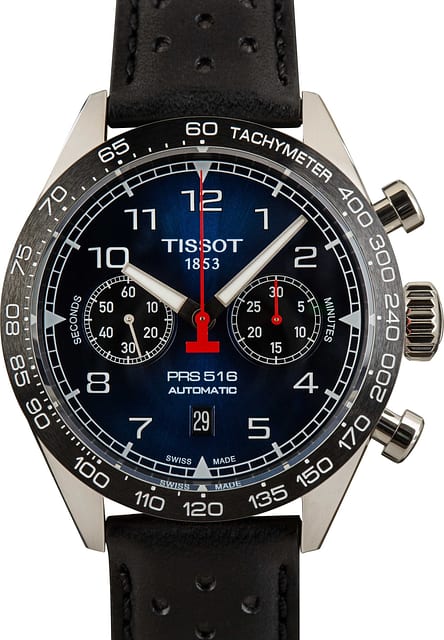
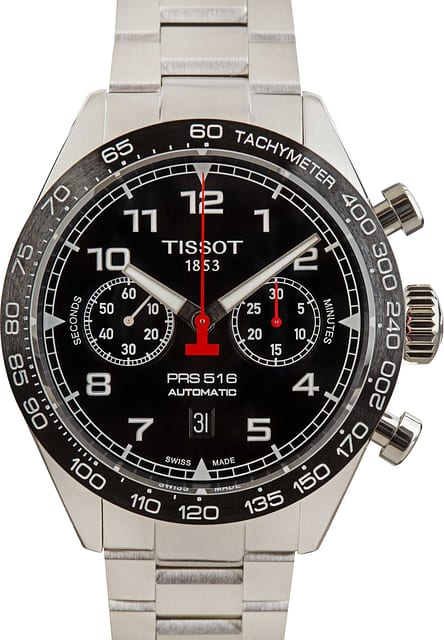
PRS 516
The PRS 516 has been part of Tissot's sports watch lineup since the 1960s, originally inspired by motorsports. The modern PRS 516 Automatic Chronograph continues that racing heritage with a 40-41mm case, chronograph complication, and sporty details like tachymeter bezels and racing-inspired dial layouts. The automatic versions use the ETA Valjoux 7750 movement or modified variants, while quartz models offer the same styling with lower maintenance requirements.
Current pre-owned prices for PRS 516 models range from $1,095 to $1,995 depending on materials and complications. Steel versions represent the best value, while steel and rose gold two-tone models command premiums for their distinctive appearance. Blue dial variants have proven particularly popular in recent years, and Arabic numeral versions offer better legibility than traditional indices. The PRS 516 occupies an interesting space in Tissot's lineup as a sports chronograph that's refined enough to wear beyond the track, making it a solid choice for people who want versatility in a single watch.
Bridgeport
The Bridgeport is a sophisticated watch with vintage-inspired designs that lean toward classic chronograph aesthetics. The Bridgeport Automatic Chronograph features traditional two or three-register layouts in cases that typically measure 41-43mm. Some models feature diamond hour markers for added refinement, particularly in versions aimed at the dress watch market.
Bridgeport models use ETA automatic movements, often the reliable Valjoux 7750 for chronograph versions. Pre-owned pricing ranges from $900 to $1,495 depending on configuration, with diamond-dial versions commanding higher prices for their added details.The collection includes everything from sportier chronographs to simple three-hand automatics, so you can pick what actually fits your day-to-day life. What makes the Bridgeport interesting is the way it pays homage to vintage design without feeling like a costume piece. It carries some classic cues, but the proportions are modern enough that it feels right at home on your wrist today.
Classic
Tissot's Classic collection encompasses their dress watches with more traditional styling, often marketed under the T-Gold Classic branding for models with gold-tone cases or details. These watches emphasize elegant proportions, clean dials, and refined finishing over complications or sports watch features. Cases typically measure 38-40mm, making them appropriately sized for formal wear, and movements range from quartz for entry-level watchesto Powermatic 80 automatics in higher-end models.
The T-Gold Classic models feature 18k gold plating rather than solid gold, delivering the aesthetic of precious metal watches at accessible prices. Pre-owned examples typically range from $900 to $1,400, representing good value for Swiss dress watches with quality finishing. These aren't watches that'll turn heads with bold designs, they're meant to be appropriate and refined in formal settings. If you need a watch for black-tie events or traditional business environments where understated elegance matters more than making statements, the Classic collection delivers exactly that.
1853
The 1853 collection pays homage to Tissot's founding year with vintage-inspired designs that pull directly from the brand's archives. These watches often feature retro dial layouts, vintage-style hands, and case designs that reference specific historical Tissot models from the 1950s through 1970s. Rose gold-tone versions are particularly popular, offering the warm aesthetic of vintage watches without the compromises that come with actually buying 50-year-old timepieces.
What makes the 1853 collection interesting is how Tissot balances vintage aesthetics with modern reliability. You get period-correct styling with contemporary movements, sapphire crystals, and modern water resistance. Pre-owned prices typically range from $1,200 to $1,600, positioning these as premium offerings within Tissot's lineup. The 1853 models appeal to people who appreciate vintage watch design but want the confidence that comes with modern manufacturing and readily available service. If you like the look of vintage Tissot but don't want to deal with vintage watch maintenance and uncertainty, the 1853 collection bridges that gap effectively.
T-Touch
The T-Touch line is home toTissot's most technologically advanced watches, featuring touch-sensitive sapphire crystals that control various functions. Press different areas of the crystal to activate features like altimeter, barometer, compass, thermometer, and more depending on the specific model. The T-Touch Connect Solar takes this further by adding Bluetooth connectivity and solar charging, essentially creating a Swiss-made smartwatch that doesn't need frequent charging or battery replacements.
T-Touch models typically feature titanium cases for light weight and durability, and they're designed for outdoor activities where the built-in sensors actually prove useful. Prices for pre-owned T-Touch watches vary widely based on generation and features, but expect to pay between $500 and $1,000 for older models. These watches appeal to a specific audience who wants Swiss watchmaking combined with genuine functionality beyond just telling time. The touch-sensitive crystal is either fascinating innovation or unnecessary complexity depending on your perspective, but there's no denying Tissot committed to the concept and executed it well within their price range.
T-Sport
T-Sport is Tissot's umbrella category for sports watches, encompassing various collections including the PRS 516, T-Race, and other athletic-focused timepieces. The T-Sport designation signals that these watches prioritize durability, water resistance, and sporty aesthetics over dress watch refinement. You'll find chronographs, dive watches, and multi-function quartz models under the T-Sport branding, all designed for active wear rather than boardroom meetings.
What unites T-Sport watches is their focus on functionality and legibility. Larger cases (typically 42-45mm), high-contrast dials, robust construction, and features like rotating bezels or chronograph complications define the category. Pricing varies significantly depending on specific models and complications, but T-Sport watches generally offer good value for Swiss sports watches. If you want a Tissot for weekend activities, outdoor pursuits, or casual daily wear where durability matters more than elegance, start your search in the T-Sport lineup. These watches are built to be used rather than babied.
Chronographs (PRX Chronograph, PRC 200, PR 100)
Tissot makes several chronograph lines, from the sports-focused PRC 200 to the dressier PR 100 to the recently released PRX Chronograph. The PRX Chronograph uses a quartz movement to keep the case thin and the price around $550, while the PRC 200 comes in both quartz and automatic variants. These watches deliver stopwatch functionality without the $5,000+ price tags that Swiss automatic chronographs usually command.
The PRC 200 is probably Tissot's most versatile chronograph, available in multiple dial colors and sizes. The quartz versions are bulletproof reliable and low maintenance, while the automatic versions use the ETA Valjoux 7750 or modified movements for more traditional appeal. Water resistance is usually 200 meters, making these viable sports watches rather than just dress chronographs. If you need to time things and want a Swiss name on the dial without Swiss-level pricing, Tissot's chronograph offerings deliver exactly that.
Tissot Watch Specifications
Materials
Tissot primarily uses 316L stainless steel for their cases and bracelets, which is the industry standard for watches in this price range. The material is corrosion-resistant, durable, and polishes well enough to look presentable even after years of wear. Some models incorporate PVD coating for gold-tone or black finishes, and the Heritage collections occasionally feature bronze cases that develop patina over time. Higher-end models like certain Seastar variants use ceramic for the bezel insert, which resists scratching and fading better than aluminum.
The brand doesn't use precious metals extensively, but they do offer 18k gold-plated options in collections like the PRX and some dress watches. These are gold-plated rather than solid gold, which keeps costs reasonable while providing the aesthetic. Sapphire crystals are standard across most of the current lineup, offering scratch resistance that acrylic or mineral crystals can't match. For the price point, Tissot's material choices are appropriate and comparable to competitors like Hamilton, Oris, and even entry-level Longines.
Movement
Tissot's movements come primarily from ETA, which makes sense since both companies are owned by the Swatch Group. The Powermatic 80 is their signature movement technology, taking the base ETA 2824-2 and modifying it with a larger barrel and different gear ratios to achieve 80 hours of power reserve instead of the standard 40-42 hours. You can take your watch off Friday night and put it back on Monday morning without needing to wind or reset it. Models designated "Silicium" use silicon balance springs, which offer better magnetic resistance and more consistent timekeeping across temperature variations.
Quartz movements appear in many Tissot collections, particularly the entry-level versions of popular models. These use quartz calibers that are reliable, accurate to within seconds per month, and require battery changes every 2-3 years. Some models feature solar quartz movements that charge via light exposure, essentially eliminating battery replacement. The automatic chronographs typically use ETA Valjoux 7750 or modified versions, which is the same movement platform found in watches costing several thousand dollars more. Tissot also produces some proprietary quartz movements for specific complications like the T-Touch series.
Bezel
Bezel design and functionality varies significantly across Tissot's collections. Dive watches like the Seastar feature unidirectional rotating bezels, typically with 120 clicks and either aluminum or ceramic inserts depending on the model. The ceramic versions resist scratching and fading better but add to the cost. Dress watches generally have fixed bezels with polished or brushed finishes that complement the case design. The PRX's integrated bezel flows into the case design in that characteristic 1970s style, creating the geometric look that defines the model.
Some sport models feature tachymeter bezels for chronographs, allowing you to calculate speed over a known distance. These are typically printed or engraved on fixed bezels rather than rotating ones. The quality of bezel finishing at Tissot's price point is solid, with clean printing, good alignment, and action that feels appropriate even if it's not quite as refined as watches costing five times more. Ceramic bezels on models like the Seastar 1000 ceramic represent good value, delivering a feature usually reserved for more expensive pieces.
Sizes
Tissot offers a practical range of case sizes, typically from 35mm to 45mm depending on the collection and intended use. The PRX comes in both 35mm and 40mm versions, addressing the trend toward smaller watches while still offering the standard size most men prefer. Dress watches like the Le Locle and Gentleman hover around 39-40mm, which works well under shirt cuffs and suits most wrist sizes. Sport watches and chronographs push larger, with Seastar models at 43mm and some chronographs reaching 45mm.
Thickness is equally important, and here Tissot generally does well. The PRX automatic sits at 10.9mm, the Gentleman at around 10.8mm, and most quartz models come in under 10mm. These measurements matter because a watch can have a reasonable diameter but feel bulky if it's too thick. The brand seems to understand that not everyone wants a 14mm slab on their wrist. Women's models typically range from 25mm to 35mm, with the PRX 35mm serving as a popular unisex option.
Water Resistance
Water resistance varies by collection and intended use. Dress watches like the Gentleman and Le Locle typically offer 50 meters (5 ATM), which is splash-resistant but not suitable for swimming. Sport watches like the Seastar 1000 deliver 300 meters (30 ATM), making them genuine dive watches that can handle recreational scuba diving. The PRX offers 100 meters (10 ATM), which is adequate for swimming and snorkeling but not serious diving. Chronograph models usually fall in the 100-200 meter range.
These ratings are conservative. A watch rated to 50 meters will probably survive a brief swim, but manufacturers don't recommend it because gaskets degrade over time and resistance isn't guaranteed forever. If you want to wear your Tissot in the water regularly, stick to models rated 100 meters or higher and have the gaskets replaced every few years during service. The Seastar line is your best bet for serious water exposure, while dress models should be treated more carefully despite their ratings.
Watch Bands
Tissot uses both integrated bracelets and traditional lug-mounted straps depending on the collection. The PRX features an integrated bracelet that's part of the watch's design DNA, with links that flow seamlessly from the case. These bracelets use a combination of polished and brushed finishing and include butterfly clasps with push-button releases. Other sport models typically come on three-link bracelets with solid end links and fold-over clasps, sometimes with diving extensions on Seastar models.
Leather straps appear on dress watches, usually in calf leather with standard buckles. The quality is appropriate for the price point, better than fashion watches but not reaching the level of luxury brands. Lug width varies by model but typically ranges from 19mm to 22mm, and standard spring bars make strap changes easy. Tissot also offers rubber straps on some sport models, and the company sells official replacement straps and bracelets through authorized dealers. Third-party strap options are abundant given the standard lug widths.
Popular Tissot Watch Comparisons
When considering a Tissot watch, people naturally compare it to other brands in the same price range. These comparisons help clarify what Tissot does well and where it stands in the broader watch market. Here are the most common matchups.
Tissot vs Seiko
Seiko and Tissot both deliver serious value, but they come from different traditions. Seiko is Japanese with a reputation for innovation and in-house manufacturing across all price points, while Tissot leans on Swiss heritage and ETA movements shared across the Swatch Group. Both brands punch above their weight, but Tissot's Swiss Made status carries cachet that matters to some buyers. Seiko often wins on technical innovation (Spring Drive, high-beat movements), while Tissot wins on traditional prestige. If you care about the Swiss label, go Tissot. If you want cutting edge tech at the same price, Seiko delivers.
Tissot vs Hamilton
Hamilton and Tissot are sister brands under the Swatch Group, which means they share movement technology and similar pricing. Hamilton trades on American heritage and aviation connections despite being Swiss made, while Tissot emphasizes pure Swiss watchmaking tradition. Both offer dress watches and chronographs in the $400 to $1,500 range. Hamilton tends toward vintage military and aviation aesthetics, while Tissot covers more ground with sports watches, dress pieces, and complications. The choice often comes down to design preference rather than quality or value differences.
Tissot vs Citizen
Citizen is Japanese and best known for Eco-Drive solar technology that eliminates battery changes, while Tissot focuses on traditional mechanical movements and Swiss credentials. Citizen typically costs less for comparable features and offers better daily practicality with quartz accuracy and solar charging. Tissot delivers the prestige of Swiss Made and the satisfaction of mechanical movements. Both brands offer solid construction and reliable performance, but Citizen is the practical choice while Tissot is the traditional watchmaking choice. Your decision probably depends on whether you value Swiss heritage or Japanese innovation and convenience.
Tissot vs Movado
Movado is an American brand known for minimalist Museum dial designs, while Tissot offers much broader variety from sports watches to complications. Movado trades heavily on design and fashion appeal with simpler movements, usually quartz. Tissot provides more horological substance with mechanical movements, complications, and deeper watchmaking heritage. Movado watches make design statements. Tissot watches deliver Swiss watchmaking at accessible prices. If you want a distinctive look for formal occasions, Movado works. If you want actual watch enthusiast credibility, Tissot is the better bet.
Tissot vs Longines
Longines and Tissot are both Swatch Group brands, but Longines occupies the tier above Tissot in terms of pricing, finishing, and prestige. Longines watches typically start around $1,000 and go up from there, with better case finishing, more refined movements, and stronger heritage marketing. Tissot delivers similar movement technology (often the same calibers) at lower price points with slightly less polished execution. If budget allows, Longines represents a step up in luxury. If you want Swiss quality without paying luxury prices, Tissot makes more sense. The gap in actual performance is smaller than the gap in price and perception.
Expert Opinion
Tissot offers real Swiss watchmaking at prices that feel realistic for people who plan to wear their watch every day, not just store it in a box. With the Powermatic 80 movement, smart design decisions, and the backing of the Swatch Group behind the scenes, it’s a hard package to argue with for under $1,000.
Why Choose Bob’s Watches
Buying a pre-owned Tissot from Bob’s Watches is a way to stretch your budget even further without giving up Swiss quality. Every watch that comes through us is carefully inspected and authenticated by experienced watchmakers who know what to look for. We check that it’s genuine, make sure everything functions properly, and evaluate the overall condition before it ever gets listed. Our pricing is straightforward and based on real market data, not inflated margins. We keep a close eye on the pre-owned space to make sure our Tissot inventory is fairly positioned. We care more about earning repeat customers than maximizing a one-time sale.
Sell Your Pre-owned Tissot Watch
If you have a Tissot sitting in the drawer that never gets wrist time anymore, we’re happy to take a look. At Bob’s Watches, we buy pre-owned Tissot models in good condition, especially popular models like the PRX Powermatic 80, Gentleman, Seastar, and Heritage lines. The process is straightforward. Send us a few photos and some basic details through our online form, and we’ll provide a quote based on current market demand. If you decide to move forward, we’ll email you a prepaid, fully insured shipping label. Once the watch arrives and everything checks out, payment is sent quickly.
We’re especially interested in Tissot watches that still have their original box and papers, but don’t worry if those are long gone. Depending on the model and overall condition, we’re still happy to consider it. The pre-owned Tissot market has picked up quite a bit in recent years, particularly around the PRX and other Powermatic 80 models, so there’s real demand out there. If you’re thinking about upgrading, freeing up some cash, or simply making room for something new, we offer a clean, straightforward alternative to dealing with random online buyers or frustrating low offers.