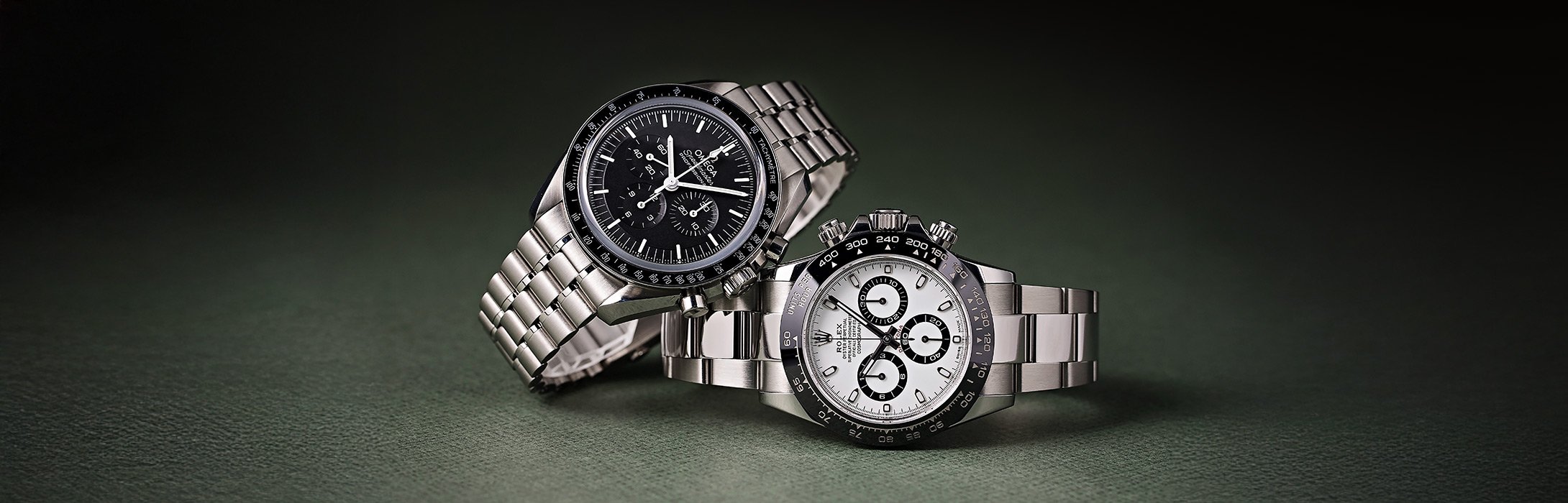

The Daytona vs. Speedmaster. It’s easily one of the most epic showdowns in watchmaking. The Rolex Daytona is King when it comes to status and overall price appreciation, while the OMEGA Speedmaster has a history as the first watch on the Moon and a more approachable price point on top of that. They’re both legendary in their own right, but tend to appeal to two very different types of collectors.
Key Takeaways: Speedmaster vs. Daytona at a Glance
- Price/Value: The Daytona is significantly more expensive (2x+ at retail, 4-5x on the secondary market), while the Speedmaster offers unparalleled horological value for money.
- Movement: The Daytona uses an automatic movement (Caliber 4131 with 72-hour power reserve) that is practical and modern, while the Moonwatch uses a manual-wind movement (Caliber 3861 with 50-hour power reserve) that is traditional and connects the wearer to the watch.
- History/Legacy: The Speedmaster is the undisputed “Moonwatch” with the verifiable NASA connection; the Daytona is the iconic racing chronograph tied to Paul Newman and the glamour of motorsports.
- Availability: The Speedmaster is easily sourced from an Authorized Dealer (AD), while the Daytona has near-impossible AD availability, forcing most buyers to the volatile grey market.
Choosing two chronographs from Rolex and OMEGA comes down to five key factors: legacy, mechanics, wearability, design, and market value. Let’s break down each to help you decide which watch you should go with.
Historical Pedigree: From the Racetrack to the Moon
Both collections have roots in motorsport, but their histories diverge dramatically from there. The Speedmaster earned its legendary status by becoming the first watch worn on the moon during the Apollo 11 mission in 1969, forever linking it to space exploration. Meanwhile, the Daytona cemented its reputation through decades of association with professional auto racing and its endorsement by Paul Newman, making it the ultimate driver’s chronograph. It’s in their histories where the differences between the two lie.
The OMEGA Speedmaster: The “Moonwatch” Legacy

Omega introduced the Speedmaster back in 1957 as a motorsport chronograph. But its greatest achievement came a few years later, when NASA put a number of watches through grueling tests (extreme heat, freezing cold, high pressure, and heavy shocks) to find one tough enough for space. Lo and behold, the Speedy was the only one to survive them all, cementing its destiny as a true space icon.
That brings us to 1969 when Neil Armstrong and Buzz Aldrin, during their Apollo 11 moon mission, carried a Speedmaster with them and Aldrin wore the Speedmaster during his stay on the Moon. This makes the Speedmaster the first watch to be worn on the Moon, and created the first OMEGA Speedmaster Moonwatch. It was created as a sports racing watch, but it was its working and proven performance under stress, not advertising, which gave it its destiny as a historical piece.
The Rolex Daytona: The Racing Cosmograph Icon

Officially introduced in 1963 and named “Cosmograph,” and then a year later, the “Daytona,” in tribute to Daytona, Florida, the hub of the racing world, the Rolex Daytona was created for use by professional racing drivers. It became a cult and pop culture classic in part through its connection with celebrities such as Paul Newman, whose own Daytona sold for one of the highest prices ever at an auction for a watch.
A no-nonsense tool watch of the 1960s, the Daytona has evolved into an international luxury icon. The racing heritage is real, but so much of the watch’s appeal today has to do with its exclusivity, and the status of the brand, as much as its technical performance.
Why Did NASA Choose Omega Over Rolex?
NASA had selected from a number of chronographs, from different manufacturers, including Rolex, OMEGA and Longines, for independent qualification testing. The earlier, submitted Rolex chronograph (presumably pre-Daytona reference 6238) failed the temperature/humidity testing while the OMEGA Speedmaster did not. NASA selected OMEGA solely on the basis of performance. They had no business relationship with OMEGA, nor was it brand name recognition or a marketing agreement of some kind. This is what gives the Speedmaster its space credentials true value.
The Battle of Movements: Manual vs. Automatic Chronograph

Manual vs. automatic winding is the most basic and traditional distinction between the two watches. The styles carry their own benefits based on what you value most.
Comparing Modern Movements: Calibre 3861 vs. Calibre 4131
| Feature | OMEGA Calibre 3861 (Modern Speedy) | Rolex Calibre 4131 (Modern Daytona) |
| Winding | Manual-Wind (Traditional) | Automatic (Self-Winding) |
| Power Reserve | ~50 Hours | ~72 Hours (Longer/More Practical) |
| Escapement | Co-Axial (OMEGA’s signature, lower friction) | Chronergy escapement |
| Certification | Master Chronometer (METAS & COSC) | Superlative Chronometer (COSC & Rolex Testing) |
| Clutch | Horizontal (Traditional feel) | Vertical (Smooth, immediate start) |
| Aesthetics | Visible via sapphire caseback (on many models) | Hidden behind solid caseback |
| Water Resistance | 50m (Less suited for water) | 100m (More robust for daily life) |
Daytona’s action is a feat of technical wizardry, with automatic winding and a longer power reserve. This makes it more convenient to wear on a day-to-day basis. Speedmaster’s 3861 calibre, on the other hand, offers a more romantic, hands-on feel with manual winding and OMEGA’s Co-Axial escapement technology, which cuts down on friction for even better long-term accuracy. On top of that, there’s the bonus of Master Chronometer certification, which means that the Speedmaster has passed anti-magnetic testing to a much higher standard than COSC.
Design and Wearability: Tool vs. Luxury Sport Watch
Examining the hardware of each offers more insight into their approaches. One watch appears to be an exercise in tailored luxury, while the other seems to celebrate the workaday in a utilitarian style.
Rolex Daytona: The Luxury Chronograph Aesthetic

Starting with size and weight, the Daytona has a 40mm case, on the smallish end for a chronograph. The watch is 11.9mm thick, and is ultra-slim. The 100m water resistance is achieved by a screw-down crown and screw-down pushers. The screw-down system is more secure but less practical for a watch that’s frequently used as a chronograph, since you have to unscrew the pushers before using the stopwatch. The polished centre links in the Oyster bracelet, ceramic bezel and polished finishing also gives it a flashier, more luxurious feel that really sets it apart from a pure tool.
OMEGA Speedmaster: The Utilitarian Companion

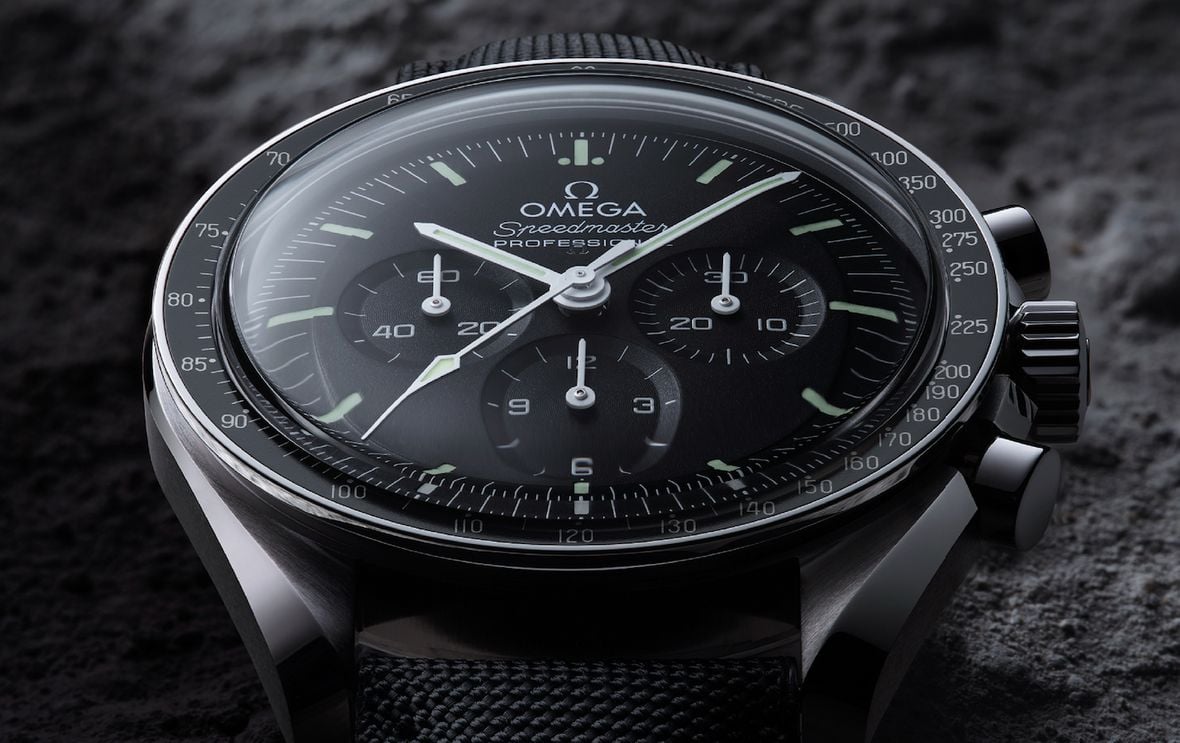
With a case size of 42mm, the Speedmaster is closer to a 40mm watch when accounting for the size of the crown guards and the bezel measurement. It also feels lighter as it has a manual-wind movement without the rotor assembly found in an automatic caliber.
Pushers are pre-down rather than screw-down for immediacy of chronograph use but at the cost of maximum water resistance of 50m. This is a result of the watch’s tool watch heritage, where operability and efficiency were valued above protection from the elements. Aesthetically the watch is very much a classic, using brushed finishes and an easy-to-read, high-contrast black dial, although other lighter-colored dials also exist. The Speedmaster goes well with NATO straps, leather, or with its signature five-link bracelet, giving collectors great options in customizing their watch.
Case, Bezel, and Crystal Differences
- Daytona: Features a modern, scratch-resistant ceramic (Cerachrom) bezel and a sapphire crystal, providing superior durability and maintaining its pristine appearance over time.
- Speedmaster: Offers a choice between the traditional hesalite (acrylic, prone to scratches but historically accurate) or a modern sapphire crystal. It typically features an aluminum bezel, which is more traditional but less scratch-resistant than ceramic. Precious metal models are available with ceramic bezels.
Market Value, Availability, and the Price Question

The economics of these two watches could not be more different. Understanding the financial implications is essential for making an informed purchase decision.
Accessibility and Retail Price
The economics of these two watches could not be more different and it is important to understand all the financial factors involved in order to make the best purchase decision for yourself.
The Daytona presents a stark contrast. Authorized Dealers maintain waiting lists that can stretch for years, and even established customers with strong purchase histories struggle to obtain one. This artificial scarcity forces most buyers to the grey market, where availability comes at a steep premium.
The Secondary Market and Investment Value
The Daytona dominates the secondary market, selling for 2 times its retail price due to scarcity and sustained demand. According to discussions on watch forums, some collectors view the steel Daytona as an expensive status symbol or investment piece rather than a watch to be worn regularly.
The Speedmaster retails for about half of the stainless steel Daytona. More to the point though, the Speedmaster is available to buy from an Authorized Dealer with minimal waiting period. It is an instant-gratification purchase.
Beyond the Moonwatch: Other Top Chronographs

OMEGA and Rolex are available in variations as well, and there are of course many more chronographs out there.
The current “hot reference” for OMEGA is the Speedmaster White Dial, which has brought a fresh look to the collection. For Rolex, the Daytona Two-Tone (Steel and Gold) version is often available at a better price than the steel Daytona on the secondary market, meaning a much more attractive price for the same movement and brand prestige.
Some other chronographs from these two brands worth checking out include the John Mayer 2.0 Daytona in full gold from Rolex and the NASA Silver Snoopy Award, AKA the OMEGA Snoopy watch, for OMEGA, which recognizes contributions to NASA missions by its partners.
Making the Final Choice: Speedmaster or Daytona

The answer is whichever one is most important to you. If you care about a legacy of prestige and investment-grade pedigree, and having the world’s most luxurious and expensive automatic movement, the Daytona is by far the most iconic option. If you want to own a piece of history that you can actually feel in your hands and experience through the pure and manual-winding only mechanics, and if you want to get the most bang for your buck in the world of watches, the Speedmaster is by far the right choice. There are no right or wrong answers, just the one that fits your story.
Are you in the market for a steel Daytona, one of the rare vintage Speedmasters? Bob’s Watches is here to help you buy or sell your next watch. Shop our OMEGA Speedmaster and Rolex Daytona for sale online to find an in-stock and ready to ship timepiece.