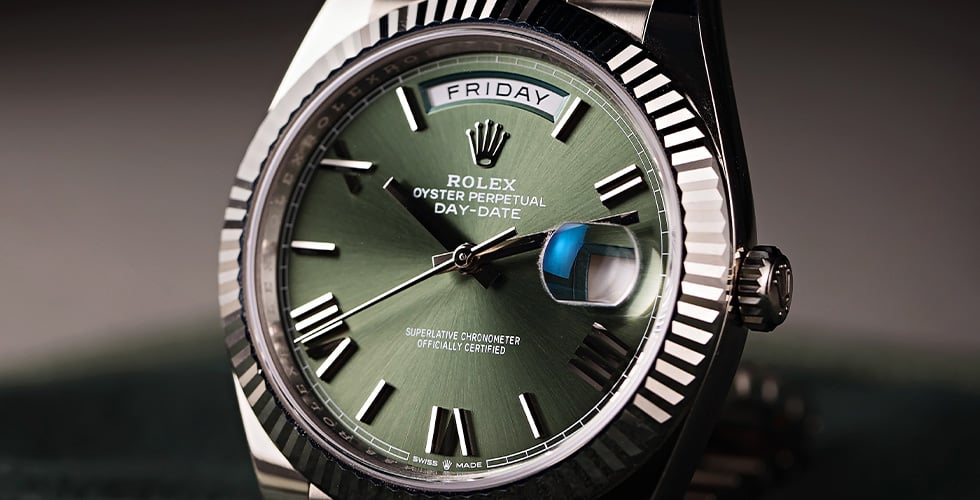
In 1926, the same year Rolex debuted its game-changing water-resistant Oyster case, the brand’s managing director and sole owner Hans Wilsdorf used the Swiss watchmaking and trading house Veuve de Philippe Hüther to trademark the name Tudor, granting exclusive usage rights to Wilsdorf.
“For some years now, I have been considering the idea of making a watch that our agents could sell at a more modest price than our Rolex watches, and yet one that would attain the standards of dependability for which Rolex is famous,” he said in a public statement announcing the establishment of Montres Tudor S.A. as a joint-stock business in 1946.
The name was a nod to the Tudor dynasty in England and to Rolex’s English roots. The German-born Wilsdorf partnered with his English brother-in-law Alfred James Davis to establish the Wilsdorf & Davis company in London in 1905, specializing in exporting pocket and wrist watches throughout the British Empire. Davis was the financial backer and silent partner, while Wilsdorf, age 24, managed the day-to-day operations.
They registered the name Rolex in 1908. Subsequently, British luxury taxes during World War I prompted the company to explore shifting its export infrastructure from England to Switzerland. In 1919, Wilsdorf bought out Davis’s financial stake and permanently moved Rolex to Geneva, where he incorporated Montres Rolex S.A. in 1920.
Veuve de Philippe Hüther transferred the Tudor trademark to Wilsdorf in 1936. A decade on, he officially established Tudor as its own brand.
Today’s Tudor is far more than a “poor man’s” Rolex. As it became more independent from its dominant sibling, it has established its own identity with a focus on no-nonsense tool watches as well as its own movements and manufacturing base.
Tudor’s Strategic Play

Unlike other firms launching cheaper lines that were budget-built from the ground up, Wilsdorf’s concept for Tudor was to capitalize on Rolex reliability without cannibalizing or impacting the parent brand’s prestige.
By initially registering Tudor through Veuve de Philippe Hüther, Wilsdorf could quietly develop the Tudor name from the mid-1920s through the early 1930s while keeping it completely separate from Rolex.
The first Tudor watches emerged in 1932, bearing no resemblance to the rugged tool watches it became known for in the mid-20th-century. The earliest examples were housed in Art-Deco-style rectangular and tonneau cases featuring dials bearing the Tudor name with an elongated horizontal bar on the T.
Wilsdorf chose remote Australia as his test market, delivering pieces to Willis & Sons, a prominent Australian jewelry firm that was his exclusive distribution partner targeting the country’s most prestigious jewelers.
Many early pieces featured double-signed dials bearing the Tudor name as well as Willis or the name of the retailer, most prominently Catanach’s, Australia’s oldest family-run jewelry store. Additionally, a very small number of these early Tudors also featured the name Rolex on the dial, effectively guaranteeing Rolex quality.
Once Tudor proved its viability, Wilsdorf took ownership of the registration in 1936. After this, Tudor watch dials bore a new insignia: a rose, in a nod to the Tudor dynasty, within a shield. The motif was interpreted as depicting the strength of the robust Oyster case protecting the delicate mechanical movement inside. Or as the brand put it: the “union of strength – the watch’s robustness – with grace – the beauty of its lines.”
Wilsdorf’s strategy for Tudor was ingenious in that it endowed Tudor with Rolex’s claim to fame—the waterproof Oyster case with a screw-down winding crown—delivering the same water-resistance of its higher-priced sibling. The savings came from swapping the engines for reliable yet more affordable off-the-shelf movements from third-party suppliers, primarily from Ébauches SA suppliers like ETA. Wilsdorf also mandated that Tudor watches be sold next to Rolex in the same authorized dealer network, openly connecting the two brands to build consumer trust in the fledgling Tudor name.
While it was born in the boom of the optimistic Roaring Twenties, the bust of The Great Depression in the 1930s did not deter Wilsdorf from pressing ahead with his vision for Tudor, which was distributed throughout Europe and the British Commonwealth. Its more affordable, value-driven market positioning could only be bolstered by the tough economic environment.
Post-War Launch & the Rose Era (1946–1968)
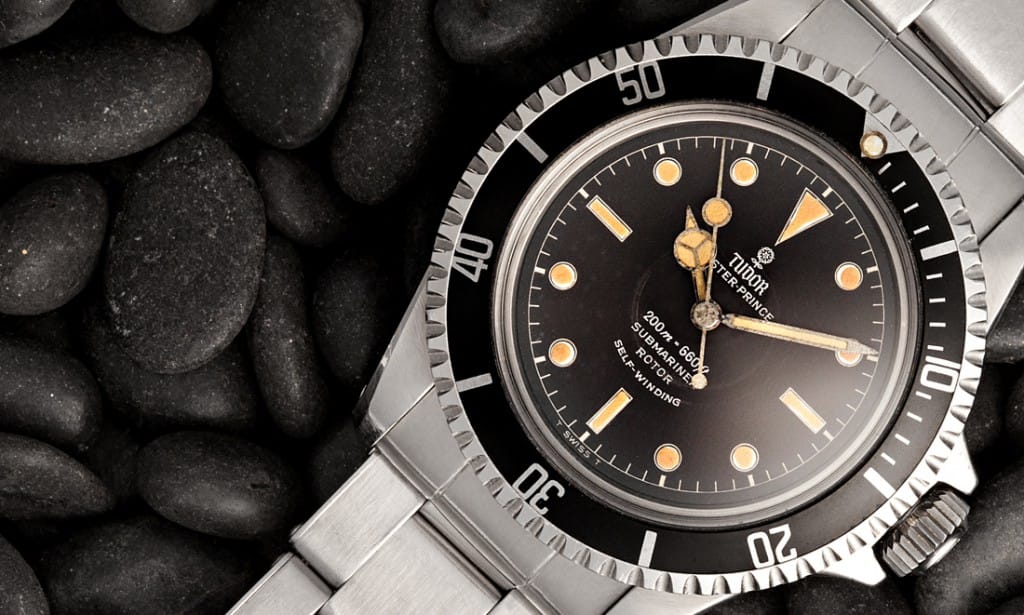
After World War II, Wilsdorf was ready to bestow Tudor with its own official brand identity. On March 6, 1946, he created the “Montres Tudor S.A.” company producing both men’s and women’s watches.
Still, he reinforced the Rolex connection: The first named Tudor collection dubbed Oyster, rolled out in 1947. That same year, Tudor dropped the shield from its logo, leaving only the Tudor Rose for a more streamlined mid-century image.
The design was defined by a delicate flower that was almost exclusively printed directly onto the dial surface. With its quiet stature, the “Small Rose” logo was subtly placed beneath the 12 o’clock marker and above the stylistic Tudor typography. It continued until the late 1950s when it was replaced by the bolder “Big Rose,” an applied steel insignia that replaced the 12 o’clock index.
The original Tudor Oyster (Ref. 4463) was housed in a classic, round 34mm stainless steel Oyster case, reflecting the shift away from rectilinear Art Deco styling and into more sporty tool watches. Early models explicitly featured “Rolex Oyster” or “Original Oyster Case by Rolex” stamps on the screw-down case backs and threaded winding crowns.
It was powered by a manually-winding Calibre 59 movement endowed with an anti-shock system for enhanced robustness and reliability. The slightly modified ebauche was supplied by FHF manufacturing facility in Fontainemelon, Switzerland. At the time FHF and ETA operated as independent production factories co-existing under the same Swiss parent manufacturing consortium, Ébauches SA.
The 1950s ushered in a thrilling era of exploration and innovation, triggering the mid-century golden age of mechanical sport watches as adventurers on land and sea demanded practical, purpose-built tool watches that could handle the elements in punishing environments.
In 1952, Tudor introduced the automatic-winding Tudor Oyster Prince incorporating Rolex’s self-winding perpetual rotor mechanism. And just as Wilsdorf outfitted the first failed 1933 Mount Everest expedition with Rolex Oysters before equipping the successful 1953 expedition by Sir Edmund Hillary and Tenzing Norgay, Tudor provided watches to the British North Greenland Expedition (BNGE), an arctic scientific mission that took place from 1952 to 1954. Like the Everest expeditions, Wilsdorf used the project to field test his latest Tudor, asking only for performance evaluations in return. The scientists monitored the watches’ accuracy in the extreme environment, recording telemetry while operating in temperatures that plummeted as low as -66°C (-87°F).
As recreational scuba diving became popularized in the postwar era, consumer dive watches, like Rolex’s Submariner and Blancpain’s Fifty Fathoms, both launched in 1953, set the benchmark for sub-aquatic gear. Tudor followed suit with the Oyster Prince Submariner Ref. 7922 in 1954, mirroring the Rolex Submariner’s architecture down to the Mercedes-style hands and 100-meter depth rating. Under the hood, these first-generation dive watches were powered by the automatic Calibre 390, a self-winding movement built on a base movement from Fleurier (FEF).
The workhorse was soon adopted by the French Navy, and the legendary French diver Jacques Cousteau, who gifted one to his second in command, André Laban in 1958. Laban joined Cousteau aboard the research vessel Calypso in 1952 and worked alongside him for over two decades. Laban wore his Tudor as a daily diving tool for more than six decades.
The Ref. 7924 “Big Crown” followed in 1958 with thicker steel and an oversize 8mm screw-down crown, and most importantly, upgraded water resistance to 200 meters.
The subsequent Ref. 7928 (1959) introduced rectangular crown guards to protect the winding mechanism from underwater impact. Early versions are highly sought after by collectors for their clean, date-free lacquered dials featuring Tudor’s original Small Rose emblem.
Over its production lifetime from 1954 until 1999, the Tudor Submariner evolved across three distinct generations, forging a unique identity separate from its Rolex sibling.
The Snowflake & Military Era (1969–1980s)
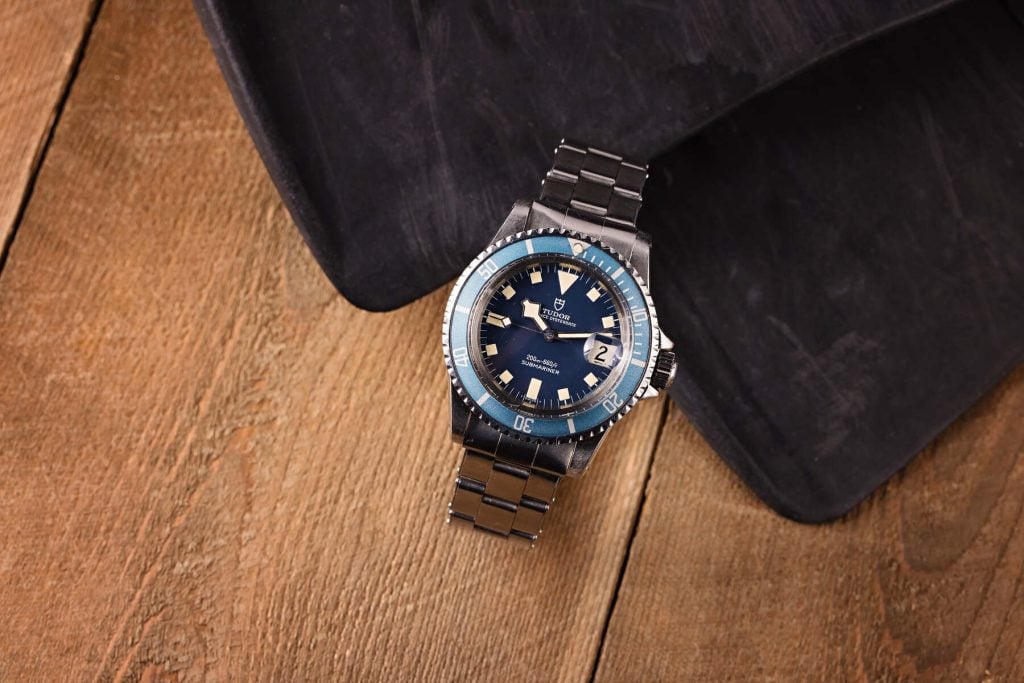
In 1969, Tudor made a dramatic break from the Rolex aesthetic to carve out its own distinct design codes with the launch of the Oyster Prince Submariner References 7016 (no date) and 7021, the first Submariner with a date complication.
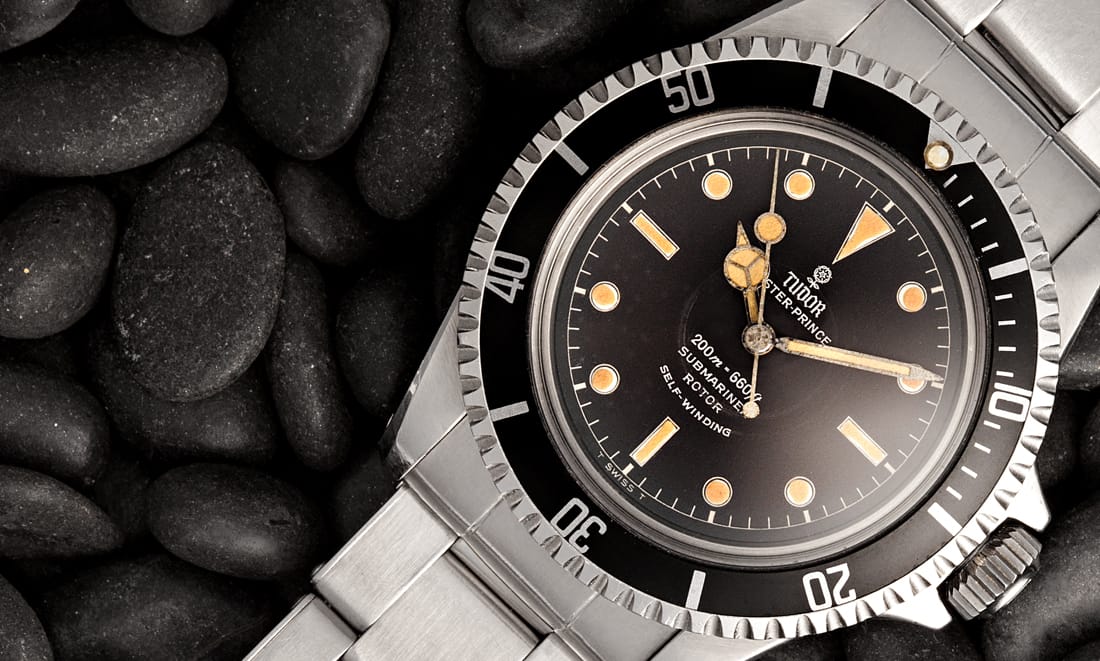
The most obvious change on Tudor’s second-gen dive watches was the “Snowflake” dial. The design broke ranks from the Rolex codes of round markers and Mercedes-style hands to a new aesthetic that catered to elite military divers.
Frogmen in the French Navy complained that traditional dive watches were difficult to read quickly when navigating murky and dark conditions. To address these issues, Tudor replaced the round markers on the dial with oversized square blocks at 3, 6, and 9 o’clock, anchored by a large, inverted triangle at 12 o’clock. It also redesigned the hands with a blocky, diamond-shaped pointer tip on the hour hand dubbed the Snowflake. The diamond shape repeated on a smaller scale as a luminous box on the sweeping seconds hand, reinforcing the visual difference between the two. This redesign also provided more surface area on which to apply luminescent tritium paint to further enhance quick reads in the dark.
The simpler no-date 7016 was favored as standard military issue, becoming the tool watch for elite underwater groups globally, most notably the French Navy and the U.S. Navy SEALS during the late 1960s and 1970s. While the Omega Speedmaster went to the Moon and the Rolex Submariner became a commercial luxury icon, these Tudors became rugged, low-profile tactical workhorses for military groups.
That same year, Tudor further distinguished itself from Rolex with the introduction of blue snowflake dials with matching bezels, a color Rolex did not offer on its standard stainless steel Submariners, cementing the shade as a Tudor signature. Additionally, the rose emblem was replaced by a streamlined shield on the dial, while the rose motif moved to the crown.
With the launch of these models, Tudor also permanently abandoned Fleurier as its dive movement provider and standardized their assembly around higher-capacity, 25-jewel movements sourced from ETA. This transition gave both models distinct calibers tailored to their specific dial functions and dramatically improved servicing reliability.
The Neo-Vintage Final Run (Mid-1980s–1999)
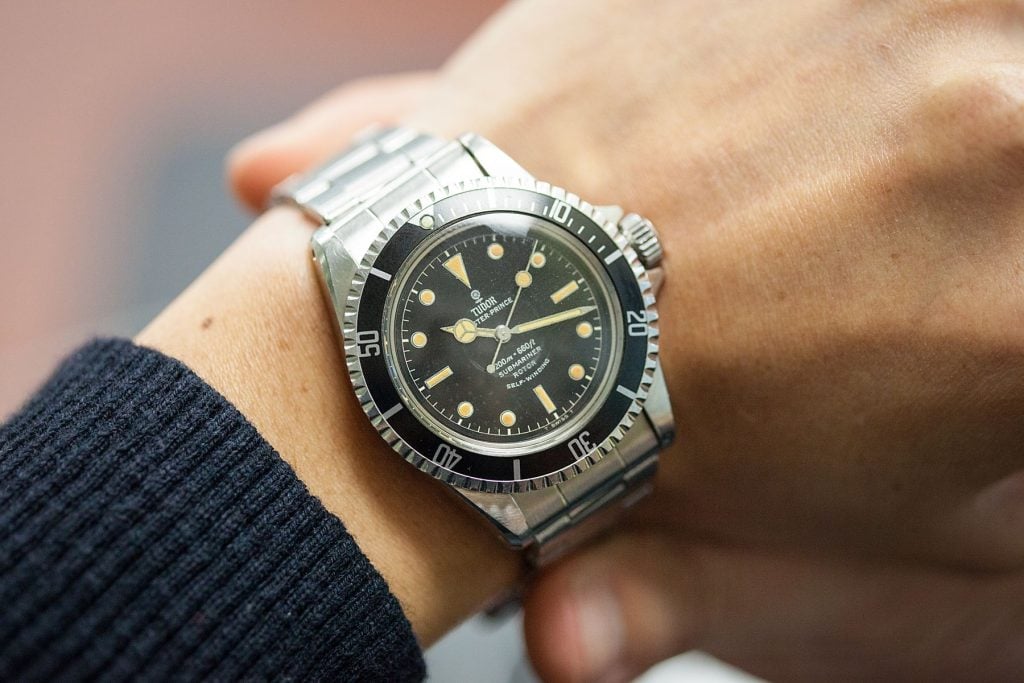
During this phase, Tudor made the strategic decision to retire the bold Snowflake hands and square indices in favor of returning to Rolex’s classic design language. This “End Game” era of the classic Tudor Submariner unfolded across three references.
The transition kicked off with the short-lived “Lollipop” hand Ref. 76100 in the mid-1980s before returning to the Rolex Mercedes hands. The oversize circular Lollipop hand suffered a design flaw that resulted in the glowing tritium luminescent paint compound to crack and break. As a result, this reference had a very short production lifespan, making it a rare find for modern collectors.
In 1989, Tudor launched the Reference 79090, marking the return the traditional Mercedes-style hands while swapping the square markers for triangular indices at 6 and 9 o’clock. Powered by the ultra-reliable ETA Calibre 2824-2, the 79090 is sought after among neo-vintage collectors for its “top-hat” plexiglass crystal and a bidirectional friction bezel, long after Rolex had converted its watches to modern sapphire crystals.
The era culminated with the final iteration of the classic Submariner, the Ref. 79190 (1995-1999), which upgraded the Submariner line with scratch-resistant sapphire crystals and safe, unidirectional notched rotating bezels, elevating Tudor’s dive icon.
Tudor Submariner reference timeline, 1954–1999
| Year | Reference | Key Change |
|---|---|---|
| 1954 | Ref. 7922 | Debuts the Oyster Prince Submariner, mirroring Rolex’s Submariner with Mercedes-style hands and a 100m depth rating |
| 1958 | Ref. 7924 “Big Crown” | Thicker case and oversized 8mm crown; water resistance upgraded to 200m |
| 1959 | Ref. 7928 | Rectangular crown guards added; clean, date-free dials with the original Small Rose emblem |
| 1969 | Ref. 7016 / 7021 | “Snowflake” dial and hands debut, breaking from Rolex design codes; 7021 adds the first date function |
| Mid-1980s | Ref. 76100 “Lollipop” | Short-lived circular hour hand, discontinued after its luminous paint began to crack |
| 1989 | Ref. 79090 | Returns to Mercedes-style hands and triangular indices; “top-hat” plexiglass crystal |
| 1995–1999 | Ref. 79190 | Final classic Submariner; upgrades to sapphire crystal and a safer unidirectional bezel |
When Tudor permanently ceased production of the Submariner in 1999, it marked the end of shared parts between Rolex and Tudor. This era closed the loop on Hans Wilsdorf’s original 20th-century vision.
The Modern Renaissance & Autonomy (2012–Present)
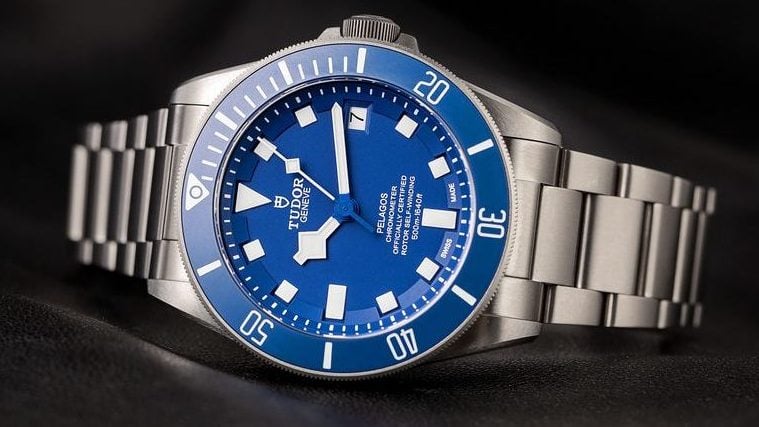
After the demise of the Submariner, Tudor went quiet for about a decade. During this dormant period, it completely withdrew from the U.S. and UK markets in 2004, focusing distribution on the European and Asian markets. However, following the launch of the retro Black Bay and Pelagos collections in 2012, Tudor was poised for a global comeback the following year.
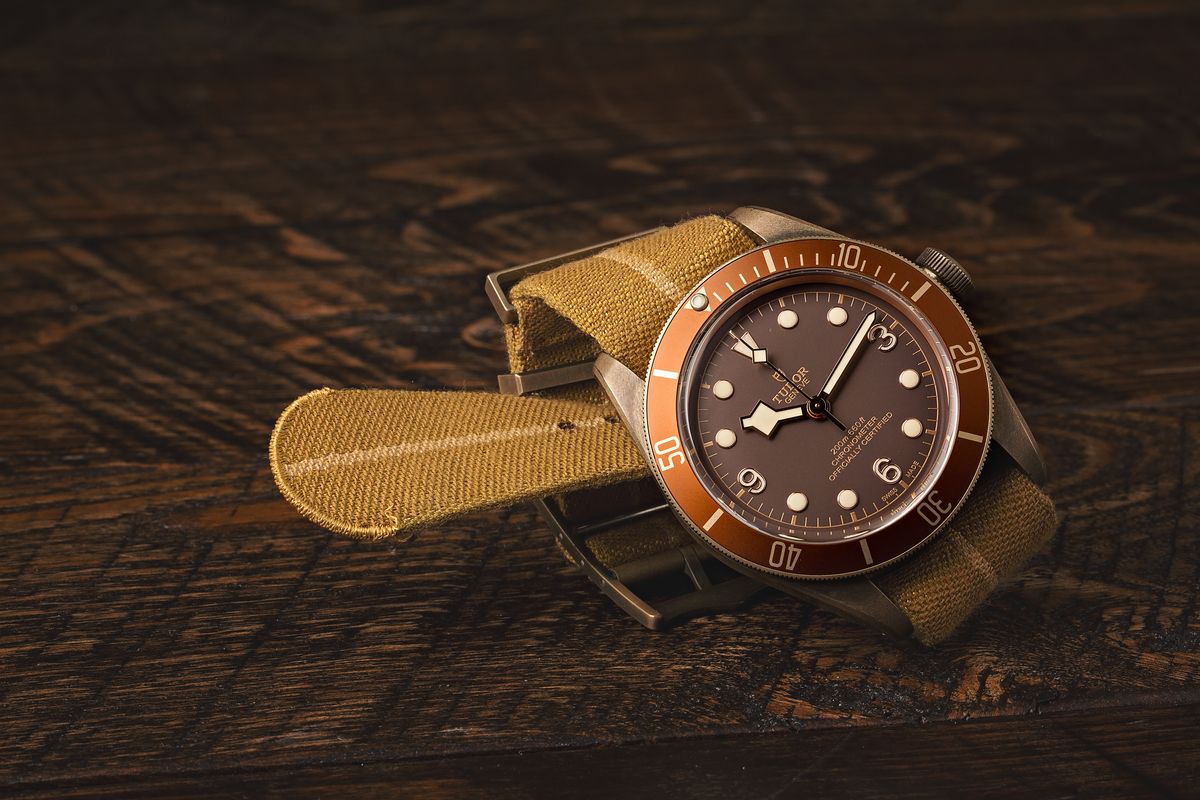
Rather than merely copying the historical 1969 Submariner, Tudor’s design team synthesized its signature design cues into a modern silhouette. The iconic Snowflake hands, the oversized winding crown from the 1958 Big Crown Submariner, and the warm, gilt-accented dials captured the nostalgia of vintage collecting without the mechanical fragility.
The subsequent debut of the Pelagos collection added a clinical, ultra-modern diver to the lineup, crafted from lightweight titanium and featuring a patented auto-adjustable spring clasp that remains a benchmark in ergonomic design.
The Snowflake hands on both models serve as a distinctive visual brand anchor for a new generation of mechanical watch enthusiasts.
In 2015, Tudor achieved corporate autonomy by rolling out its first proprietary, in-house manufacture movements. For decades, Tudor could safely rely on affordable mass-produced calibers from ETA, the movement behemoth owned by The Swatch Group. But, in the 2000s, Swatch announced plans to drastically scale back supplying base movements to brands outside of its portfolio, prompting a number of brands to seek alternative movement supply lines.
To build its own movement capacity, Tudor secretly founded the movement making firm named Kenissi, a word derived from the Greek word kinisi, which translates directly to “movement” or “motion.”
By creating a separate entity, Tudor could gather watchmaking experts to engineer a state-of-the-art “tractor” movement from scratch. This gave birth to the MT (Manufacture Tudor) caliber family.
Tudor creatively funded the initiative in part by offering Kenissi movements to other brands that were similarly squeezed by ETA cutbacks. By selling versions of their high-spec manufacture caliber to other companies, Tudor scaled their production volume and dramatically brought down manufacturing costs.
In 2016, Breitling became the first third-party industrial client in an unusual arrangement that provided their in-house B01 chronograph movement to Tudor in exchange for Kenissi’s three-hand calibers. Chanel acquired a 20% minority stake in Kenissi in 2018 to supply their J12 lines. Today, Kenissi supplies calibers to brands including TAG Heuer, Norqain, Bell & Ross, and Fortis, keeping Tudor movement production separate and distinct.
Today, Tudor operates at its highest capacity in history with its first fully dedicated, state-of-the-art manufacture in Le Locle, Switzerland, completed in 2021. The Le Locle manufacture allows Tudor to scale production of high-performance movements, bringing METAS certification to the broader catalog, and completing its full evolution from a secondary alternative to Rolex to an independent tool-watch powerhouse.
Tudor’s path to movement independence, 2015–2021
| Year | Milestone |
|---|---|
| 2015 | Tudor rolls out its first proprietary in-house movements and secretly founds Kenissi to build them, as the Swatch Group scales back ETA’s supply to outside brands |
| 2016 | Breitling becomes Kenissi’s first third-party client, trading its in-house B01 chronograph movement for Kenissi’s three-hand calibers |
| 2018 | Chanel acquires a 20% minority stake in Kenissi to supply its J12 line |
| 2021 | Tudor completes its first fully dedicated manufacture in Le Locle, Switzerland, scaling production and bringing METAS certification to the broader catalog |
Centennial Models

Tudor is celebrating its 100th anniversary with models that emphasize its independence in mechanical movement making while taking the obligatory stroll through the archives for inspiration.
The anchor of the 100-year celebratory lineup is the revival of the sporty yet elegant Monarch (1991-2003). The reimagined design is housed in a faceted 39mm stainless steel case, balancing sharp, satin-finished angles with polished surfaces. The standout feature is its dark-Champagne dial with a vertical brushed finish. A refined execution of the classic California dial layout pairs applied black Roman numerals on the upper half with Arabic numerals on the lower half.
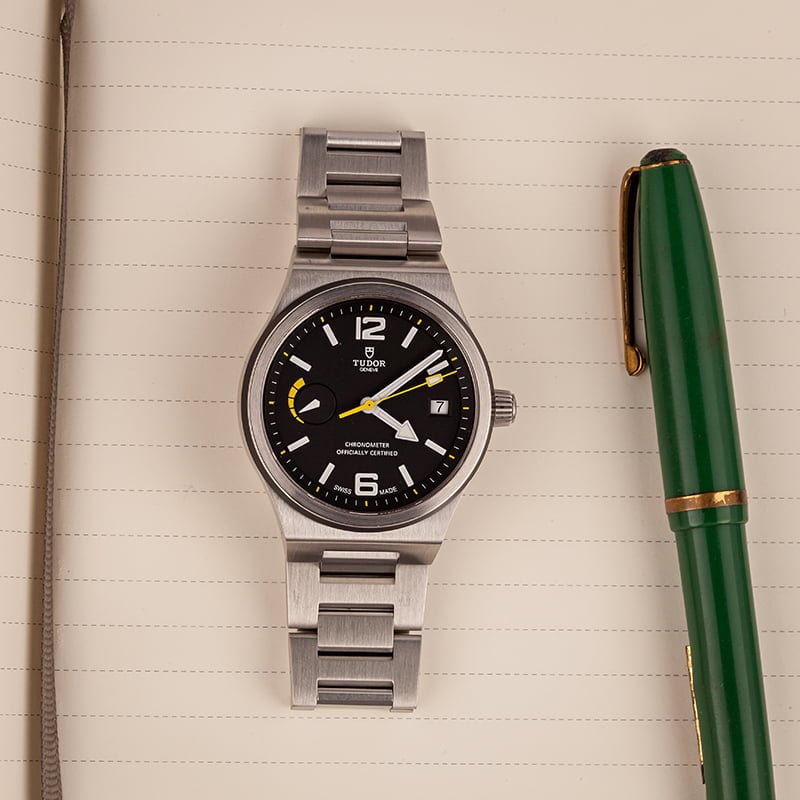
This fall, Tudor revisits 2015’s North Flag, which channeled the 1970s style of the Ranger II in Tudor’s first model powered by an in-house movement. Aimed at the modern traveler, the new 40mm North Flag GMT features a fully integrated dual-time mechanism rather than a module, allowing the wearer to adjust the local hour hand independently in one-hour increments. The black dial is anchored by monobloc ceramic luminous hour markers and classic North Flag hands, while the updated two-link steel bracelet features the “T-fit” rapid adjustment clasp for tool-free micro-adjustments.
Tudor also surprised its fanbase this year with the stealthy Black Bay 41 Full Black Ceramic, combining a micro-blasted matte black ceramic monobloc case with a matching three-link bracelet. The domed charcoal sunray dial is appointed with blackened Snowflake hands and applied markers filled with a dark luminescent material. The sapphire case back reveals the blackened Manufacture Calibre MT5602-U, a Kenissi-produced automatic engine.
Centennial model specifications
| Model | Case | Movement | Certification | Power Reserve | Magnetic Resistance |
|---|---|---|---|---|---|
| Monarch | 39mm steel | MT5662-2U | METAS Master Chronometer | — | 15,000 gauss |
| North Flag GMT | 40mm steel | MT5652-U | COSC + METAS Master Chronometer | 65 hours | 15,000 gauss |
| Black Bay 41 Full Black Ceramic | Ceramic monobloc | MT5602-U | COSC + METAS Master Chronometer | 70 hours | 15,000 gauss |
The brand also upgraded its foundational fleet. The popular Black Bay 58 collection got a technical boost with METAS Master Chronometer certification, plus a sleek new 5-link bracelet, and a thinner case profile. Meanwhile, the smaller Black Bay 54 Sapphire Blue modernizes the classic range with a striking sunburst blue dial and matching bezel. And finally, the dressier, integrated-bracelet Tudor Royal line is now equipped with Kenissi manufacture calibers (including the MT5201, MT5412, and MT5633) as part of Tudor’s strategy to phase out remaining third-party base calibers.