Written By: Paul AltieriReviewed By: Bob's Watches
Few watches from the brand’s collection are as unconventional as the Rolex Milgauss. You could forgive the Rolex Milgauss, a timepiece created in the mid-1950s for the button-down world of scientists and engineers, for getting a little lost in the crowd. Once one of the brand’s very rare underperformers as far as sales were concerned, the Milgauss had the misfortune to arrive around the same time as some of horology’s greatest legends. The Submariner, Explorer, GMT-Master, and Day-Date all made their debuts in the same several years, with Rolex going through an explosion of creativity like no other.
Key Takeaways
Anti-Magnetic Shield: The name Milgauss derives from mille (French for one thousand) and Gauss (a unit of magnetic flux density). It features a special internal shield, or cage, that protects the movement from magnetic fields up to 1,000 gauss, operating as a Faraday Cage.
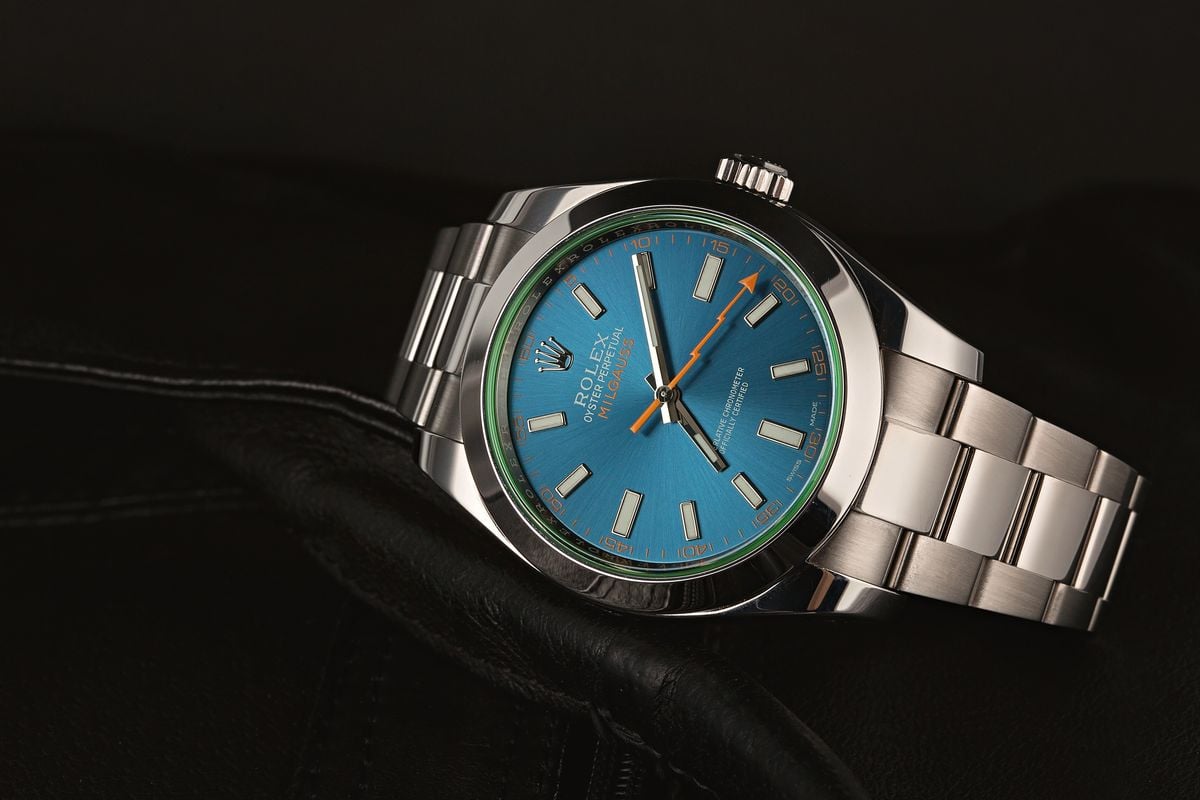
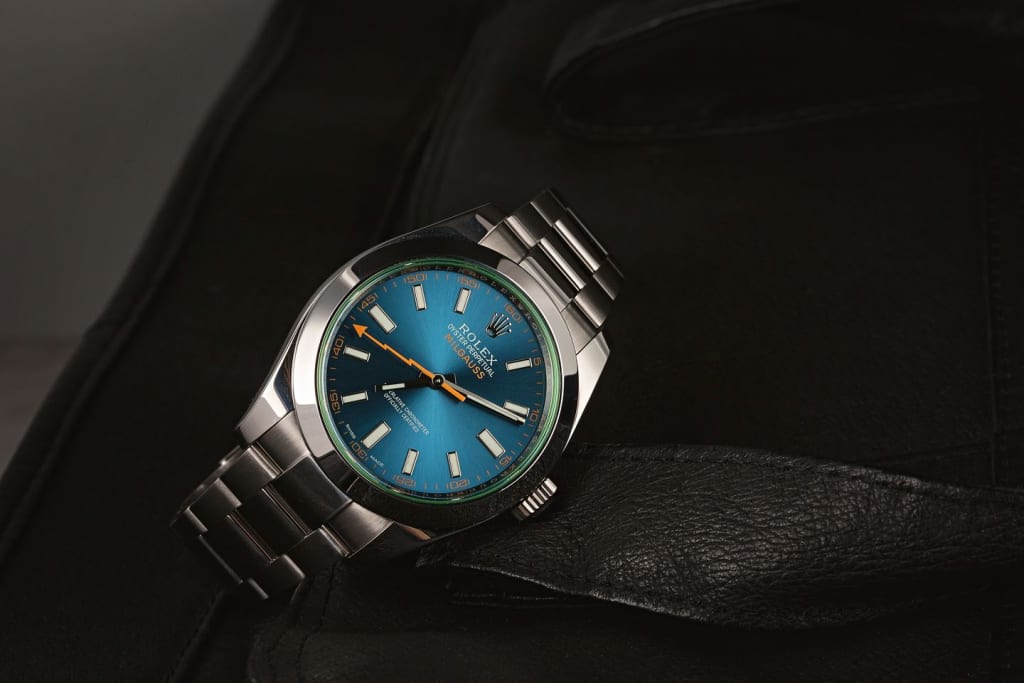
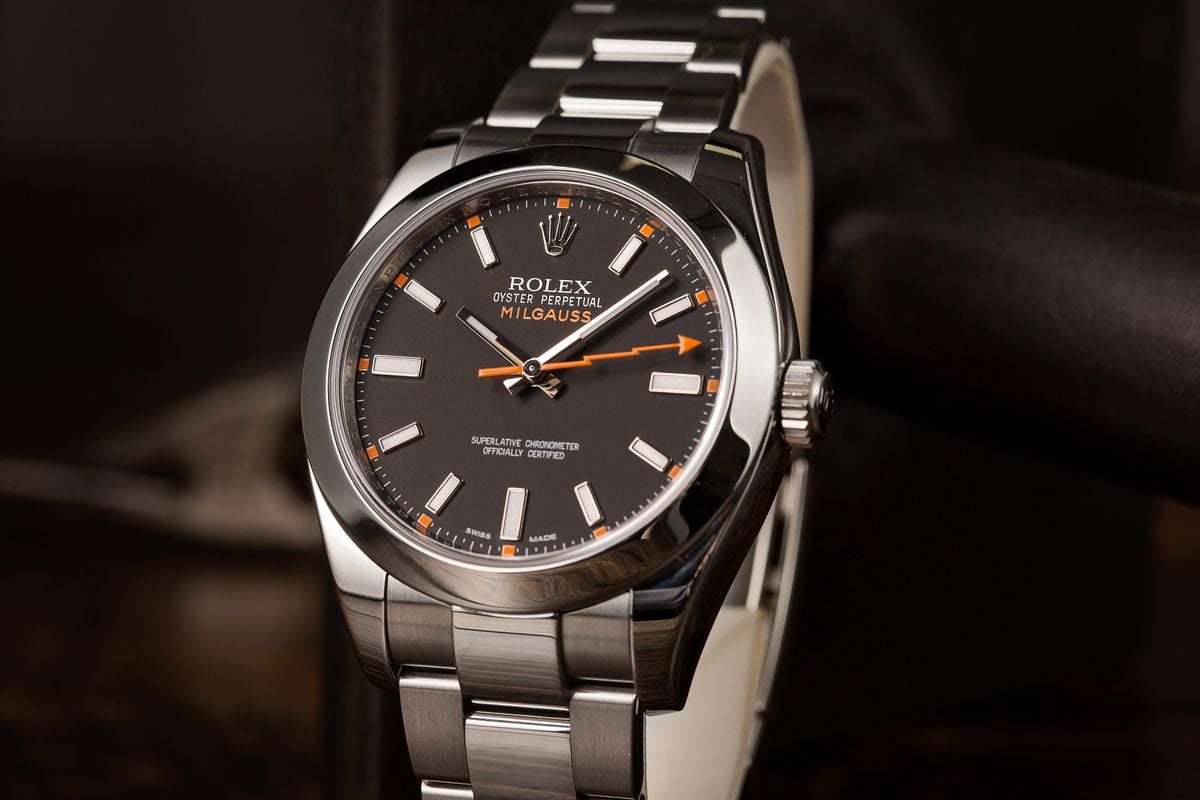
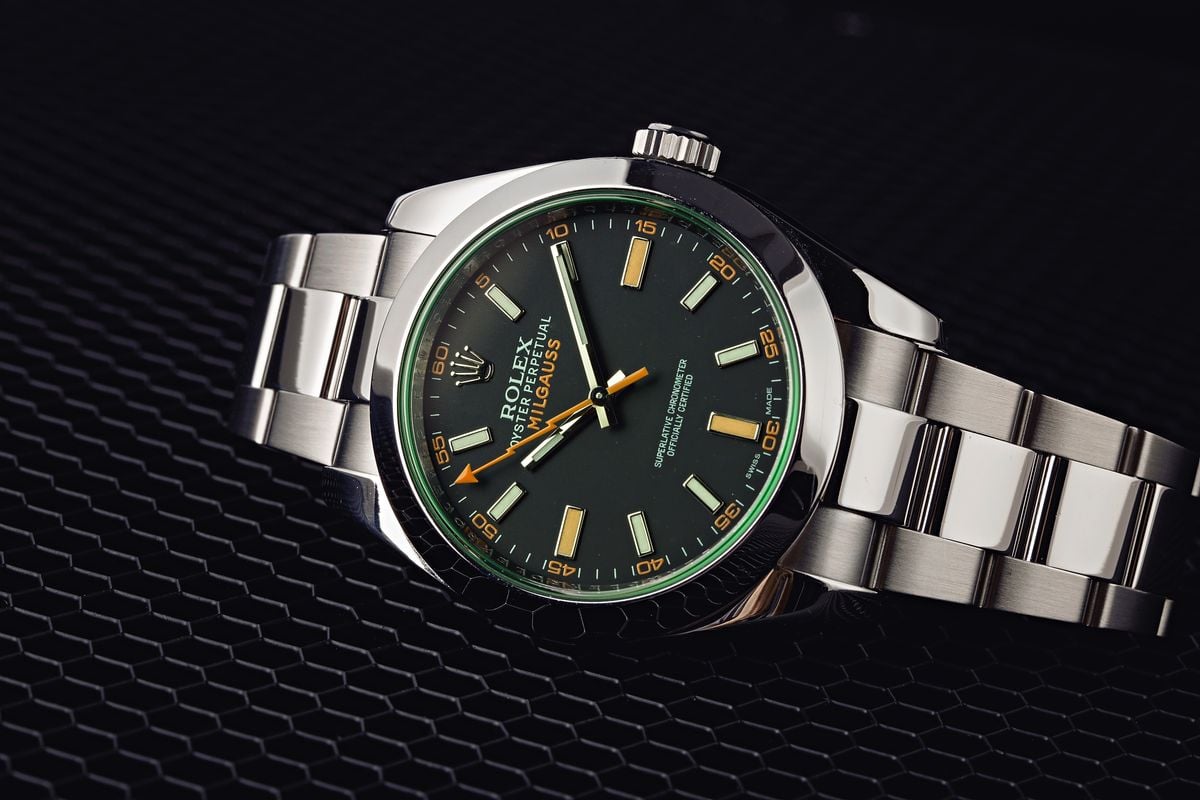
Distinctive Design: The Milgauss 116400 can be easily identified by its signature bright orange lightning bolt second hand and the optional green sapphire crystal referred to as Glace Verte (GV).
Caliber 3131: The watch houses a specialized movement that incorporates paramagnetic materials like the blue Parachrom hairspring to enhance its magnetic resistance.
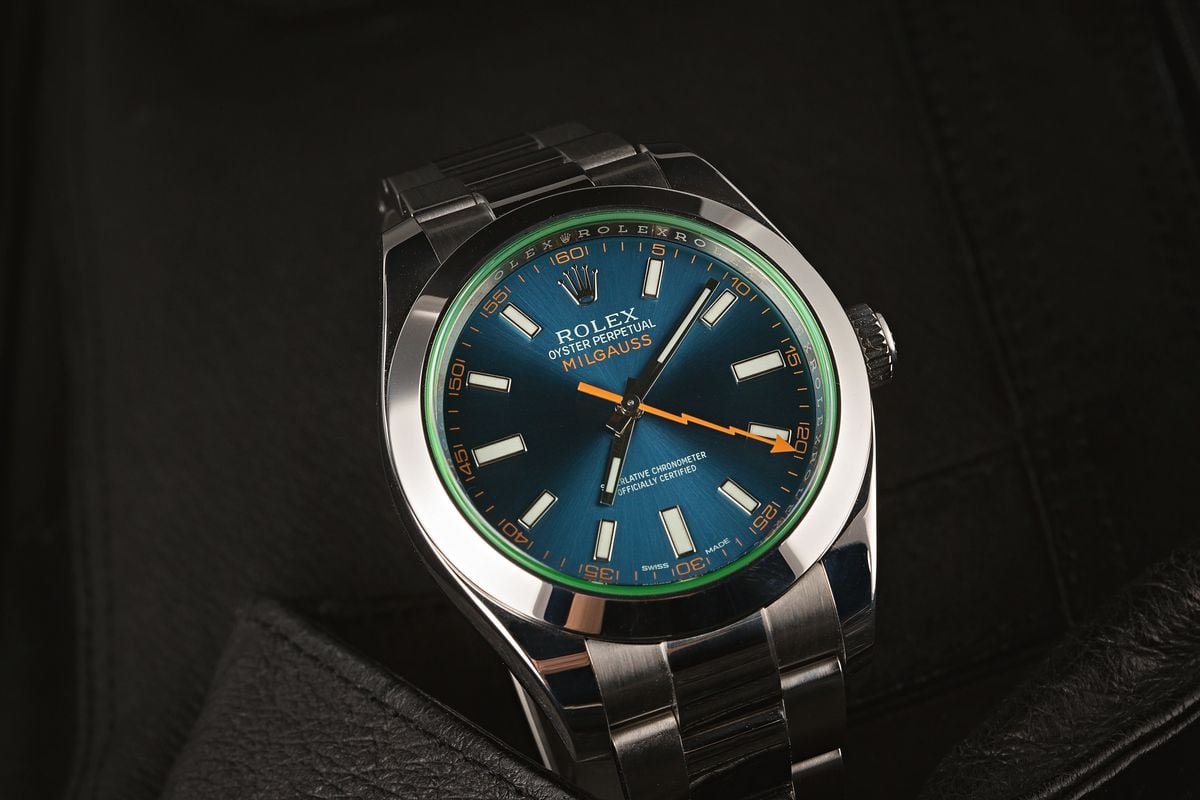
Classic Status: Despite being discontinued in 2023, the Milgauss maintains a strong following. Certain models like the Z-Blue (Ref. 116400GV) continue to command premiums on the secondary market.
The Rolex Milgauss is worth considering if you want a discontinued Rolex with real tool-watch history, anti-magnetic engineering, and a design that stands apart from the Submariner, GMT-Master II, Daytona, and Datejust. The modern 116400 and 116400GV references are the most accessible choices, while the Z-Blue 116400GV is generally the most recognizable modern version. The trade-offs are its thicker case, polarizing design, and smaller buyer pool compared with more mainstream Rolex sports watches.
For buyers, the Milgauss is best viewed as a distinctive daily Rolex with collector appeal, not as the safest or most liquid Rolex investment. Its 2023 discontinuation has helped support interest, but condition, dial color, box and papers, and overall originality still play a major role in value.
What It’s Like to Own and Wear
The Rolex Milgauss is one of the most unusual modern Rolex watches because it combines traditional Oyster case proportions with a design language that is noticeably more playful than most Professional models. The orange lightning bolt seconds hand, green sapphire crystal on GV models, and Z-Blue dial give the watch a personality that some collectors love and others find too bold.
On the wrist, the Milgauss wears larger than a standard 40mm Oyster Perpetual or Datejust because of its internal magnetic shield and solid case construction. It is not oversized, but it does have more wrist presence than many simple time-only Rolex watches. That extra thickness is part of the watch’s purpose, since the internal Faraday cage is what helps protect the movement from magnetic interference.
As a daily watch, the Milgauss is durable, water resistant to 100 meters, and powered by Rolex’s Caliber 3131 automatic movement. The movement uses anti-magnetic components, including the blue Parachrom hairspring, along with the internal shield that gives the Milgauss its defining function. The result is a watch that feels practical, technically interesting, and different from the usual Rolex sports-watch choices.
My Expert Opinion
The Rolex Milgauss is best for someone who wants a discontinued Rolex with character, history, and technical purpose. Buyers who want maximum resale liquidity or a more universally recognized Rolex may be better served by a Submariner, GMT-Master II, Explorer, or Datejust.
A Short History of the Rolex Milgauss
There is some debate over how exactly the Rolex Milgauss came to be built in the first place. One anecdote of its origins suggests that Rolex created it at the direct request of scientists at the recently-opened European Organization for Nuclear Research (CERN), located on the outskirts of Geneva. Those working in the high energy physics labs were certainly in need of something special in the wristwatch department, but there is no real evidence to support the story. Nonetheless, it is certainly not out of the realm of possibility, with it being a similar tale as to how both the GMT-Master and Sea-Dweller came into being – at the requests of Pan Am Airlines and COMEX, respectively.
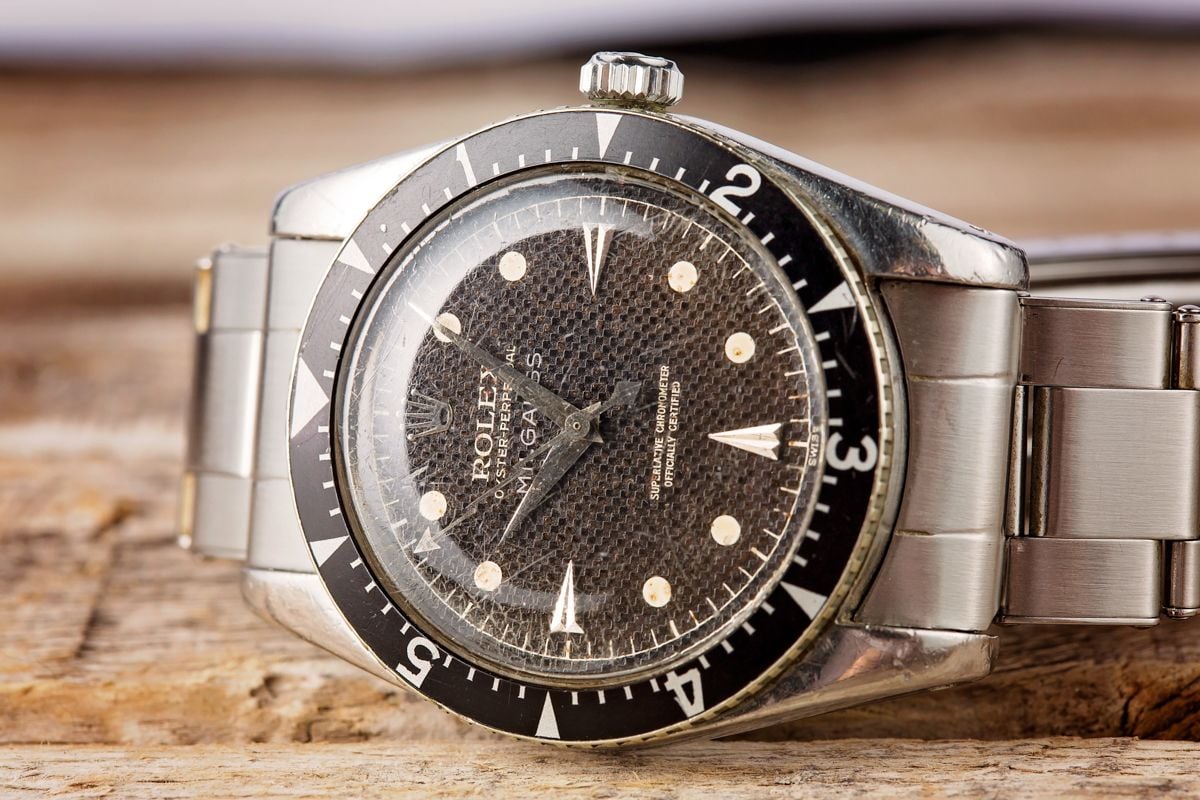
Whatever the truth is, the history of the Rolex Milgauss starts in 1954 with the ref. 6543, and the first run was indeed tested by scientists at CERN. That reference, which was little more than a prototype with only around 150 examples ever produced, was found to be resistant to magnetic forces of up to 1,000 gauss. The model name was taken from that, with mille being the French for a thousand and gauss a unit of magnetic flux density. It is also interesting to note that Rolex does not formally recognize the Rolex 6543 as the first Milgauss and instead cites the subsequent Rolex 6541 that appeared two years later in 1956 as the official start of the Milgauss collection.
How the Milgauss Works
Rolex achieved this impressive level of magnetic defense by effectively creating an internal Faraday cage to shroud the Milgauss’s movement. Crafted from ferromagnetic alloys selected by Rolex, the internal shield redistributes potentially disruptive magnetic fields through its material, protecting the movement inside. Given that the most defining feature of the Milgauss was not something that was apparent to the untrained eye, Rolex’s first scientist’s watch largely resembled the Submariner. The round steel case, the dial, even the black rotating bezel could all be mistaken for being from Rolex’s legendary dive watch. Only the handset really offered any variety, with dauphine hour and minute hands mirroring the pointed hour markers at the three, six, and nine o’clock positions.
The ref. 6543 was only in production for two years, replaced by the ref. 6541 in 1956. This too bore an uncanny resemblance to the Submariner and the launch of the ref. 6541 also marked the official start of the Milgauss collection. However, the new Milgauss it did receive one subtle flourish all its own: the seconds hand took on an erratic, lightning bolt shape, a small nod to the lab-coated realm for which the Milgauss was intended. But even that uncharacteristic dash of Rolex whimsy didn’t seem to help. The Milgauss continued to underwhelm in the same way as did the Omega Railmaster and the Ingenieur from IWC – two other watches that did the same job in the same way.
The Rolex Milgauss ref. 1019 Arrives…and Stays
In what was almost a final throw of the dice, Rolex released the third generation of the Milgauss in 1960. The reference 1019 arrived with all the sporty-looking tool watch pretensions removed, and with a far more restrained and straightforward aesthetic – as would befit its sober anticipated audience.
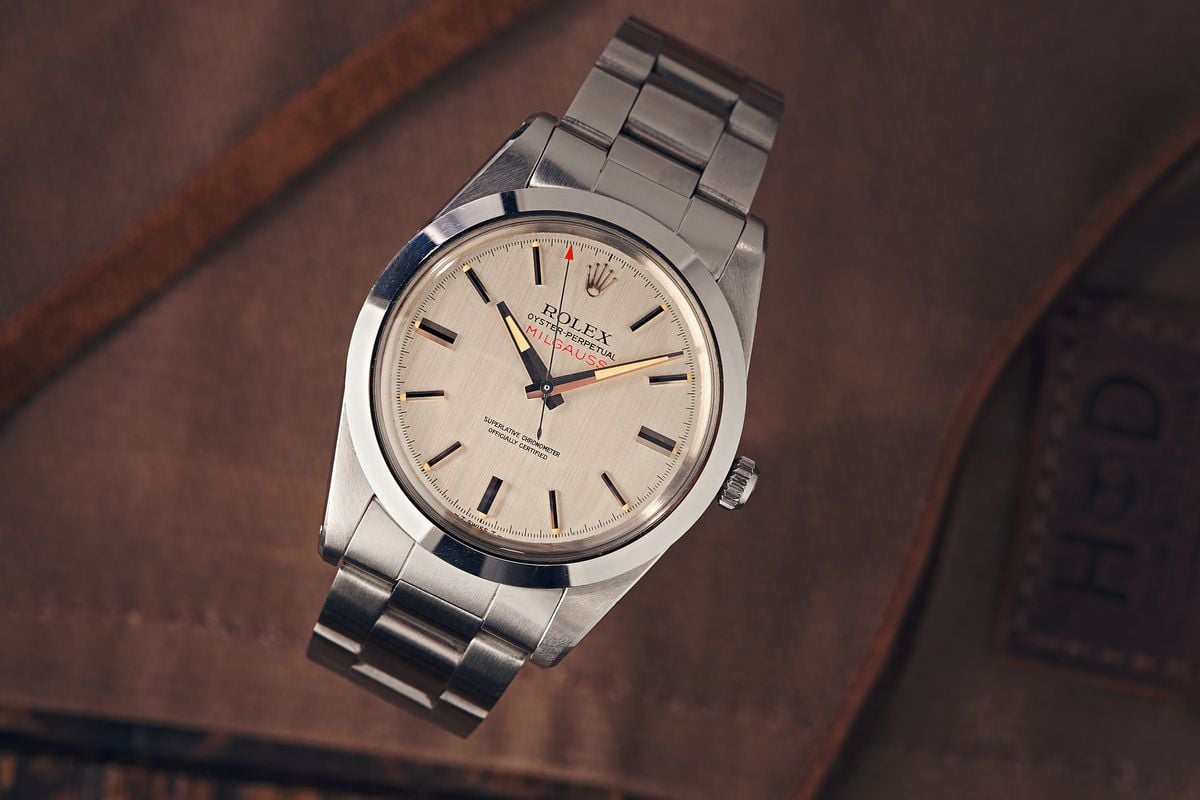
Gone was the rotating bezel; a fixed smooth one in plain stainless steel now took its place. The hour markers reverted to the plain batons – more like the style found on the Datejust and Day-Date; likewise, the handset was changed to a more standard stick shape. Unfortunately, the drastic toning down also extended to swapping the quirky lightning bolt-shaped seconds hand for a pencil straight alternative, topped with a tiny red arrowhead. However, the Rolex 1019 did offer a choice in dial color for the first time, albeit a small one. Buyers could pick either black or silver, and neither had the distinctive honeycomb design that was characteristic of previous references.
However, there was also one additional type of dial offered for the Milgauss 1019, and rumor has it that it was created to meet the request of scientists at CERN. Otherwise identical to the standard silver dial variants, these special Milgauss watches featured no lume at all on either the dial or the hands. It was believed that the radioactive tritium lume – despite being far less radioactive than the radium that was previously used – would still disrupt the incredibly sensitive lab equipment. Now known as the CERN dials, they are among the most sought after and valuable examples of vintage Milgauss 1019 watches.
Inside, the movement went through an update as well. The initial two references had been powered by the Cal. 1080, the antimagnetic variant of the base Cal. 1030. For this latest arrival, the Milgauss was given its first caliber from the Cal. 1500 series, the Cal. 1580. There were far more similarities than differences between the outgoing and incoming movements, but the balance frequency increased from 18,000vph to 19,800vph and a hacking function was added, allowing for users to stop the seconds hand by pulling out the crown.
After that, just as Rolex did with the Explorer from the same era (the ref. 1016), the brand seemed to just forget about the Milgauss. Both models have traditionally occupied the second tier of the brand’s lineup, perpetually overshadowed by the big household names and becoming more cult favorites and oddities in the range. Unlike the Explorer though, the Milgauss was eventually retired. The ref. 1019 went on unchanged for an incredible 28-years, until Rolex finally pulled the plug on it in 1988, with most people thinking that was that for the scientists’ watch.
Rolex Milgauss Released & Discontinued a Second Time
In 2007, Rolex surprised everyone when it reintroduced the long-absent scientist’s watch, to coincide with the opening of CERN’s Large Hadron Collider, the world’s highest-energy particle accelerator. The new Rolex 116400 arrived in three versions, all 40mm as opposed to their predecessor’s 38mm, and constructed from Rolex’s own Oystersteel alloy, which is part of the 904L family.
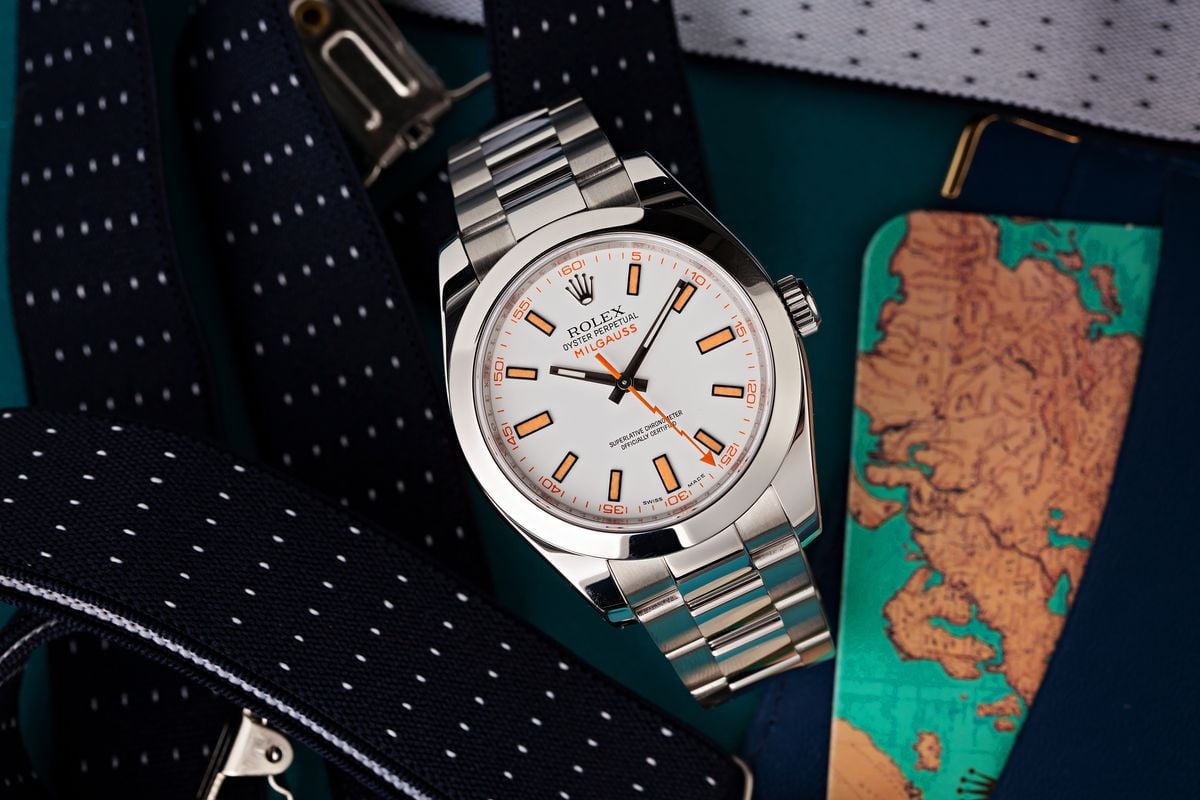
The new generation of Milgauss watches featured an internal antimagnetic shield – just like the inaugural model from the 1950s. However, the Caliber 3131 movement used to power the new generation also featured naturally magnetic-resistant components (such as Rolex’s blue Parachrom hairspring), offering even greater magnetic resistance. The trio of new Milgauss models consisted of a black dial and a white dial piece; the latter already somewhat of a standout in the Professional Collection, which contains conspicuously few white-dial tool watches. The third variation also featured a black dial (although it did have a couple of differences compared to the standard black dial model).
While the other two Milgauss watches from this generation featured traditional clear sapphire crystals above their dials, the third model included a revolutionary new type of sapphire crystal – one with a unique and a beautiful green-colored tint. Known as the ref. 116400GV (GV stands for Glace Verte – “green glass” in French), it represented the first time Rolex had ever made a colored crystal, and it reportedly involves a process so complex that the manufacturer didn’t even bother patenting it, entirely confident that no one else would be able to replicate it.
By 2014, Rolex had discontinued the black dial version of the ref. 116400 fitted with the clear sapphire crystal and introduced a new dial variation known as Z-Blue. Featuring an electric blue sunburst finish with bright orange accents, the new Z-Blue Milgauss also featured Rolex’s green sapphire crystal, making it one of the most vivid and vibrant Rolex models ever created. By 2016, Rolex discontinued the white dial version of the Milgauss, leaving only the two green sapphire models in the brand’s current catalog, and in 2023 discontinued the collection once again.
These days, rather than being the eternally ignored outlier in the lineup, the Rolex Milgauss has garnered its own group of loyal devotees. Now considered a bit of a “cult-classic” within the Rolex catalog, the Milgauss is the perfect option for those seeking something a little out of the ordinary in a world dominated by the same handful of Submariner and Daytona references.
Is a New Milgauss Coming Back? What the Patents Suggest
For the first time since the 2023 discontinuation, there’s real reason to think the Milgauss name may not be retired permanently. Two pieces of patent activity, combined with a calendar milestone, have pushed the rumor mill into overdrive heading into Watches & Wonders 2026.
The first signal is a Rolex patent granted on September 30, 2025 (US 12,428,335 B2), which describes a refined method for producing colored sapphire crystals. That’s notable because the only modern Rolex ever fitted with a colored crystal was the Milgauss 116400GV, the green sapphire Glace Verte models. A patent covering production-ready colored sapphire suggests Rolex isn’t treating the green crystal as a one-off experiment from 2007; it’s quietly building the tooling to produce colored crystals repeatably and at scale, and possibly in colors beyond green.
The second signal is technical. The Land-Dweller, introduced in 2024, debuted Rolex’s Calibre 7135 with the new Dynapulse escapement. Because that escapement uses silicon components, it is inherently resistant to magnetism, meaning a Milgauss built around a no-date variant of this caliber wouldn’t need the bulky internal soft-iron Faraday cage that has defined every Milgauss since 1956. The result would be a thinner, lighter watch with magnetic resistance equal to or greater than the outgoing 116400, and a genuine engineering story to justify the relaunch rather than just an anniversary tribute.
The third signal is the calendar. 2026 marks the 70th anniversary of the Milgauss reference 6541, the model Rolex officially recognizes as the start of the collection. Rolex isn’t always sentimental about anniversaries, the GMT-Master’s 70th in 2025 came and went without a dedicated release, but the combination of a relevant patent, a ready-made antimagnetic movement, and the milestone year is a stronger setup than the brand has had in years.
What This Means for Buyers Right Now
Speculation isn’t confirmation, and Rolex has surprised the market plenty of times by ignoring what looked like obvious cues. But the possibility of a new Milgauss creates a genuine fork in the road for current buyers:
If a successor arrives: The discontinued 116400 and 116400GV become true neo-vintage references. Historically, the first generation of a discontinued Rolex model tends to hold or strengthen in value once a new version exists, particularly the most distinctive variants, in this case, the Z-Blue and the green sapphire crystal models.
If no successor arrives: The current modern Milgauss remains the only modern Milgauss, period. That scenario also supports prices, especially for unpolished examples with full sets.
The wild card: A radically redesigned new Milgauss, something thinner, with a different crystal color, or built around the 7135 movement, could either spotlight or overshadow the outgoing references depending on how collectors respond to the new aesthetic.
For most buyers, the practical takeaway is that the discontinued 116400 generation looks well-positioned regardless of which way Watches & Wonders 2026 lands. The downside risk is limited; the upside is real if Rolex stays quiet and the existing references become the last word on the modern Milgauss.
How Much is a Rolex Milgauss?
Because Rolex discontinued the Milgauss in 2023, buyers now need to look to the pre-owned and secondary markets rather than authorized retail. Prices vary based on reference, dial color, crystal type, condition, production year, box and papers, and overall originality.
Milgauss 116400GV Z-Blue: $13,000-$16,000
Milgauss 116400GV Black Dial: $12,000-$14,000
Milgauss 116400 Black Dial: $11,000-$12,000
Milgauss 116400 White Dial: $11,000-$12,000
Milgauss 1019: $20,000-$50,000
Milgauss 6541 or 6543: $100,000-$250,000
Modern Rolex Milgauss 116400 and 116400GV models are generally more accessible than many stainless steel Rolex sports watches, but the Z-Blue dial and green sapphire crystal versions often command stronger prices because they are the most recognizable modern Milgauss variants.
As a general 2026 market guide, modern Milgauss 116400 models with black or white dials and clear sapphire crystals often trade below the Z-Blue 116400GV. The black dial 116400GV with green crystal usually sits in the middle, while the Z-Blue 116400GV tends to carry the strongest premium among modern examples. Vintage references such as the 1019, 6541, and especially early 6543 examples can be significantly more expensive due to rarity and collector demand.
While the Milgauss has lived its life being somewhat shunned in favor of more recognizable Rolex models, its antimagnetic protection makes it a particularly relevant piece in today’s world. Practically everything we rely on in our everyday life now emits some kind of magnetic field, including computers, hairdryers, mobile phones, and even kitchen appliances. For a traditional mechanical watch, a force as low as 50-100 gauss (about the strength of a fridge magnet) has been shown to be enough to impact the timekeeping of a movement. Having the extra security of the internal antimagnetic shield means that the Milgauss will be untroubled by virtually all day to day activities.
Buying a Pre-Owned Rolex Milgauss
Since the Milgauss is no longer in production, buying pre-owned is now the primary path for most collectors. That makes condition, originality, service history, and seller reputation especially important. Unlike a current-production Rolex that may still be available through an authorized dealer, every Milgauss on the market now has its own ownership history.
When comparing Milgauss watches, look closely at the dial, hands, bracelet, clasp, bezel, crystal, and case condition. For GV models, confirm the green sapphire crystal is correct to the reference. For vintage references, originality becomes even more important because replacement parts, relumed dials, polished cases, and non-original components can significantly affect value.
However, that’s not to say things won’t change. The Milgauss is one of those models that is finally getting to enjoy its moment in the sun. There is a large percentage of the Rolex collecting community that has a particular fondness for the brand as it used to be – back when Rolex was simply a manufacturer of exceptional, tough-as-nails tool watches that were designed to last a lifetime. The Rolex Milgauss has never been offered in precious metals, staying true to its original tool watch roots and cultivating a loyal following of fans and collectors in the process.
Best Rolex Milgauss to Buy
The best Rolex Milgauss depends on whether you want the most collectible model, the best daily wearer, or the strongest value.
Buyer Type
Best Milgauss
Why
Best overall modern Milgauss
116400GV Z-Blue
Most recognizable modern version, with the blue dial, orange accents, and green crystal.
Best daily wearer
116400GV black dial
Still distinctive, but more versatile than the Z-Blue.
Best value
116400 black or white dial
Clear-crystal models can offer a more accessible entry point.
Best vintage choice
Milgauss 1019
Historically important, restrained, and highly collectible.
Best grail collector model
Milgauss 6541 or 6543
Extremely rare early references with major collector appeal.
For most buyers, the 116400GV Z-Blue is the easiest Milgauss to understand and the most visually tied to the modern collection. For someone who wants a more understated Rolex, the black dial 116400GV is probably the better daily watch.
Is the Rolex Milgauss a Good Investment?
es, the Rolex Milgauss can be a good long-term investment, especially for collectors who choose the right reference, condition, and dial configuration. The 2023 Milgauss discontinuation changed the market by ending new retail supply, which has helped strengthen interest in the most desirable modern examples, especially the 116400GV Z-Blue and green sapphire crystal models.
The Rolex Milgauss is a good long term investment. The model’s 2023 discontinuation choked off retail supply, and since then the quirky 116400GV with the green sapphire crystal has appreciated meaningfully on the secondary market. The Milgauss discontinuation in 2023 changed the watch’s market dynamics by creating permanent scarcity.
That said, the Milgauss should not be viewed as a guaranteed investment. It has a smaller buyer pool than the Submariner, GMT-Master II, Daytona, or Datejust, which can make resale less immediate. The strongest Milgauss purchases are usually made by buyers who genuinely like the watch’s design and history, not only by those expecting short-term appreciation.
Rolex Milgauss References
So far, there have only been four Rolex Milgauss references, not including the green sapphire crystal version of the ref. 116400. Below we lay out the models so far.
The first Rolex Milgauss was basically a modified version of the original Turn-O-Graph and was almost a visual clone of the newly introduced Submariner, right down to the iconic rotating bezel and three flat-link Oyster bracelet. A black dial was the only option available, and it was given a honeycomb pattern with the ‘Milgauss’ name printed prominently in red. There were, however, two bezel versions; one calibrated to 60 minutes like the Submariner, the other to 6 units. The ref. 6543 was the reference given over to CERN scientists to test, who confirmed its ability to withstand magnetic fields in excess of 1,000 gauss.
Dial: Black Honeycomb w/ lightning bolt seconds hand
Bezel: Rotating black bezel; fixed smooth bezel also available
Crystal: Acrylic
Movement: Caliber 1080
The second-generation Rolex Milgauss carried on very much where the first left off. There was little to choose between them mechanically and the movement remained the Cal. 1080. Stylistically though, there was one small decoration. The straight seconds hand of the previous reference was swapped for one shaped like a lightning bolt, as a reference to the watch’s antimagnetic capabilities. The black rotating bezel also stayed for the most part, but there was a version of the ref. 6541 that was fitted with a large, fixed smooth bezel (rumored to have been produced for the U.S. market).
Dial: Silver or Black w/ straight bolt seconds hand (non-luminous CERN dial also available)
Bezel: fixed smooth bezel
Crystal: Acrylic
Movement: Caliber 1580
With the ref. 1019, Rolex set about giving the Milgauss its own identity for the first time, rather than following the general design language of the Turn-O-Graph and Submariner. That identity though was exceptionally conservative compared to the design of its predecessors, and the watch became one of the more aesthetically unadventurous in Rolex’s catalog. A fixed smooth bezel replaced the rotating version found on previous models. The dials, available in either black or silver, lost their honeycomb pattern, and the lightning bolt seconds hand disappeared, swapped out for a straight, arrow tipped alternative. Additionally, the mix of hour markers found on the dials of the ref. 6543 and ref. 6541, with their medley of dots and darts, became ordinary batons, similar to those found in the brand’s dress watch collections.
The Milgauss’s movement went through an update too. The Cal. 1580 was brought in – essentially a Faraday cage-equipped version of the Cal. 1530; it would continue powering the Milgauss 1019 all the way up to the end of its production run, nearly three decades later. In the end, there simply wasn’t enough of an audience for the model to sustain it. Just as Omega’s Railmaster suffered in the glamor stakes, always playing second fiddle to the Seamaster and Speedmaster, the Rolex Milgauss could never quite fight its way out of the shadows cast by some of horology’s brightest stars. In 1988, Rolex retired the Milgauss altogether.
In 2007, to celebrate the unveiling of the Large Hadron Collider at CERN, Rolex dusted off the Milgauss name, gave it a radical overhaul, and released the Rolex 116400. It arrived sporting a new 40mm case, now crafted from 904L stainless steel (which Rolex now calls “Oystersteel”). Inside, a two-part shield, manufactured from a pair of different ferromagnetic metals, surrounds and protects the movement. The top is engraved with a capital B, with an arrow above it, the symbol for magnetic flux density.
The first run of the new Rolex Milgauss references consisted of a white and black dial version, each with a standard clear sapphire crystal over the top. Additionally, there was also a third variant with a black dial and a green-tinted sapphire crystal, known as the ref. 116400GV or Glace Verte. Best of all, the lightning bolt seconds hand was back, this time in a bright, vibrant orange color. Both of the models with clear crystals have since been discontinued. In fact, the entire collection has been discontinued.
The Rolex Milgauss Features and Options
Rolex has never really been a brand to pursue complications just for the sake of offering a more complex timepiece. Every function and feature added to its watches have been to address specific and often widespread problems, whether it’s to help overcome jetlag, time motor racing laps, or simply measure elapsed time while underwater.
The Rolex Milgauss’s USP is the same today as it’s always been; fending off strong magnetic fields. It was a necessity in the 50s when it was first created and is arguably even more important now. The fact that it has long struggled for buyers has been a consistent image problem rather than due to any mechanical shortcomings of the watch itself. Timepieces created for airline pilots, endurance racers, or professional divers are likely to have a wider appeal than one marketed to the more conventional world of the laboratory, regardless of how many pilots, divers, or racing drivers are actually members of the general population.
If it’s Worth Engineering, it’s Worth Over Engineering
In reality, the Rolex Milgauss is at least as technically impressive as any of its stablemates. The early examples were tested up to 1,000 gauss; however, with modern-day additions such as Rolex’s Blue Parachrom hairspring, the current generation of the Milgauss probably offers magnetic resistance far greater than that.
As you would expect, 1,000 gauss is also way beyond the official regulations for what qualifies as an antimagnetic watch. The international standard for ‘Magnetic Resistant Watches; ISO 764 (Horology)’ requires that a model must be protected from a direct current field of 4,800 A/m, which works out at about 60 gauss.
The Rolex Milgauss Comes Full Circle
Although the Rolex Milgauss has largely been unable to call upon celebrity owners or fall back on a military heritage of any kind, two things that often do wonders for any watch’s bankability, its relative obscurity is now becoming its biggest asset. For serious collectors, the rarer the better, and the early references are very rare indeed. Even the ref. 1019, in production for 28-years, is not an especially abundant watch, and prices on the vintage market reflect that.
As for the latest examples of Rolex Milgauss watches for sale, they stand as some of the most vivid and unusually colored pieces in the lineup, thanks to the lively orange detailing and, of course, that innovative green crystal. While it may never get to compete with the brand’s ultra-famous models, the Rolex Milgauss is still a big favorite among Rolex fans and it has never been more in demand than it is right now.
Frequently Asked Questions
Yes, Rolex discontinued the Milgauss in 2023. The model is no longer part of the current Rolex retail collection, so buyers generally need to shop the pre-owned market.Yes, the Rolex Milgauss is a good watch for buyers who want a distinctive Rolex with tool-watch history and anti-magnetic engineering. It is durable, technically interesting, and less common than many other modern Rolex sports watches.The Rolex Milgauss can be worth buying in 2026 if you like its unusual design, discontinued status, and scientific history. It is best for collectors who want something different from the more common Submariner, GMT-Master II, Daytona, or Datejust.For most modern buyers, the Rolex Milgauss 116400GV Z-Blue is the best-known and most recognizable option. The black dial 116400GV is a better choice for someone who wants a more versatile daily watch.The main difference is the crystal. The standard 116400 has a clear sapphire crystal, while the 116400GV has Rolex’s green sapphire crystal. GV stands for Glace Verte, which means green glass in French.Yes, the Z-Blue Milgauss is collectible because it combines the green sapphire crystal with a bright blue dial and orange accents. It is one of the most recognizable versions of the discontinued modern Milgauss.The Rolex Milgauss generally holds value well, especially compared with many non-Rolex luxury watches. However, it usually has a smaller buyer pool than the Submariner, GMT-Master II, Daytona, or Datejust, so resale demand can vary by reference and condition.The Milgauss wears slightly thicker than some other time-only Rolex watches because of its internal anti-magnetic shield. Most buyers still find it wearable, but those who prefer a slimmer Rolex may want to compare it with an Oyster Perpetual, Explorer, or Datejust.
About Paul Altieri
Paul Altieri is a vintage and pre-owned Rolex specialist, entrepreneur, and the founder and CEO of BobsWatches.com. - the largest and most trusted name in luxury watches. He is widely considered a pioneer in the industry for bringing transparency and innovation to a once-considered stagnant industry. His experience spans over 35 years and he has been published in numerous publications including Forbes, The NY Times, WatchPro, and Fortune Magazine. Paul is committed to staying up-to-date with the latest research and developments in the watch industry and e-commerce, and regularly engages with other professionals in the industry. He is a member of the IWJG, the AWCI and a graduate of the GIA.
Alongside running the premier retailer of pre-owned Rolex watches, Paul is a prominent Rolex watch collector himself amassing one of the largest private collections of rare timepieces. In an interview with the WSJ lifestyle/fashion editor Christina Binkley, Paul opened his vault to display his extensive collection of vintage Rolex Submariners and Daytonas.
Paul Altieri is a trusted and recognized authority in the watch industry with a proven track record of expertise, professionalism, and commitment to excellence.
Bob's Watches Blog Updates
Sign up and be the first to read exclusive articles and the latest horological news.