We cannot imagine the iconic Rolex Daytona being called anything else. But when Rolex’s cool new chronograph – or “Cosmograph,” in the brand’s terminology – first debuted in 1963 as Ref. 6239, some early advertising in the United States referred to the new timepiece as the “Le Mans.” The name appeared in print ads, though never on the dial itself. By 1964, Rolex had shifted course, and “Daytona” began appearing on the dial of the later production Ref. 6239, marking the true birth of the model as we know it today.
While France’s famed Circuit de la Sarthe staged its first 24 Hours of Le Mans in 1923, Daytona International Speedway in Florida had officially opened in 1959, ushering in a new era of American “superspeedway” racing. Built by NASCAR founder Bill France Sr., the 2.5-mile tri-oval quickly became the epicenter of stock car and endurance competition in the United States. Its high banking and sheer scale made it a symbol of speed and spectacle, and its growing international profile offered Rolex a compelling stage on which to align its chronograph with modern motorsport.
Why Rolex Chose the Name Daytona

As Daytona’s prominence rose throughout the early 1960s, the name carried increasing commercial weight – particularly in the U.S., which had become Rolex’s most important market – making “Daytona” a far more strategic and resonant choice than “Le Mans.” The 24 Hours of Daytona meanwhile began as a shorter three-hour sports car race in 1962 before expanding to a full 24-hour Le Mans-style endurance race in 1966. Over time, the race grew into one of the most important endurance racing events in the world, attracting international manufacturers such as Porsche and Ferrari and professional racing teams.
The Rolex 24 at Daytona and Endurance Racing Legacy
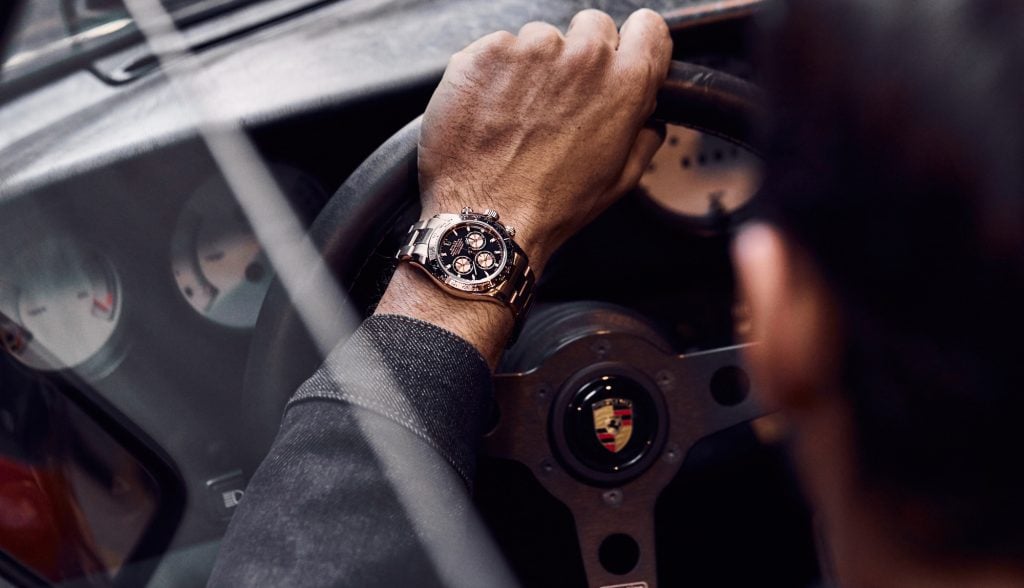
The Daytona 500 meanwhile – the 68th running of which just took place this past weekend – was first held in 1959 as the inaugural 500-mile stock car race at the newly opened speedway, organized by NASCAR, the National Association for Stock Car Auto Racing, and is more all-American, you might say. While Rolex has never sponsored NASCAR, it has maintained a deep association with endurance racing at Daytona, becoming title sponsor of the 24 Hours of Daytona in 1992, when the event was officially renamed the Rolex 24 at Daytona. The Daytona speedway has also been used for events like Ferrari’s Finiali Mondiali championship.
Rolex’s connection to auto racing stretches back even further. In 1935, Sir Malcolm Campbell wore a Rolex Oyster while setting a land speed record at the Bonneville Salt Flats, marking one of the brand’s earliest high-profile ties to motorsport. By the 1960s, Rolex had begun formal relationships within endurance racing, including involvement at Daytona as official timekeeper prior to its 1992 title sponsorship. Over the decades, that relationship has only strengthened, helping cement the Daytona not just as a watch named after a racetrack, but as one of the most enduring symbols of speed, precision, and competitive timing.
The Modern Daytona Still Honors Its Racing Origins
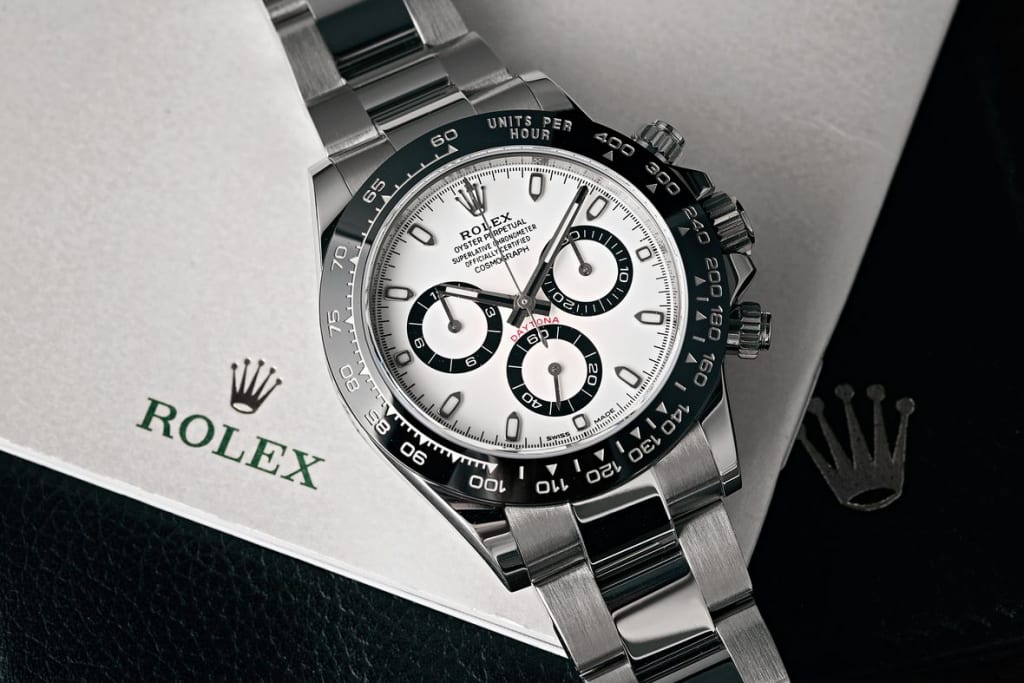
Today’s Rolex Cosmograph Daytona for sale – now in its sixth decade – has evolved far beyond the manually wound Ref. 6239. Modern iterations such as the 116500, 126500 and 116515 feature in-house automatic chronograph movements, high-tech materials such as Cerachrom bezels, and proprietary alloys like Everose gold. You can even get one festooned with precious jewels. Yet despite the technical advancements, the spirit of the original remains intact: a racing chronograph born in the 1960s, shaped by America’s most iconic racetrack, and forever linked to the endurance tradition that gave it its name.