The IWC Portugieser is worth buying if you want a refined luxury watch with classic design, strong watchmaking heritage, and a more understated alternative to sportier options. The right model depends on what you want from it. For a classic everyday look, the Portugieser Chronograph (Ref. 3716) is the natural pick. For pure mechanical watchmaking, look to the Automatic 40 or the 7-Day Automatic. For the most prestigious entry into the line, focus on the Perpetual Calendar.
Key Takeaways:
- Core Appeal: A timeless, minimalist maritime design built around Arabic numerals and slim leaf hands.
- Value Retention: Strongest among stainless steel Chronograph models, especially classic blue or silver dial versions.
- Sizing: Once a large watch line at 42mm and up, recent releases include wearable 40mm and 41mm cases.
- Movements: The entry and mid tier range now runs entirely on in-house IWC calibers.
Nearly a century of design updates, reference changes, and case metals can make the collection feel hard to navigate. The clearest way to understand a modern Portugieser is to start with the request that created it, since the watch’s history explains why it looks the way it does today.
The Maritime Roots: Why the Portugieser Defies Standard Dress Watch Sizes

The Portugieser wears larger than a traditional dress watch for a specific reason, and that size is a direct result of its original purpose. To understand why a modern Portugieser still carries a bold presence on the wrist, it helps to look back at the challenge that started it all and the design choices that followed.
The 1939 Origin Story (Ref. 325)
In 1939, two Portuguese businessmen approached IWC with a clear challenge. They wanted a wristwatch that kept time with the accuracy of a marine chronometer, the precise instrument used for navigation at sea. At the time, that level of accuracy lived inside large pocket watch movements, not in the small calibers used for wristwatches.
IWC’s engineers found a direct solution. They fitted a pocket watch movement, the Caliber 74, into a wrist case, creating the Reference 325 with a case close to 43mm. That was unusually large for the era, when most men’s dress watches measured roughly 30mm to 33mm. The oversized footprint was not a style statement at first. It was the price of housing a movement accurate enough to satisfy the original brief.
Evolution of the Signature Design Language
Over the decades, the Portugieser settled into a look that is easy to recognize at a glance. The dial favors a clean railway style minute track, raised Arabic numerals, and an ultra slim bezel. That thin bezel does more than save space. It lets the dial reach closer to the edge of the case, which makes the watch read larger and more open on the wrist.
These details have stayed remarkably consistent. Whether you look at a time only model or a complicated calendar, the same DNA appears: legible numerals, leaf hands, and a balanced layout. For buyers, that consistency is part of the appeal, since a Portugieser from one decade speaks the same visual language as a Portugieser from another.
The Core Pillars: An In-Depth IWC Portugieser Review of Key Models
The Portugieser is not a single IWC watch. It is a family that ranges from simple time only pieces to high complications. The models below represent the core of the modern collection, and each one suits a different kind of buyer. Reviewing them side by side makes it easier to match a watch to your wrist, your budget, and the type of watchmaking you value most.
The IWC Portugieser Chronograph (Ref. 3716)
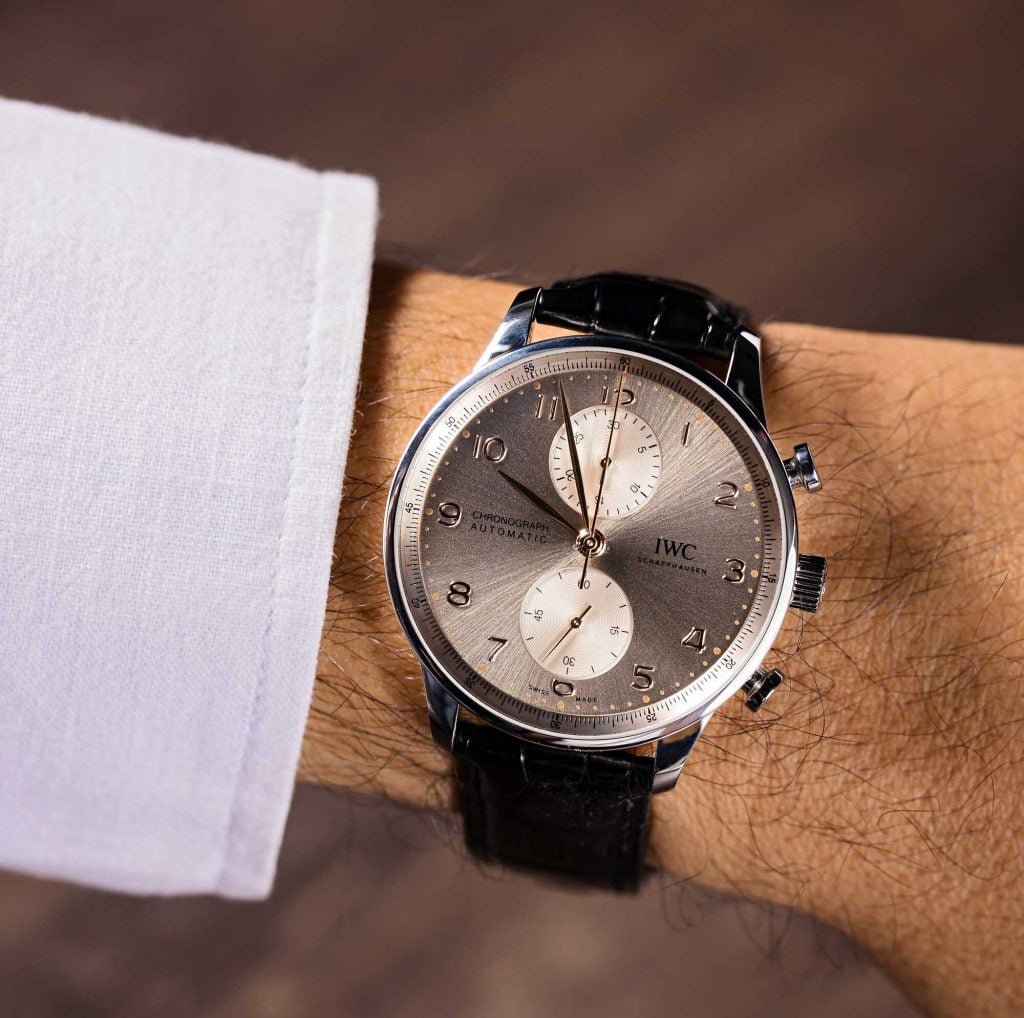
The Chronograph is the model most people picture when they think of the Portugieser. Its dial is built around vertical balance, with two sub dials stacked at 12 and 6 o’clock rather than spread across the face. That clean, two register layout keeps the dial open and symmetrical, which is a large part of its lasting appeal.
The current Reference 3716 brought a major upgrade under the dial. Earlier versions, sold as the Reference 3714, ran on a movement based on the Valjoux 7750 and hidden behind a solid caseback. The 3716 replaced it with the in-house Caliber 69355, a column wheel chronograph now visible through a sapphire caseback. The case measures 41mm across and about 13.1mm thick, with a 46 hour power reserve. The change gave the watch genuine in-house credentials without altering the proportions buyers already loved.
The IWC Portugieser Automatic (40mm vs. 42mm 7-Day)
Two automatics anchor the time only side of the collection, and they speak to different tastes. The Automatic 40 (Ref. 3583) keeps things simple and compact. It uses the in-house Caliber 82200, offers a 60 hour power reserve, and measures 40.4mm, which makes it one of the easiest Portugieser models to wear from morning to night.
The 42mm 7-Day Automatic (Ref. 5007) is the choice for buyers who want to feel the engineering. It runs the Caliber 52010, part of IWC’s larger 52000 family, and pairs the famous Pellaton winding system with twin barrels. Together they build a full 168 hour, or seven day, power reserve, shown on a dedicated indicator on the dial. At 42.3mm it wears with more presence, which suits larger wrists and anyone who likes a technical centerpiece.
High Complications: Perpetual Calendars and Beyond
At the top of the range sits the Perpetual Calendar (Ref. 5033), built around one of IWC’s most celebrated achievements. The perpetual calendar module was developed by former head watchmaker Kurt Klaus in the 1980s. Its signature feature is elegant simplicity. The entire calendar, including the date, day, month, and a four digit year, can be adjusted through the crown alone, with no extra pushers crowding the case.
The Portugieser version also carries IWC’s double moon phase display, which shows the moon as it appears in both the northern and southern hemispheres. Powered by the Caliber 52610 with the same seven day reserve, and housed in a 44.2mm case, it is aimed squarely at serious collectors who value mechanical depth as much as looks.
Structural Comparison
| Reference / Model | Case Size | Movement Type | Power Reserve | Best Suited For |
| Automatic 40 (Ref. 3583) | 40.4mm | In-House Cal. 82200 | 60 Hours | Minimalist and daily wear |
| Chronograph (Ref. 3716) | 41.0mm | In-House Cal. 69355 | 46 Hours | Versatile and elegant |
| Automatic 7-Day (Ref. 5007) | 42.3mm | In-House Cal. 52010 | 168 Hours | Tech enthusiasts and larger wrists |
| Perpetual Calendar (Ref. 5033) | 44.2mm | In-House Cal. 52610 | 168 Hours | Serious collectors |
Vintage vs. Modern: Key Traps to Avoid When Buying Pre-Owned

Buying a Portugieser on the pre-owned market opens up real value, but it also calls for a careful eye. Two areas trip up buyers most often: the movement inside an older Chronograph, and the condition of the slim case and dial. Knowing what separates a strong example from a compromised one protects both your money and your enjoyment of the watch.
The Movement Transition: 3714 vs. 3716
The single most important detail on the secondary market is which Chronograph you are looking at. The earlier Reference 3714 uses a modified Valjoux 7750, sealed behind a solid caseback. That movement is well understood and generally cheaper to service, which some buyers see as a practical advantage.
The modern Reference 3716 carries the in-house Caliber 69355 behind a sapphire exhibition caseback, so you can watch the column wheel chronograph at work. Neither choice is wrong. The 3714 offers solid value and proven reliability, while the 3716 delivers in-house prestige and a view of the movement. What matters is paying the right price for the reference in front of you, not paying 3716 money for a 3714.
Dial and Case Quality Inspections
The Portugieser’s thin bezel is part of its beauty, and also its biggest vulnerability on the used market.
Warning: Be cautious of over polished cases. Because the Portugieser bezel is so slim, aggressive polishing can permanently round off the sharp original geometry. Once those crisp edges are gone, they cannot be brought back.
Beyond the case, a few checks separate a clean buy from a risky one:
- Confirm the paperwork. Look for a stamped warranty book and a serial number that matches the one engraved between the lugs.
- Inspect the case edges. Sharp, defined lines suggest the watch has not been heavily polished.
- Check the strap. On models fitted with alligator leather, verify that the strap and buckle are genuine IWC parts.
- Review service history. Records of past servicing add confidence, especially on older pieces.
Investment Value: Which Portugieser Models Hold Value Best?

There are buyers who are constantly searching for hte best investment watches. No watch should be bought purely as a investment, but value retention is a fair thing to weigh. The Portugieser behaves much like the wider luxury market: steel models with classic dials hold up best, while precious metal and highly complicated pieces follow a different curve. Understanding that pattern helps you buy with clear expectations.
Retail Depreciation vs. Secondary Market Reality
Like most luxury watches outside of stainless steel sports models, a precious metal Portugieser usually takes an initial dip in value the moment it leaves the boutique. Gold cases carry a high retail premium, and that premium rarely transfers in full to the first resale. This is normal across the industry and is not unique to IWC.
The picture is steadier for steel. Experts and online communities that track the secondary market note that stainless steel Chronograph models, especially the 3716, tend to hold a strong share of their original retail over time, with figures often cited in the range of roughly 70 to 80 percent. Actual numbers move with condition, dial color, and demand, so treat any percentage as a guide rather than a guarantee.
The Liquid Configurations
Some versions are simply easier to sell than others. The most liquid Portugieser configurations tend to be stainless steel cases paired with the most classic dials, namely blue dials or silver dials with gold markers. These combinations appeal to the widest audience, which helps them preserve value more comfortably over a 5 to 10 year horizon.
Bolder choices, such as green or burgundy dials, can be rewarding to own and stand out on the wrist. They also speak to a narrower group of buyers, which can make resale slower. If long term value sits high on your list, the safest path is the configuration that the largest number of collectors already want.
Making the Choice: Investing in a Watchmaking Legend

Whether you are drawn to the everyday balance of the 41mm Chronograph or the mechanical depth of a seven day automatic, choosing a Portugieser means owning a distinct chapter of horological history. The line traces a clear path from a 1939 request for marine chronometer accuracy to a modern collection built on in-house calibers. Few watches manage to wear this large while still feeling this elegant.
A final word on budget. The pre-owned market offers excellent value on gold and complicated models, where the steepest depreciation has already happened and a careful buyer stands to benefit. For a brand new stainless steel model, updated factory coverage works in your favor, since the My IWC program can extend the standard warranty up to a total of eight years. That makes a fresh purchase a secure and rewarding way into luxury timekeeping.