Rolex Tiffany Blue is the name given to the turquoise blue dial used on some contemporary Rolex Oyster Perpetual timepieces. It was released in September 2020. It is not a branded collaboration with Tiffany & Co., but a term that has been used by collectors for the dial color, as it closely resembles that of the Tiffany company’s robin’s egg blue shade. The turquoise dial is one of the most coveted in Rolex’s present-day collection, with some models selling for three or four times their retail price on the secondary market.
Key Takeaways:
- Official vs. Nickname: Modern turquoise dials are Rolex-only creations, while vintage Rolex watches with “Tiffany & Co.” stamped dials represent actual retailer partnerships from decades past
- Discontinuation Status: The 41mm Oyster Perpetual (Ref. 124300) was discontinued in 2022, while the 36mm, 34mm and 31mm versions remain in production as of 2025
- Investment Potential: Limited production and high demand have driven market prices to $20,000+ for models that originally retailed around $6,000
- Model Availability: The turquoise color appears across multiple sizes (31mm, 34mm, 36mm, 41mm) and variations, including the Day-Date with stone dials and the 2023 Celebration motif
Whether it’s the cultural icon Oyster Perpetual you are after or the understated luxury of a turquoise stone dial Day-Date, this review covers every model, every price range and every bit of history you need to make an educated purchase. We’ll explain the differences between lacquer and stone dials, how to decipher secondhand market pricing and more.
What is a “Rolex Tiffany Blue” Watch?

Officially known as Turquoise Blue, the bright dial color became an option for the new and updated Oyster Perpetual collection back in September 2020. Basically, it’s a lacquer applied to the dial with a color and finish that Rolex explained was inspired by the vibrant and bright colors found on Rolex’s vintage Stella dials from the 1970s. The dial’s eye-catching shade sits somewhere between aqua and cyan, creating an unmistakable presence on the wrist that stands apart from traditional watch colors like black, blue, or white.
The “Tiffany” reference stems from the dial color itself and its immediate similarity to Tiffany & Co.’s signature robin’s egg blue color, which the luxury jeweler has trademarked. Tiffany & Co. collaborated with Patek Philippe in 2021 to release a limited edition Nautilus 5711/1A-018 watch with an official Tiffany-stamped dial and has since become one of the most hyped watch releases in recent memory. As luck would have it for Rolex, the Patek-Tiffany Blue collaboration watch was released shortly after the Rolex Oyster Perpetual with the Turquoise Blue dial. Conversations on social media and collector groups were abound with comparisons, and as “Tiffany Blue” fever swept through the watch world, the new Rolex turquoise dial caught the perfect wave and became the must-have new color.
Turquoise vs. Tiffany & Co. Stamped Dials

The modern turquoise dial is distinctly different from a vintage Tiffany-stamped dial. Vintage Rolex watches from the 1960s, 1970s, 1980s and 1990s sometimes bore the words “Tiffany & Co.” printed on the dial either just below the Rolex signature, or sometimes above the six o’clock position. Tiffany & Co. functioned as an authorized retailer that tasked Rolex with producing watches that incorporated their retailer stamp on the dial. These watches are highly collectible watches and reflect an actual business relationship between the two companies.
The modern turquoise Oyster Perpetual bears no affiliation with Tiffany & Co. There is no stamping, there is no co-branding, there is no partnership, there is no special edition or any other tie to Tiffany & Co. Collectors utilize this name solely because it reflects a color resemblance. This means that while the vintage stamped dials carry historical significance and documented provenance, the modern turquoise dials represent a Rolex-only creation that collectors have simply nicknamed “Tiffany” for convenience. Both are valuable, but for entirely different reasons.
The Modern “Tiffany” Oyster Perpetual Collection

The 2020 Oyster Perpetual collection signaled a new direction for Rolex’s entry-level sports watch. Five playful new dial colors in turquoise, coral red, yellow, green and candy pink were launched in three different case sizes, 41mm (Ref. 124300), 36mm (Ref. 126000) and 31mm (Ref. 277200). The dials were reminiscent of the Stella dials from the 1970s and injected the collection with much needed playfulness and character. The watches had for many years been stuck in a rut of conservative, “safe” design. The turquoise dial in particular had a way of popping and grabbed people’s attention both for its relative audacity and timely arrival alongside the Patek Tiffany.
The watches feature the same reliable Rolex DNA found across the brand’s lineup: Oystersteel cases, scratch-resistant sapphire crystals, and the Chromalight display with long-lasting blue luminescence. The movements differ by size, with the 41mm housing the Caliber 3230, the 36mm using the Caliber 3230, and the 31mm equipped with the Caliber 2232. All offer approximately 70 hours of power reserve and carry COSC chronometer certification. While the specifications are straightforward, the dial color transformed these otherwise simple time-only watches into some of the most coveted pieces Rolex produces.
The Oyster Perpetual 41 (Ref. 124300)

| Specification | Details |
| Reference Number | 124300 |
| Case Size | 41mm |
| Movement | Caliber 3230 |
| Power Reserve | 70 hours |
| Retail Price | ~$6,400 |
| Secondary Market Price | $20,000 – $25,000 |
| Production Status | Discontinued (2022) |
| Production Period | ~2020 – 2022 |
Of all the modern “Tiffany Blue” Rolexes, the 41mm Oyster Perpetual with turquoise dial is the most coveted (and expensive). Only two years of production meant that it became immediately rare, which was quickly amplified by the market reaction. The size is also very popular amongst collectors, as a growing number prefer larger cases. Therefore the right combination of demand (size preference) and scarcity (only available for 2 years) made the 41mm the holy grail of the four.
It being discontinued means the only way the supply can go is down (breakages, mods, going into private collections, etc). For someone trying to acquire the most well-known variation of the “Tiffany Blue” hype, the 41mm is it. Prices went up shortly after it was discontinued, but have stayed relatively steady since, which shows its desirable demand.
The Oyster Perpetual 36 (Ref. 126000)
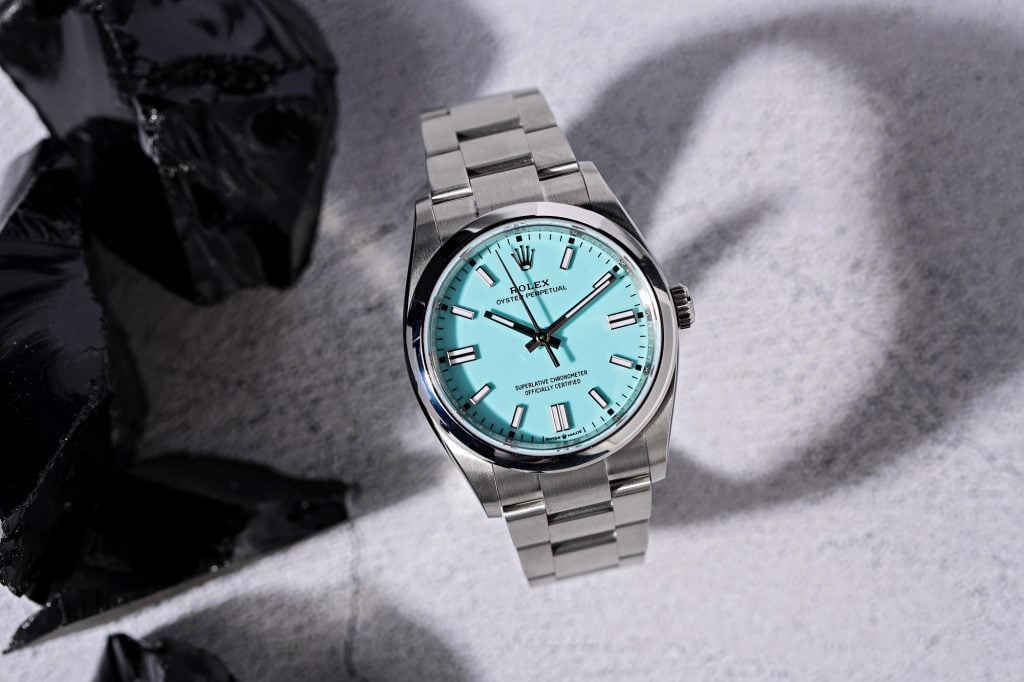
| Specification | Details |
| Reference Number | 126000 |
| Case Size | 36mm |
| Movement | Caliber 3230 |
| Power Reserve | 70 hours |
| Retail Price | ~$6,350 |
| Secondary Market Price | $15,000 – $18,000 |
| Production Status | In Production (2025) |
| Target Audience | Unisex |
The 36mm Oyster Perpetual with turquoise dial is in-production through at least the end of 2025. This technically means the model is “available”, and Rolex Authorized Dealers will still list it on their websites, but acquiring one new from a retailer is virtually impossible for most people. Authorized Dealers have multi-year waitlists and existing clients with purchase histories are at the front of the list.
Rolex’s 36mm case size has always been the most popular because it suits smaller wrists and larger wrists, making it a genuine unisex size that is well-proportioned for both men and women. It’s also not in the stratospheric price point of the discontinued 41mm. The 36mm is the sweet spot between availability and potential value that a buyer is willing to accept if they don’t mind buying on the secondary market, rather than wait for years to buy through an authorized channel.
The Oyster Perpetual 31 (Ref. 277200)
| Specification | Details |
| Reference Number | 277200 |
| Case Size | 31mm |
| Movement | Caliber 2232 |
| Power Reserve | 70 hours |
| Retail Price | ~$5,950 |
| Secondary Market Price | $10,000 – $13,000 |
| Production Status | In Production (2025) |
| Target Audience | Ladies / Small Wrists |
The 31mm Oyster Perpetual with turquoise dial targets a more specific audience, traditionally marketed toward women, though smaller-wristed men and those who prefer vintage-inspired proportions also gravitate to this size. Like the 36mm, it remains in production, but finding one at an authorized dealer still requires patience and, often, an existing relationship with the store.
When considering investment options in the turquoise dial family, the 31mm model stands as the easiest entry point. The 31mm model is the best purchase for those who value owning the iconic turquoise color over seeking the most popular watch reference. The smaller size also means slightly less competition among collectors, making it occasionally possible to find one with less difficulty than its siblings.
The “Celebration” Motif Dial

| Specification | Details |
| Introduction Year | 2023 |
| Available Sizes | 31mm, 36mm, 41mm |
| Dial Design | Turquoise with multi-colored bubbles |
| Bubble Colors | Yellow, pink, red, green, turquoise |
| Production Status | Discontinued (2025) |
Rolex unveiled a new dial variation for its Oyster Perpetual line in 2023 which features a design pattern that Rolex describes as the “Celebration” motif. This design incorporates a turquoise blue base with multi-colored bubble shapes scattered across the dial, creating a playful, almost festive aesthetic. The Celebration dial represents Rolex’s intensified expression of creativity which builds upon the company’s previous success with solid color dials launched in 2020.
Functionally, this is a “Tiffany Blue” variant, but has found a different reception in the market. The additional design elements make it more divisive, with some fully embracing it and others preferring the cleaner look of the solid turquoise dial. The Celebration dial does at least offer another route for someone looking for a turquoise dial, but one that is also more of a statement.
Other “Tiffany Blue” Rolex Models (Stone Dials & Daytona)
Beyond the Oyster Perpetual collection, turquoise appears in other areas of Rolex’s lineup, though in very different contexts and price ranges. These alternatives use natural stone dials rather than lacquer finishes, placing them in a completely different category in terms of materials, exclusivity, and cost.
Rolex Day-Date 36 Turquoise (Ref. 128348RBR)
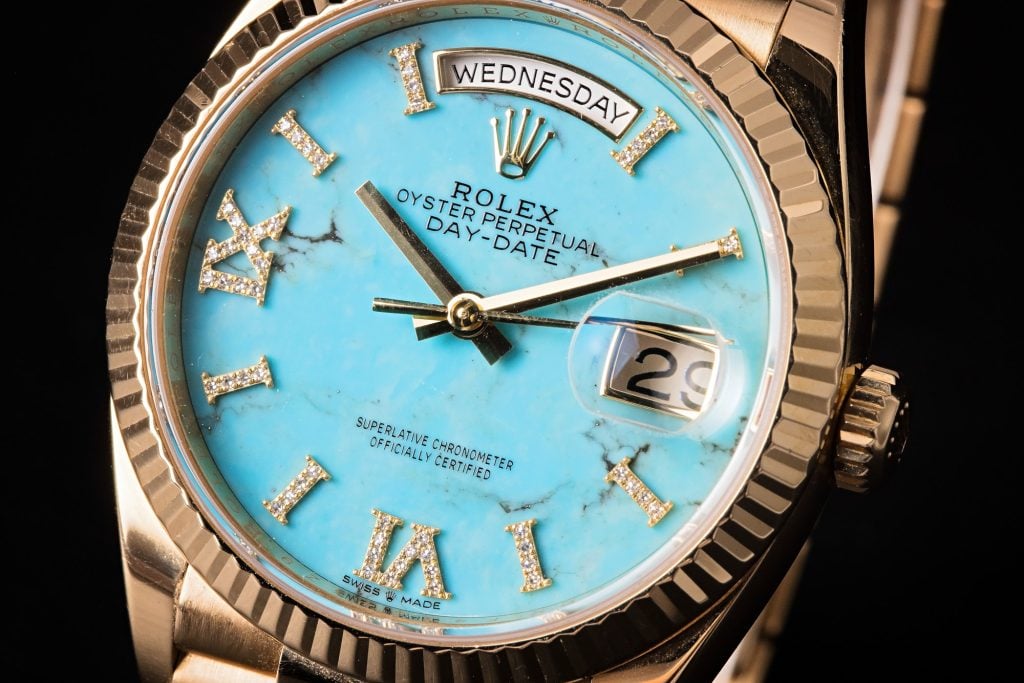
| Specification | Details |
| Reference Number | 128348RBR |
| Case Size | 36mm |
| Dial Material | Natural turquoise stone |
| Case Material | Yellow gold |
| Bezel | Diamond-set |
| Retail Price | $67,700 – 122,900(plain vs diamond bracelet) |
| Secondary Market Price | $110,000 – $200,000 |
| Production Status | In Production |
| Bracelet | President with or without diamond links |
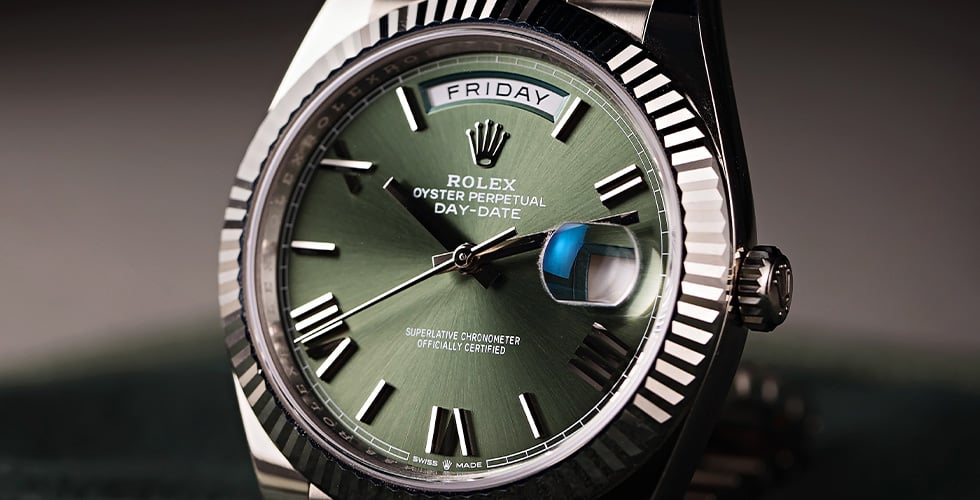
The Day-Date 36 with turquoise dial is at the luxury end of the turquoise watch spectrum. Where the Oyster Perpetual has a lacquer dial, the Day-Date has a genuine turquoise stone dial, thin slices of natural stone selected and fitted together to make the dial. The difference in materials alone accounts for a large part of the price difference. The Day-Date is available only in precious metals, in yellow gold, white gold and Everose gold, and many variations have diamond-set bezels and/or diamond hour markers.
The Day-Date also has the brand’s signature day and date display, along with the iconic President bracelet and the option for polished or diamond-set center links. If you are looking for turquoise from Rolex in its most prestigious incarnation, the Day-Date will not disappoint, though it will be a stretch for all but those willing to pay precious metal prices for a watch. The dial is made of natural stone and may vary slightly from watch to watch.
The “Beach” Daytona (Turquoise)
| Specification | Details |
| Reference Number | 116519 |
| Case Material | White gold |
| Dial Material | Turquoise stone |
| Complication | Chronograph |
| Production Period | Early 2000s |
| Secondary Market Price | $50,000 – $80,000 |
| Production Status | Discontinued |
Before the current turquoise trend, Rolex offered turquoise stone dials on select Daytona chronographs. The Ref. 116519 Daytona in white gold featured a turquoise stone dial option that collectors now refer to as the “Beach” Daytona. Produced in the 2000s, these watches predated the modern hype cycle by years. The turquoise stone paired with white gold created an elegant summer aesthetic, though the color choice remained relatively under the radar at the time.
Today, the “Beach” Daytona has gained renewed interest as collectors have become more focused on turquoise dials across the board. The chronograph functionality and Daytona heritage add layers of collectability that the simple time-only Oyster Perpetual lacks. For buyers who want turquoise but prefer the complication and prestige of a Daytona, the “Beach” models offer a compelling alternative, albeit at a significant premium.
Is There a Tiffany Blue Daytona?

Buyers often confuse “Tiffany Blue Daytona” with the platinum Daytona Ref. 116506 with an ice blue dial. Ice blue is not turquoise; even though both colors are in the blue color family, ice blue is an altogether different color. Rolex uses ice blue only on platinum models, and the hue is a pale silvery blue rather than the bright turquoise found on the Oyster Perpetual. The ice blue Daytona is priced at over $75,000 and is in a completely different league.
Rolex does not offer a true turquoise lacquer dial Daytona to match with an Oyster Perpetual in the same shade. A Rolex Daytona with a bright turquoise lacquer dial is either a vintage stone dial watch or a custom aftermarket dial. Aftermarket dials are to be avoided due to value and authenticity risks. Custom dial jobs can look appealing in photos but destroy a watch’s collectibility and resale value. Buyers searching for “Rolex Daytona Tiffany Blue” should be aware that unless they’re looking at a stone dial white gold model from years past, they’re likely encountering custom work that should be avoided.
Rolex Tiffany Blue Price Guide & Investment Analysis
Turquoise dial Rolexes break every rule of traditional watch investment thinking. For a stainless steel, time-only watch to retail for about $6,000 yet trade for $20,000 or more in the secondary market is an unheard-of 200%-300% mark up. This phenomenon stems from a perfect combination of factors: artificial scarcity through controlled production, cultural timing with the Patek Tiffany release, and social media amplification.
| Model | Reference Number | Retail Price | Secondary Market Price | Production Status |
| OP 41 Turquoise | 124300 | ~$6,400 | $20,000 – $25,000 | Discontinued (2022) |
| OP 36 Turquoise | 126000 | ~$6,350 | $15,000 – $18,000 | In Production |
| OP 31 Turquoise | 277200 | ~$5,950 | $10,000 – $13,000 | In Production |
| Day-Date 36 Stone | 128348RBR | $67,700 – 122,900 (plain vs. diamond bracelet) | $110,000 – 200,000 | In Production |
Factors Influencing Value
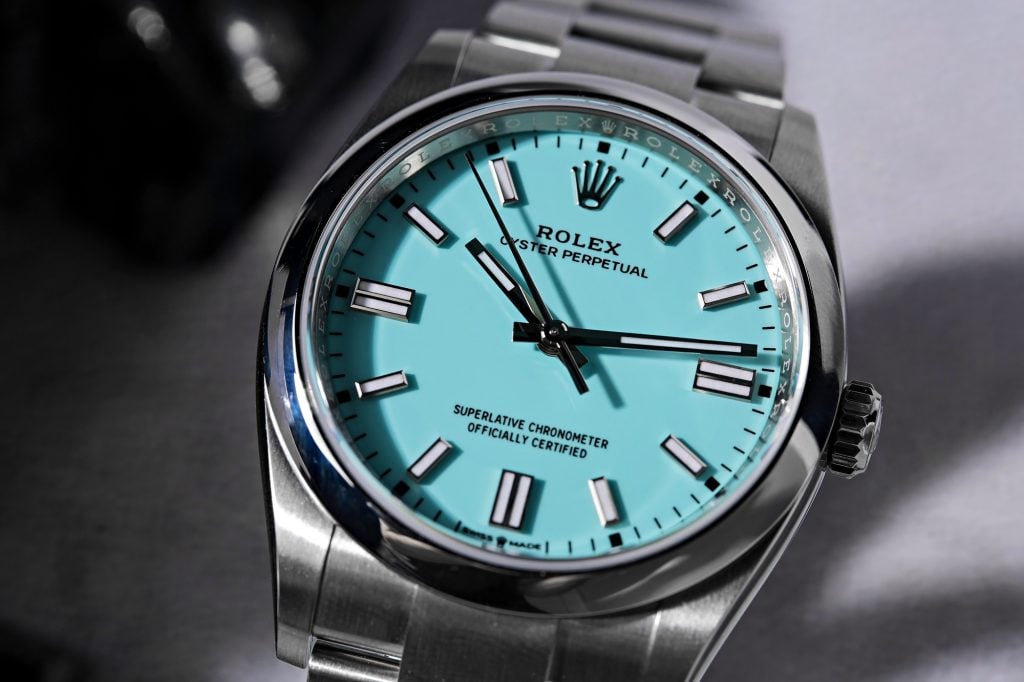
The exact price a given watch will command within those ranges is affected by a number of factors. Condition is important and an unworn example will demand a significant premium over a worn one. Full sets including box, papers, warranty cards and purchase receipt will trade at a premium to a watch-only example as these help to prove authenticity and indicate ownership history. Price stability at the higher end is most pronounced for the discontinued 41mm, while the 36mm and 31mm are more volatile as Rolex continues to produce them.
Prices are currently affected by the wider market for luxury watches, peaking when inflation and excess liquidity are high, and normalizing when the economic outlook is uncertain. The watches retain their value well but expectations of further spectacular gains are probably misplaced. The color has achieved icon status, which suggests long-term collectability, but buying at current secondary market prices requires more careful consideration.
Investment Outlook

The investment case for turquoise dial Rolexes depends on your time horizon and purchase price. Buyers who acquired 41mm models at retail in 2020 or 2021 have seen substantial returns. However, purchasing at current secondary market prices requires more careful consideration, as much of the appreciation has already occurred. For pure investment purposes, buying at retail (if possible) or during market dips offers the best potential. For enjoyment and wearability, the premium may be justified if you genuinely love the aesthetic.
Buyer Beware: Real vs. Fake & Aftermarket Dials
The turquoise dial’s simplicity makes it vulnerable to counterfeiting. A standard Rolex dial can be refinished or painted turquoise relatively easily, creating what appears to be the coveted color. These “custom” or aftermarket dials destroy a watch’s value and authenticity. While they might look acceptable in photos, close inspection reveals differences in color depth, finish quality, and printing sharpness. Collectors and dealers can spot these modifications, meaning resale becomes nearly impossible.
The solution is purchasing only from sources that guarantee authenticity. Bob’s Watches and similar reputable dealers authenticate every component, ensuring the dial left the Rolex factory in turquoise. Private sales carry more risk, particularly on platforms where sellers aren’t held accountable. If a price seems too good to be true, especially for a 41mm model, it probably has a refinished dial or other modifications. The premium paid to trusted dealers is essentially insurance against costly mistakes that could result in owning a watch worth a fraction of what you paid.
Is the Hype Here to Stay?
The turquoise dial has transitioned from trend to modern classic over its five-year existence. While initial demand was driven partly by hype and the Patek association, sustained interest suggests deeper appeal. The color represents something unusual for Rolex, a brand known for conservative design choices. This rarity gives the turquoise dial lasting significance in the brand’s history. Even as other dial colors come and go, the turquoise has proven it resonates beyond temporary fashion.
Rolex’s approach to producing this color ensures it remains special. By keeping production limited relative to demand, even for models still in production, Rolex maintains the dial’s desirability. The discontinuation of the 41mm reference further cemented its collectability. Looking forward, these watches will likely be remembered as capturing a specific moment in watch collecting culture, when social media, collaboration hype, and pandemic-era collecting fervor converged. Bob’s Watches regularly stocks these sought-after models, offering collectors the opportunity to own a piece of this modern Rolex story.