The Breitling Navitimer is one of those watches you can spot from across a room. That circular slide rule bezel, the clean tri-compax dial, the enduring pilot’s watch aesthetic. It’s been turning up on wrists and in cockpits for decades. Underneath all that visual complexity is serious substance, especially in modern models powered by Breitling’s in-house B01 movement. In this Navitimer review, we’ll walk through how it started as a wrist-mounted flight computer, how the design has evolved, what’s going on inside the case, and how it holds up today in the pre-owned market. If you’re thinking about buying a contemporary B01 Chronograph or a vintage ref. 806, this should give you a clear sense of whether the Navitimer actually fits your wrist and your collecting goals.
Key Takeaways
- Powered by the in-house Breitling B01 chronograph caliber, delivering a 70-hour power reserve with a column wheel and vertical clutch for smooth, reliable timing.
- Available in multiple case sizes, from the compact 36mm up to the commanding 46mm, covering a wide range of wrist sizes and personal preferences.
- Features a fully functional analog flight computer via its rotating slide rule bezel, capable of performing multiplication, division, fuel burn calculations, and unit conversions.
- Pre-owned market data shows strong and growing demand over the past decade, with average transaction prices stabilizing in the mid-$5,000 range.
In the sections ahead, we will walk through the Navitimer’s rich history, break down its design and wearability across different case sizes, examine the mechanics of its celebrated B01 movement, and share exclusive internal market data that answers whether this watch is a smart buy on the secondary market. If you’ve ever wondered what makes the Navitimer more than just a pretty dial, read on.
The Legacy of a True Aviation Instrument

The Navitimer was born in 1952, the result of a partnership between Breitling and the Aircraft Owners and Pilots Association (AOPA). Company founder Willy Breitling saw an opportunity to adapt the existing Chronomat’s rotating bezel into a wrist-mounted version of the E6B flight computer, the circular slide rule that pilots relied on for in-flight calculations. The result was a chronograph that could multiply, divide, calculate fuel burn rates, convert units, and compute speed, time, and distance problems, all from the wrist. It was not just a watch. It was a cockpit instrument shrunk down to wearable size.
That original design struck a chord. The AOPA logo sat proudly on early dials, and the Navitimer quickly became standard equipment for professional aviators. Over the following decades, Breitling continued to refine the model through numerous references and movement upgrades, building it into one of the longest-running production chronographs in Swiss watchmaking. Today, the Navitimer’s winged logo and circular slide rule remain some of the most instantly recognizable design elements in the entire watch industry.
Vintage Milestones: Ref. 806, Caliber 11, and the Quartz Crisis
The earliest Navitimer references are among the most sought-after by collectors. The Ref. 806, introduced in the 1950s, used the hand-wound Valjoux 72 movement in early models, the same family of calibers that powered early Rolex Daytona watches. The Ref. 809 Cosmonaute, destinedfor orbital use with a 24-hour dial, also commands serious collector premiums. These vintage models are the purest expression of the Navitimer concept before the age of automation.
Things really changed in 1969. That’s when Breitling rolled out the Caliber 11, one of the very first automatic chronograph movements to hit the market. It was a modular design featuring a micro-rotor, and its introduction shifted the crown to the left side of the case, giving those early automatics a very distinct look. Then the quartz crisis of the 1970s hit. Breitling struggled along with most of the Swiss industry, at one point releasing a Navitimer LED Digital model in a bid to stay relevant. The brand eventually sold the Navitimer’s design rights to German watchmaker Sinn, which produced the Sinn 903 as a near-identical sibling. It was only after Breitling’s revival in the 1980s under new ownership that the Navitimer returned to its rightful home and began its mechanical comeback.
The First Swiss Wrist Chronograph in Space

In 1962, astronaut Scott Carpenter wore a modified Navitimer aboard the Aurora 7 spacecraft during NASA’s Mercury-Atlas 7 mission, making it the first Swiss wrist chronograph to orbit the Earth. Breitling had adapted the standard Navitimer into the Cosmonaute variant specifically for Carpenter. The key change was the 24-hour dial. In the zero-gravity environment of orbit, where day and night cycle every 90 minutes, a standard 12-hour dial would have been quite confusing. The 24-hour display let Carpenter track mission-elapsed time without ambiguity.
That trip to space changed the Navitimer’s story overnight. It wasn’t just a pilot’s tool anymore. It had literally left the atmosphere. Suddenly, the watch was tied to one of the boldest moments in human exploration, and that kind of association sticks. Breitling didn’t just gain a marketing angle. It gained credibility in a way few brands ever do. That wasn’t lost on Breitling, which continues to release limited-edition Cosmonaute watches even today.
Deep Dive into Navitimer Design and Features

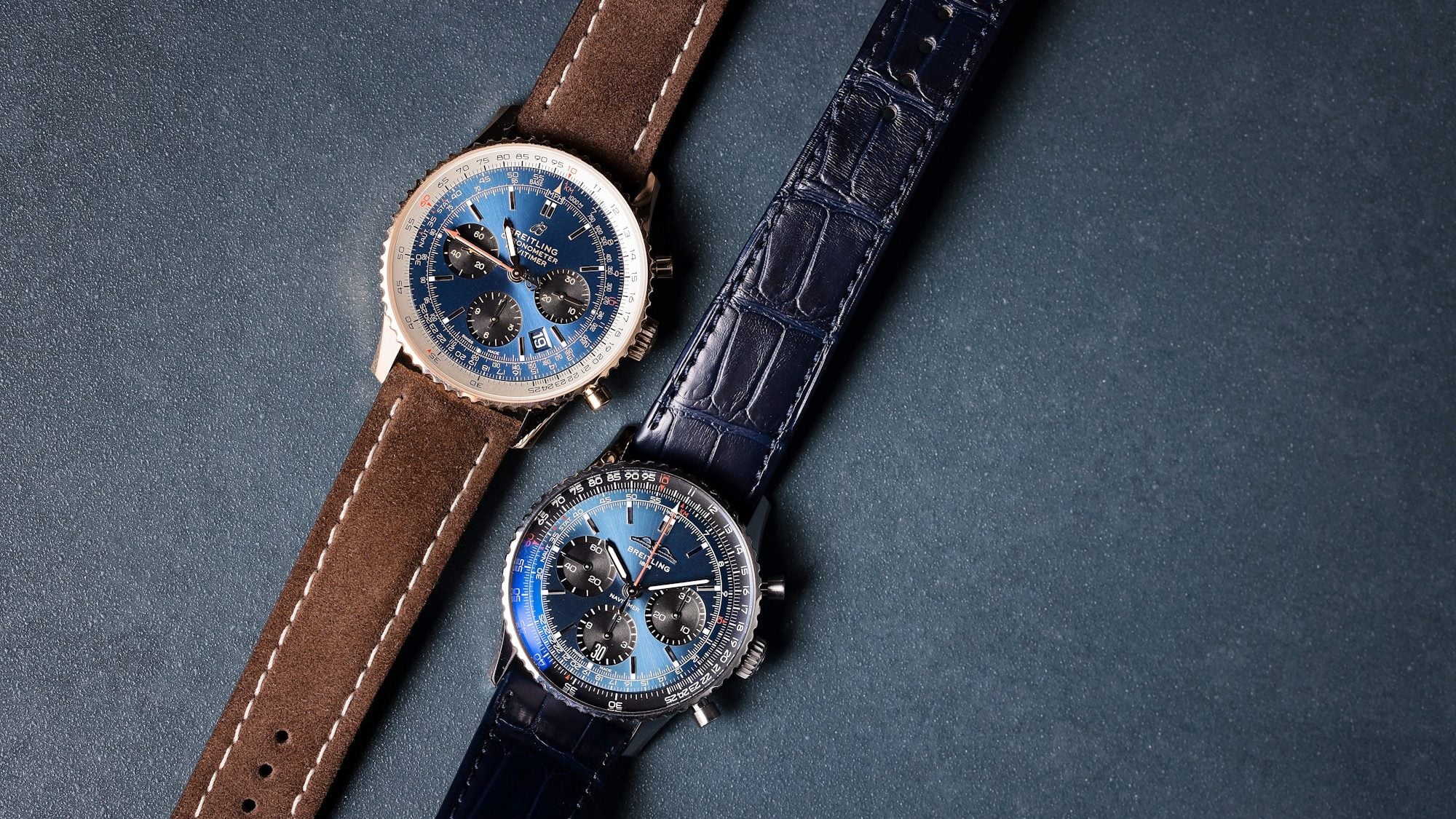
At first glance, the Navitimer dial looks a bit chaotic. Three subdials, a tachymeter scale, a rotating slide rule bezel with two logarithmic scales, minute markers, and hour markers all compete for real estate. But that apparent clutter is entirely purposeful. Each element serves a function, and once you understand the layout, the dial really starts to make sense. The chronograph subdials track elapsed seconds, minutes, and hours; the outer bezel handles the mathematical computations; and the inner scales tie it all together.
Beyond the standard black or white dial configurations, vintage Navitimers are home to quite a bit of collectible variety. Reverse panda dials, which feature dark subdials on a light background, are especially prized. Gold-filled and solid gold cases pop up in the vintage market as well, often commanding significant premiums. Even among modern references, Breitling has enough dial colors, strap combinations, and case materials to keep collectors busy for years.
How to Use the Slide Rule Bezel

The Navitimer’s slide rule is has two logarithmic scales: an inner fixed scale and an outer rotating scale. Together, they can handle multiplication, division, and a range of practical calculations. Here is a simple example using a speed, distance, and time problem.
Example: You are flying at 120 knots and want to know how far you will travel in 45 minutes.
- Find 12 (representing 120 knots) on the outer rotating bezel.
- Rotate the bezel until 12 lines up with the speed index triangle on the inner scale, sometimes marked as the “MPH” or base-10 marker.
- Locate 45 on the inner fixed scale.
- Read the corresponding value on the outer scale directly across from 45. The answer will be 90 nautical miles.
The same principle applies to currency conversions, unit conversions, and fuel burn calculations. You’re essentially multiplying or dividing two numbers using the relationship between the two scales. It takes a few minutes of practice, but once the logic clicks, you have a surprisingly powerful analog calculator on your wrist at all times. For a deeper dive, read our Breitling Navitimer bezel guide.
Case Sizes and Wearability: 41mm vs. 43mm vs. 46mm

Choosing the right Navitimer size is probably the biggest decision most buyers wrestle with. On paper, it sounds simple. The B01 Chronograph comes in 41mm, 43mm, and 46mm, and if you’re looking at the time-only Automatic models, there are smaller options like 32mm and 36mm. But the numbers don’t tell the whole story. The Navitimer dial is busy by design, and that detail can feel more balanced and legible as the case size goes up. At the same time, this isn’t a slim dress watch. The chronograph movement gives it some height, so it has real presence on the wrist. A 41mm Navitimer doesn’t wear like a 41mm Datejust. Trying one on, if you can, makes all the difference.
| Case Size | Recommended Wrist Size | Character |
| 32mm | 5.5– 6.0 inches | Elegant, understated. Automatic only (no chronograph). Ideal for smaller wrists or those who prefer a dressy look. |
| 36mm | 6.0–6.5 inches | Versatile everyday size. Available in the Automatic line. Balanced proportions without the heft of a chronograph. |
| 41mm | 6.5–7.0 inches | The modern sweet spot for most buyers. Wears comfortably on average wrists while keeping the dial fully readable. Available with the B01 movement. |
| 43mm | 7.0–7.5 inches | The classic Navitimer proportions. Slightly larger presence that gives the slide rule bezel more room to breathe. Also available with the B01. |
| 46mm | 7.5+ inches | A bold, commanding presence. Best reserved for larger wrists. The oversized dial is the easiest to read but can overpower a slim wrist. |
For most buyers with wrists in the 6.5 to 7-inch range, the 41mm and 43mm Navitimer B01 Chronograph models will be the best fit. However, the 41mm is the easiest entry point for most people. It feels current, balanced, and doesn’t overwhelm the wrist. Step up to 43mm and you start to get that more classic Navitimer stance. It has a little more dial, a little more presence, the kind of size longtime collectors tend to gravitate toward. The 46mm, though, is a different story. It’s bold, unapologetic, and definitely makes itself known. Some collectors love that about it. But it’s one of those sizes you really want to see on your own wrist before making the call.
Exploring the Breitling B01 Movement

For most of its life, the Navitimer relied on outsourced movements. Very early models had the hand-wound Valjoux 72, and then later the Venus 178. Those movements eventually gave way to the Caliber 11 automatic in 1969, and later models used the Valjoux 7750, a reliable engine but one shared across dozens of brands. That changed in 2009 when Breitling debuted the B01 caliber, its first fully in-house chronograph movement. It was a pretty big milestone for the brand that marked its commitment to manufacturing independence and positioned the Navitimer as a more serious contender among high-end chronographs.
The B01 is built around a column wheel and vertical clutch, two features typically associated with high-end modern chronographs. The column wheel orchestrates the start, stop, and reset functions with mechanical precision, while the vertical clutch engages the chronograph without the jarring “stutter” of a horizontal clutch. The practical result is that the chronograph hand starts smoothly, and you can leave the chronograph running continuously without added wear. Breitling enthusiasts often compare the B01 favorably to the Rolex Caliber 4130, noting that both movements share the same fundamental architecture at a very different price point.
| Specification | Details |
| Caliber | Breitling B01 |
| Type | Automatic chronograph, in-house |
| Power Reserve | Approximately 70 hours |
| Frequency | 28,800 vibrations per hour (4 Hz) |
| Jewels | 47 |
| Chronograph Type | Column wheel with vertical clutch |
| COSC Certified | Yes (Chronometer) |
The 70-hour power reserve is genuinely practical. You can take your watch off Friday night, let it sit all weekend, and when you strap it back on Monday morning, it’s still set. No resetting, no winding ritual unless you want one. Add in COSC chronometer certification, and it has the kind of accuracy and everyday reliability you’d expect at this level. It’s not just impressive on paper. It makes the watch easier to wear, which is really what matters.
Why the Breitling Navitimer Is the Smartest Chronograph
If you want to explore further, our full video review walks through the Navitimer piece by piece. We actually demonstrate how the slide rule bezel works, show the B01 in action, and talk through what we’re seeing in our own market data. It’s not just specs on a screen. It gives you a real sense of how the watch looks and feels. We also have an honest conversation about how it compares to heavyweights like the Rolex Daytona and OMEGA Speedmaster.
Breitling Navitimer Investment Value and Market Trends
One of the most common questions collectors ask is whether a Breitling Navitimer holds its value. Based on our internal sales data spanning from 2014 through 2025, the answer is a confident yes, particularly when buying pre-owned. Two trends to note: sales volume has climbed dramatically, and average transaction prices have remained remarkably stable.
On the volume side, secondary market demand for the Navitimer has grown steadily year over year, with a sharp acceleration in recent years. What was once a niche collector’s pick has become one of the most consistently traded luxury chronographs in the pre-owned market. That upward trajectory in buyer interest is a strong signal that the Navitimer is not a passing trend but a lasting staple among collectors.
On the pricing side, our data shows that average pre-owned Navitimer transaction prices have settled dependably in the mid-$5,000 range over the past several years. While buying at full retail does come with an initial depreciation hit (as with nearly all luxury watches outside of a handful of hyped models), purchasing on the secondary market means that dip has already been absorbed. From there, the pricing floor is solid. Because the Navitimer does not carry the speculation-driven “hype tax” that inflates watches like the Rolex Daytona, buyers get serious mechanical value for their money without the anxiety of bubble pricing.
The Ultimate Aviation Chronograph for the Modern Collector
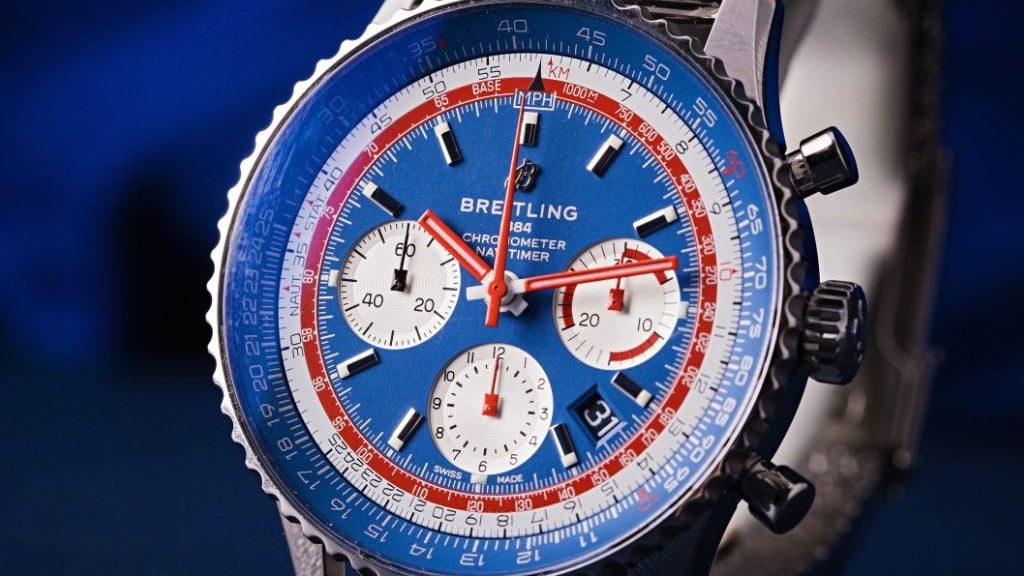
The Breitling Navitimer is not a watch you buy just for the name on the dial. It is a mechanical computer that defined an era of aviation, with a design rooted in real function rather than fashion. Its slide rule bezel, column-wheel chronograph, and COSC-certified B01 movement make it one of the most capable watches in its price range, and its seven-decade production history gives it the kind of heritage that can’t be manufactured overnight. For the collector who values mechanical ingenuity and authentic purpose over pure brand prestige, the Navitimer is a must-have.
Buying a luxury watch is never just about specs. It’s about what feels right when you put it on your wrist. Maybe you’ve been tracking down a vintage reverse panda Ref. 806 for years. Maybe the modern 43mm B01 Chronograph is more your speed. Either way, our team at Bob’s Watches is here to talk it through and help you decide on the version that actually fits your wrist and your collecting goals. Take a look at our inventory and see which one speaks to you.