
Rolex Bracelets Explained: Oyster, Jubilee, President, Pearlmaster and Oysterflex
Rolex makes five bracelets: the Oyster, the Jubilee, the President, the Pearlmaster, and the Oysterflex. Every Rolex you will ever handle wears one of those five, a factory leather strap, or something that did not come from Rolex. At Bob's Watches, we handle pre-owned Rolex watches every day, and one lesson comes up again and again: people underestimate the bracelet most. It is the first thing you feel, the first thing that wears, and the thing that quietly decides whether you reach for the watch every morning.
Key takeaways
- The five Rolex bracelets are the Oyster (three-piece links, sport models), the Jubilee (five-piece links, created for the Datejust in 1945), the President (semi-circular links, gold or platinum only, created for the Day-Date in 1956), the Pearlmaster (jewelry-style, five-piece links), and the Oysterflex (elastomer over metal blades, introduced in 2015).
- The Oyster is by far the most common. Based on our sales data from November 2025 through October 8, 2026, approximately 63% of the Rolex watches we sold had an Oyster bracelet, including vintage variations, while roughly 26% had a Jubilee.
- Rolex does not publish bracelet-only prices and, in our experience, authorized dealers generally do not sell a bracelet on its own. Rolex service is the route for a worn bracelet, and buying a pre-owned watch that already wears the bracelet you want is often the simpler path.
- Most genuine bracelets carry a reference number and an end-link code stamped into the metal. Matching those codes to your watch is the fastest compatibility check you can do yourself, but codes can be copied, so they are a first pass, not proof.
- A tired or non-original bracelet is one of the most common reasons a Rolex sells for less than it should, so the bracelet deserves the same attention as the dial and the case.
This guide covers what each Rolex bracelet is, how to tell a genuine one from an aftermarket copy, how the bracelet affects the watch's value, and what it takes to get a replacement.
The 5 Rolex Bracelets at a Glance
| Bracelet | Introduced | Links and where you find it |
| Oyster | Late 1930s | Flat three-piece links; Submariner, GMT-Master II, Explorer, Daytona, Datejust, Oyster Perpetual |
| Jubilee | 1945 | Five-piece links, polished center; Datejust, steel GMT-Master II since 2018 |
| President | 1956 | Semi-circular three-piece links, gold or platinum only; Day-Date and select Lady-Datejust |
| Pearlmaster | 1992 | Rounded five-piece links, gold, often gem-set; Pearlmaster |
| Oysterflex | 2015 | Elastomer over metal blades; gold Yacht-Master, Daytona, Sky-Dweller |
The Oyster Bracelet
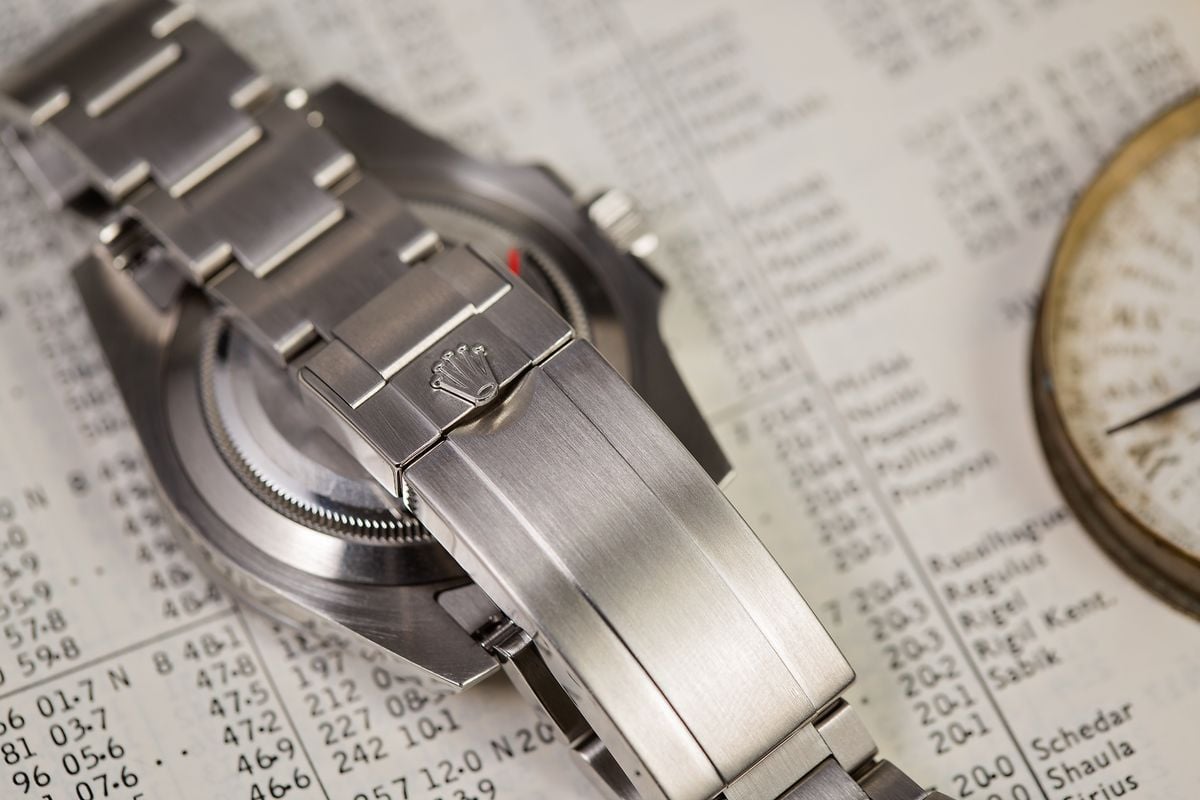
The Oyster is the bracelet most people picture when they think of a Rolex: flat, three-piece links, a wide center link, and a brushed top. Rolex traces its development to the late 1930s, and it has been the standard bracelet on the Submariner, GMT-Master, Explorer, Daytona, and most of the sport line ever since. I recommend it to anyone who wants one watch to wear every day without thinking about it.
The Oyster has changed more than any other Rolex bracelet, and our experts use those changes to date one on sight. Early riveted versions with hollow links gave way to folded links, then solid links, and finally the current solid-link bracelets. The clasp depends on the model: the Submariner and other sport models use the Oysterlock safety clasp, the Datejust and Oyster Perpetual use the simpler Oysterclasp, most references add the Easylink 5 mm extension, and the Submariner and Sea-Dweller use the tool-free Glidelock instead (paired with the Fliplock extension on the Sea-Dweller and Deepsea). A riveted Oyster on a 1960s Submariner and a solid-link Oyster on a current one share a name and a silhouette and almost nothing else.
Oyster Bracelet Link Types And Introduction Years
|
Oyster bracelet code |
Link type and end-link width |
Approximate introduction |
|
6635 / 6636 |
Riveted and expandable, 19 mm / 20 mm |
1954 |
|
7205 / 7206 |
Riveted, 19 mm / 20 mm |
1954 |
|
7835 / 7836 |
Folded, 19 mm / 20 mm |
1967 |
|
9315 |
Folded with diver clasp, 20 mm |
1969 |
|
9316 |
Folded with diver clasp, 20 mm (Sea-Dweller) |
1969 |
|
78350 / 78360 |
Solid, 19 mm / 20 mm |
1975 |
|
93150 |
Solid with diver clasp, 20 mm |
1975 |
|
93160 |
Solid with diver clasp, 20 mm |
1978 |
Introduction years are collector-community estimates compiled from clasp date codes and catalog appearances; Rolex publishes no bracelet-code list.
Oyster Bracelet Codes, End-Link Width, And Watch Model
|
Oyster bracelet code |
End-link width |
Rolex watch model |
|
70130 |
13 mm |
Oyster Perpetual 26 |
|
70160 |
16 mm |
Oyster Perpetual 31 |
|
70190 |
19 mm |
Oyster Perpetual 34 |
|
70200 |
20 mm |
Oyster Perpetual 36 |
|
70400 |
20 mm |
Oyster Perpetual 39 |
|
72130, 72131, 72133, 74138, 74139 |
13 mm |
Lady-Datejust 26 |
|
72340, 72341, 72343 |
14 mm |
Lady-Datejust 28 |
|
72160, 72161, 72163 |
16 mm |
Datejust 31 |
|
73168 |
16 mm |
Datejust 31 |
|
72190 |
19 mm |
Oyster Perpetual Date 34 |
|
72600, 72601, 72603 |
20 mm |
Datejust 36 |
|
72801, 72803, 72800 |
20 mm |
Datejust 36 |
|
78360 |
20 mm |
Datejust 36, GMT-Master II, Explorer II (five-digit references) |
|
72210, 72213 |
21 mm |
Datejust II |
|
72610, 72611 |
21 mm |
Datejust 41 |
|
73205, 73208, 73209 |
20 mm |
Day-Date 36 |
|
73605 |
20 mm |
Day-Date 36 |
|
72415, 72418, 72419, 72223, 72220 |
21 mm |
Sky-Dweller |
|
72400 |
20 mm |
Milgauss |
|
77200 |
20 mm |
Explorer 39 (discontinued) |
|
77210 |
21 mm |
Explorer II |
|
71200 |
20 mm |
Air-King 40 |
|
78200, 78203, 78208, 78209, 79201, 79205 |
20 mm |
GMT-Master II |
|
78210, 78211, 78218, 78219 |
21 mm |
Yacht-Master II |
|
78590, 78593, 78595, 78596, 78598, 78599 |
20 mm |
Cosmograph Daytona |
|
78740, 78743, 78750, 78753 |
17 mm |
Yacht-Master 35 (discontinued) |
|
78763, 78800 |
20 mm |
Yacht-Master 40 |
|
97200 |
20 mm |
Submariner |
|
97200, 97203, 97208, 97209 |
20 mm |
Submariner Date |
|
93150, 93250 |
20 mm |
Submariner Date (five-digit references) |
|
97400 |
20 mm |
Sea-Dweller 40 |
|
97220, 97223 |
22 mm |
Sea-Dweller 43 |
|
98210 |
21 mm |
Deepsea |
|
98220 |
22 mm |
Deepsea |
The Oyster is also the bracelet we handle most. As noted above, approximately 63 percent of the Rolex watches we sold in the past year were on an Oyster, which reflects how much of the Rolex catalog wears one. If you are comparing two watches and one is on a replacement Oyster, start with the reference number stamped on the clasp and the code on the end links, because an Oyster that fits a 40 mm Submariner will not fit a 36 mm Datejust. A wrong-generation bracelet on a vintage watch is a value question, not just a fit question.
The Jubilee Bracelet
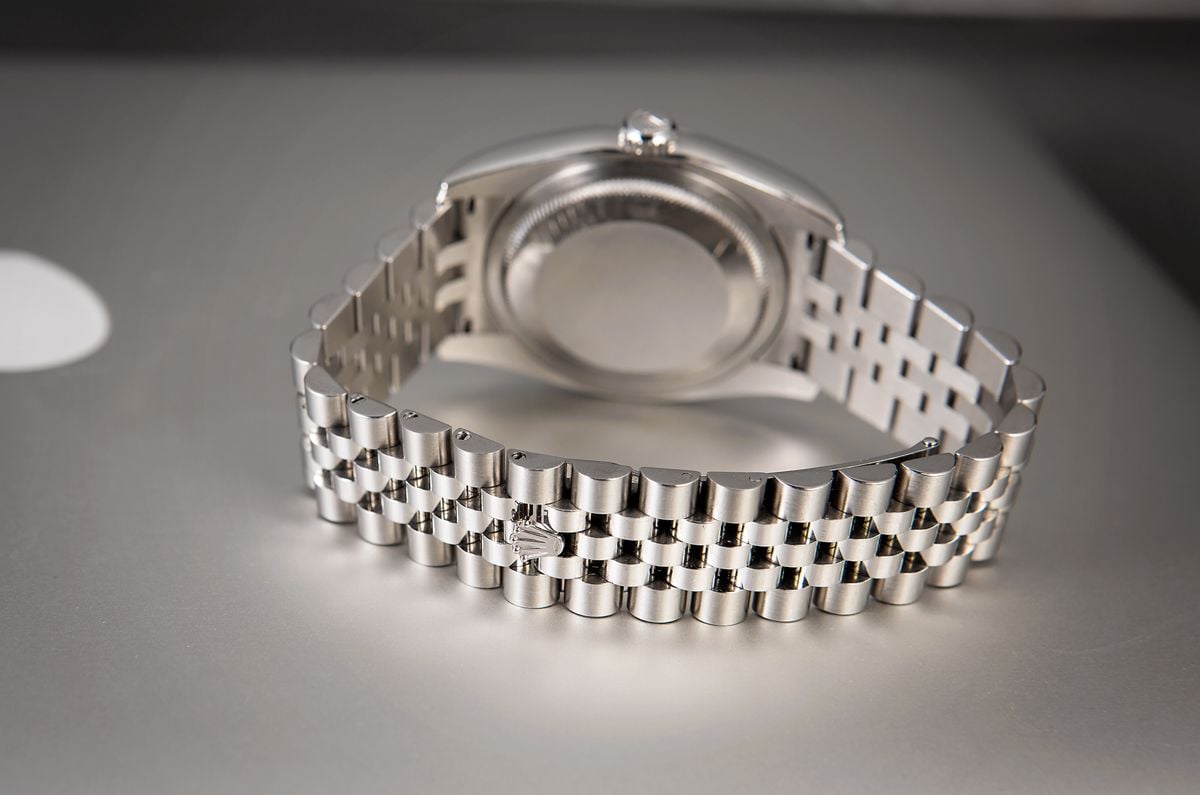
The Jubilee is the dress bracelet of the lineup and, in my opinion, the most comfortable bracelet Rolex makes. Rolex launched it in 1945 to mark 40 years of the company and created it specifically for the Rolex Datejust, which debuted the same year. The five-piece link design, two wide satin-finished outer links flanking three narrow polished center links, drapes over the wrist in a way the flatter Oyster cannot. On a Datejust it is the choice most buyers make, and I understand why.
The Jubilee was created for the Datejust, but it has a long history on the GMT-Master too. Steel GMT-Master references such as the 1675 were sold on a Jubilee from the 1960s onward, and the five-digit GMT-Master II was also available on one. The modern six-digit steel GMT-Master II launched only on an Oyster, so when Rolex put the steel "Pepsi," reference 126710BLRO, on a Jubilee with the Oysterlock clasp and Easylink extension in 2018, it was a return rather than a first. It made the Jubilee fashionable again on a watch most buyers had been choosing on an Oyster. Rolex has since offered the steel GMT-Master II on either bracelet, so the choice is yours.
That choice shows up in the pre-owned prices above: on the stainless steel GMT-Master II 126720VTNR, the Jubilee version sold for more than the Oyster version. My take: if you wear your GMT-Master II watches daily rather than on occasion as a travel tool, the Jubilee is the better everyday bracelet. It is more flexible, conforms to the wrist, and the polished center links dress the watch up without a strap change.
Jubilee Link Designs And Estimated Manufacturing Years
|
Jubilee link design |
Estimated manufacturing years |
|
Swiss-made folded link |
1950s to 1970s |
|
Made in USA or Mexico oval link |
1950s to 1970s |
|
Swiss-made D link |
1970s to 2000s |
|
Swiss-made solid link |
2000s to present |
Jubilee bracelet codes, end-link width, and watch model
|
Jubilee bracelet code |
End-link width |
Rolex watch model |
|
63130, 63131, 63133 |
13 mm |
Lady-Datejust 26 |
|
63345, 63348, 63341 |
14 mm |
Lady-Datejust 28 |
|
63160, 63161, 63163, 64169 |
16 mm |
Datejust 31 |
|
63600, 63601, 63603, 63608, 62803, 62800 |
20 mm |
Datejust 36 |
|
62613 |
21 mm |
Datejust 41 |
|
62510H, 62523 |
20 mm |
Datejust 36 (five-digit references) |
|
69200 |
20 mm |
GMT-Master II |
If you want a Datejust or GMT-Master II on a Jubilee, the simplest route is to buy one that already wears it. See our pre-owned Datejust collection and GMT-Master II inventory, where the bracelet is listed with every watch.
The President Bracelet
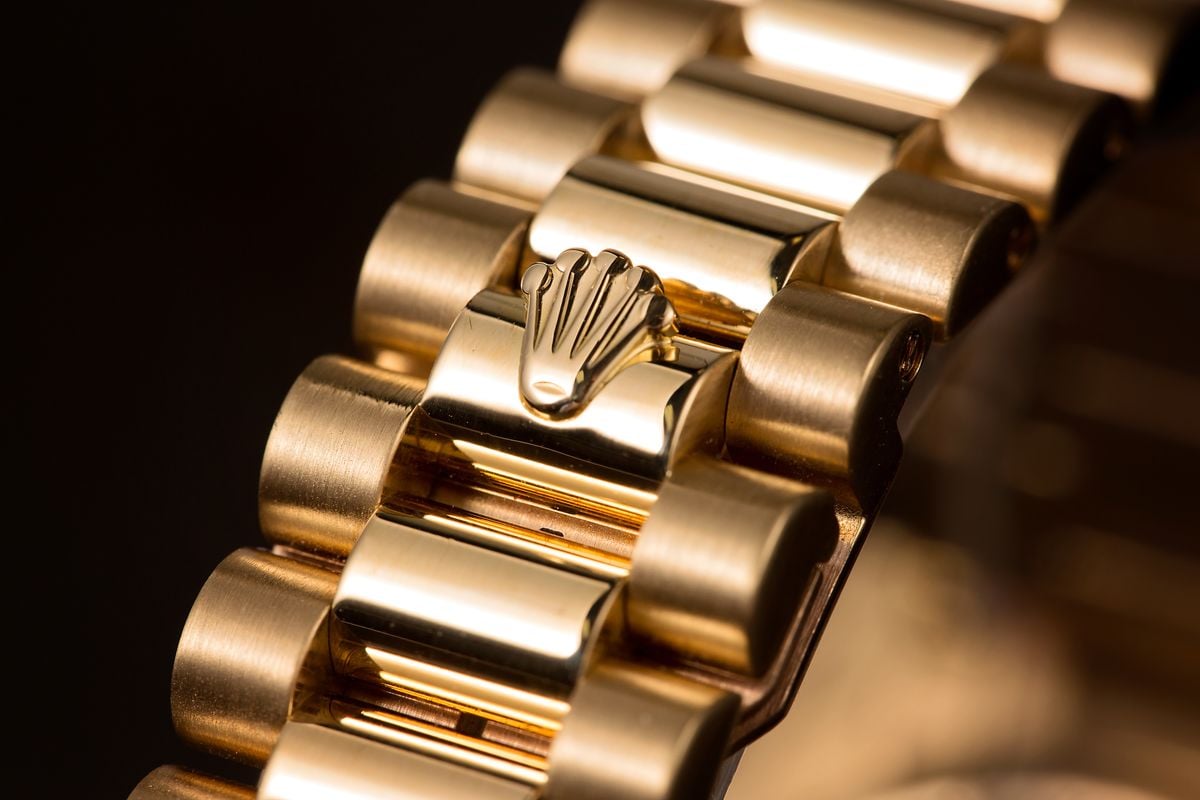
Rolex unveiled the President bracelet in 1956 on the Day-Date, and it has never been made in steel. Rolex produces it only in 18 kt gold and 950 platinum, with semi-circular three-piece links that combine polished and satin finishes, and it closes with a concealed Crownclasp that leaves nothing but the coronet visible on the wrist. Rolex named the bracelet the President from the start; the Day-Date took the same nickname from the bracelet and from the heads of state who wore it. The Day-Date is still its home, though Rolex also fits the Rolex President to select gold and platinum Lady-Datejust models.
Because it is solid precious metal, the President is the bracelet where condition matters most to value. Gold is soft, and a President worn hard for thirty years shows it: stretched links, rounded edges, and a clasp that no longer sits flush. When our team evaluates a Day-Date, the bracelet can move the offer as much as the dial does. A tight, correct President on an older Day-Date is a real find, and our offer reflects it.
President Bracelet Codes, End-Link Width, And Watch Model
|
President bracelet code |
End-link width |
Rolex watch model |
|
83135, 83136, 83138, 83139 |
13 mm |
Lady-Datejust 26 |
|
83345, 83346, 83348 |
14 mm |
Lady-Datejust 28 |
|
83165, 83168, 83169, 83369, 83368, 83365, 84166, 84168 |
16 mm |
Datejust 31 |
|
83205, 83206, 83208, 83209, 83408, 83405, 83409, 84206, 84208, 84209 |
20 mm |
Day-Date 36 |
|
83415, 83416, 83418, 83419 |
21 mm |
Day-Date 40 |
|
83215, 83216, 83218, 83219 |
21 mm |
Day-Date II |
See our Rolex Day-Date guide for which President references match each case size and generation.
The Pearlmaster And The Oysterquartz Integrated Bracelet
Rolex launched the Pearlmaster bracelet in 1992 for the Lady-Datejust Pearlmaster watches. It uses five-piece links like the Jubilee, but the links are rounded and fully polished; it is made in 18 kt yellow, white, or Everose gold and, on a few references, in platinum , and it closes with a concealed folding Crownclasp. Diamond-set versions run from a few set links to full pavé. In the 2000s, some 39 mm Day-Date "Masterpiece" editions wore Pearlmaster-style bracelets, which Rolex's catalog labeled "Oyster Special Edition." It is the rarest of the five bracelets to see on the pre-owned market, and the one least likely to be swapped onto another watch, because it was built for the Rolex Pearlmaster case alone.
Pearlmaster Bracelet Codes, End-Link Qidth, And Watch Model

|
Pearlmaster bracelet code |
End-link width |
Rolex watch model |
|
72845, 72848, 72849 |
17 mm |
Pearlmaster 34 |
|
44745, 42745, 42749 |
20 mm |
Pearlmaster 39 |
|
72746, 72748, 74746 |
20 mm |
Day-Date "Special Edition" Masterpiece |
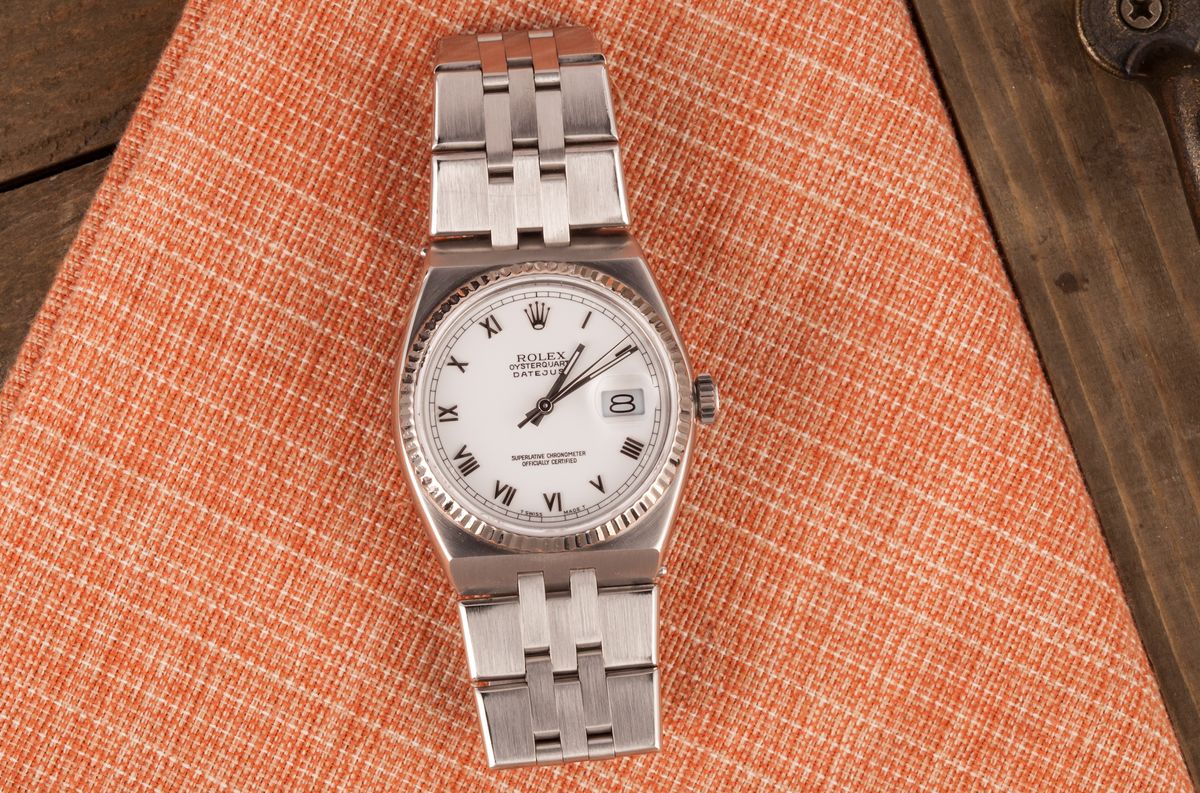
In 1977, Rolex introduced a range of Oysterquartz watches powered by in-house quartz calibers. The Oysterquartz, produced into the early 2000s and now discontinued, is the one Rolex with an integrated bracelet, meaning the bracelet flows directly into the angular case with no separate end links. It cannot be fitted to any other Rolex, and the watch cannot wear any other bracelet. If you own one, treat the bracelet as part of the case: a damaged Oysterquartz bracelet is a much harder problem to solve than a damaged Oyster.
Oysterquartz References And Their Integrated Bracelets (Discontinued)
|
Oysterquartz reference |
Style |
Rolex watch model |
|
17010, 17000B |
Steel Oyster |
Oysterquartz Datejust |
|
17013, 17013B |
Two-tone Jubilee |
Oysterquartz Datejust |
|
19018, 19028 |
Yellow gold President |
Oysterquartz Day-Date |
|
19019 |
White gold President |
Oysterquartz Day-Date |
The Oysterflex Bracelet And Rolex Leather Straps
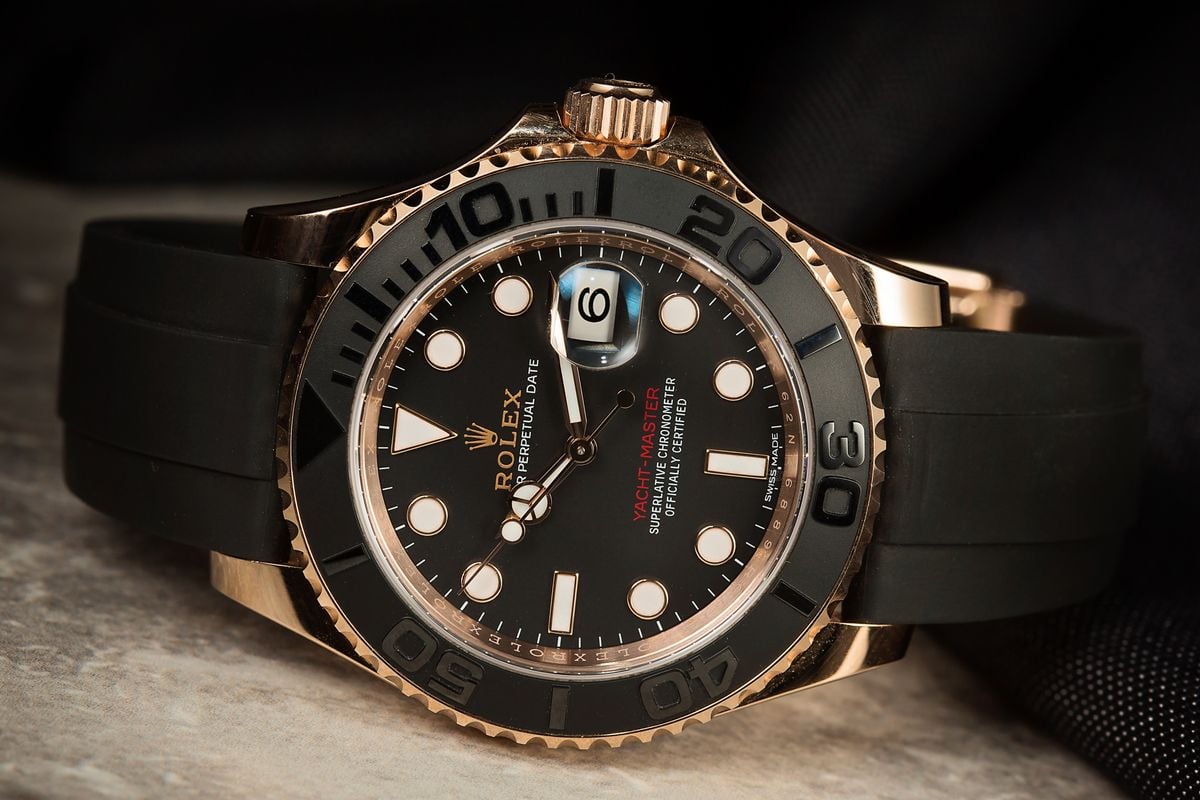
Rolex introduced the Oysterflex in 2015 on the Everose gold Yacht-Master 40 and 37, and it is the only Rolex "strap" that Rolex itself calls a bracelet. The reason is what is inside: two flexible metal blades overmoulded in black elastomer, with cushions on the underside that hold the watch in place. It has the flexibility of a rubber strap with the support of metal blades inside, and Rolex has reserved it for gold cases, including the Yacht-Master, Daytona, and Sky-Dweller, as of 2026. The brand has never offered Rolex Oysterflex watches on a steel model, so a steel Rolex on a black rubber strap is likely using an aftermarket strap, not an Oysterflex.
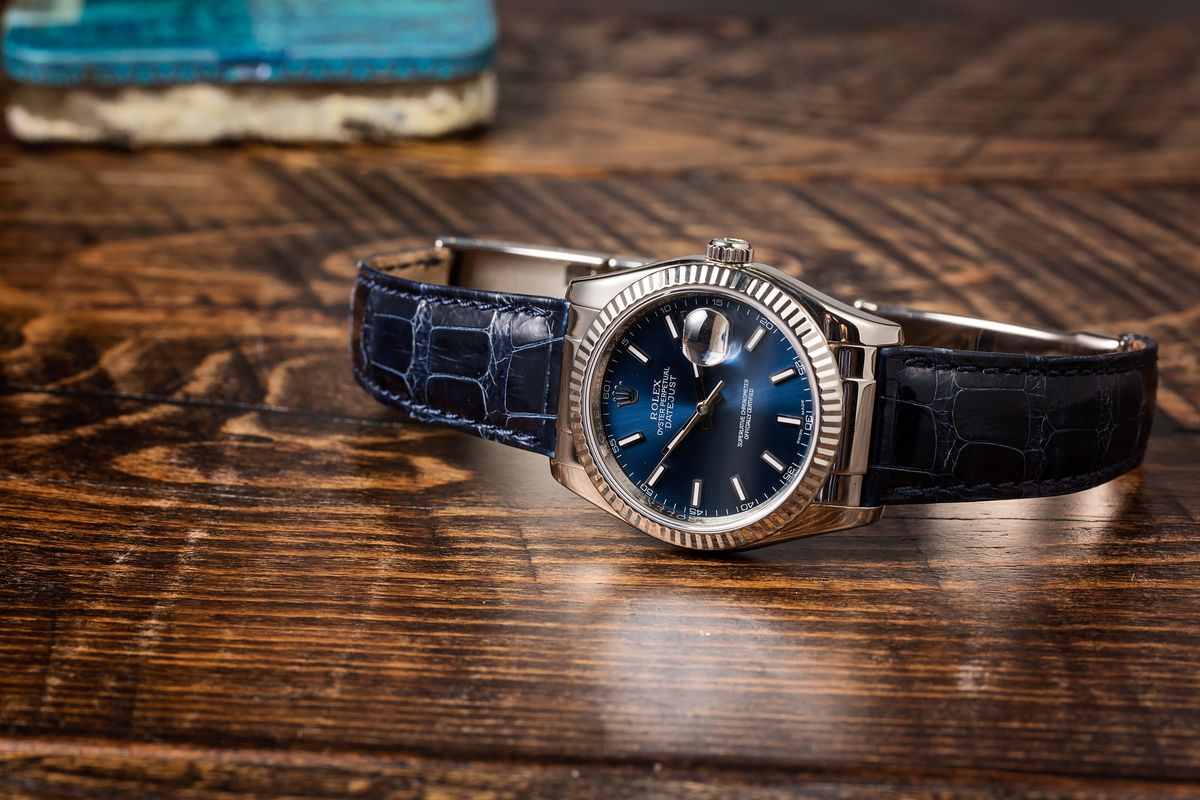
Rolex leather straps are a different story. Rolex supplied leather straps, usually with a gold or steel folding clasp, on dress models such as the Cellini and on some Datejust and Day-Date references, and it still does: the current Perpetual 1908 comes on an alligator leather strap with a double folding Dualclasp. Rolex has offered leather straps on certain gold references over the years, and most of the factory leather straps we see come in on 36 mm cases. A genuine Rolex leather strap is stamped with the Rolex name and a reference on the underside and is sized to a specific lug width, most commonly 20 mm on a 36 mm case.
How A Bracelet Affects The Value Of A Rolex
We sell complete watches, not bracelets, so the question we can answer with real numbers is: how much does the bracelet change a Rolex's value? Material is the biggest driver. A steel Oyster or Jubilee adds the least, two-tone sits in the middle, and a solid gold or platinum bracelet can make up a large share of the watch's value.
Four things decide how much a bracelet adds to or takes from a watch's price, and our buying team weighs them in this order:
- Originality. A watch on the bracelet it left the factory with, including the correct end links and the right clasp for its reference, generally sells for more than the same watch on a replacement, even a genuine one, because originality is the first thing an experienced buyer checks.
- Stretch and wear. Older hollow-link Oyster and Jubilee bracelets stretch over decades of wear. A tight example commands a premium; a stretched one needs a specialist to tighten and sometimes cannot be saved, and the price reflects that.
- Material. On a two-tone or solid gold watch, the bracelet is a large part of the metal weight, so its condition moves the number more than it does on a steel watch.
- Parts integrity. We want to see a bracelet with the original clasp blade, intact spring bars, and no replaced links when a watch comes in.
"People spend months choosing the dial and about five seconds thinking about the bracelet. Then they wonder why two of the same watch are priced two thousand dollars apart. The bracelet is usually the answer. When a Rolex comes across our desk, its condition is the first thing we check, and it is the first thing that changes our number."
Carol Altieri, COO, Bob's Watches
Genuine vs. Aftermarket: How To Verify A Real Rolex Bracelet
Search for a Rolex bracelet today, and the shopping results fill with "Rolex-style" and "fits Rolex" bands for a fraction of what a genuine one costs. Some are honest aftermarket straps. Some are copies built to pass as the real thing, and some of those end up on watches offered for sale. Our experts have handled a great many of both, and these are some of the checks they run.
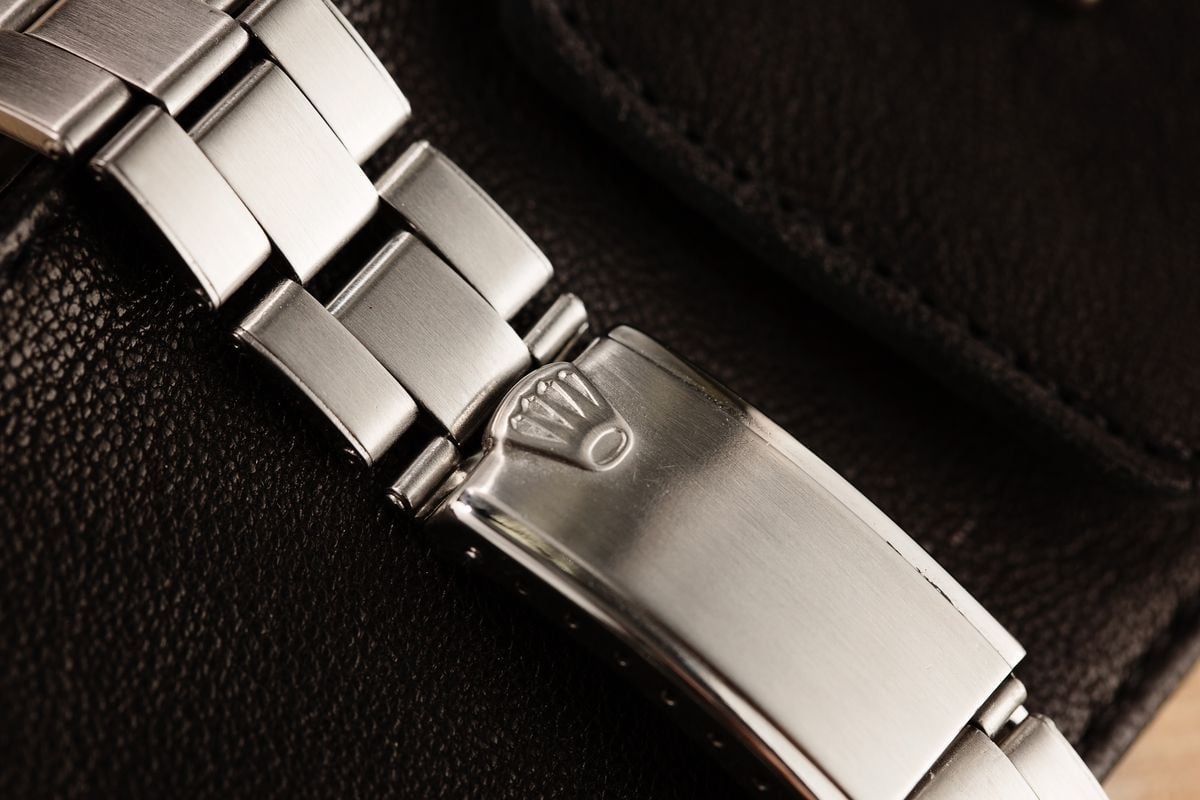
- Find the bracelet reference number. On most Rolex bracelets, it is stamped on the inside of the clasp, on the blade or the clasp cover, though the exact markings vary by generation. Common examples are 78360 and 93250 for Oyster bracelets and 62510H for a Jubilee. Look the number up in the reference tables on this page and confirm it belongs to your model and case size. Keep in mind that a correct number only tells you the bracelet is the right type for the watch; counterfeiters copy real reference numbers, so the number alone proves nothing.
- Check the end links. The small curved pieces that join the bracelet to the case carry their own stamped code, such as 580 or 501B. The end-link code has to match the bracelet reference and the case. A mismatch means the bracelet was assembled from parts, and that affects both fit and value.
- Read the clasp code. Rolex stamped a production date code inside the clasp for decades. Depending on the period, the code points to the approximate year and month or quarter the clasp was made; more recent clasp codes don't follow the same system and cannot be dated using the old charts. On a vintage watch, the code should be reasonably consistent with the watch's age, and a mismatch usually means a genuine replacement bracelet, which is fine if it is disclosed. Our Rolex clasp guide walks through the codes.
- Feel the weight and the finishing. Solid-link Rolex bracelets have a density most copies don't match. Brushing runs in one direction and stops cleanly at polished edges. Links pivot without side play. Hollow-link copies rattle and feel light.
- Test the clasp. An Oysterlock or Crownclasp closes with a precise, damped click and no sharp edges. The engraving on the clasp cover is crisp and even. Cheap copies have shallow, uneven engraving and a clasp that snaps rather than clicks.
None of these checks alone proves a bracelet is genuine, but a bracelet that fails any of them is one we may walk away from. When in doubt, buy from a seller who guarantees authenticity.
Frequently Asked Questions
Final Thoughts
I have watched the bracelet go from an afterthought to one of the first things a serious buyer asks about, and that is the right direction. The bracelet is the part of a Rolex you touch every day. Buy the right one, keep the original, and have it looked at when it starts to loosen.
If you are looking to add a watch to your collection, browse our pre-owned Rolex watches, where the bracelet type is listed with every watch. If you are thinking about selling a Rolex, tell us about your watch, and we will give you a straight number, bracelet included.
