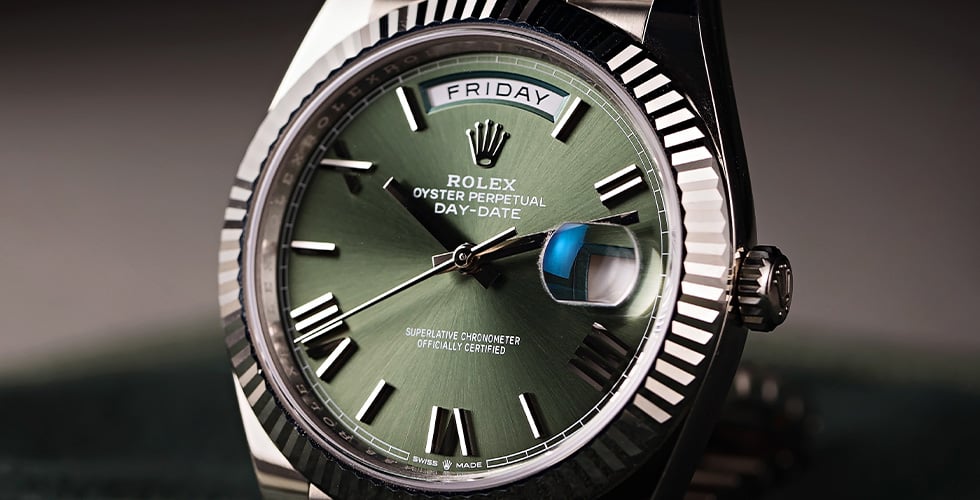
The Breitling Navitimer watch is a Swiss pilot’s chronograph introduced in 1952, defined by its circular slide rule bezel and powered by the in-house Caliber B01. In this Breitling Navitimer review i’ll cover current retail versus pre-owned sold prices, sizes, movements, and inspection points to help you better understand which reference is best for you.
Key Takeaways
- The Breitling Navitimer is a pilot’s chronograph introduced in 1952 and defined by its bidirectional circular slide rule bezel.
- Current Navitimer B01 Chronograph models come in 41mm, 43mm, and 46mm cases, all powered by the in-house Caliber B01 with a 70-hour power reserve and COSC certification.
- Current retail for a stainless steel Navitimer B01 Chronograph 43 on a bracelet is $10,700, while Bob’s Watches pre-owned sales of the same reference averaged about $6,450 between August 2024 and August 2026.
- Older Valjoux-based Navitimers are the cheapest to own and service, while in-house B01 models demand a strict check of box, papers, and service records, according to Bob’s Watches Co-Owner and COO Carol Altieri.
- Water resistance of 30 meters and a crown that does not screw down make the Navitimer a desk, cockpit, and travel watch rather than a swim watch.
I have handled Navitimers from the hand-wound 1960s ref. 806 through the current 41mm B01, and I have studied two years of our own sales data on them. What follows is the review I would give a friend: what the watch is, how it wears, which movement to buy, and what it actually costs on both markets.
What Is the Breitling Navitimer?

The Breitling Navitimer is a Swiss pilot’s chronograph wristwatch introduced in 1952 and identified by a rotating circular slide rule bezel that lets the wearer multiply, divide, and compute fuel burn, airspeed, and distance. Current models are offered in 41mm, 43mm, and 46mm chronograph cases powered by Breitling’s in-house movement, the Caliber B01, alongside smaller three-hand Navitimer Automatic and GMT versions. A stainless steel Navitimer B01 Chronograph 43 carries a current retail price of $10,700, and Bob’s Watches pre-owned sales of the same reference have averaged about $6,450 over the past two years.
The Navitimer family is broader than the chronograph most people picture. The Navitimer B01 Chronograph 41, 43, and 46 are the only current Navitimers with the in-house chronograph movement. The Navitimer Automatic 41 is a three-hand, date only watch on Breitling Caliber 17, an ETA-based automatic, and the Automatic GMT 41 adds a 24-hour hand on Caliber 32. The Automatic 36 and 35 bring the design to smaller wrists. Before the 2022 relaunch, the same idea lived on as the Navitimer 01 (refs. AB0121 in 43mm and AB0127 in 46mm), the Navitimer 8 B01 (ref. AB0117), and a long run of Valjoux-based Navitimers such as the Navitimer 41 (ref. A13324) and the Navitimer World GMT 46 (ref. A24322).
In my opinion the B01 Chronograph is the real Navitimer, because the slide rule was designed to convert an interval the chronograph has just timed. The Automatic models are handsome and far more affordable, but they wear the costume without carrying the tool.
Reading the Dial and Using the Slide Rule Bezel
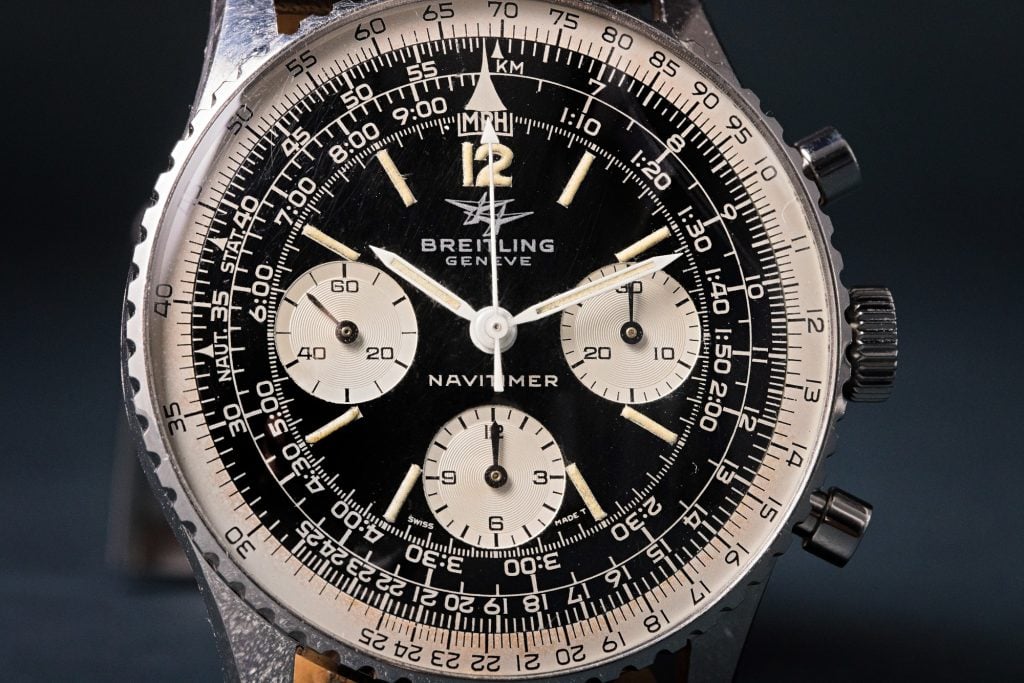
The Navitimer slide rule bezel is a circular logarithmic calculator made of two scales: an outer scale that rotates with the bezel and an inner scale fixed to the dial. Because both scales are logarithmic, lining up two numbers performs a multiplication or division, and every other flight calculation is a variation on that move. On the current generation the bezel is bidirectional and ratcheted, so it stays where you set it; on older beaded bezels it can drift against a shirt cuff.
The dial is a tri-compax layout: a 30-minute counter at 3 o’clock, a 12-hour counter at 6 o’clock, running seconds at 9 o’clock, and on the B01 43 a date window at 6 o’clock. The 2022 redesign flattened the slide rule, domed the sapphire crystal so the case reads slimmer than its 13.69mm, and returned the AOPA wings to 12 o’clock. The dial looks chaotic in photographs and legible on the wrist. Here is the worked example I give every first-time owner.
Example: You are flying at 120 knots and want to know how far you will travel in 45 minutes.
- Find 12 (representing 120 knots) on the outer rotating scale.
- Rotate the bezel until 12 lines up with the speed index triangle on the inner scale.
- Locate 45 on the inner fixed scale.
- Read the value on the outer scale directly across from 45. The answer is 90 nautical miles.
The same alignment handles fuel burn, currency conversion, and kilometers to miles, and it takes an evening to learn. For the complete set of operations, including the unit conversion markers, read our full walkthrough of the Navitimer slide rule bezel.
Case Sizes and Wearability: 41mm vs. 43mm vs. 46mm

The Breitling Navitimer B01 Chronograph 43 is the size most buyers should try first, because it is the historical proportion of the watch and the size Breitling treats as the core of the range. A Navitimer does not wear like its case diameter, though. The wide bezel and busy dial make it read larger than a plain three-hand watch of the same size, while the domed crystal and downturned lugs make it sit lower than the 13.69mm thickness suggests. The 43 uses a 22mm lug width.
Our sales data adds something the spec sheet cannot. Between August 2024 and August 2026, current generation 43mm and 46mm B01 Chronographs sold in under a month of listing. The 41mm B01 took a median of roughly three months to find a buyer, and the Automatic 35 took about the same. I read that two ways: the 46 has a loyal following that surprised me, and the 41, which I consider the best-proportioned modern Navitimer for an average wrist, is underappreciated on the secondary market and the one I would take a second look at.
| Case size | Wrist range | My take |
| 35mm and 36mm Automatic | 5.5 to 6.5 inches | Time-and-date only. Dressy and slim. Slowest sellers in our data, so expect choice and room to negotiate. |
| 41mm (B01, Automatic, GMT) | 6.5 to 7 inches | The most versatile size and the one I would buy for daily wear. Under-loved on the pre-owned market for now. |
| 43mm B01 Chronograph | 7 to 7.5 inches | The classic Navitimer proportion. Breitling’s core reference. Sells fast at Bob’s, median about two weeks. |
| 46mm B01 Chronograph | 7.5 inches and up | Bold and unapologetic. Easiest dial to read. Moves quicker than its size would predict. |
Inside the Navitimer: Caliber B01 vs. the Valjoux-Based Chronographs

The Breitling Caliber B01 is an in-house, self-winding chronograph movement introduced in 2009 with a column wheel, a vertical clutch, an approximately 70-hour power reserve, a 28,800 vibrations per hour frequency, 47 jewels, and COSC chronometer certification. It is visible through the sapphire caseback of every current Navitimer B01 Chronograph. Breitling Caliber 13 is the movement it replaced in the Navitimer line: a COSC-certified version of the Valjoux/ETA 7750, a cam and lever chronograph with an oscillating pinion, an approximately 42-hour power reserve, and 25 jewels. The Navitimer World uses the related Caliber 24, built on the 7754 with a second time zone hand.
The two movements feel different. The B01’s column wheel gives the start pusher a light, even travel, and the vertical clutch starts the central seconds hand dead on its mark with no jump. The 7750-based Caliber 13 has a stiffer, clickier pusher, and the seconds hand can flick a fraction when engaged because the oscillating pinion meshes gears rather than pressing friction plates together. Neither is a flaw. The B01 is the more refined instrument; the Caliber 13 is the movement every competent watchmaker has serviced a thousand times.
That last point is where Carol Altieri, Co-Owner and COO of Bob’s Watches, changed how I advise buyers. According to Carol, the Valjoux-based Navitimers are a reliable and more affordable option into the model. In her words:
“My biggest piece of advice for secondary buyers is to buy the seller and focus on the movement and service history. The older models using modified Valjoux ETA movements are incredibly reliable and a good option.”
Carol Altieri, COO of Bob’s Watches
| Attribute | Caliber B01 (in-house) | Caliber 13 (Valjoux 7750 base) |
| Chronograph control | Column wheel with vertical clutch | Cam and lever with oscillating pinion |
| Power reserve | Approximately 70 hours | Approximately 42 hours |
| Frequency | 28,800 vph (4 Hz) | 28,800 vph (4 Hz) |
| Jewels | 47 | 25 |
| Certification | COSC chronometer | COSC chronometer |
| Found in | B01 Chronograph 41/43/46, Navitimer 01, Navitimer 8 B01 | Navitimer 41 (ref. A13324), Old Navitimer II, Navitimer 92 |
Breitling Navitimer History: From AOPA Flight Computer to Orbit

Willy Breitling developed the Navitimer in 1952 as a wrist worn chronograph with a circular slide rule for flight calculations, and in 1954 the Aircraft Owners and Pilots Association named it its official timepiece. The name is a contraction of “navigation timer.” Breitling itself dates to 1884, when Léon Breitling opened his workshop in Saint-Imier, and the company had already put a slide rule bezel on the Chronomat in the early 1940s. The Navitimer rescaled that idea for the E6B flight computer calculations a pilot needed, which is why the AOPA wings sat on early dials in place of the Breitling name.
The watch’s reputation was made in 1962, when astronaut Scott Carpenter wore a version with a 24-hour dial, the Navitimer Cosmonaute, aboard Aurora 7 on the Mercury-Atlas 7 mission. In orbit, where day and night cycle every 90 minutes, a 12-hour dial is ambiguous, so Breitling built the 24-hour display for the flight. In 1969 Breitling was part of the consortium that launched the Caliber 11, one of the first automatic chronograph movements, and the Navitimer Chrono-Matic that carried its crown on the left side of the case. The quartz crisis followed. Willy Breitling sold the company in 1979, the Navitimer’s design and tooling passed to the German brand Sinn, which produced the closely related Sinn 903, and the Navitimer returned to a revived Breitling in the 1980s under Ernest Schneider. The 2009 debut of Caliber B01 and the 2022 seventieth anniversary redesign are the two modern milestones that matter to a buyer today.
| Year | Milestone | Why it matters to a buyer |
| 1884 | Léon Breitling founds the company in Saint-Imier, Switzerland | Breitling is a chronograph specialist by origin, not a fashion brand that added one |
| 1952 | Willy Breitling develops the Navitimer | The design has been in continuous demand for more than 70 years |
| 1954 | AOPA adopts the Navitimer as its official timepiece | Early AOPA-winged dials carry a collector premium |
| 1962 | Scott Carpenter wears the Cosmonaute on Aurora 7 | The Cosmonaute remains the most collectible vintage variant |
| 1969 | Caliber 11 automatic chronograph debuts | Left-crown Chrono-Matic models are a distinct vintage category |
| 1979 | Willy Breitling sells the company; Sinn later produces the 903 | Explains the production gap and the Sinn lookalikes on the market |
| 2009 | Caliber B01 launches | Divides the pre-owned market into in-house and Valjoux-based generations |
| 2022 | Navitimer B01 Chronograph 41/43/46 redesign | Flattened bezel, domed crystal, wings back at 12; the current generation in our data |
Vintage Ref. 806 and the Cosmonaute Ref. 809
The Breitling Navitimer ref. 806 is the vintage reference collectors mean when they say “the original,” produced from the 1950s into the early 1970s with the hand-wound Venus 178 and, in later examples, the Valjoux 72. Its beaded bezel, twin jet logo on later dials, and reverse panda variants are the details that separate a $6,000 example from a $9,000 one, and the Cosmonaute ref. 809 with its 24-hour dial commands more. Vintage ref. 806 examples sold through Bob’s Watches in the past two years ranged from roughly $6,000 to $8,300, which I consider fair for this much history on a movement any skilled watchmaker can maintain.
Breitling Navitimer Prices: Current Retail vs. Pre-Owned Market Data

Breitling Navitimer prices split into two separate markets: current retail from Breitling and its authorized dealers, and the pre-owned market where Bob’s Watches sold data shows most steel examples trading between roughly $3,600 and $7,600. The two should never be blended into one figure. On the retail side, Breitling lists the stainless steel Navitimer B01 Chronograph 43 on a steel bracelet at $10,700 as of this writing. The 41mm and 46mm B01 Chronographs sit near that figure, and the three-hand Navitimer Automatic 41 opens the current catalog at a lower price.
The pre-owned figures below come from completed Navitimer sales at Bob’s Watches between August 2024 and August 2026. They are what buyers actually paid, not asking prices.
| Navitimer reference family (steel unless noted) | Bob’s average sold price, Aug 2024 to Aug 2026 | Typical sold range |
| B01 Chronograph 43, current generation (ref. AB0138) | About $6,450 | $5,795 to $7,595 |
| B01 Chronograph 46, current generation (ref. AB0137) | About $6,900 | $6,495 to $7,295 |
| B01 Chronograph 41, current generation (ref. AB0139) | About $6,500 (excluding one example with a diamond bezel) | $5,795 to $7,495 |
| Navitimer 01, previous B01 generation, 43 and 46 (refs. AB0121, AB0127, A23322) | About $5,770 | $4,295 to $7,495 |
| Navitimer World GMT 46, Caliber 24 (ref. A24322) | About $4,880 | $4,295 to $5,995 |
| Valjoux-based Navitimer chronographs, all references | About $4,640 | $3,995 to $6,695 |
| Navitimer Automatic GMT 41, Caliber 32 (ref. A32310) | About $4,260 | $3,895 to $4,625 |
| Navitimer Automatic 41, Caliber 17 (ref. A17326) | About $3,950 | $3,595 to $4,995 |
| Navitimer Automatic 35 (ref. A17395) | About $3,640 | $2,895 to $4,730 |
Three patterns stand out. First, the current generation steel B01 43 sells pre-owned for about 60 percent of its $10,700 retail price, a larger gap than on a steel Rolex sports model and the single best argument for buying this watch used. Second, prices are firming: the average sold price of Navitimers with the B01 movement moved from about $6,400 in the second half of 2024 to about $6,900 in 2025 and about $7,000 so far in 2026, roughly a 10 percent rise. Third, the Valjoux-based chronographs are the fast movers: the Navitimer World GMT sold within a median of nine days of listing, the quickest of any reference, and the Valjoux group averaged about $1,800 less than the current B01 43.
The Navitimer is the second most traded Breitling family through Bob’s Watches after the Superocean, and across all references the median time from listing to sale was about three weeks. Black and silver dials are our most common sellers with blue close behind; green and mother-of-pearl dials take longer. You can compare these figures against our current pre-owned Breitling Navitimer listings to see where a specific watch sits within its range.
Is a Breitling Navitimer a Good Investment?
A Breitling Navitimer is generally considered a watch that can hold its value on the pre-owned market rather than one that appreciates, and I want to be direct about that distinction. Our data shows stable to gently rising sold prices for the B01 generation over two years, which is good news for someone who wants to enjoy the watch without watching its value erode, and not a reason to treat it as a financial instrument. A buyer at current retail absorbs the gap to the pre-owned market immediately; a buyer who purchases pre-owned at a fair price and keeps the box, papers, and service records can reasonably expect to recover most of the purchase price years later. Certain references, including clean vintage 806 examples, Cosmonautes, and limited editions, may appreciate. No Navitimer guarantees a profit, and condition, provenance, and demand at the time of sale decide the outcome.
How to Buy a Pre-Owned Breitling Navitimer
How to Buy a Pre-Owned Breitling Navitimer
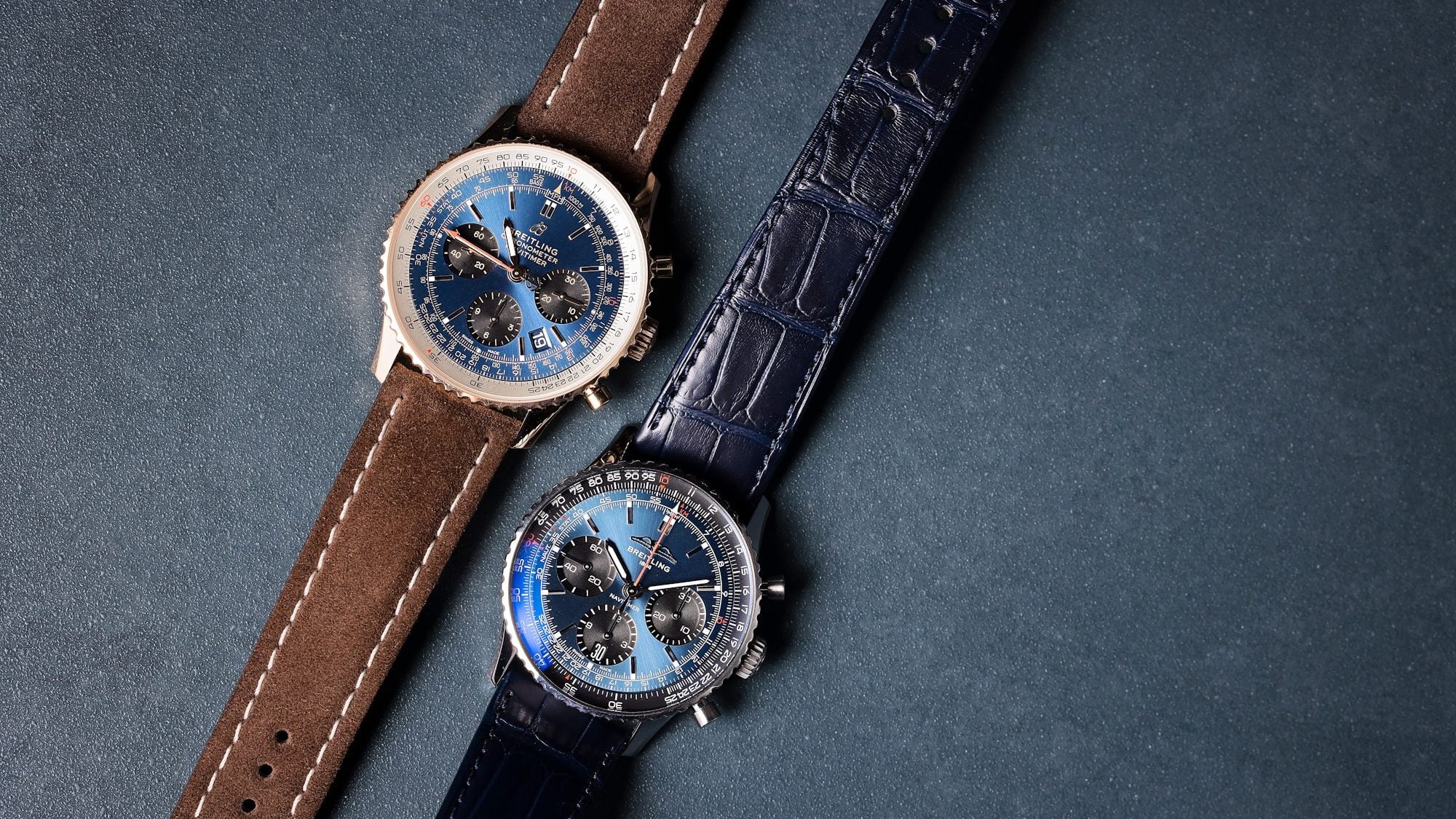
A pre-owned Breitling Navitimer should be bought on three things, in order: the seller, the movement and its service history, and the completeness of the box and papers. Everything else, including dial color and bracelet versus strap, is preference. The order matters because a Navitimer looks the same in a listing photograph whether it was serviced last year or never, and the price of finding out later is a chronograph service. Breitling issues a digital passport linked to the blockchain as a certificate of ownership for current watches, so for a recent B01 the papers are partly digital and the transfer of that record is part of a complete sale.
Carol Altieri puts the B01 point more bluntly than I would, and she is right:
“However, if you are looking at the modern, in-house Caliber B01 versions, make absolutely sure it comes with its digital box and papers. Servicing an in-house Breitling chronograph out-of-pocket can easily turn a secondary market ‘steal’ into a very expensive lesson if the previous owner neglected it.”
Carol Altieri, COO at Bob’s Watches
Here is the inspection list we work through on every Navitimer before it goes into inventory.
- Seller: buy from a dealer who inspects, guarantees authenticity in writing, and offers a return window. A price far below the ranges above is a warning, not a bargain.
- Movement and service history: identify B01 or Valjoux-based from the reference number, then ask for service receipts. A B01 with no history should be priced as if it needs a service.
- Box and papers: warranty card with matching serial, manual, and for current models the Breitling digital passport transfer. Missing papers on a Valjoux era watch is a discount; missing papers on a recent B01 is a reason to walk.
- Bezel: the ratchet should click evenly in both directions with no dead spots; on vintage beaded bezels, check that the beads are intact.
- Pushers and crown: run the chronograph and confirm the reset snaps all counters to zero. The crown does not screw down, so confirm it seats firmly; worn gaskets here are the usual route for moisture.
- Crystal and case: look for chips at the crystal edge and for heavy polishing that has softened the lug lines, and confirm the serial and reference on the case back match the papers.
- Bracelet: minimal stretch and all screws present. A replacement strap is fine; a replacement bracelet is a cost to factor in.
Is Breitling as Prestigious as Rolex?
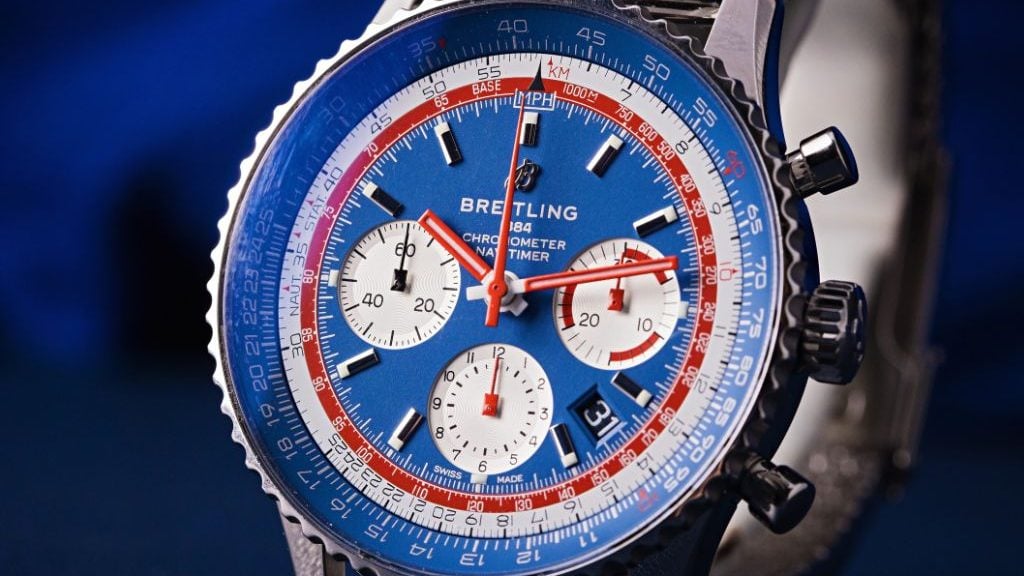
Breitling is not as prestigious as Rolex in the general public’s eyes, and I would rather say that plainly than pretend otherwise. Rolex has stronger name recognition, faster resale liquidity, and tighter pricing on the pre-owned market. Where the comparison gets interesting is the chronograph category. The Caliber B01 and the Rolex Caliber 4130 share the same architecture, a column wheel and a vertical clutch, and both are certified chronometers. A pre-owned Navitimer B01 43 at about $6,450 buys that architecture for a fraction of a steel Daytona. If prestige means what strangers recognize, Rolex wins. If it means what a watchmaker respects when the caseback comes off, the gap is much smaller than the price gap.
The Breitling Navitimer Verdict: Who Should Buy One in 2026

The Breitling Navitimer is the right chronograph for a buyer who wants mechanical substance, a design with real history, and a price that leaves room in the budget for a second watch. My specific recommendations: buy the current generation B01 Chronograph 43 pre-owned if you want the definitive version and can verify its service history; buy a Valjoux-based Navitimer or the Navitimer World if you want the look and the aviation credentials with the lowest ownership cost; buy the 41mm B01 if you have an average wrist and want the best proportions in the modern range at a price the market has not yet caught up to. Skip the Navitimer if you need a watch for swimming; 30 meters and a crown that does not lock are firm limits.
At Bob’s Watches, every Navitimer we sell has been through the inspection list above and comes with our authenticity guarantee, which is how we can publish the sold data in this guide with confidence. If you are ready to compare specific pieces, start with the Navitimer B01 Chronograph models we currently have in stock, then work backward through the Valjoux era references if the budget calls for it. Whichever direction you take, buy the seller first, the movement second, and the dial color last.