A platinum Rolex is the most expensive to buy at retail and, for most buyers, the smartest way to aquire one is buying a pre-owned platinum Rolex. My answer for most people is a pre-owned Day-Date. This guide covers every platinum model, what each costs today, and which one I would buy at every budget, based on the Rolex watches we sell at Bob’s Watches.
Key Takeaways
- A pre-owned platinum Day-Date 36 from the 2000s sells for roughly $27,000 to $33,000 in our transactions, less than half the current retail of its replacement.
- The cheapest solid platinum Rolex is the discontinued Cellini Cellinium, which sells in the $9,500 to $13,000 range.
- Platinum costs roughly $8,000 to $10,000 more than white gold on a pre-owned Day-Date 36, which I think is worth paying; on a Daytona it roughly doubles the price, which I do not.
- Rolex reserves the ice blue dial for platinum, and that dial is the single biggest reason platinum buyers pay the premium.
- Current catalog platinum models such as the Daytona 126506, Day-Date 40 228236, and 1908 52506 trade above retail, so the value is in discontinued references.
- The Yacht-Master in Rolesium is a steel watch with a platinum bezel, and it prices like a steel watch.
Pricing statements below are based on actual sale prices from Bob’s Watches transactions between August 2024 and August 2026, blended with our current market pricing data. Figures are rounded ranges, and sales with thin data are labeled as market pricing rather than sales.
What makes a Platinum Rolex Different
A platinum Rolex is made from 950 platinum, an alloy containing 950 parts per thousand pure platinum that Rolex produces in its own foundry. Platinum is denser than gold, so a platinum Day-Date on a President bracelet weighs more than the identical watch in yellow or white gold, and that heft is the first thing every client notices when I hand one over. The second thing is the color: platinum has a cooler, slightly grayer white than Rolex white gold. Rolex also reserves the ice blue dial for its platinum watches, so the dial itself is a metal signature.
Platinum scratches more easily than gold or steel, and I would rather tell you that than have you discover it later. Platinum displaces rather than wears away when it scratches, so a platinum case develops a soft satin patina over the years and can be refinished with less material loss than a gold case. My opinion on who platinum is for: the buyer that wants the top of the Rolex catalog without needing anyone else to know it. From across a room a platinum Day-Date reads as a white metal watch. If you want a watch that announces itself, buy yellow gold.
Platinum vs. White Gold: Is The Premium worth It?

The platinum premium over white gold is worth paying for a Day-Date 36 and a 1908, and it is hard to justify on a model from the Daytona collection. In our transactions, a platinum Day-Date 36 ref. 118206 sells for roughly $27,000 to $33,000, while the white gold 118239 mostly lands in the low $20,000s, so the platinum premium works out to about $8,000 to $10,000 more for a heavier, rarer watch with access to the ice blue dial.

Here is my opinion. Pay the premium when you want the ice blue dial, the weight, or the top of the line, and pay it on the models where the premium is a few thousand dollars rather than tens of thousands. White gold is the rational buy on the Daytona, where both versions share the same case shape, the same Cerachrom bezel material, and the same caliber 4130 in the discontinued generation, and where platinum costs twice as much. On the Day-Date 36, platinum costs one third more and delivers what feels like a different watch, and that is a trade I would personally make every time.
Joe Alessindrini, our Chief Financial Officer, sees the same pattern from the buying side.
“When we make an offer on a trade-in, platinum Day-Dates are the easiest precious metal watches to price because the market for them is steady. White gold Day-Dates are the hardest, because many buyers cannot tell them from steel at a glance. We pay more for platinum than white gold, and the most for anything with an ice blue dial.”
Every platinum Rolex, model by model
Every platinum Rolex will generally fall into one of three tiers, and buyer intent differs by tier.
- Tier 1 is the current catalog.
- Tier 2 is discontinued modern production, where most of our platinum transactions happen and where the value sits.
- Tier 3 is vintage and special order rarities that trade at auction, if at all.
Each family opens with a one line verdict. Three platinum families are in the Rolex catalog in 2026: the Day-Date in 36mm and 40mm, the Cosmograph Daytona, and the 1908 collection. Each trades above retail on the pre-owned market as of this writing.
Day-Date 36 and 40

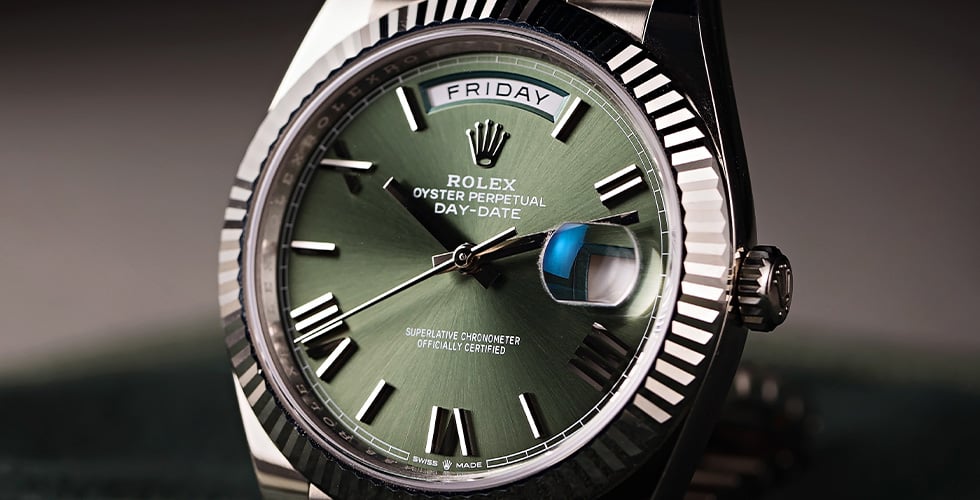
The Rolex Day-Date is a self-winding wristwatch introduced in 1956 that displays the date and the day of the week spelled out in full, and Rolex has made it only in gold or platinum from the beginning. The current platinum references are the 128236 in 36mm and the 228236 in 40mm, both with a fluted platinum bezel and the caliber 3255 with a power reserve of approximately 70 hours.
The 228236 lists at $68,800 with a white dial, and a diamond set 128236 with a pink opal dial lists at $73,450. In our transactions, the 228236 has sold for $77,000 to $85,000 with olive green, slate, and blue dials, above retail for a watch most dealers cannot supply on request.
The gem set versions belong to a different budget: a 128396 with an ice blue diamond dial has sold through us for roughly $93,000, and a 228396 for roughly $118,000. I like the 40mm fluted bezel more than I expected to, because the fluting catches light in a way the smooth bezel never did on a white metal case. I cover the full lineage in our Day-Date platinum buying guide.
Cosmograph Daytona 126506

The ref. 1265060 sits at $84,600 at current retail and roughly $100,000+ for pre-owned examples; I would consider this a grail of the platinum catalog.
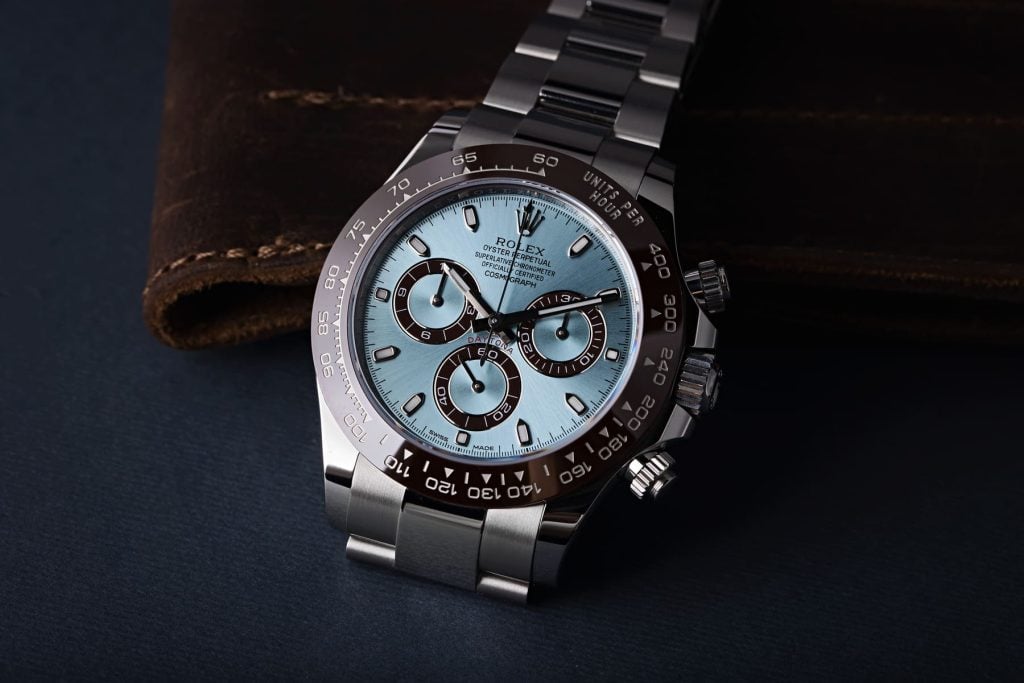
The Rolex Cosmograph Daytona was introduced in 1963, and the 126506 is its platinum version, introduced in 2023 for the model’s 60th anniversary as the successor to the 116506. It pairs an ice blue dial with a chestnut brown Cerachrom bezel, runs the caliber 4131 with a power reserve of approximately 72 hours, and was the first Daytona with a transparent case back. Retail is $84,600, and in our transactions diamond dial examples have changed hands at roughly $100,000 and above.
In 2026 Rolex introduced the Daytona 126502 in Rolesium, a steel case with a platinum bezel ring and case back ring and a white enamel dial, sold off catalog. I expect it to pull collector attention without reducing demand for the 126506, because only one of the two is a platinum watch. My hands on impressions are in our platinum Daytona review.
1908 (52506)

At $33,600 retail and roughly $45,000 to $58,000 pre-owned based on our transactions; the platinum 1908 dress watch is my pick for the prettiest dial Rolex makes today.
The Rolex 1908 is a dress watch introduced in 2023, and the 52506 is its platinum version, fitted with an ice blue dial in a rice grain guilloché pattern that Rolex does not offer on the gold references. The 39mm case houses the caliber 7140 with a Syloxi silicon hairspring and a power reserve of approximately 66 hours, visible through a transparent case back. Retail rose to $33,600 in January 2026. In our transactions the 52506 has sold for roughly $45,000 to $58,000, and market pricing has since softened toward the low to mid $40,000s as more examples reach the market.
I think this is the platinum Rolex to watch over the next few years. The premium over retail has been shrinking, and if the market brings it close to retail, a pre-owned 52506 becomes the easiest platinum recommendation I can make.
Day-Date lineage (18206 through 228206)

Roughly $27,000 to $68,000 depending on generation; the pre-owned sweet spot and the answer for most readers of this guide.
The platinum Day-Date lineage runs three decades deep. The 1990s brought the smooth bezel 18206 and its diamond bezel siblings, the 18296 and 18346, along with the baguette set 18366, and the 2000s brought the 118206, 118296, 118346, and 118366 with the same bezel logic.
The Day-Date II 218206 arrived in 2008 at 41mm alongside the diamond bezel 218399, and the Day-Date 40 228206 followed in 2015 with a smooth bezel and the ice blue dial that made it famous before the fluted 228236 replaced it. In our transactions, the 118206 sells for roughly $27,000 to $33,000, the diamond bezel and dial 118346 for roughly $40,000 to $45,000, the 218206 for roughly $46,000 to $55,000, and the 228206 for roughly $47,000 to $68,000 with most examples near $60,000.
The depth of this lineage is its own selling point. A buyer with $30,000 can own a platinum President with an ice blue dial from the 2000s, and a buyer with $60,000 can own a 40mm 228206 on the current caliber 3255 that is nearly indistinguishable on the wrist from the $68,800 watch in the window. The smooth bezel 228206 is the version I would pick for myself.
Cosmograph Daytona 116506

At roughly $85,000 to $100,000 pre-owned, with diamond dial examples above $100,000; the discontinued reference that trades above the retail price of its replacement.
The Daytona 116506 was introduced in 2013 for the Daytona’s 50th anniversary as the first serially produced platinum Daytona, with an ice blue dial, a chestnut brown Cerachrom bezel, and the caliber 4130, and Rolex discontinued it in 2023. In our transactions it has sold for roughly $85,000 to $100,000, and ice blue diamond dial examples have cleared $100,000, which puts a discontinued watch above the $84,600 retail price of the current one.
Discontinuation did not hurt this watch. The 116506 was the only platinum Daytona for a decade, the closed case back gives it a cleaner profile than the 126506, and the dial and bezel combination is identical. If I were buying a platinum Daytona to wear, this is the one.
Cellini and Cellinium (5240, 5241)

The $9,500 to $13,000 pre-owned price is the cheapest solid platinum Rolex and the watch almost nobody knows exists.
The platinum Rolex Cellini is the company’s dress watch line, named for the Renaissance goldsmith Benvenuto Cellini, and the Cellinium was the platinum only model within it, produced under references 5240 and 5241. The dials we have handled include black, glacier blue, and mother of pearl. In our transactions these watches sell for roughly $10,000 to $12,500, with market pricing for the 5240 starting just under $10,000, which is a solid platinum Rolex for the price of a steel sports model.
I underestimated this watch for years. A 5241 with a glacier blue dial came across my desk not long ago and I wore it for a week. It weighs more than a steel Submariner, and every person who picked it up assumed it cost five times what it did. It sold for a little over $12,000 and I still think about it. In my opinion the Cellinium is the most undervalued platinum watch Rolex has ever made.
Lady-Datejust and Datejust 31 (69136, 79136, 179136, 179166, 179296, 178246)
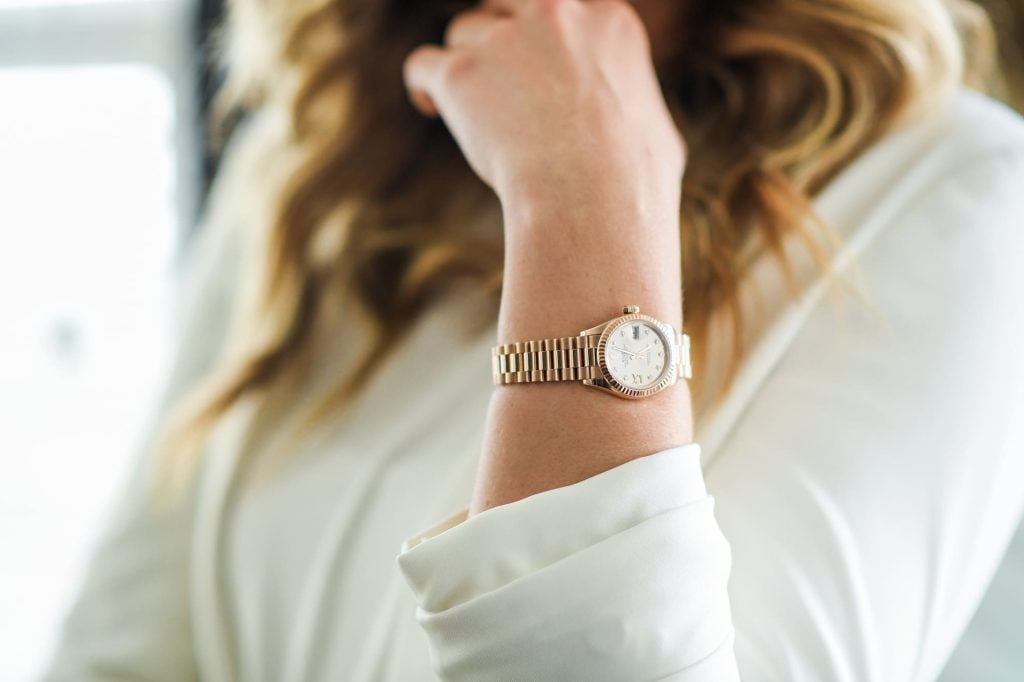
Pre-owned models sell for about $14,500 to $22,000 in our transactions; the solid platinum Rolex under $25,000 that most buyers do not know exists.
The Rolex Lady-Datejust is the 26mm version of the Datejust, and Rolex produced it in solid platinum Lady-Datejust across several generations: the 69136, the 79136, and the 179136, 179166, and 179296, with the 178246 covering the 31mm Datejust in platinum with a diamond bezel. In our transactions, a 179166 with a glacier blue dial has sold for roughly $14,500 to $19,500, and a 179296 with an ice blue diamond dial for roughly $22,000.
For a smaller wrist, this is the best value in the entire platinum catalog. The buyer gets the same 950 platinum and a glacier blue or ice blue dial that the white gold and steel versions never received, for less than a current steel Daytona costs at retail.
Day-Date Masterpiece and Pearlmaster (18946, 18956)
At $45,000 to $50,000 based on current market pricing for a diamond bezel 18946 with a meteorite dial; pricing above that is bespoke.
The Day-Date Masterpiece is a Day-Date fitted with a diamond bezel and the five link Pearlmaster bracelet, and the 18946 is the platinum version with a round diamond bezel, while the 18956 carries baguette diamonds. Our data here is thin, so the figure above is market pricing rather than a sales range.
I treat these watches as special order territory even when pre-owned. Two examples with the same reference number can differ by tens of thousands of dollars based on the dial and the stones, so I price them one at a time.
Vintage Platinum Day-Dates

The vintage platinum Day-Date, produced under reference 1806 and in diamond bezel variants during the 1960s and 1970s, is among the rarest catalog Rolex watches ever made. Rolex offered the Day-Date in platinum from its 1956 launch, but the overwhelming majority of production was yellow gold, and platinum examples from this era surface at auction rather than on dealer shelves.
I do not publish a price for these because the last few public sales are not at market, they are events, and condition, dial originality, and provenance move the number by multiples.
Platinum Oysterquartz Day-Date
The Rolex Oysterquartz was the company’s in-house quartz movement family, introduced in 1977, and a Day-Date version existed in platinum in very small numbers. The angular case and integrated bracelet make it one of the most distinctive Day-Dates ever made, and I would not buy one as a first platinum Rolex, but a collector who already owns the mainline pieces will find nothing else like it.
Special order Zenith era platinum Daytonas
Before the 116506 arrived in 2013, Rolex produced a small number of special order platinum Daytonas during the Zenith caliber era, which ran from 1988 to 2000. One example with provenance to a former Rolex chief executive sold at auction. These pieces were never in the catalog, which is why a knowledgeable collector will tell you the 116506 was not the first platinum Daytona, only the first one you could order. Any platinum Daytona from before 2013 needs its history documented before money changes hands.
A note on Rolesium (Yacht-Master 268622, 116622, 126622)
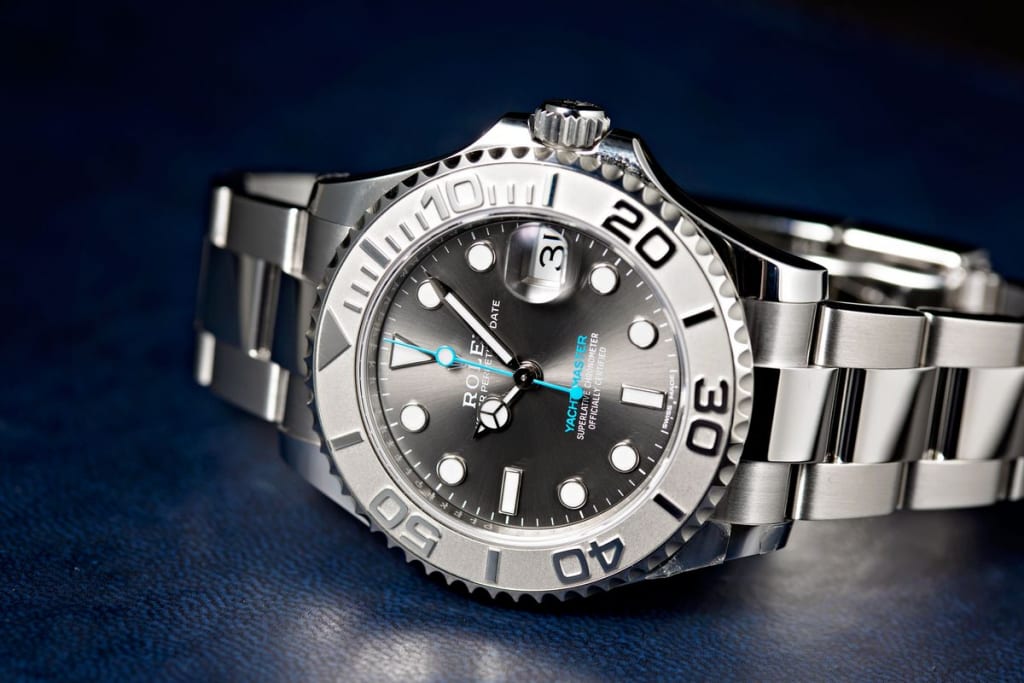
Rolesium is the Rolex name for a steel watch fitted with a platinum bezel and, on some references, a platinum dial, and it is not a solid platinum watch. Rolex introduced it on the Yacht-Master 16622 in 1999, and it continues on the current Yacht-Master 40 ref. 126622 and Yacht-Master 37 ref. 268622. Because the case and bracelet are steel, a Rolesium Yacht-Master prices like a steel watch: in our transactions, the 16622 sells for roughly $9,000 to $11,500, the 116622 for roughly $11,000 to $14,000, the 126622 for roughly $15,000 to $16,000, the 268622 for roughly $12,500 to $13,500, and the smaller 168622 and 169622 for roughly $6,000 to $9,500.
I include Rolesium because searchers conflate it with solid platinum, and it is excluded from every solid platinum value claim in this guide.
What a platinum Rolex costs in 2026
A platinum Rolex costs anywhere from roughly $9,500 for a pre-owned Cellinium to well over $100,000 for a gem set Day-Date 40 or a diamond dial platinum Daytona. Pre-owned ranges below are rounded and drawn from our transactions unless labeled as market pricing, and retail figures are 2026 U.S. list prices for current references.
| Family | Typical pre-owned range | Current retail (2026) |
| Cellini Cellinium (5240, 5241) | $9,500 to $13,000 | Discontinued |
| Lady-Datejust platinum (179166, 179296) | $14,500 to $22,000 | Discontinued |
| Day-Date 36 platinum (118206) | $27,000 to $33,000 | Discontinued; 128236 successor from the low to mid $60,000s |
| Day-Date 36 diamond bezel (118346) | $40,000 to $45,000 | Discontinued |
| Day-Date II platinum (218206) | $46,000 to $55,000 | Discontinued |
| Day-Date 40 smooth bezel (228206) | $47,000 to $68,000 | Discontinued |
| Day-Date 40 fluted bezel (228236) | $77,000 to $85,000 | $68,800 (white dial) |
| Day-Date Masterpiece (18946) | $45,000 to $50,000 (market pricing) | Discontinued |
| 1908 platinum (52506) | $45,000 to $58,000 (our sales); market softening toward the low to mid $40,000s | $33,600 |
| Daytona 116506 | $85,000 to $100,000; diamond dial above $100,000 | Discontinued |
| Daytona 126506 | $100,000 and up (diamond dial) | $84,600 |
| Gem set Day-Date (128396, 228396) | $90,000 to $120,000 | Varies by configuration |
| Rolesium Yacht-Master (not solid platinum) | $6,000 to $16,000 | 126622 and 268622 in catalog |
Two things stand out. Every current catalog platinum reference trades above retail, which is an availability premium rather than a metal premium. And the discontinued Day-Date 36 trades at less than half the retail of its replacement, which is the best number in this guide for a buyer who wants platinum without paying platinum retail.
Do Platinum Rolexes Hold Their Value?

Platinum Rolexes generally hold their value less well than gold Rolexes when measured against retail over a full ownership cycle, with a short list of exceptions holding value well as of 2026. The clearest way to see the pattern is to compare a discontinued reference with the current retail of its replacement. A 2000s platinum Day-Date 36 ref. 118206 sells through us for roughly $27,000 to $33,000 against a current retail in the low to mid $60,000s for the 128236, which is well under half. A 2000s yellow gold Day-Date 36 ref. 118238 sells for roughly $23,000 to $35,000 against $43,700 at current retail for the 128238, which is well over half. The platinum premium paid at retail is the part that does not come back, which is why I steer buyers toward pre-owned platinum: the previous owner already absorbed it.
Family verdicts, in measured terms. Discontinued Day-Date 36 platinum has already taken its markdown and can hold value from current levels, though nothing guarantees it. Day-Date 40 platinum is mixed: the smooth bezel 228206 sells below the 228236 retail while the 228236 itself sells above retail, and I expect the two to converge over time. The Daytona 116506 is the standout, a discontinued reference that sells above the retail price of its successor. The 1908 52506 trades above retail but has been softening, and that premium should not be treated as permanent. The Cellinium and Platinum Lady-Datejust sit so far below their original retail that further downside looks limited to me, but that is an opinion, not a promise.
Carol Altieri, our Chief Operating Officer, tracks how quickly inventory turns.
“Ice blue platinum Day-Dates and platinum Daytonas rarely sit. They are usually spoken for within days of listing. Older platinum Day-Date 36s sell steadily, but those buyers are more price sensitive, which is exactly why they end up with the best value on the site.”
Which Platinum Rolex I’d buy At Every Budget

My picks, by budget. At $10,000 to $15,000 I would buy a Cellinium 5241 with a glacier blue dial, because it is the only solid platinum Rolex at the price. At $20,000 to $25,000 I would buy a platinum Lady-Datejust 179166 or 179296 for a smaller wrist, or stretch to a silver dial 118206 for a larger one. At $45,000 to $65,000 I would buy a Day-Date 40 ref. 228206 with an ice blue dial, the same caliber and case as the current watch at a discount to retail, or a diamond bezel 118346 for a buyer who wants 36mm with some flash. At $80,000 and up I would buy a 228236 in ice blue, pre-owned rather than on a boutique waiting list. The grail is the platinum Daytona, and between the two I would take the 116506 for the closed case back and the identical dial.
The thread through all of those picks is the same: buy the platinum watch someone else paid retail for. Bob’s Watches exists because that trade works for both sides, the seller who wants liquidity and the buyer who wants the watch without the markup. When you are ready to compare examples, our full selection of pre-owned platinum Rolex watches is organized by model family with current pricing on every piece.