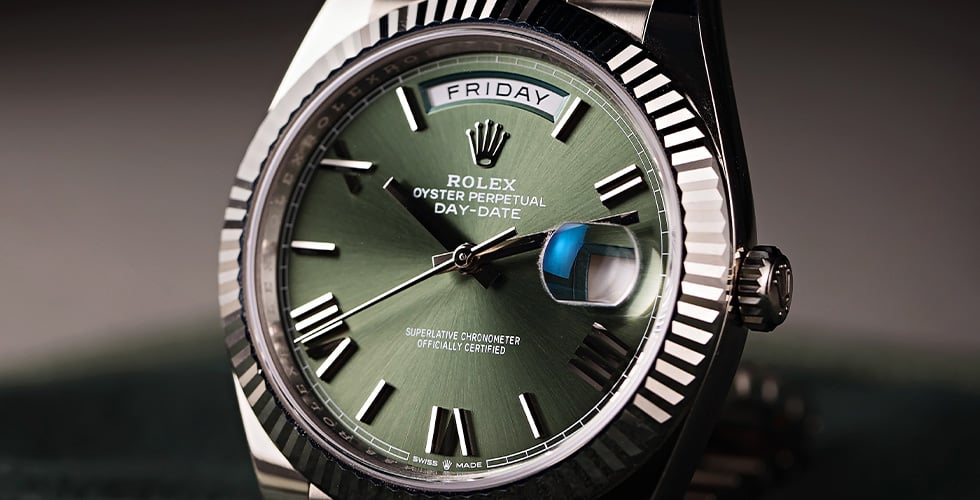
Cartier vs Rolex is a choice between engineering and design. Rolex watches lead on in-house movements, durability, and resale value, while Cartier watches leads on shape, heritage, and a lower entry price. After decades of selling both, my answer is simple. Buy a Rolex if resale value matters most to you, and buy a Cartier if design is why you’re buying a watch.
Key Takeaways
- My verdict: Rolex is the better watch to own if resale value and durability matter most, and Cartier is the better watch to own if design is the reason you want one.
Investment: Rolex steel sports models generally sell above retail, while most Cartier models sell below retail at a discount that has held steady in our sales. - Innovation: Cartier created the Santos in 1904, the first wristwatch built for a pilot, nearly fifty years before the Submariner arrived in 1953.
- Movement: Every Rolex runs an in-house Superlative Chronometer rated to -2/+2 seconds per day, while Cartier pairs in-house calibers like the 1847 MC with quartz movements built for reliability rather than record accuracy.
- Wearability: Cartier’s key models are thinner and dressier than Rolex’s Oyster cases, which is why buyers who wear a suit more than a wetsuit choose them.
- Availability: Cartier can be bought at retail the day you walk in, while popular steel Rolex models still carry waitlists or a secondary market premium.
Both houses are among the best Swiss watch brands , and I buy and sell both every week at Bob’s Watches. Below I compare them on design, movements, popular models, a Santos versus Submariner showdown, and pricing backed by our own sales data.
Head-to-Head: Rolex vs. Cartier Comparison Table
Rolex and Cartier differ on almost every axis a buyer cares about, and the fastest way to see those differences is side by side. Prices reflect current retail as of September 2026.
| Feature | Rolex (The Crown) | Cartier (The Jeweler) |
| Primary Identity | Tool watch and mechanical innovator | Design house and jeweler of kings |
| Brand Recognition | Global #1 luxury watch brand | World-renowned luxury maison |
| Case Shape Focus | Predominantly round (Oyster Case) | Master of shapes (square, rectangular, tonneau) |
| Movement | 100% in-house, COSC certified | Mix of in-house automatic and quartz movements |
| Water Resistance | Excellent (100m to 11,000m) | Good (Typically 30m to 100m) |
| Retail Availability | Long wait times, tightly allocated | Generally available to walk-in buyers |
| Resale Value | Industry-leading (most models retain/gain value) | Competitive (models often trade below retail) |
| Entry Price Point | Higher (Starting around $6,100 to $7,750) | Lower (Starting around $3,000 to $4,200) |
Design Philosophy and Aesthetics: Sporty Utility vs. Elegant Shape

Rolex designs watches as tools, and Cartier designs watches as jewelry. That single difference explains almost everything else: Rolex builds round, brushed, luminous, and legible, with proportions chosen for durability, while Cartier builds polished and sculptural, with proportions chosen for how the watch looks on a cuff. My own collection leans heavily toward Rolex tool watches, but I understand exactly why a customer walks past a Submariner and picks up a Tank.
Rolex: Consistency, Durability, and the Oyster Case

The Rolex Oyster case is a screw-down, water-resistant watch case that Rolex introduced in 1926, and it remains the foundation of nearly every watch the brand makes a century later. The history of Rolex is a history of refining that case rather than replacing it: the self-winding Perpetual rotor in 1931, the Submariner in 1953, the ceramic Cerachrom bezel in 2005. Each step made the same object tougher without changing what it looked like.
What I like most about Rolex design is that it does not ask you to think about it. A GMT-Master II from 1985 and one from 2026 are unmistakably the same watch. Key design features:
- Unmistakable Look: A consistent aesthetic across every collection that has changed by millimeters, not by redesigns.
- Luminescence: Chromalight lume on hands and markers for real low-light legibility.
- Robust proportions: Thick lugs and crown guards that give the watch presence and protect it from knocks.
Cartier: Artistic Vision and the Master of Shapes
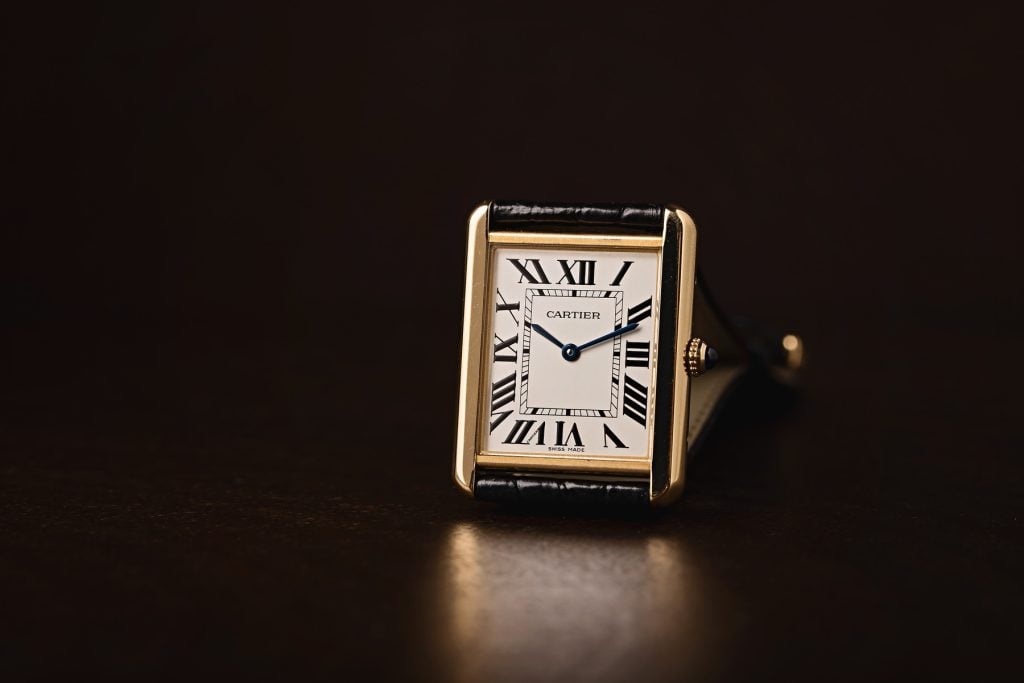
Cartier is a Parisian jeweler founded in 1847 by Louis-François Cartier, and it approached the wristwatch from the start as jewelry that happened to tell time. Cartier built the Santos for the aviator Alberto Santos-Dumont in 1904 and put it into general production in 1911, then followed with the rectangular Tank in 1917. Both challenged the round case before Rolex had built its first Oyster, and both are still in the catalog. Our list of the most iconic Cartier watch designs shows how far that shape language extends.
I think Cartier’s real genius is restraint. The Roman numerals, blued sword hands, and cabochon crown are the same on a $3,750 Tank Must and a $48,800 gold Santos, which is why a Cartier is recognizable across a room without a logo in sight. Key design features:
- Signature elements: Roman numerals, blued hands, a railway minute track, and a cabochon crown that create instant recognition.
- Versatility (QuickSwitch): Current Santos models use QuickSwitch and SmartLink for tool-free strap changes and bracelet sizing.
The Movement and Engineering Comparison
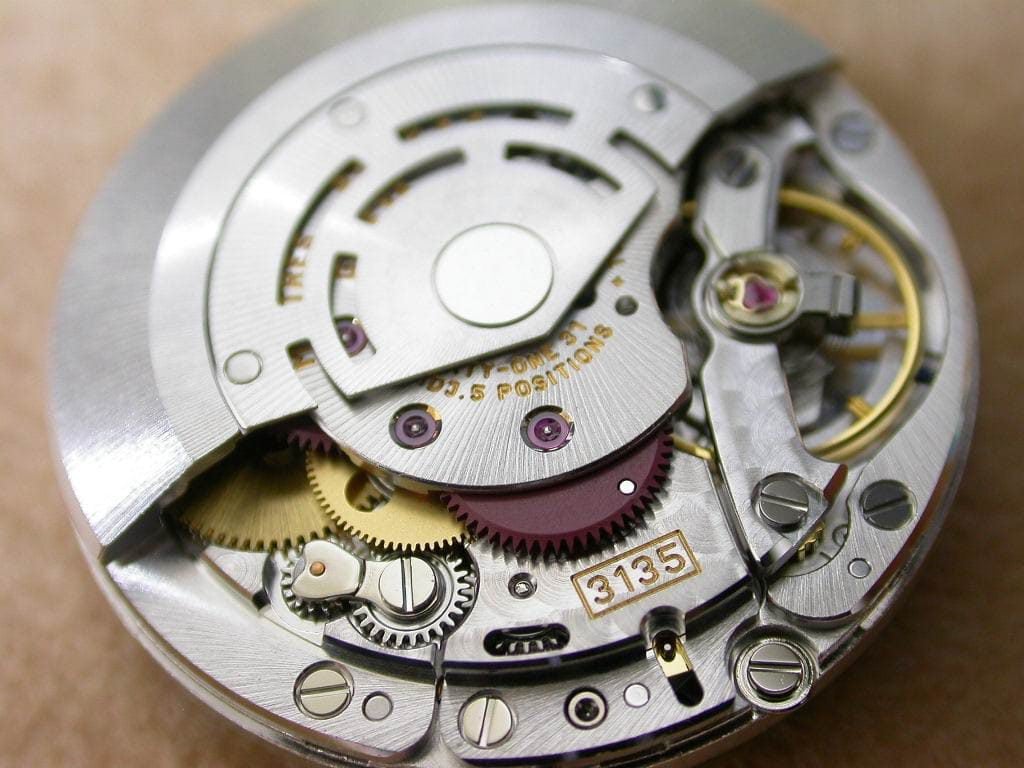
Rolex wins the movement comparison, and it is not close. Rolex produces everything from the Rolex hairspring to the bracelet in-house. Every current Rolex movement is COSC certified as a chronometer before Rolex cases it and tests it again to its own Superlative Chronometer standard of -2/+2 seconds per day. The caliber 3235 inside the current Submariner Date carries a Chronergy escapement, a redesigned Swiss lever escapement in nickel-phosphorus alloy that Rolex says improves efficiency by about 15 percent and resists magnetic fields, plus a Parachrom hairspring and a power reserve of roughly 70 hours.
Cartier takes a different route. The caliber 1847 MC, named for the year Cartier was founded and introduced in 2015, is an in-house automatic that powers most Santos de Cartier and many current Ballon Bleu models with a power reserve of about 42 hours. Cartier also uses quartz and SolarBeat photovoltaic movements across the Tank Must and Panthère lines. What I tell customers is that a Cartier movement is built to be reliable and thin enough to disappear inside a dress case, not to win a timing contest, and our watchmakers confirm it on the bench. Our roundup of Cartier innovations covers where the brand does push the technical envelope.
Technical Specifications Breakdown (Rolex vs. Cartier)
The table below sets the Rolex caliber 3235 (Submariner Date) against the Cartier caliber 1847 MC (Santos de Cartier).
| Specification | Rolex Caliber 3235 | Cartier 1847 MC |
| Accuracy Standard | Superlative Chronometer (-2/+2 sec/day) | No published chronometer standard |
| Power Reserve | Approximately 70 Hours | Approximately 42 Hours |
| Escapement | Chronergy (nickel-phosphorus, optimized Efficiency) | Swiss lever with nickel-phosphorus components |
| Certification | COSC + Rolex In-House Testing | Not Chronometer Certified |
Rolex’s Most Popular Watches

Rolex’s most popular watches are the Submariner, Daytona, Datejust, and Day-Date, and those four families account for the majority of the Rolex watches we sell. Each was introduced decades ago and refined rather than replaced.
- Rolex Submariner: The Rolex Submariner is a dive watch introduced in 1953 with a unidirectional rotating bezel and 300 meters of water resistance. It defined the category, and it is the model I have collected most in my own life.
- Rolex Daytona: The Rolex Daytona is a chronograph introduced in 1963 and named for the Florida speedway. The current generation houses the in-house caliber 4131, and the steel version remains one of the hardest watches to buy at retail.
- Rolex Datejust: The Rolex Datejust was introduced in 1945 as the first self-winding wristwatch with a date that changed automatically at midnight. In hundreds of configurations, it is the closest thing Rolex makes to a single watch that does everything.
- Rolex Day-Date: The Rolex Day-Date , introduced in 1956, spells out the day of the week in full and is made only in precious metals. Its nickname, the President, comes from the bracelet Rolex designed for it.
Cartier’s Most Popular Watches

Cartier’s most popular watches are the Santos, Tank, Ballon Bleu, and Panthère, and the Tank and Santos families alone make up more than half of the Cartier watches we sell. Each is defined by a case shape rather than a complication, a very different way to build a catalog than Rolex’s.
- Cartier Santos: The Cartier Santos is a square wristwatch designed in 1904 for Alberto Santos-Dumont and sold to the public from 1911. Its exposed bezel screws and QuickSwitch bracelet make it the Cartier I recommend most often to buyers coming from Rolex.
- Cartier Tank: The Cartier Tank is a rectangular wristwatch introduced in 1917, its case inspired by the silhouette of a WWI tank seen from above. It has been in production for more than a century, from the quartz Tank Must to the gold Tank Louis Cartier.
- Cartier Ballon Bleu: The Cartier Ballon Bleu is a round automatic introduced in 2007 whose crown guard wraps the sapphire cabochon into a case shaped like a pebble. It sells well to both men and women.
- Cartier Panthère: The Cartier Panthere is a square quartz jewelry watch introduced in 1983 and relaunched in 2017, with a supple brick-link bracelet that wears like a cuff. It holds its value best of any Cartier in our sales.
Top Model Showdown: The Cartier Santos vs. Rolex Submariner
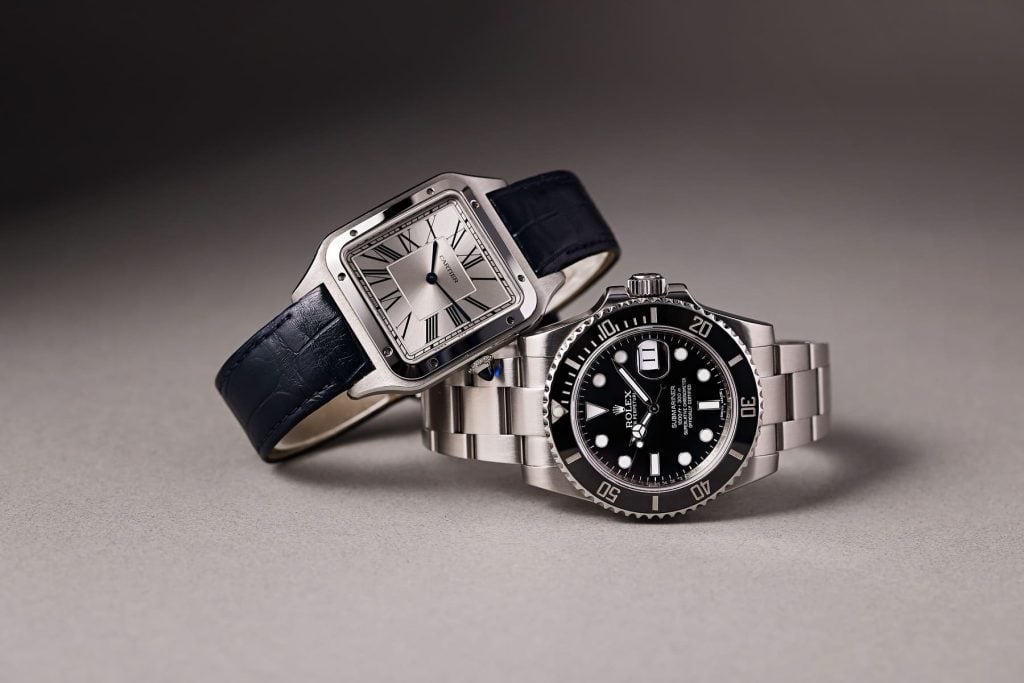
The Santos and the Submariner are the two luxury watches that best represent their makers, and they are the two models buyers most often ask me to compare. Both are steel automatics, both are the sports watch of their brand, and both retail within a couple thousand dollars of each other.
Rolex Submariner: The Undisputed Icon
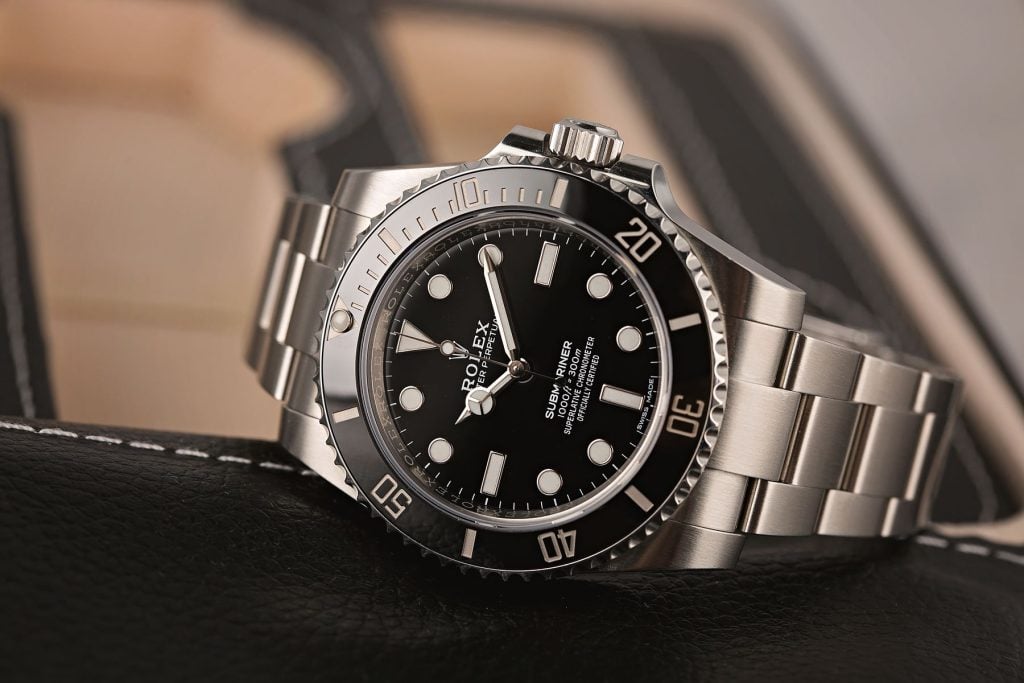
The Rolex Submariner is a 41mm steel dive watch, and the current Submariner Date reference 126610LN retails for $11,350. It has been the benchmark dive watch since 1953, both a working tool and one of the most recognized status symbols on earth. I have owned dozens, from 1950s references to the current model, and it remains the watch I reach for most.
Rolex Submariner Pros:
- Benchmark Dive Watch Heritage: Continuous refinement since 1953 without a redesign that broke the original look.
- Extreme Durability: Water resistance to 300 meters and a case meant to withstand serious abuse in real-world conditions
- Best-in-Class Clasp: The Glidelock extension Rolex clasp system allows on-the-fly adjustment in 2mm increments without tools
- Strong secondary market: The 126610LN has sold above retail in every quarter of our sales data, making it one of the most liquid watches we handle.
Rolex Submariner Cons:
- Ubiquitous Recognition: Everyone knows what it is, which cuts against buyers who want discretion.
- Large Presence: The 41mm case can feel like a suit of armor on a smaller wrist.
- Retail Unavailability: Authorized dealers still run waitlists, so most buyers pay a premium pre-owned.
Cartier Santos: The Original Pilot’s Watch
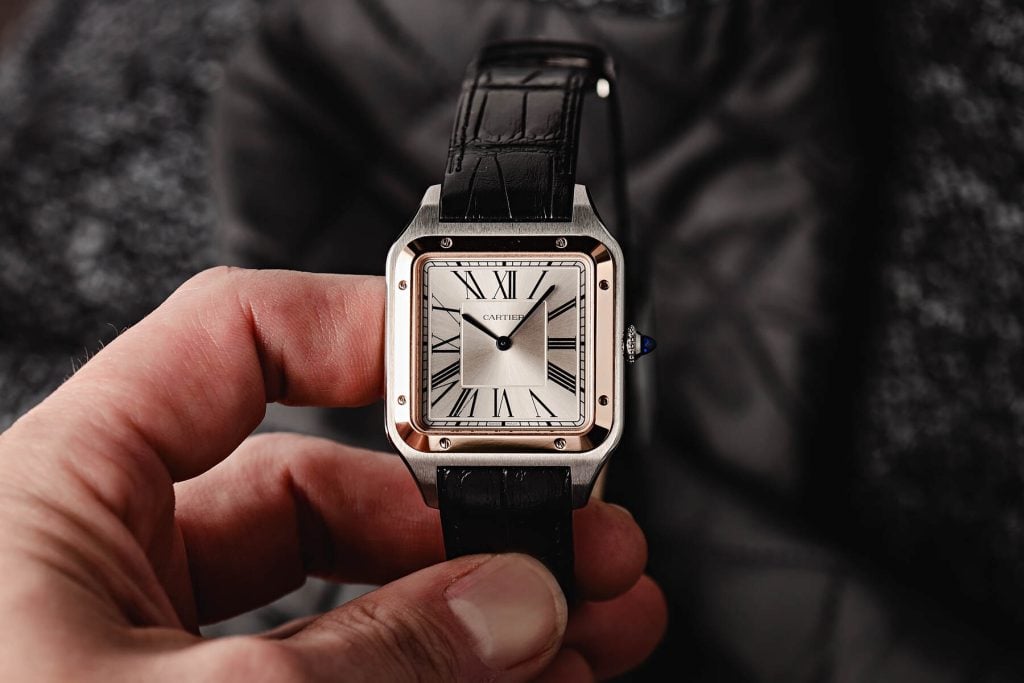
The Cartier Santos is a square steel sports watch, and the current Santos de Cartier Large in steel retails for $9,200 as of September 2026. Its case measures 39.8mm across and 9.38mm thick, with 100 meters of water resistance and the caliber 1847 MC inside. It carries a design lineage older than any wristwatch Rolex makes and still looks modern on a bracelet or a strap.
Cartier Santos Pros:
- Pioneered the Modern Wristwatch: The Santos established the purpose-built wristwatch in 1904, and the current model keeps the original’s screws, bezel, and Roman dial.
- Slim Case Profile: At 9.38mm thick, the Santos Large slides under a shirt cuff in a way no modern Submariner can.
- QuickSwitch System: Tool-free swaps between bracelet and strap turn one watch into two.
- Immediate Availability: Most Cartier boutiques will sell you a Santos the day you walk in.
- Quiet Luxury Appeal: It signals taste to people who know watches without shouting.
Cartier Santos Cons:
- Polished Bezel: The polished bezel is a scratch magnet and shows wear faster than any other part of the watch.
- Limited Clasp Adjustment: The Santos lacks the quick micro-adjustment of the Rolex Glidelock.
- Lower Resale Value: The Santos sells below retail on the secondary market, unlike most steel Rolex sports models.
If I could only keep one of these two, it would be the Submariner, and I say that as someone who admires the Santos more every year. The Submariner is the watch I can wear into the ocean, into a boardroom, and into a trade-in conversation with total confidence about what it is worth. The Santos is the watch I would recommend to anyone tired of seeing a Submariner on every wrist at the club
Financial Consideration: Value Retention and Pricing
Rolex holds value better than Cartier, and the gap is measurable in our own sales. Steel Rolex sports watches remain the closest thing the industry has to a liquid asset: the Submariner Date, GMT-Master II, and Daytona all sell above retail because authorized dealers cannot supply the demand. No watch is guaranteed to hold or gain value, and certain references have fallen from their 2022 peaks, but Rolex is generally considered the safest store of value in steel.
Cartier is a different proposition, and I think it is an underrated one. Most Cartier models sell below retail pre-owned, which makes a lightly worn Santos or Tank one of the best ways to buy into a house with nearly 180 years of history at a discount. Cartier raised its United States retail prices in September 2025 and again in May 2026, and those increases have pulled pre-owned prices up behind them. The discount is real, but it is a steady one rather than a falling one.
Price Range Comparison (Current Retail Estimates):
- Rolex entry point (Oyster Perpetual 36): $6,750 retail
- Cartier entry point (Tank Must, small, steel): $3,750 at retail.
- Rolex mid-range (Submariner Date 126610LN): $11,350 at retail; roughly $15,000 to $17,000 pre-owned in our recent sales.
- Cartier mid-range (Santos de Cartier Large, steel): $9,200 at retail; roughly $7,200 to $8,000 pre-owned in our recent sales.
Bob’s Watches Market Data (September 2026)
Our sales data from the past six months tells the story more precisely than any generalization can. A steel Santos de Cartier Large has been selling at Bob’s Watches for between roughly 78 and 87 percent of its current $9,200 retail price, with most sales landing right around 80 percent. A Submariner Date 126610LN over the same window has been selling for between roughly 130 and 150 percent of its $11,350 retail price, with a typical sale near 140 percent. The Santos Large’s pre-owned price at Bob’s climbed about 15 percent year over year, roughly double the rate of the Submariner Date, tracking Cartier’s retail increases over the same period.
Two other trends surprised even me. Cartier sales revenue at Bob’s grew faster than Rolex sales revenue over the twelve months ending July 2026, and Cartier pieces leave our inventory at least as fast as Rolex: the typical Cartier watch sells within about two weeks of listing, and a higher share of Cartier watches sell in their first thirty days than Rolex watches.
“From a balance sheet standpoint, a steel Submariner is the closest thing this industry has to cash, and we price it that way,” says Joe Alessandrini, CFO of Bob’s Watches. “Cartier is a different animal. You accept a discount to retail on the day you sell, but the core steel models have held that discount steady for years, and every retail increase from Cartier can increase the pre-owned market price.”
Cartier or Rolex for Women?

Cartier or Rolex for women is a different decision than the one men face, because the two brands built their women’s catalogs from opposite directions. Cartier’s Panthère, Tank, and small Santos are jewelry first, with quartz movements, slim cases, and bracelets designed to sit alongside a bangle. Rolex’s Lady-Datejust, Datejust 31, and Oyster Perpetual 28 and 31 are the men’s Oyster architecture scaled down, with the same automatic movements and water resistance. More than half of the Cartier watches we sell are 32mm or smaller; for Rolex that figure is about one in six.
The Panthère de Cartier is the clearest example of what Cartier does well for women. The small steel version has been selling at Bob’s Watches for roughly what it costs at the boutique, the strongest value retention of any Cartier line we handle. The Rolex counterpart is the Lady-Datejust, a 28mm automatic with a Cyclops date and a choice of smooth, fluted, or diamond bezels, in a case that has been in production since the 1950s. One is jewelry that keeps time; the other is a small tool watch that happens to be beautiful.
“When a woman calls us deciding between the two, I ask what she wants the watch to do,” says Carol Altieri, COO of Bob’s Watches. “If she wants something that reads as jewelry first, I point her to a Panthère or a Tank. If she wants one watch for the gym, the office, and the pool, it is a Lady-Datejust or an Oyster Perpetual. Both are the right answer for different women.”
For picks in each brand, start with our guide to the best Cartier watch for ladies and our roundup of the best Rolex for women .
Defining Your Watch Collection

The choice between Cartier and Rolex comes down to what you value in a watch, and both answers are correct. Rolex delivers performance, precision, and the strongest value retention in steel, and if those drive your decision, Rolex is the clear pick. Cartier delivers design, heritage, and a lower cost of entry, and if you want a watch that looks like nothing else on the wrist next to yours, Cartier is a brand I would happily own. For a deeper look at that second question, read is Cartier a good watch brand .
Either way, the pre-owned market is where I would start. Every Rolex and Cartier at Bob’s Watches is inspected and authenticated by our watchmakers before it is listed, and our inventory of luxury watches for sale covers both brands. And if this comparison has you leaning toward a switch, you can sell or trade in your current watch ; we buy and sell both bra