Most people recognize the Cartier Tank. Designed in 1917 by Louis Cartier and inspired by the military tanks of World War I, it became the blueprint for the modern rectangular dress watch. But the Tank is not a single watch. It is an entire family of sub-models, each with its own personality, price point, and purpose. Thinking about adding a Cartier Tank to your collection? This guide breaks down the current models, explains sizing, and looks at how different versions tend to hold their value.
Key Takeaways
- The Tank Must is the most accessible entry point, starting around $3,300 in stainless steel with quartz or SolarBeat movements.
- The Tank Louis Cartier is the purest expression of the original 1917 design, made exclusively in 18k gold with a manual-wind mechanical movement.
- The Tank Française features an integrated chain-link bracelet and a more angular, square case, making it the sportiest Tank in the lineup.
- The Tank Américaine has an elongated, curved profile that hugs the wrist, giving it a more contemporary and fluid look.
- Sizing matters: The Tank Must XL (41mm x 31mm) is the only Must model with an automatic movement and a date window, which changes the character of the watch significantly.
- Value retention: Cartier Tank watches generally hold 65–75% of their retail value over five years on the secondary market, with vintage and gold models performing even better.
This guide looks at the history behind the Tank, reviews the models in the current collection, and offers practical advice on sizing, pricing, and long-term value. If you’d like to explore pre-owned options, you can also browse our selection of authenticated Cartier Tank watches at Bob’s Watches.
A Brief History of the Cartier Tank Watch

The story of the Cartier Tank begins during World War I. In 1917, Louis Cartier designed a watch inspired by the overhead profile of the Renault FT-17 tank, translating the vehicle’s parallel treads into the watch’s elongated side bars, known in French as “brancards.” The first prototype was gifted to General John Pershing, commander of the American Expeditionary Forces in France, and the model was introduced to the public in 1919. Only six watches were produced in that initial release.
Over the next few decades, Cartier expanded the Tank into an entire family of designs. The Tank Cintrée arrived in 1921, featuring an elongated and curved case. The Tank Louis Cartier debuted in 1922, softening the angular lines of the original with rounded brancards. Throughout the 1920s and 1930s, Cartier released several other variations, including the Tank Chinoise, the Tank Basculante, and the Tank à Guichet. Each one reinterpreted the rectangular DNA in a unique way, but all stayed true to the core design: clean lines, Roman numerals, blued steel hands, and a cabochon-set crown.
By the second half of the 20th century, the Tank had become synonymous with style and status. Princess Diana, Jacqueline Kennedy, Andy Warhol, Muhammad Ali, and Fred Astaire all wore variations of the Tank. Andy Warhol famously said he wore his Tank not to tell the time but because it was the watch to wear. That cultural resonance continues today. In 2021, Cartier revived the Must de Cartier line, reintroducing an affordable steel Tank to a new generation. The current lineup reflects that broader approach, with several models that make the design easier to enter than ever before.
Understanding the Current Cartier Tank Lineup
When people talk about the Cartier Tank, they often speak as if it were a single watch. In practice, Cartier’s current catalog includes four distinct Tank models, each aimed at a slightly different type of wearer. It is worth noting that this structured lineup is a relatively modern development. Cartier only revived the Must line in 2021, and prior to that, the hierarchy did not exist in its current form. Let’s go over each of the four main models: the Tank Must, the Tank Louis Cartier, the Tank Française, and the Tank Américaine.
Tank Must: The Gateway

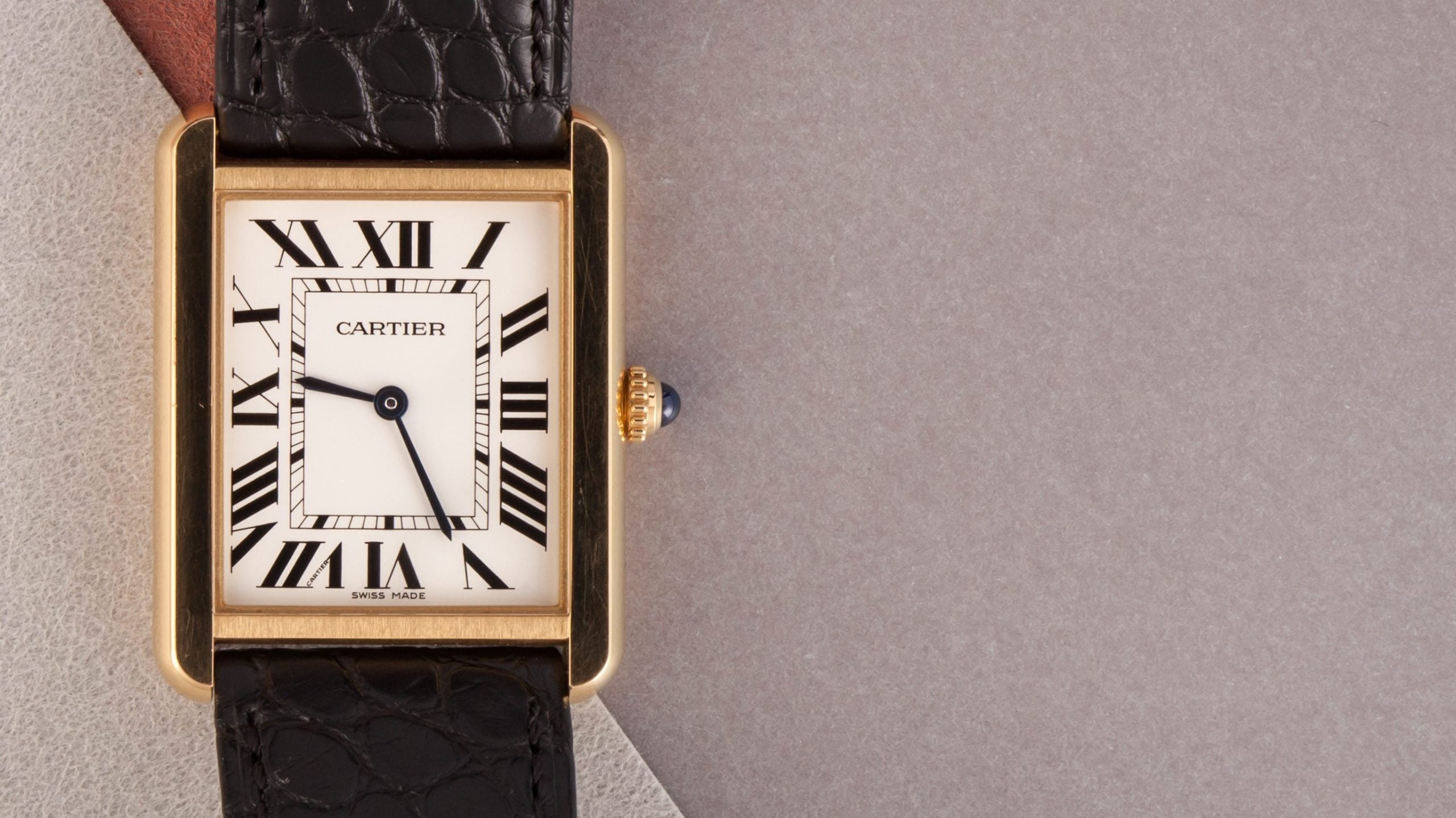
Within Cartier’s current hierarchy, the Tank Must is the entry point. It has the classic Tank Louis silhouette, with rounded brancards and traditional proportions, but in stainless steel rather than precious metals. Do not let the “entry-level watch” label take away from its significance, though. The Must line was originally created in the 1970s to help bring Cartier to a broader audience during the quartz crisis. Its 2021 revival returned to that same mission: accessibility without sacrificing the soul of the design.
The standard Tank Must runs on either a self-winding mechanical movement (extra large model only) or a high-efficiency quartz caliber with an eight-year battery life. Cartier also makes a SolarBeat version, which uses a photovoltaic cell hidden beneath the dial to power the watch with light, giving it a battery life of approximately 16 years. The Small measures 29.5mm x 22mm, and the Large comes in at 33.7mm x 25.5mm. Both are slim, elegant, and require almost no maintenance. If you want the iconic Tank look without the price tag of gold, the Must is a great choice. Retail pricing for the steel quartz models starts around $3,600.
| Specification | Tank Must Small | Tank Must Large |
| Case Material | Stainless Steel | Stainless Steel |
| Case Dimensions | 29.5mm x 22mm | 33.7mm x 25.5mm |
| Movement | Quartz or SolarBeat | Quartz or SolarBeat |
| Water Resistance | 30 meters | 30 meters |
| Approximate Retail Price | From ~$3,600 | From ~$3,800 |
Tank Louis Cartier: The Purest Expression

If the Must is the gateway, the Tank Louis Cartier is the destination. This model is exclusively offered in precious metals, either 18k yellow gold or rose gold, and it is the closest descendant of the original 1917 design. The brancards are softer and more rounded than on the Must, and the overall presence on the wrist feels distinctly classic. It was the founder’s favorite model, and it has been the preferred Tank among collectors and public figures for over a century.
Inside, the Tank Louis houses the in-house Caliber 1917 MC, a manual-wind mechanical movement. There are also some options powered by quartz. Unlike the quartz Must, this watch requires you to wind it by hand each day, which many enthusiasts consider part of the ritual of owning a fine timepiece. In 2025, Cartier also introduced the Tank Louis Cartier Automatic in a larger case (38.1mm x 27.75mm), powered by the Caliber 1899 MC. The automatic version brings a new dimension to the collection for those who prefer not to wind their watch daily. With retail prices starting around $13,400 for the manual-wind Small and reaching $16,400 for the new Automatic, the Tank Louis is a significant investment, but it is also the watch that most directly connects its owner to Louis Cartier’s original vision.
Tank Française: The Architectural Sport

In 1996, Cartier did something unexpected with the Tank formula. The Tank Française replaced the traditional leather strap with an integrated chain-link bracelet and gave the case a more angular, square shape. The result was a watch that wears more like a refined piece of jewelry than a traditional dress watch. By Cartier standards, it’s the “sporty” option, though it’s still elegant enough for any formal occasion.
The Française earned a devoted following quickly. Princess Diana was frequently photographed wearing her yellow gold Tank Française, and the model has recently gained renewed attention, partly due to the appearance of a similar square Cartier design on the wrist of Jackie Kennedy Onassis in the television series Love Story. The most popular versions are the full stainless steel models, which start in the mid-$3,000 range at retail. Gold options are also available, though they come at a higher price. The Tank Française is a strong option for anyone who prefers the practicality of a bracelet and plans to wear their watch every day.
Tank Américaine: The Elongated Curve

The Tank Américaine takes the rectangular Tank DNA and stretches it into something more fluid and contemporary. It’s a modern descendant of the 1921 Tank Cintrée, and its defining feature is its curved caseback, which is shaped to hug the wrist rather than sit flat on top of it. This gives the Américaine a sleek, almost sculptural profile that sets it apart from every other model in the lineup.
If you find the standard Tank to be too boxy or static, the Américaine has a bit more movement and grace. It’s currently available in steel or precious metal and with a quartz or an automatic movement. The Américaine is less of an everyday tool watch and more of a statement piece, a sophisticated choice for someone who already knows what they want from a watch and is looking for something with a bit more personality. Retail prices for current models typically start around $6,850 to $9,300 depending on the metal and configuration.
Cartier Tank Model Comparison at a Glance
The table below provides a side-by-side overview of the four main Tank models currently in Cartier’s catalog. Use this as a quick reference when narrowing down your options.
| Model | Key Details | Best For |
| Tank Must | Steel case | Automatic, Quartz or SolarBeat movement | Leather strap | From ~$3,300 | First luxury watch buyers; everyday wear |
| Tank Louis Cartier | 18k Gold (Yellow/Rose) | Quartz, Manual-Wind or Automatic (2025) | Leather strap | From ~$13,400 | Collectors; heirloom gifts; dress occasions |
| Tank Française | Steel or Gold | Quartz or Automatic | Integrated chain-link bracelet | From ~$4,300 | Daily wear; bracelet lovers; jewelry aesthetic |
| Tank Américaine | Steel or 18k Gold | Quartz or Automatic movement | Leather strap | From ~$9,300 | Those seeking a sculptural, contemporary profile |
Cartier Tank Size Guide: Finding the Right Fit
Choosing the right size is one of the most important decisions when buying a Tank, and it’s also where many first-time buyers make mistakes. Cartier’s sizing conventions can be confusing because the Tank doesn’t really follow the same rules as a round sports watch. A “Large” Tank is still a relatively compact watch by modern standards, and the proportions of a rectangular case sit differently on the wrist than a circular one.
As a general rule, the Small size works well for wrists under 6 inches, while the Large is a versatile option for wrists between 6 and 7.5 inches. Both sizes have the clean, balanced proportions that define the Tank’s identity.
The XL Exception: Why It Changes Everything
The Tank Must XL is a model that catches many new buyers off guard. At 41mm x 31mm, it is significantly larger than the standard Small and Large sizes, and it introduces two features that purists consider controversial on a Tank: an automatic movement and a date window. These features, in many ways, change the character of the watch. The dial is busier, the symmetry of the Roman numerals is interrupted by the date aperture, and the seconds hand adds visual complexity that the smaller models avoid.
None of this makes the XL a bad watch. It’s still very well-made and has a more tool-watch feel for those who want mechanical movement in a steel Tank. But if your goal is to own the classic, minimalist Tank look that has endured for over a century, most collectors and watch communities recommend sticking to the Small or Large sizes. The XL is a different proposition, and it is best to understand that distinction before making a purchase.
Watch: Decoding the Cartier Tank Lineup
This video walks through the Cartier Tank collection model by model. We begin with the Tank Must, often considered the entry point to the lineup, before moving on to the Tank Louis Cartier, which stays closest to the original 1917 design. From there, we look at the Tank Française, known for its integrated bracelet and its long association with Princess Diana, and the Tank Américaine, the elongated and curved interpretation of the classic shape.
The video also takes a closer look at the often misunderstood Tank Must XL, explaining how its automatic movement and date window set it apart from the standard Must sizes. If you are comparing models or trying to decide which version fits your style, the video serves as a helpful visual companion to the written guide above.
Do Cartier Tank Watches Hold Their Value?

Value retention is a common concern for anyone spending several thousand dollars on a watch. The short answer is that Cartier Tank watches hold their value reasonably well, though they behave differently on the secondary market than brands like Rolex or Patek Philippe. Most new Cartier watches experience some initial depreciation after purchase, similar to buying a new car. However, the Tank and Santos collections tend to retain more value than Cartier’s fashion-oriented lines because of their collector recognition and cultural significance.
Secondary market data from 2024 through 2026 shows that well-maintained steel Tank models generally hold between 65% and 75% of their retail price over a five-year period. Gold models and vintage pieces can perform even better, especially those with original documentation and box. Vintage Tank watches from the 1970s through the 1990s have seen notable appreciation, with certain rare references reaching well into five-figure territory at auction. The key factors that influence value retention are model rarity, case material (gold tends to hold better than steel), condition, and the completeness of original paperwork.
New vs. Pre-Owned: Where the Value Is
Buying pre-owned is often the smartest strategy for maximizing your investment in a Cartier Tank. Since most new Cartier watches trade below retail on the secondary market, you can purchase a like-new or gently worn Tank for a meaningful discount, sometimes 15% to 25% less than boutique pricing. This means the original owner has already absorbed the initial depreciation, and your watch is more likely to hold steady or even appreciate over time. The pre-owned market is also where you’ll find discontinued models and vintage references that are no longer available at retail, many of which carry significant collector interest.
What to Look for When Buying a Cartier Tank
Whether you are buying new from a boutique or pre-owned from a trusted dealer, there are several things to keep in mind that will help you make a confident purchase.
Authenticity and Documentation
Always verify that the watch is authentic. This means purchasing from a reputable source that provides a certificate of authenticity or, at minimum, detailed photographs of the watch’s movement and serial numbers. Original box and papers can add 10% to 20% to a watch’s resale value, so look for complete sets whenever possible. If you’re buying pre-owned, a dealer that offers authentication and a warranty provides an extra layer of confidence.
Condition and Service History
The condition of the case, crystal, dial, and strap or bracelet all factor into a watch’s value. Scratches on a stainless steel case can typically be polished out, but a cracked crystal or a faded dial may indicate neglect. Ask about the watch’s service history. Cartier recommends servicing mechanical watches every five to seven years, and a recent service from Cartier or a certified watchmaker is a positive sign. For quartz models, confirm that the battery has been replaced recently or that the watch is running accurately.
Movement Type: Quartz vs. Mechanical
Choosing between quartz and mechanical usually comes down to what you want from the watch. Quartz movements are more accurate, require less maintenance, and are more affordable. They are the practical choice for someone who simply wants a reliable, beautiful watch they can put on and forget about.
Mechanical movements, whether manual-wind or automatic, appeal to a different kind of buyer. They require regular winding or wearing, periodic servicing, and cost more, but they also tend to hold their value better on the secondary market. Neither choice is wrong. It really depends on the kind of relationship you want to have with the watch on your wrist.
Cartier Tank vs. Cartier Santos and Ronde: How They Compare
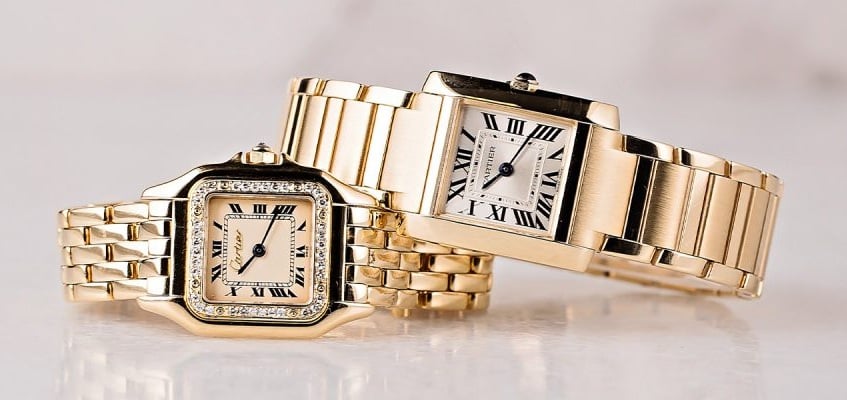
If you are considering a Cartier watch but are not yet sold on the Tank, it helps to understand how it compares to the brand’s other popular collections. The Cartier Santos, designed in 1904 for aviator Alberto Santos-Dumont, is the world’s first men’s wristwatch. It features a square case with exposed screws and an integrated bracelet, and is a sportier, versatile daily wearer. The Santos is available in steel, two-tone, and gold, with both medium and large sizes. If you prefer a bolder, more modern aesthetic and want a watch that transitions easily from the office to the weekend, the Santos may be the better fit.
The Cartier Ronde, by contrast, is a round-cased collection with a more traditional watch silhouette. It shares the Tank’s Roman numeral dial, blued hands, and cabochon crown, but in a circular case. The Ronde appeals to buyers who love Cartier’s design language but prefer the familiarity of a round watch. Among the three, the Tank remains the most iconic and the most collected, but the Santos and Ronde both have loyal followings. Ultimately, it comes down to which shape and style feels right to you, and which one you can imagine wearing for years.
Your Cartier Tank: Choosing the Right Model for Your Collection

The Cartier Tank is not the most expensive luxury watch you can buy, and it certainly isn’t the most complicated. What it has proven, after more than a century of continuous production, is that great design can outlast almost everything else in watchmaking. From the steel Tank Must that introduces the collection to new buyers, to the 18k gold Tank Louis Cartier that stays closest to the founder’s original vision, each model carries the same design language in its own way. Choosing the right Tank isn’t really about spending the most money. It’s about finding the version that fits your wrist, your lifestyle, and your sense of style.