The Rolex Air-King gives you the look and functionality of a professional Rolex without the usual sticker shock. It is one of Rolex’s oldest continuous models outside of the Oyster Perpetual, dating back to the 1920s and 1930s. The Air-King has always lived in that middle ground between tool watch and simple daily wearer, which is probably why it flew under the radar for so long. With updates like the newer ref. 126900, that’s starting to change.
Key Takeaways:
- Heritage: Came to market in 1945, making it older than the Submariner
- Value: One of the most affordable entry points into the professional Rolex catalog
- Design: Evolved from classic 34mm vintage styles to the bold 40mm “Bloodhound” dial configuration
- Status: Often underrated, offering strong investment potential and better availability compared to GMTs or Daytonas
A Pilot’s History: 5 Eras of the Air-King

It’s interesting to see how the Air-King has evolved since the 1940s. It started as a simple dress watch, eventually arriving at the sports watch collection as we know it today and all without losing its core DNA. Understanding each era in its evolution will help explain overall collector appeal and current pricing demands.
Era 1 (1945): The “Air” Series Origins
The lineage of the Air-King starts as a commemorative series dedicated to the British Royal Air Force pilots fighting in the Battle of Britain. Rolex designer Hans Wilsdorf wanted to dedicate an entire line of “Air” watches to them including the Air-Lion, Air-Giant, and Air-Tiger. Some of these early references such as the 4925 and 4499 are very rare today.
Rolex even excludes this period from their timeline making these early watches as more of a variant of the Oyster Perpetual instead of a true Air-King lineage. Interestingly, many of the earliest examples never even said “Air-King” on the dial. That’s part of the appeal today, especially for collectors drawn to aviation history and lesser-seen Rolex references, even if tracking down solid documentation can be tricky since these luxury watches don’t always show up cleanly in the brand’s archives.
Era 2 (1958-1989): The Classic Reference 5500

The Rolex 5500 is what many would call the ultimate vintage Rolex Air-King. Designed and produced for over thirty years, this original 34mm time-only watch set the style for generations of Air-Kings to come. A simplistic dial, stark hands and lack of date function gave the watch its clean lines we desire from a tool watch strictly for telling time.
The 5500 used more than just one movement. Early watches had the caliber 1530, before Rolex moved to the 1520 sometime in the 1960s. Even though both movements could be chronometer-rated in other models, the Air-King never was and by design as an entry-level watch. Also, you’ll see the dials marked with either “Precision” or “Super Precision,” which actually reveals quite a bit about each variant of the watch. “Precision” Air-Kings have a 17-jewel movement (cal. 1520), while “Super Precision” models use higher jewel counts of 25 or 26 (cal. 1530). That small line of text ends up making a real difference in value today.
Era 3 (1989-2006): The Modern Bridge (Ref. 14000)

Ref. 14000 carried the Air-King into the modern era and without changing things too much, including its familiar 34mm size and no-frills design set. The acrylic crystal gave way to tougher sapphire and the 15XX movements were swapped out for the higher-beat cal. 3000 and then later cal. 3130.. Options also increased, now offering colors like salmon, blue, white and black dials.
The Rolex 14010 featured an engine-turned bezel option for customers desiring a bit more style on their Air-King than the ubiquitous smooth bezel offered. Rolex introduced another revision to the line in 2000 with the release of the 14000M. The new movement, Caliber 3130, featured improvements such as a Breguet overcoil and a full balance bridge. Neither the Caliber 3000 nor 3130 movements used in these references were COSC certified, as keeping production costs down helped keep the Air-King’s prices accessible.
Era 4 (2007-2014): The Super Case (Ref. 114200)
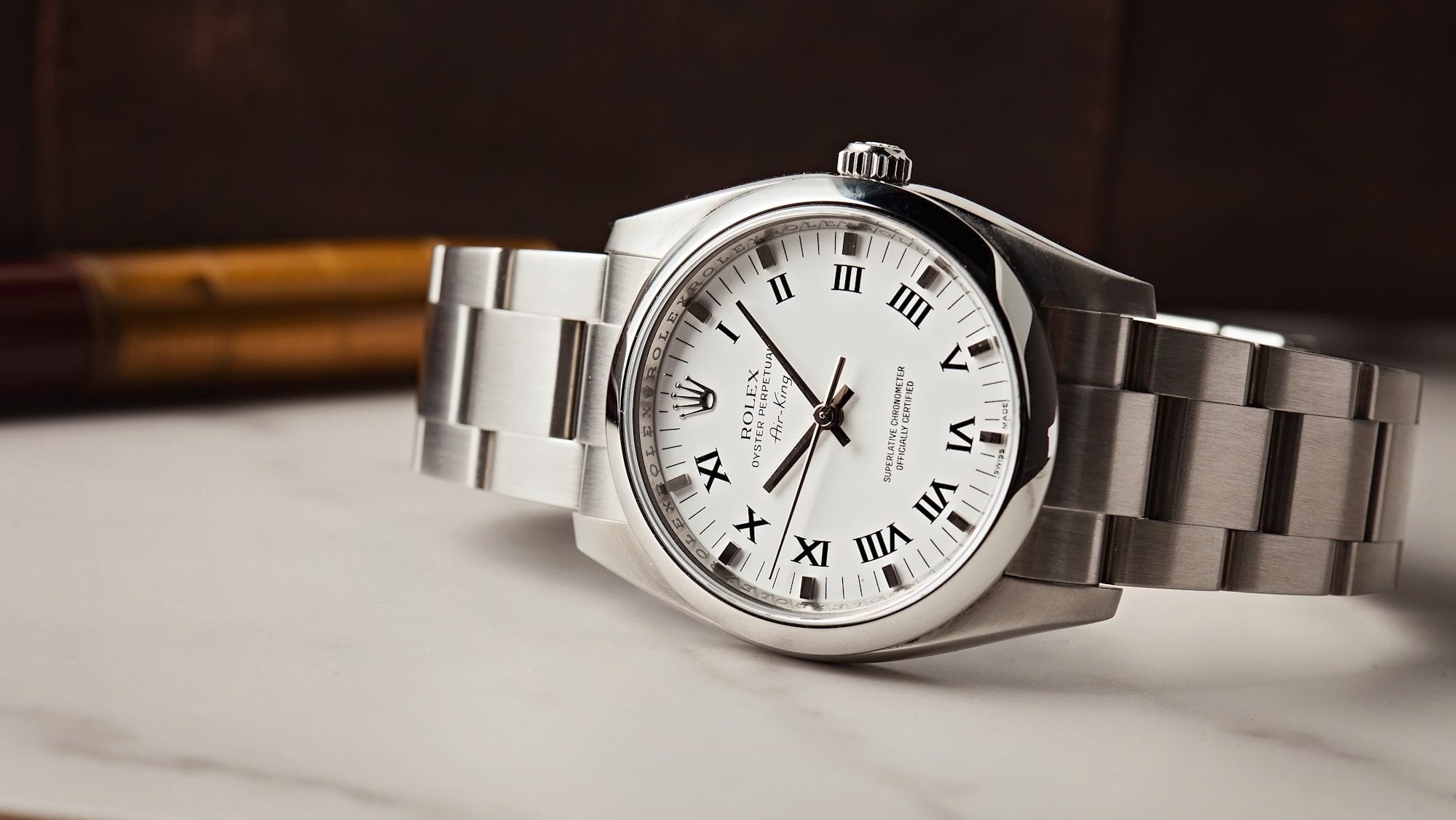
The Rolex 114200 updated the Air-King to modern standards of wider lugs and a thicker appearance on the wrist without increasing the case diameter beyond 34mm. Modern features such as solid-link 904L Oyster bracelets were used for the first time as were COSC-certified movements in an Air-King watch. The Caliber 3130 movement used in this generation would FINALLY receive chronometer certification as well, putting the Air-King on par with every other Rolex watch.
Editions with 18k white gold fluted bezels were produced during this generation as were ultra-luxurious versions with diamond-set dial markers. This version didn’t enjoy the same long run as the ref. 5500. That watch was in production for more than three decades. Even so, it’s attracting a small but growing following among collectors in the know. When Rolex finally pulled the plug on the Air-King in 2014, it quietly closed the book on nearly 70 years of continuous production.
Era 5 (2016-Present): The New Identity (Ref. 116900 & 126900)

Rolex brought back the Air-King line after two years in 2016. The new model was completely redesigned. Rolex 116900 expanded to 40mm and incorporated the Milgauss case design with a soft-iron inner casing to guard against magnetic fields of up to 1,000 gauss. The dial on this iteration was named “Bloodhound” after the Bloodhound SSC land speed record car. It features oversized 3-6-9 hour markers and a controversial green and yellow logo combination.
In 2022, the Air King got its very own case via Rolex 126900. It was thinner and now had crown guards like other professional series watches. It also housed a newer movement, caliber 3230 with a longer 70-hour power reserve. Upgrades extended to the dial also, with a new “05” marker for better balance and lumed 3/6/9 Arabic numerals. The newest version is Rolex’s most capable edition yet, with improved materials and a price point that still falls below most other Rolex tool watches.
At a Glance: The Rolex Air-King Specs
Vintage & Transitional Models
| Feature | Ref. 5500 (1958-1989) | Ref. 14000 (1989-2006) |
| Case Size | 34mm | 34mm |
| Movement | Cal. 1530/1520 | Cal. 3000/3130 |
| Water Resistance | 100m | 100m |
| Lume | Tritium | Tritium/Luminova |
| Crystal | Acrylic | Sapphire |
| COSC Certified | No | No (Yes on Ref. 114200) |
Modern Models
| Feature | Ref. 116900 (2016-2022) | Ref. 126900 (2022-Present) |
| Case Size | 40mm | 40mm |
| Movement | Cal. 3131 | Cal. 3230 |
| Water Resistance | 100m | 100m |
| Lume | Chromalight | Chromalight |
| Crystal | Sapphire | Sapphire |
| COSC Certified | Yes | Yes |
Watch: Will the Air-King Ever Have Its Big Moment?
Join the team at Bob’s Watches as we analyze transaction data and explore the history of the Air-King to answer one of the most interesting questions in the pre-owned Rolex market: Is the Air-King the brand’s most undervalued asset? This video breaks down price trends, collector sentiment, and market positioning to help you understand whether now is the right time to add an Air-King to your collection.
Case and Design Updates

The largest aesthetic difference between the new and old reference is the inclusion of crown guards. These were conspicuously absent from the previous iteration, but add visual weight to the watch so that it feels more integrated and purpose-designed. It also visually aligns this model with other Rolex professionals. The case profile has moved away from the rounded, Milgauss-derived look of its predecessor and sports much more slab-sided design elements that help distinguish this Air-King.
At 40mm, this is a watch that works on a wide range of wrists and never feels oversized. The case has a slimmer profile and is easier to wear than the dimensions might suggest than the previous 116900. And Rolex’s case finishing is exactly what you’d expect. There’s clean brushed surfaces, subtle polished elements, and that mix of textures the brand does so well. The Oyster bracelet feels solid on the wrist. It has an Oysterlock clasp and the handy 5mm Easylink extension for quick adjustments throughout the day.
The “Bloodhound” Dial

The dial is probably the most divisive aspect of the new Air-King. Large 18k white gold 3-6-9 numerals now filled with Chromalight cover most of the dial while big obnoxiously pointy minute markers at 5 minute intervals consume what little space is left. While the green “ROLEX” script paired with the yellow crown Rolex logo is an uncommon color scheme on today’s Rolex models, it does tie into the partnership Rolex has with Bloodhound SSC.
The Rolex 126900 improved dial legibility with enhanced Chromalight lume applied to the large numerals, a feature absent from the previous reference. The addition of the “05” minute marker, which was missing on the 116900, creates better visual balance. While traditionalists may prefer simpler designs, the busy dial serves its intended purpose remarkably well, providing instant readability under various lighting conditions and orientations.
Movement and Performance

Powering the 126900 is Rolex’s newest time-only movement. It has a 70-hour power reserve compared to previous Air King movements at 48 hours. Also, the movement uses Rolex’s Chronergy escapement for even better efficiency and the Paramagnetic blue Parachrom hairspring for anti-magnetism. The movement has full COSC certification as a chronometer, calibrated to -2/+2 seconds/day.
While Reference 116900 had incorporated the soft-iron Faraday cage found on the Milgauss to protect against magnetism, Rolex instead uses the inherent anti-magnetic properties of the modern movement materials and architecture to sufficiently protect the 126900 for daily life. While the Rolex 116900 reference could withstand magnetic fields up to 1,000 gauss, the 126900 provides sufficient protection for everyday situations without the added weight and thickness of an inner shield.
On the Wrist
The Air-King 126900 fits better on the wrist than the previous version thanks to an improved case design. 40mm across, it has a comfortable presence on the wrist and doesn’t feel large. The lug-to-lug distance isn’t overly large so those with smaller wrists shouldn’t have any problems
At 11.5mm thick, this watch shouldn’t have problems fitting under shirt cuffs like some beefier sports watches can. It doesn’t feel too heavy or too light on the wrist due to a solid bracelet and heavy weight of Oystersteel. The dial elements in green and yellow are just funky enough to make you say something to the wearer.
Buying Guide: Key Air-King Variations to Know
Beyond the standard production models, certain Air-King variations have developed cult followings among collectors. Understanding these special editions and variations helps buyers identify potential value opportunities and historically significant pieces that may appreciate more aggressively than standard references.
The “Dominos” Rolex

Corporate dial Air-Kings are easily the oddest corner of the vintage market. Rolex created special dials emblazoned with company logos for bulk purchasers that gave watches to employees as gifts or awards. The most well known of these are the Dominos Pizza Air-Kings awarded to franchise owners that hit sales goals. There are also corporate dials from Winn-Dixie supermarkets, and regional businesses around the country.
These watches were originally given away as promotional items and held little collector interest for decades. Nowadays that has changed and corporate dial Air-Kings can demand heavy premiums thanks to their scarcity and kitschy appeal. After all, who wouldn’t want to own a luxury watch with a pizza logo stamped across the dial?
The Precision vs. Super Precision
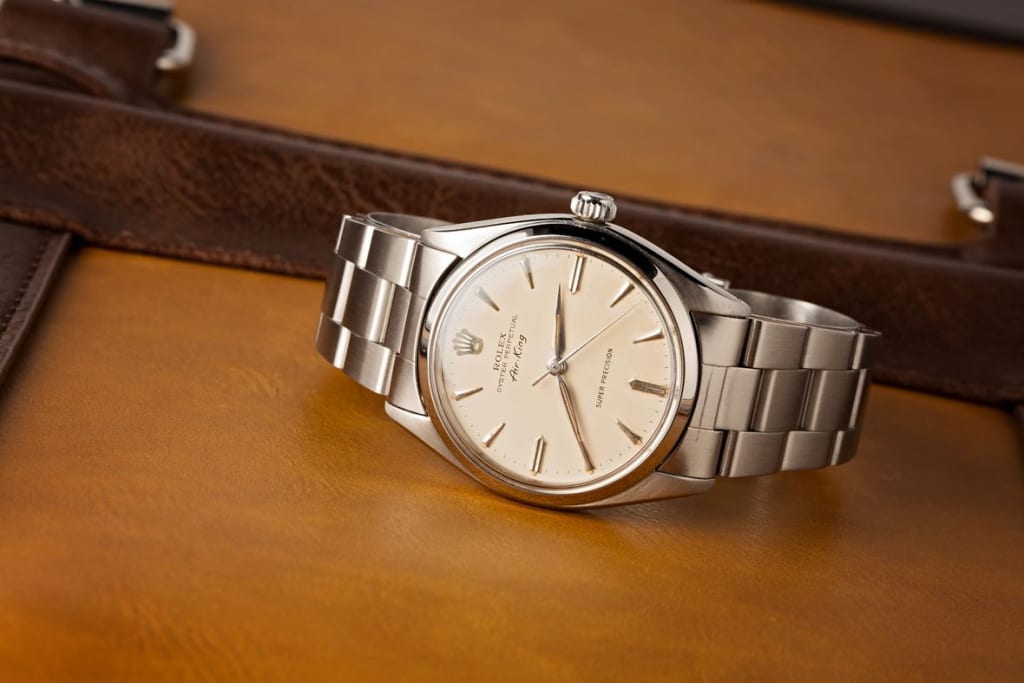
Vintage Reference 5500 dials can have either “Precision” or “Super Precision” stamped on the dial. This refers to the number of jewels in the movement. The original 17 jewel Caliber 1520 movement on this vintage Rolex watches was labeled Precision. The later 25 or 26 jewel movements were labeled Super Precision. As jewel count can indicate better timekeeping ability and craftsmanship many collectors prefer the Super Precision versions.
On vintage Air-Kings you can tell which movement is in the watch by simply looking at the dial. Super Precision watches will typically be worth more however the condition of the dial, movement and originality of the watch should also play a factor. Some collectors might even try to obtain a pair of both watches to display side by side.
The Date Variation (Ref. 5700)
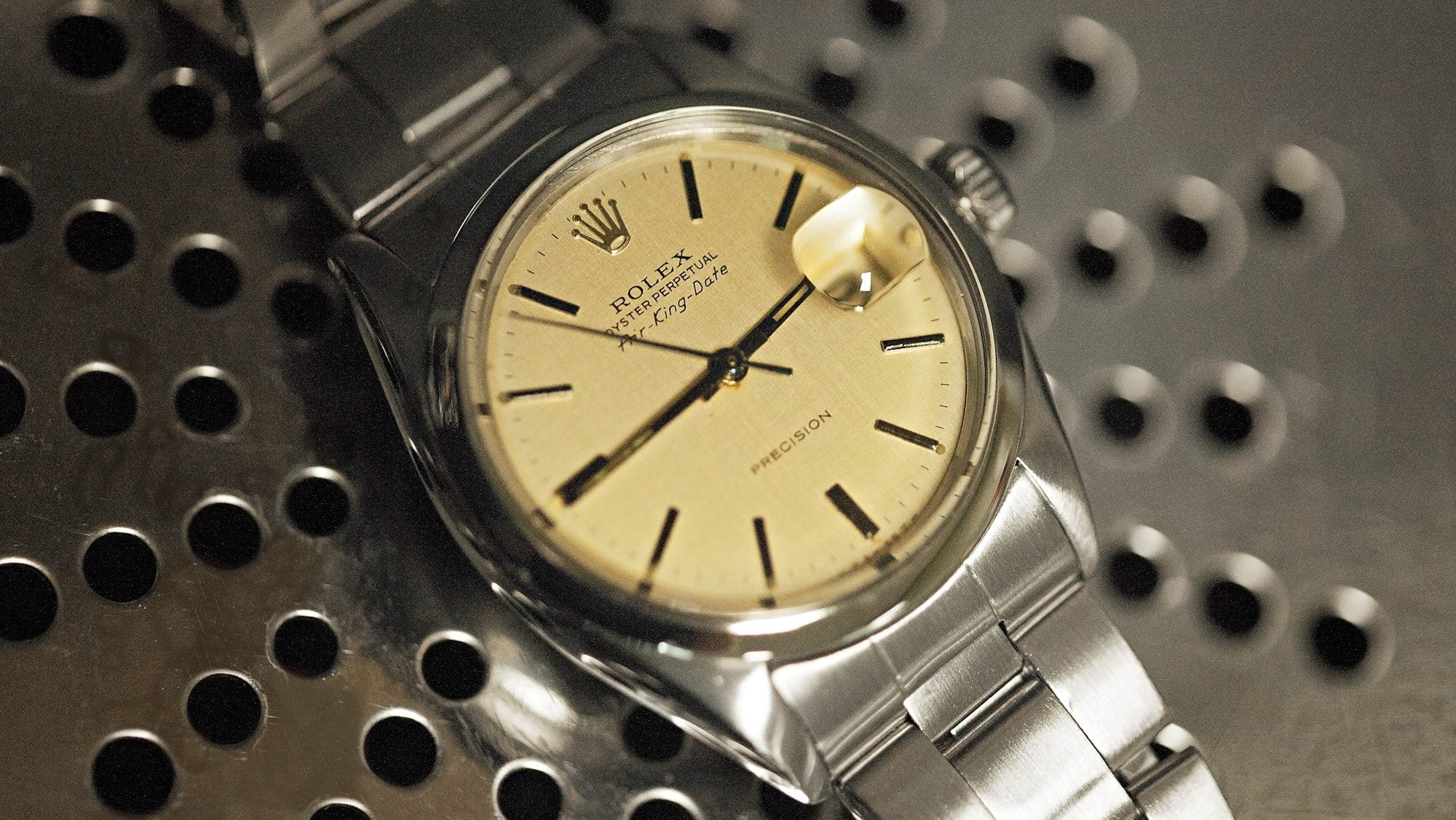
In addition to time-only variants of the Air-King collection, Rolex also made a Date version designated as Reference 5700. These are much rarer than time-only versions, but add an intriguing piece to Rolex’s most minimalist collection. They feature the date window at 3 o’clock. Date-only variants of the Air-King are rare.
These date watches hold an interesting place in Air-King history as they show Rolex willing to toy around with the formula. Those who search for rare pieces in the Air-King line might want to seek out this model. However, most collectors tend to prefer the simplistic appearance of the time-only models as it keeps with the reason the Air-King was created in the first place: to be worn by pilots.
Rolex Air-King Price & Investment Analysis

The vintage Air-King market has been strong for the past 15 years with all reference numbers continuing to appreciate year-over-year. Through analyzed sales from Bob’s Watches transactions the Air-King hit an all-time average price high in 2025, with values roughly tripling since 2010. While we saw a softening in the luxury watch market in 2023 prices for the Air-King did not dip and have remained on the uptrend.
Individual vintage Reference 5500 watches that sold for less than $3,000 ten years ago are averaging around $5,000 today. Thanks to growing interest in vintage Rolex watches in general and newfound awareness of the Air-King’s pedigree and craftsmanship there is little left of the “$3,000 Rolex” myth. Investment potential has been proven even with the oldest/entry level models.
2025 Average Market Prices
| Reference | Model Era | 2025 Price |
| 126900 | Current (Crown Guards) | $9,286 |
| 116900 | Discontinued (Milgauss Case) | $8,178 |
| 114200 | Modern 34mm | $5,762 |
| 14000 | Sapphire Vintage | $5,300 |
| 14010 | Engine-Turned Bezel | $5,213 |
| 5500 | Vintage Classic | $5,000 |
The Reference 14010 presents an interesting value proposition at around $5300. This pricing tier may represent an opportunity for collectors seeking something visually different at a more accessible price point. The engine-turned bezel adds character without significantly increasing production costs, making it a smart choice for those building a collection on a budget.
The approximately $1,100 pre-owned price difference between the discontinued Reference 116900 and the current 126900 reflects several factors. The 116900 features the Caliber 3131 with a genuine Faraday cage providing enhanced magnetic protection, a unique technical selling point. Some collectors prefer this specification despite the watch being discontinued, viewing the anti-magnetic cage as superior to the material-based protection of the newer model. However, the 126900’s crown guards and refined proportions appeal to those seeking Rolex’s latest design language.
Air-King vs. Explorer vs. Oyster Perpetual

Comparing the Air-King to its closest relatives helps collectors decide which one is right for them. The three lines exist in the same price bracket and all share the time-only configuration. Despite these similarities each timepiece appeals to different types of buyers.
The Explorer is the most traditional and utilitarian. Born on mountaineering adventures and perfected over generations, this watch has the largest use-case due to its smaller 36mm case and all-around history. The Oyster Perpetual has the simplest and cleanest look of the bunch thanks to its offering of various dial colors. This model attracts buyers who desire a sporty Rolex without obvious ties to tool watches.
Last is the current Air-King. Bold and brash with its busy dial and aviation background. This watch attracts buyers who desire something a bit different from their Rolex. While the Explorer exudes subtle sophistication and the Oyster Perpetual has sleek versatility the Air-King roars down the page. This lends itself to the Air-King being somewhat polarizing as a timepiece. Those who don’t appreciate it tend to not care for it at all.
Why The “Underdog” Status is Your Advantage
Rolex‘s forgotten pilot’s watch, the Air-King presents some real opportunities for purchasers. Don’t have your name on allocation lists for GMT-Masters and Submariners? No worries, Air-Kings are readily available at dealers and much more common on the pre-owned market. The advantage of this means that you can purchase and wear your watch within a few days instead of waiting months or years to do so.
Once you start diving into the specs, the deal gets even sweeter. The Air-King boasts the same 904L Oystersteel used on watches double the price, equivalent finishing and quality control, and a movement with a 70-hour power reserve from Rolex’s current generation. You get genuine Rolex quality and performance without paying the premium associated with more famous model names.
At Bob’s Watches, we see the Air-King as a sleeping giant in the Rolex catalog. Whether you seek a vintage 5500 for its classic proportions and historical significance or the latest 126900 for its modern capabilities, the Air-King offers an entry into the Crown that few other models can match in terms of value. The combination of accessible pricing, strong build quality, and distinctive character makes it an ideal choice for both first-time buyers and experienced collectors looking to diversify their holdings.