
Cartier Watch Buying Guide
Buying a Cartier watch comes down to four decisions: collection (Tank, Santos, Ballon Bleu, or Panthère), movement (quartz or mechanical), material (steel, 18k gold, or vintage vermeil), and market (current retail or pre-owned). Across our luxury watches sold data, the typical pre-owned Cartier watch sells for about $5,000.
Key Takeaways
- Cartier is a serious watchmaker as well as a historic jewelry house, with in-house calibers and a design legacy dating to 1847.
- The Tank, Santos, Ballon Bleu, and Panthère are the four pillar collections, and each one serves a different kind of buyer.
- Quartz Cartier models cost less and need less maintenance, while mechanical models carry more traditional horological value.
- Cartier watches generally hold value well on the pre-owned market, with solid gold pieces and steel icons retaining the most.
- Pre-owned buying can save thousands versus current retail, but only through a dealer who verifies the movement, dial, and secret signature.
Below, we break the catalog into its functional pillars, spotlight the references we would actually recommend to a friend, and walk through the checks that separate a smart purchase from an expensive lesson.
Is Cartier a Serious Watch Brand?

Cartier is a serious watch brand as well as a historic jewelry house. Founded in Paris in 1847 by Louis-François Cartier, the Maison created some of the first purpose-built wristwatches and today Cartier produces in-house mechanical calibers alongside its quartz collections. Industry estimates consistently place Cartier second only to Rolex in global Swiss watch sales.
In our opinion, the old "just a jeweler" dismissal says more about the person repeating it than about Cartier. The brand invented the modern shaped watch, ran the collector-revered Collection Privée Cartier Paris program from 1998 to 2008, and continues it today through the Cartier Privé limited editions that sell out on announcement. What we see in the pre-owned market backs this up: demand for core Cartier references is deep, steady, and growing, and our Cartier inventory now turns quickly. Buyers who already own sport watches from other brands come to Cartier for a design language nothing else offers.
The Cartier Catalog: Four Pillars and Where to Start
The Cartier catalog organizes cleanly into four pillar collections plus a group of collector-focused shapes. The Tank and Santos-Dumont anchor the dress side, the Santos and Pasha cover everyday and sport-leaning wear, the Ballon Bleu is the versatile round option, and the Panthère is the jewelry-watch hybrid. Nearly every configuration is available on the secondary market, and browsing pre-owned Cartier watches side by side is the fastest way to learn which case shape suits your wrist.
Cartier Tank
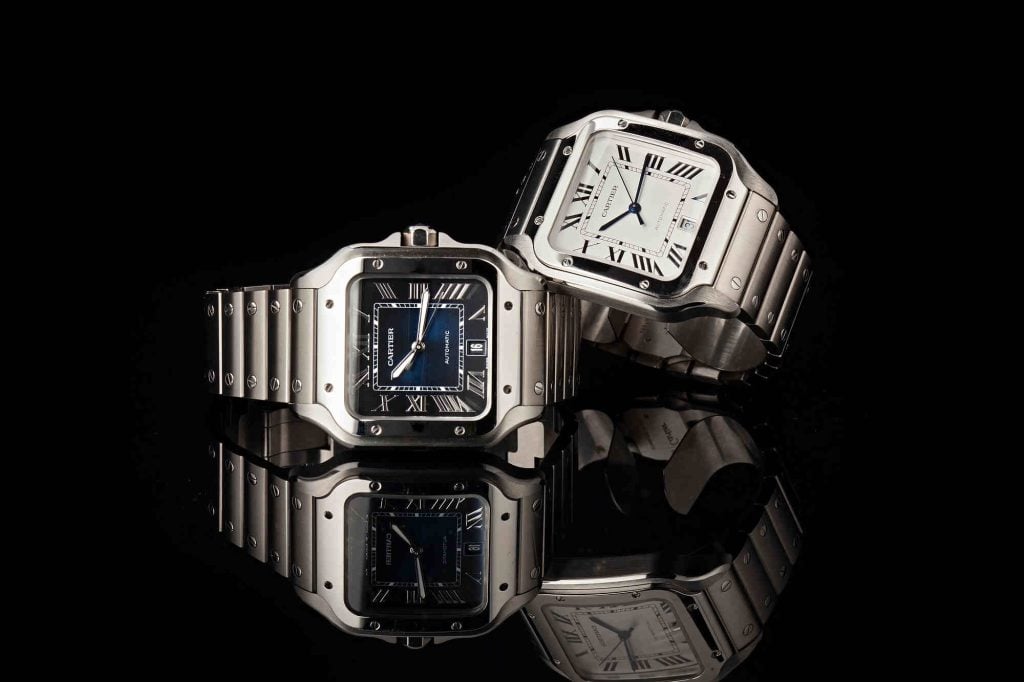
The Cartier Tank is a rectangular dress watch introduced by Louis Cartier in 1917, its linear case inspired by the silhouette of the tanks deployed on the Western Front of World War I. More than a century later, the family spans the quartz Tank Must at the entry level, the Tank Française on its integrated bracelet, the curved Tank Americaine, and the Tank Louis Cartier in precious metal. The Tank Must relaunch of 2021 added the SolarBeat photovoltaic movement, which Cartier rates for roughly 16 years between services.
Our sold data from January 2025 through September 2026 puts the Tank family between roughly $1,800 and $27,000 on the pre-owned market, with the quartz Tank Must at a median sold price of $3,995 and the Tank Louis Cartier at a median of $8,245. In our view, the Tank Louis Cartier in yellow gold is the single best pure dress watch Cartier makes, and one of the best from any brand at its price. For a deeper model-by-model breakdown, read our dedicated Cartier Tank buying guide.
Santos de Cartier

The Santos de Cartier is a square-cased sports watch defined by its exposed screws, sword hands, and beaded crown. Louis Cartier created the Santos in 1904 for the Brazilian aviation pioneer Alberto Santos-Dumont, making it one of the first wristwatches ever designed for men and the first built specifically for a pilot.
The 2018 relaunch modernized the collection with the QuickSwitch interchangeable strap system and SmartLink tool-free bracelet sizing, and it is the reason the Santos has become, in our opinion, the strongest one-watch answer in the entire catalog. It dresses up under a cuff and shrugs off daily wear in steel. In our sold data, the modern pre-owned Santos de Cartier carries a median sold price of $7,195, with most examples landing between $6,000 and $16,000, and the typical example sells within about eight days of listing, among the fastest turnover of anything we stock. Vintage Santos references, including the Galbee, start well under $5,000. Learn more about this model by visiting our Cartier Santos buying guide.
Ballon Bleu de Cartier

The Ballon Bleu de Cartier is a round watch introduced in 2007, recognizable by the blue cabochon crown tucked inside an integrated guard on the case flank. Its domed profile flatters almost every wrist, which explains why it has become one of the most gifted luxury watches we sell. In our sold data, used Ballon Bleu watches range from about $3,300 for quartz models to nearly $30,000 in gold, with a median sold price of $5,995. It is also the slowest mover of the four pillars in our inventory, which makes it the pillar where patient buyers find the best negotiating room. Our honest advice: confirm exactly which movement a given reference carries before paying an automatic premium, because case size alone does not tell you whether the watch is quartz or mechanical. For a full breakdown of the model, be sure to visit our guide on the Cartier Ballon Bleu watch.
Panthère de Cartier

The Panthère de Cartier is a jewelry-first watch introduced in 1983 and relaunched in 2017, built around a fluid brick-link bracelet and a slim square case. Its design descends from the panther motif that jewelry director Jeanne Toussaint made the emblem of the house. Nearly all pre-owned Panthère models run quartz movements, which keeps them thin and low-maintenance. In our sold data, Panthère examples range from about $2,700 in steel to nearly $30,000 in gold with diamonds, with a median sold price of $6,495, and the typical Panthère sells within ten days of listing, the fastest of the four pillars. Learn more when you visit our Cartier Panthere buying guide.
Beyond the Pillars: Pasha, Santos-Dumont, Baignoire, and Crash

Four more families matter to buyers. The Pasha de Cartier, launched in 1985 and relaunched in 2020, is the round sport-dress hybrid with a chained crown cap. The Santos-Dumont collection is the slim, elegant sibling of the Santos for buyers who want the square case without the bracelet presence. The Cariter Baignoire, introduced in 1957, is the oval cocktail watch currently having a genuine fashion moment. And the Crash collection, born in London in 1967 with its melted asymmetric case, is the brand's avant-garde grail: production is tiny and examples routinely command six figures at auction. Discontinued modern lines such as the Roadster, Drive, and Clé survive only on the pre-owned market, and several are quiet value picks.
Go Deeper: Cartier Collection Guides
Model-by-model breakdowns of the collections covered in this guide.
- Pasha de Cartier Ultimate Buying Guide History, references, and what to check before buying a Pasha.
- The Cartier Crash: A Curious Piece of Art and History How a melted case from 1967 became the brand's ultimate collector grail.
Quartz vs. Mechanical: Which Cartier Movement Is Better?
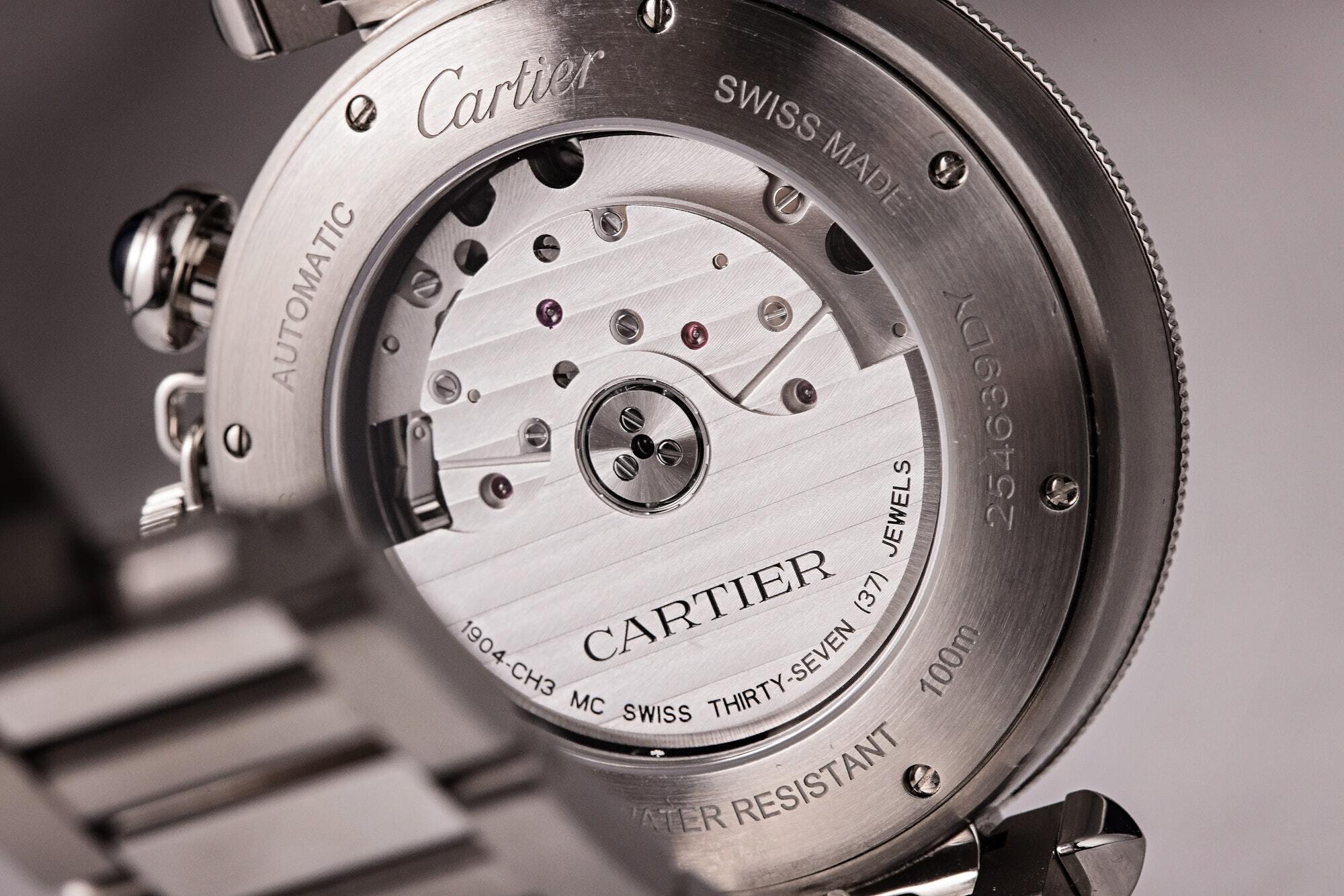
Neither quartz nor mechanical is universally better in a Cartier; the right movement depends on how you wear the watch and what you want it to be worth later. Quartz models cost less, run thinner, and ask nothing of you beyond a battery change, which makes them the practical choice for occasional wear. Mechanical models cost more to buy and to service, but they carry the traditional watchmaking value that collectors pay for, and they dominate the upper end of the catalog.
The Cartier caliber 1847 MC is an in-house automatic movement introduced in 2015 and named for the year of the Maison's founding. It powers the current Santos de Cartier and uses nickel phosphorus components in its escapement, which resist the everyday magnetic fields produced by phones, laptop cases, and bag clasps.
Our opinion, having handled both sides of the catalog daily: under about $4,000, quartz is the smarter first Cartier, and the SolarBeat Tank Must is the best low-maintenance dress watch on the market. Above $6,000, we steer most buyers toward mechanical references, because that is where long-term demand concentrates. Budget for a mechanical service every five to seven years.
Do Cartier Watches Hold Value?

Cartier watches generally hold their value well on the pre-owned market, and certain references can appreciate over time. Our own sold data makes the case directly: between 2025 and 2026, the median Cartier sold price at Bob's Watches rose from about $4,600 to about $5,300, an increase of roughly 15 percent, and the typical Cartier sold within 14 days of listing, matching the pace of our Rolex inventory. Cartier values tend to be stable and predictable rather than prone to the sudden spikes seen in certain Rolex sports models, and in our experience that stability is a feature, not a weakness: buyers know roughly what a Santos or Tank will be worth in three years, which makes upgrading painless.
Retention is not uniform across the catalog. Solid 18k gold pieces hold value best because the metal itself sets a floor. The Santos and Tank are the most traded Cartier families in our sales, and demand converts fast: the modern Santos de Cartier and the Tank Française each typically sell within about eight days of listing, with the Panthère close behind at ten. The Ballon Bleu moves more slowly, and discontinued fashion-era models and heavily customized pieces retain the least. Condition, originality, and a complete set with box and papers all move the number meaningfully. No Cartier purchase guarantees a profit, and we would never advise buying one purely as an investment; buy the watch you want to wear, and let stable resale value be the safety net.
Materials and Sizing: Steel, Gold, and Vermeil
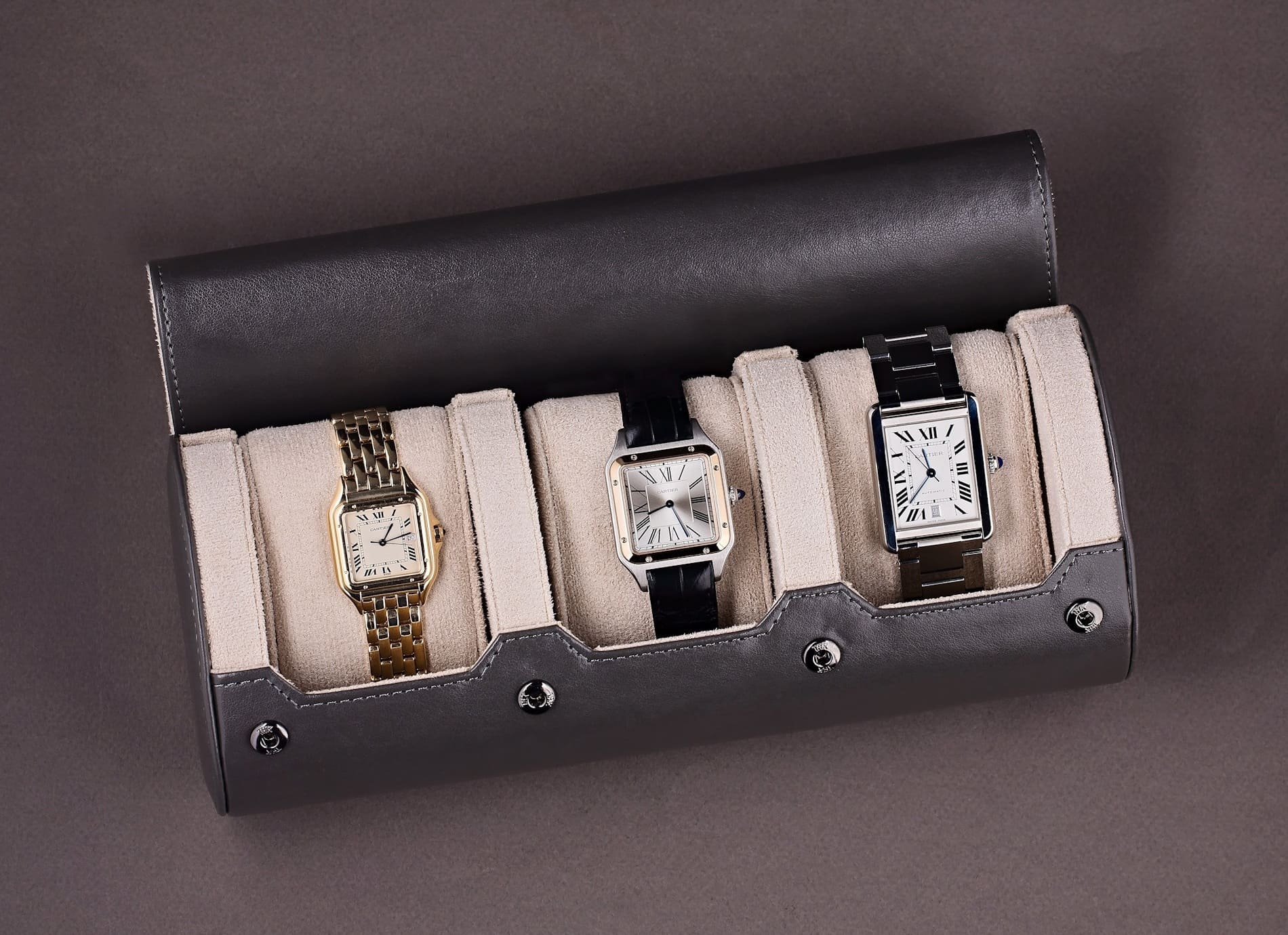
Cartier builds its watches in three material tiers that behave very differently as ownership propositions. Stainless steel tolerates scratches, polishes well, and suits daily wear. Solid 18k gold costs the most upfront and retains secondary market value best. Gold vermeil, a layer of gold over sterling silver used heavily in the vintage Must de Cartier line launched in 1977, offers the classic gold Tank look at entry prices, but the plating wears through at the case edges over decades and periodic re-plating is part of the cost of ownership.
On sizing, remember that Cartier labels many models Small, Medium, and Large rather than quoting a single diameter, and that shaped cases wear differently than round ones. A rectangular Tank wears smaller than its length suggests, while the domed Ballon Bleu wears larger than its stated diameter. Try the shape on, or measure your wrist against the published case dimensions, before assuming a size.
What to Check Before Buying a Pre-Owned Cartier
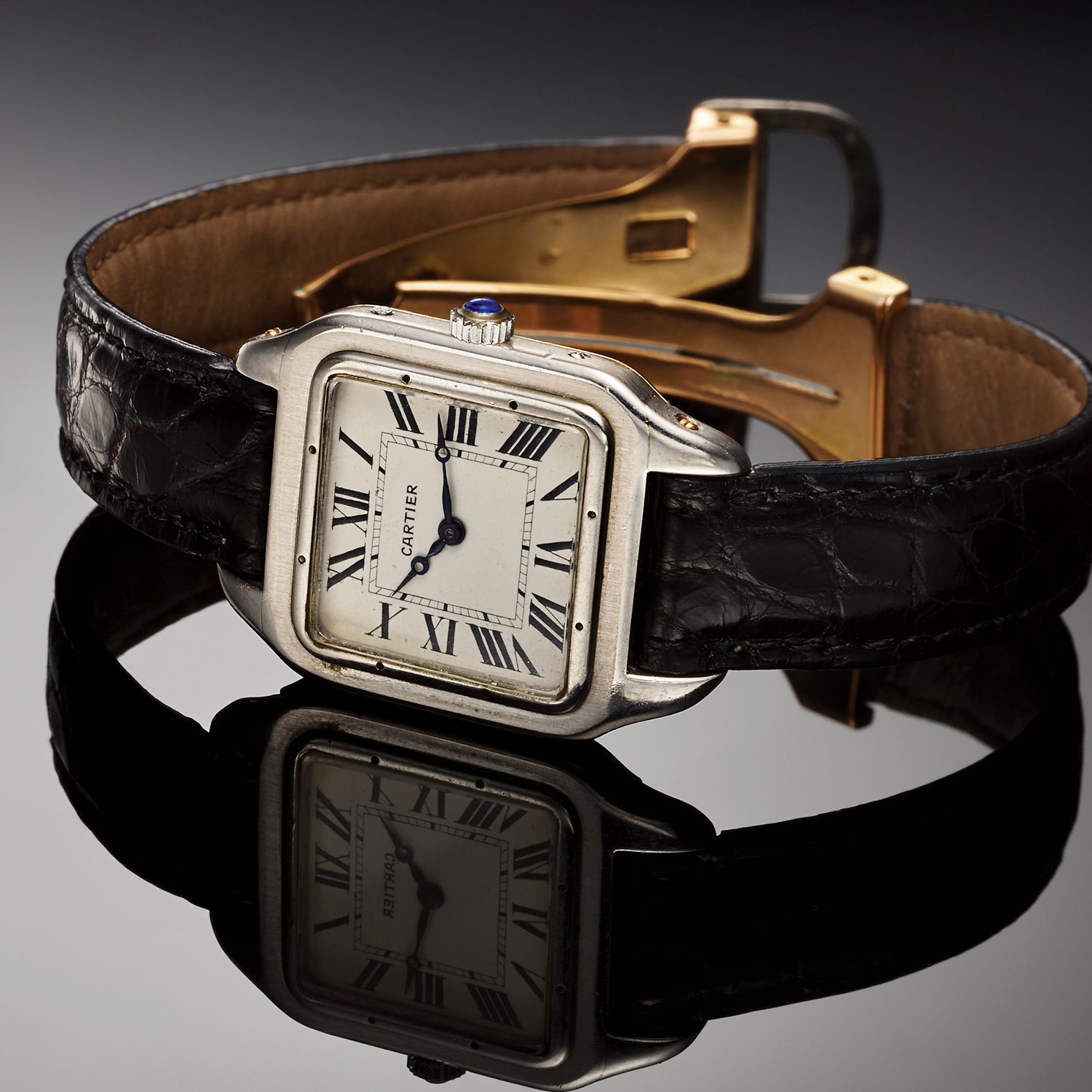
Every pre-owned Cartier deserves the same six-point inspection we perform in-house before a watch is listed. Cartier's popularity makes it one of the most counterfeited luxury brands, and the fakes have improved, so a disciplined checklist matters more here than with almost any other maker.
- Secret signature. Cartier hides the word "Cartier" in tiny script inside a Roman numeral on most dials, often within the VII. It takes a loupe to see, and counterfeiters rarely execute it correctly.
- Case and serial numbers. The reference and serial engraved on the caseback should be crisp, correctly formatted, and matched to any accompanying papers.
- Correct movement. Open-caseback or watchmaker verification confirms the caliber matches the reference; swapped quartz movements inside mechanical-spec cases are a known franken trap.
- Dial originality. Refinished vintage dials and aftermarket diamond-setting both cut resale value sharply, no matter how clean they look.
- Vermeil and plating wear. On Must de Cartier pieces, check the case edges and lugs for brassing, and price in re-plating if you find it.
- Bracelet, crown, and cabochon. Panthère brick links should articulate without sag, and the sapphire or spinel cabochon in the crown should be free of chips.
Condition language varies wildly between sellers, which is why we grade every watch against our published watch condition grading scale rather than leaning on adjectives.
"Every Cartier that comes through our doors gets the same inspection a Rolex does: movement, case, dial, and paperwork. The first thing our watchmakers check is the secret signature hidden in the Roman numerals, because it is the one detail counterfeiters almost never get right."
Where to Buy: Cartier Boutique vs. the Pre-Owned Market

You can generally walk into a Cartier boutique and buy most watches the same day, which is a genuine difference from the waitlists attached to steel sports models at some other brands. Buying at current retail gets you the full international warranty, the latest catalog, and the boutique experience, at the highest possible price. A handful of high-demand references and Cartier Privé limited editions are the exception, allocated to established clients.
The pre-owned market flips those trade-offs. Savings versus current retail are often substantial, discontinued collections like the Roadster and Drive are only available secondhand, and vintage pieces with real patina simply do not exist at retail. The entire decision comes down to the seller: an authenticated pre-owned Cartier from a reputable dealer with a warranty and return policy carries essentially the same ownership confidence as a boutique purchase, while a private-party bargain with no verification carries all of the risk we outlined in the checklist above.
Cartier Price Tiers: Entry-Level to Grail
Cartier pricing on the pre-owned market breaks into three practical tiers. The ranges below reflect actual Bob's Watches sold prices from January 2025 through September 2026, not current retail.
|
Tier |
Typical Pre-Owned Range |
Representative Models |
|
Entry-Level |
Roughly $1,400 to $4,500 |
Must de Cartier vermeil, Tank Must quartz, Tank Solo, Ronde, vintage Pasha |
|
Mid-Tier Core |
Roughly $4,500 to $15,000 |
Santos de Cartier steel, Ballon Bleu, Panthère, Tank Française, Tank Louis Cartier |
|
Grail and Collector-Grade |
$15,000 and up |
Gold Ballon Bleu and Panthère, Cartier Privé editions, Crash, high-jewelry pieces |
Choosing Your First Cartier with Confidence

Choosing the right Cartier comes down to three decisions made in order: pick your pillar by case shape, pick your movement by lifestyle, and pick your material by budget and resale priorities. Our own shorthand after years in this market: the Santos for one-watch versatility, the Tank for pure elegance, the Ballon Bleu for a rounder everyday profile, and the Panthère when the watch should read as jewelry first. Whichever direction you choose, the checklist in this guide applies before any money changes hands.
At Bob's Watches, every Cartier we sell passes our in-house authentication, is graded against a published condition scale, and ships with a warranty, because we believe the pre-owned market only earns trust one verified watch at a time. Whether your first Cartier is a $3,000 Tank Must or a Cartier Crash watch, buy from someone willing to prove what they are selling.
Frequently Asked Questions
