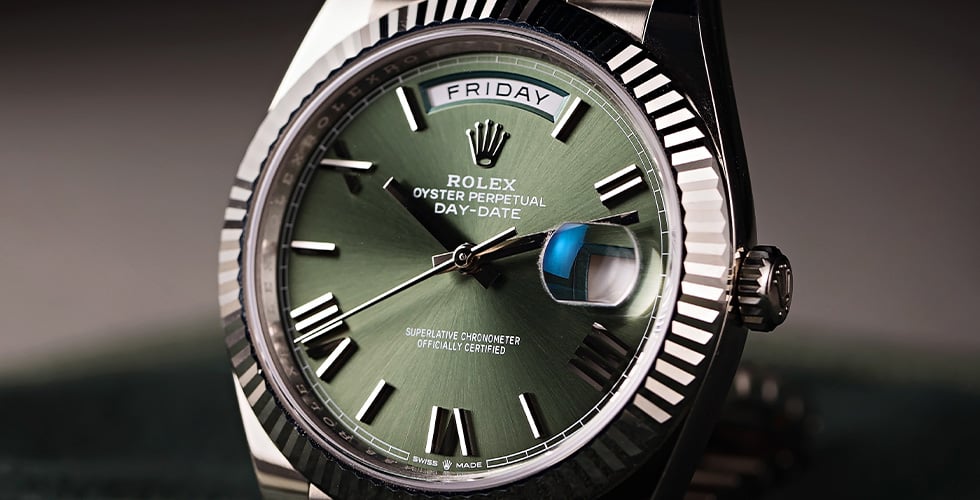
Few watches have undergone a more extreme reversal of fortune than the Rolex Cosmograph Daytona. Introduced in 1963 as a racing chronograph, it was a notoriously slow seller at first. Then, Italian and American collectors rediscovered them in the late 1980s and 1990s, turning an unwanted chronograph tool watch into a vintage-watch trophy.
As its popularity grew, so did its extravagance. By the 1990s, Rolex was producing Daytonas paved with diamonds, ringed with sapphires, and fitted with hardstone dials such as sodalite. Recently, in September 2026, four unique gem-set “Four Seasons” Daytonas sold at Phillips for about $49.5 million. Its journey from tool watch to luxury grail reflects a striking shift in taste, from unwanted “exotic” dials to some of the most elaborate factory-set ornamentation in the watch world.
This guide looks at what separates factory gem-set Daytonas from aftermarket creations, the references collectors chase, and the rare off-catalog pieces you won’t find in a boutique. We’ll also look at what these watches actually sell for.
What Makes a Factory Gem-Set Rolex Daytona So Special?

Every stone on a factory gem-set Daytona was chosen, tested, and set by Rolex before the watch left Geneva. Rolex treats this as part of making the watch, not as decoration added afterward.
Testing every stone. Every diamond and colored stone that arrives at Rolex goes to in-house gemmologists. Each stone is compared against certified master stones. Press coverage of Rolex’s 2018 gemmology presentation confirms Rolex accepts only internally flawless diamonds and selects highly translucent natural gemstones.
Engineering the setting. Before any stone is set, the setters agree the layout and colors with Rolex’s designers. Then they work with the case and bracelet engineers to work out how much metal each stone needs. The setting itself is done by hand. The setter carves a seat for the stone with a graver and adjusts the stone. Then the setter pushes the surrounding metal over its edges to lock it in place.
The Rainbow Daytona shows the gemmologists’ work most clearly. Its bezel holds 36 baguette sapphires that graduate through the spectrum. The Everose 116595RBOW raised the difficulty with each of its 11 sapphire hour markers graduating smoothly on the dial.
A skilled jeweler can reproduce aspects of gemstone setting. However, what distinguishes a factory-set watch is its documented origin, original configuration, workmanship, and provenance.
The Holy Grails: Famous Gem-Set Daytona References
Gem-Set Rolex Daytona References at a Glance
| Reference | Nickname / Key Feature | Metal | Primary Bezel Cut | Secondary Market Value |
|---|---|---|---|---|
| 6269 | Commissioned for Sultan Qaboos of Oman; diamond-pavé dial | 18k yellow gold | Brilliant-cut diamonds | Auction only; ~$1.71M (Phillips, 2025) |
| 6270 | “The King”; baguette bezel, eight known | 18k yellow gold | Baguette diamonds | Auction only; ~$5.23M (Sotheby’s, 2025) |
| 116598SACO | “Leopard”; leopard-print dial and strap | 18k yellow gold | Baguette cognac sapphires (36) | $176,400 (Christie’s, 2024) |
| 116598RBOW | “Rainbow” | 18k yellow gold | Baguette sapphires, graduated (36) | $350,000–$470,000 |
| 116595RBOW | “Rainbow” (Everose); sapphire hour markers | 18k Everose gold | Baguette sapphires, graduated (36) | $415,000–$600,000 |
| 116588TBR | “Eye of the Tiger”; striped diamond dial, Oysterflex | 18k yellow gold | Trapeze-cut diamonds, invisibly set | $190,000–$245,000 |
| 126599TSA | “Blue Sapphire”; off-catalog, obsidian dial | 18k white gold | Baguette blue sapphires (36) | $1.14M–$1.54M |
| 126598TBR | Gold Sundust diamond dial; catalog model | 18k yellow gold | Trapeze-cut diamonds (36) | $180,000–$210,000 |
| 126595TBR | Everose diamond Daytona; catalog model | 18k Everose gold | Trapeze-cut diamonds | Retail $160,900 |
| 126599 SAVL | “Four Seasons: Spring”; unique piece | 18k white gold | Trapeze-cut purple sapphires (36) | ~$9M (Phillips charity sale, 2026) |
| 126595 SARO | “Four Seasons: Summer”; unique piece | 18k Everose gold | Trapeze-cut pink sapphires (36) | ~$13.65M (Phillips charity sale, 2026) |
| 126598 TML | “Four Seasons: Autumn”; unique piece | 18k yellow gold | Trapeze-cut green tourmalines (36) | ~$13.52M (Phillips charity sale, 2026) |
| 126596 SABV | “Four Seasons: Winter”; unique piece | 950 platinum | Trapeze-cut graduated blue-to-fuchsia sapphires (36) | ~$13.25M (Phillips charity sale, 2026) |
Ranges are current secondary-market asking prices as of October 2026; single figures are auction results unless otherwise noted. Four Seasons figures are hammer prices from a charity auction with no buyer’s premium and are not market benchmarks.
Historic Grails: References 6269 and 6270
The factory-jeweled Daytona story begins in the 1980s with references 6269 and 6270, commissioned by Sultan Qaboos bin Said Al Said of Oman. The 6269 used a brilliant-cut diamond bezel with a diamond-pavé dial and sapphire hour markers; the 6270 had baguette diamonds around the bezel. Phillips credits Qaboos’s request with bringing the first two bejeweled Rolex sports references into existence.
Around 30 examples of the 6269 have been produced; Phillips sold a Red Khanjar example for about $1.71 million in 2025. Eight 6270s are known to the market, and Sotheby’s sold an example called “The King” for about $5.23 million in 2025. Their secondary market is essentially auction-driven rather than a conventional dealer market. Both Jay-Z and John Mayer have been seen with the 6270s.
The “Leopard”: Reference 116598SACO

If the 6269 and 6270 proved Rolex would put diamonds on a sports chronograph, the 2004 reference 116598SACO (for saphirs cognac) “Leopard” Daytona proved it was willing to go much further. Yellow gold, a leopard-print dial and matching strap, diamond-set lugs and a bezel of 36 cognac-colored sapphires made it one of the most startling watches Rolex had ever produced. Phillips cites Nicolas Cage as an owner, while Christie’s sold Elton John’s own Leopard for $176,400 in 2024.
The Rolex Rainbow Daytona: References 116598RBOW and 116595RBOW

The “Rainbow” Daytona, which debuted in 2012, initially divided opinion. Its colorful sapphire bezel departed from its traditionally understated racing-watch aesthetic, and some collectors dismissed it as too flashy. Over time, rarity, gem-setting craftsmanship, and unmistakable design made it one of Rolex’s most coveted modern Daytonas.
The yellow-gold reference 116598RBOW has 36 graduated baguette sapphires around the bezel, diamonds on the dial, lugs and crown guards, and a reported retail price of about $89,100. Phillips sold one for $330,200 in 2026; current secondary prices are around $350,000–$470,000.
The Everose-gold 116595RBOW followed in 2018 and added color-matched sapphire hour markers. Its retail price was $96,900. An unworn example set a $693,000 auction record at Phillips in 2022. Current asking prices are roughly $415,000–$600,000 depending on dial, condition, and completeness. Mark Wahlberg and Adam Levine have both worn Rainbow Daytonas publicly.
“Eye of the Tiger”: Reference 116588TBR
The 2019 reference 116588TBR “Eye of the Tiger” Daytona pushed the high-jewelry Daytona even further aesthetically, combining yellow gold, a black-lacquer-and-diamond dial, champagne counters and a trapeze-diamond bezel on Oysterflex. The nickname came from the dial’s striped appearance. Reported retail was around $75,900. Phillips sold a like-new example for around $153,000 in 2024; current asking prices are around $190,000–$245,000. LeBron James, Anthony Davis and Aaron Judge have all been photographed wearing one.
Off-Catalog Secrets: Reference 126599TSA
An off-catalog Rolex is still a factory Rolex. The term describes exceptionally scarce configurations not normally shown in the public catalog. They are typically allocated to important clients, often without a public retail price.
The white-gold reference 126599TSA shows what “off-catalog” means today. Roger Federer was photographed wearing the model in 2025: blue baguette sapphires surround a silver-sheen obsidian dial, while diamonds cover the lugs and case flanks. Rolex does not publish a retail price, and no major-house auction benchmark has yet emerged. The current asking-price range is roughly $1.14 million to $1.54 million; for most buyers, the secondary market is effectively the only route to one.
Diamond Rolex Daytonas in the Catalog: 126598TBR and 126595TBR
The current yellow-gold reference 126598TBR, sometimes called the “Golden Baguette,” “Golden Dial,” and “Midas Touch,” proves that gem-set and off-catalog are not synonyms. Rolex publicly lists the watch at $156,600, with 36 trapeze-cut diamonds on the bezel, baguette diamond hour markers, and diamond-set lugs; current secondary prices are roughly $180,000–$210,000. And the Everose-gold 126595TBR “Sundust” diamond Daytona is listed at $160,900.
The “Four Seasons”: Unique Pieces at Auction
The four unique Daytonas sold in September 2026 are the logical endpoint of that evolution. Spring, reference 126599 SAVL, combined white gold with a chrysoprase dial, lepidolite counters, and purple sapphires, selling for about $9.01 million. Summer, reference 126595 SARO, used Everose gold, a turquoise dial, ruby counters, and pink sapphires, bringing in about $13.65 million. Autumn, reference 126598 TML, paired yellow gold with a mookaite dial, chrysoprase counters, and green tourmalines, and sold for about $13.52 million. Winter, reference 126596 SABV, used platinum, a blue opal dial, lapis lazuli counters, and graduated blue-to-fuchsia sapphires, bringing in about $13.25 million. Given this result, the era of gem-set Daytonas might just be getting started.
Factory-Set vs. Aftermarket Gem-Set Rolex Daytonas

A factory-set Daytona left Rolex with its gemstones already in place. A custom or aftermarket Daytona is something else entirely: a normal Rolex modified after sale by an outside jeweler. The bezel may be replaced, the case drilled and set with diamonds, or a new dial installed. These watches appear because the real ones may be too expensive or difficult to acquire.
The distinction matters to collectors. A factory-set watch retains its original Rolex configuration, while aftermarket modifications may affect its collectibility and value as well as warranty coverage and service eligibility under Rolex’s applicable terms.
How to assess a gem-set Daytona:
- Check the documentation. Compare the reference on the warranty card and other available paperwork with the watch’s actual configuration. The reference can offer useful clues, but paperwork alone doesn’t establish that every component is original.
- Examine the materials and setting. Compare the metal, gemstones, dial, bezel, and other details with documented examples of the exact reference. A configuration that differs from the factory specification warrants closer inspection, but appearance alone isn’t definitive proof.
- Verify the watch’s history. Ask whether the watch has undergone any modifications or component replacements, and look for supporting service records and provenance.
- Get an expert assessment. For a high-value gem-set Daytona, have a qualified specialist examine the watch and assess whether its stones and components are consistent with its original factory configuration.
When in doubt, buy from a reputable Rolex watch dealer who can explain the watch’s history and stand behind its factory-original status in writing.
What’s Next for the Gem-Set Rolex Daytona

The gem-set Daytona started as a showpiece. Sultans commissioned it, athletes wore it, and purists dismissed it as fashion rather than watchmaking. The Four Seasons sale suggests a different future. Rolex made unique pieces, named them like a series of artwork, and sold them in a private charity auction benefiting the Federer Foundation and Re:wild. That’s how the art world treats its most important objects, and the top of the gem-set market is starting to look the same way.
What holds value hasn’t changed, though: the work done in Geneva. A factory-set Daytona carries Rolex’s gemmology, its reference suffix and its service history. Whatever you’re considering, buy the papers and the provenance before the stones.