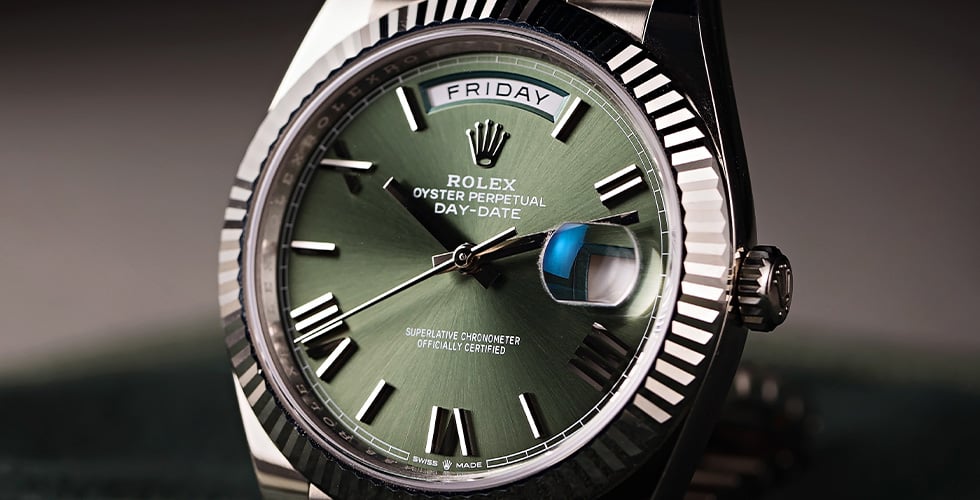
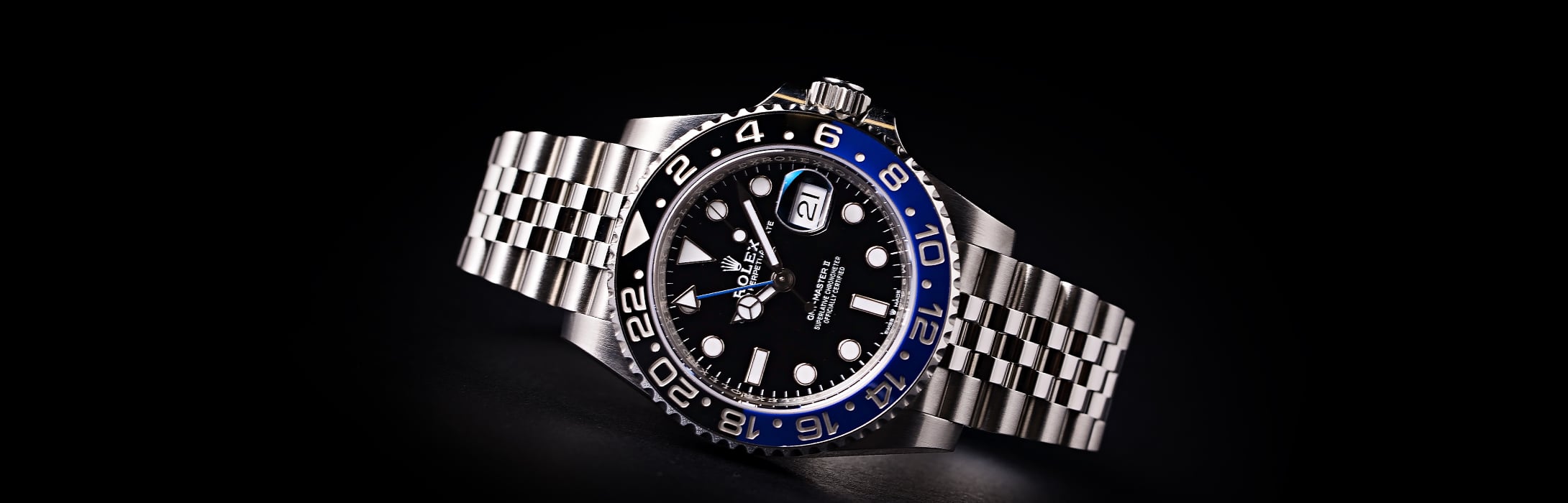
A chronograph watch is a watch with a built-in stopwatch function, allowing you to time something while still keeping track of the time of day. On the standard two-pusher chronograph, the top pusher starts and stops the timing function, and the lower pusher resets it to zero. Most chronographs have sub-dials (or counters) that show elapsed minutes and hours, as well as running seconds. Some designs (monopusher chronographs, for instance) work in a completely different way to achieve the same result.
The name is derived from the Greek roots ‘chronos’ (time) and ‘graphos’ (writer), so it literally means ‘time writer’ and was originally designed to record the passage of time. The chronograph remains one of the most popular and exciting complications in horology, admired for its practical functionality, utility, mechanical sophistication, and the sheer variety of dial designs available. There are luxury watches such as the Rolex Daytona that is perhaps the best example of the chronograph’s enduring appeal and is one of the most recognizable and sought-after chronographs in the world.
Key Takeaways
- A chronograph is a regular watch plus a stopwatch, controlled by pushers on the side of the case.
- You can often recognize a chronograph by pushers near the crown and elapsed-time counters on the dial, although layouts vary.
- Common chronograph designs include conventional two-pusher, monopusher, flyback, and split-seconds mechanisms; some models combine these features.
- Quartz, automatic, and hand-wound versions all exist. The movement type determines how the watch is powered, while the design determines how its timing controls operate.
So how does a chronograph actually work? Here’s what you need to know about its mechanics, how to read the sub-dials, the various types available, and what you can expect to pay.
What Is a Chronograph Watch?

On a standard two-push-button chronograph, the top pusher starts and stops the timing hand, and the lower pusher resets it. That’s the basic principle, but monopusher, flyback, and so on work differently.
- The upper pusher on a conventional two-pusher, usually around 2 o’clock, starts the stopwatch. Pressing it again stops the timing and holds the result on the dial.
- The lower pusher, usually around 4 o’clock, resets the counters to zero after timing stops on a conventional chronograph. Flyback and other designs can operate differently.
- The crown generally winds a mechanical watch and sets the time of day; the stopwatch is operated separately on conventional two-pusher models. Some monopushers incorporate the timing control into the crown.
- On many mechanical chronographs, including the Rolex Daytona, the central seconds hand is used for elapsed timing, while continuously running seconds appear on a sub-dial. Other layouts exist. A stationary central hand therefore does not necessarily mean the watch has stopped.
Many chronographs have a tachymeter scale on the bezel or along the edge of the dial. On a conventional units-per-hour tachymeter, you time an event over a known distance (e.g., one mile) and then read the scale to get the average speed in miles per hour. That’s the principle behind the Daytona’s bezel. Many owners also like the look of it, regardless of whether they actually use the scale.
What Do the Sub-Dials on a Chronograph Watch Mean?

Many have two or three small registers that display the continuously running seconds, the elapsed minutes, and the elapsed hours. The exact functions and the locations of the registers will, of course, vary depending on the movement and the dial layout. Not every chronograph will have three registers.
- Running seconds: shows the watch’s continuously running seconds. On many modern Rolex Daytonas, it is at 6 o’clock.
- Elapsed minutes: records minutes timed by the chronograph, often on a 30-minute counter, although other capacities exist.
- Elapsed hours: records longer timed intervals, often up to 12 hours on chronographs equipped with an hour counter.
Not every chronograph has all three registers. Many two-register designs display running seconds and an elapsed-minute counter, while three-register designs may add an elapsed-hour counter. Layout terminology varies by maker and collecting context. One arrangement is no better than the other; it’s simply a matter of which information and dial balance you prefer.
Common Types of Chronograph Watches
Chronographs use several different operating systems, the most common being the conventional two-pusher, the monopusher, the flyback, and the split-seconds. These are not necessarily mutually exclusive, and a watch can have a number of these functions. The vast majority of first-time buyers will start with a conventional chronograph and then look at more specialized functions as and when they wish.
Standard Chronograph

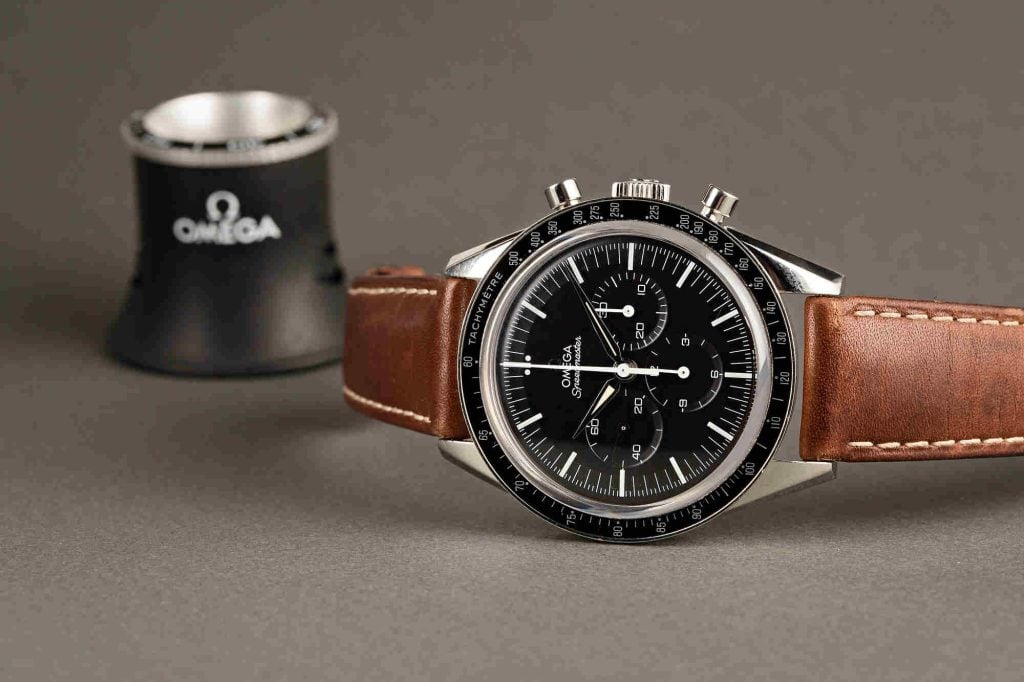
A standard chronograph has two pushers: one on top for starting and stopping, and the lower one for resetting. The Rolex Daytona and the OMEGA Speedmaster Moonwatch are classic examples. For a basic chronograph, that’s all you really need. The two-pushbutton arrangement is very straightforward to use. There are, of course, more specialized versions with additional functions, and these can affect the complexity of servicing.
Monopusher Chronograph

A monopusher operates the start, stop, and reset sequence via a single button (often incorporated into the crown). It gives a cleaner case profile, though the operating sequence differs from a standard two-pusher and usually requires a reset before starting a new timed interval.
Flyback Chronograph

A flyback lets you reset and instantly restart the timing with a single press while the chronograph is still running. Pilots used to love it for timing successive navigation legs without having to fiddle with three button presses. Today, on the wrist, it’s less about navigation as a pilots watch and more about the sheer mechanical pleasure of watching the hand snap back and carry on. Definitely worth experiencing at least once.
Split-Seconds (Rattrapante) Chronograph

A split-second (or rattrapante) chronograph uses two superimposed hands so that one can be stopped for an intermediate reading while the other continues. It is a complex mechanism often associated with higher-end watchmaking.
Does a Chronograph Watch Need a Battery?

Not at all. A chronograph is the stopwatch function; it has nothing to do with the power source. A mechanical one will, of course, be wound with a mainspring, while a quartz one may use replaceable batteries or be solar-powered with rechargeable batteries.
- Quartz chronographs use electronic movements and are generally more accurate than their mechanical counterparts. Many have replaceable batteries, while others have a rechargeable system. Maintenance needs and battery replacement frequency vary from model to model.
- Automatic chronographs wind a mechanical mainspring using the motion of the wearer’s wrist. They do not need a battery for ordinary mechanical timekeeping. The modern Rolex Daytona is one example.
- Hand-wound chronographs need the crown turned every day or two. The classic Speedmaster Moonwatch is the famous holdout, and winding it is half the charm.
If you’re asked whether a watch is an automatic chronograph, the answer is: it depends. ‘Chronograph’ refers to the stopwatch function. ‘Automatic’ refers to the winding system. For a watch I’m going to wear daily, I may well go for automatic winding. For a watch I’m only going to wear from time to time, hand winding can be part of the attraction.
Chronograph vs Chronometer
A chronograph measures the passage of time; a chronometer is a timepiece tested for accuracy. The terms are similar, but when comparing a chronograph vs chronometer, it is important to undersstand that their meanings are quite different.
In the world of Swiss watchmaking, COSC is a major independent body that certifies chronometer accuracy. Other manufacturers will of course go beyond this and apply their own additional testing and certification criteria to their finished watches. A chronograph can also be chronometer certified (the Rolex Daytona is a modern example of this), with the chronograph function and the chronometer certification being entirely separate.
What Does a Chronograph Watch Cost?
Preliminary analysis of completed Bob’s Watches transactions (Jan-Oct 2026) suggests a median chronograph sale price of approximately $9,900, with observed sales ranging from about $1,400 to over $50,000. These are historical transaction prices, not asking prices, not current valuations, and not any guarantee of future resale.
| Chronograph brand | Median sold price | Observed range |
| Tissot | about $1,950 | $1,350 to $2,275 |
| Tudor | about $6,200 | $4,500 to $8,000 |
| IWC | about $8,100 | $5,250 to $12,900 |
| Breitling | about $9,050 | $3,000 to $26,000 |
| Omega Speedmaster | about $9,100 | $4,700 to $50,900 |
| Rolex Daytona | about $19,100 | $12,000 to $48,400 |
Source: Completed Bob’s Watches transactions (Jan to Oct 2026).
The initial table shows significant price differentials between the brands and the references. A wide price range for a OMEGA Speedmaster likely reflects differences in reference, materials, and condition. If you’ve got a chronograph, historical completed sales can provide context. Still, the current resale value of any particular timepiece depends on the reference, condition, configuration, accessories, and current demand.
“Chronograph prices can vary significantly, even within the same brand. What we’ve seen in our sales data is that the specific reference, condition, and market demand all play an important role in determining what buyers are willing to pay. For anyone considering a chronograph, understanding actual transaction prices rather than just advertised prices can provide a much clearer picture of its market value.”
Joe Alessandrini, Chief Financial Officer, Bob’s Watches
Are Chronograph Watches Worth It? My Take

Yes, if you like the functionality, the engineering, and the design. A phone is probably easier for day-to-day timing. Still, a mechanical chronograph offers a tangible, hands-on experience, and it has a long history in sports, aviation, and watchmaking. Many people will quite happily own one even if they don’t use the stopwatch at all.
Where I’d put my own money:
- First mechanical watch would be a hand-wound OMEGA Speedmaster, a compelling option (a very good choice given its pedigree and the experience of winding a mechanical movement).
- A compelling option for daily wear: consider an automatic Breitling or Tudor chronograph if its proportions, features, and service requirements fit your routine. Resale performance depends on the specific reference, purchase price, condition, and market demand.
- One for the long term: in my view, the steel Rolex Daytona is the watch of choice (it’s a great design, a great watch to wear, and it has a very strong collector’s market). The OMEGA Speedmaster is a very good alternative at a different price point.
- Pure heart purchase: anything vintage with two registers and a story. Nobody needs it. That’s the point.
On value: some of the watches that are widely collected (specifically certain Rolex Daytona references) have a very strong resale track record, and some will in fact appreciate. The actual result will, of course, depend on the original purchase price, the reference, the condition, the ownership costs, and the time of sale. No chronograph will guarantee you a profit. Buy the watch you want to wear; potential value retention is a very secondary consideration.
Choosing Your First Chronograph Watch

Start with how you’ll wear it rather than just the specs. A quartz chronograph is ideal for grab-and-go, a hand-wound one is all about the winding, and an automatic is perfect for regular wear. You’ll want to select the register layout and case shape that work for you. The complication will be appreciated for both its practical function and its mechanical design.
Every chronograph offered for sale by Bob’s Watches undergoes our watch-specialist assessment process. If a watch in the pricing table interests you, our team can help you compare references and fit.