The biggest difference between the original Rolex GMT-Master and the GMT-Master II is how their internal movements handle the time zones, allowing the GMT-Master II to track up to three time zones compared to the original’s two.
I’ve handled thousands of Rolex watches over the years, and few pairs get mixed up more often than these two. From across the room, they can look nearly identical. Under the dial, however, they are fundamentally different watches.
Key Takeaways
- The GMT-Master (1955 to 1999) displays two time zones; the GMT-Master II (1983 to present) displays up to three.
- The GMT-Master II’s local hour hand adjusts independently in one-hour jumps without stopping the watch or disturbing the 24-hour hand.
- Rolex discontinued the GMT-Master in 1999, so every current-production Rolex travel watch in this family is a GMT-Master II.
- The first GMT-Master II, ref. 16760 “Fat Lady,” gave up the quickset date function to make room for the jumping hour hand.
- Vintage GMT-Master references appeal to collectors who value history and patina; the GMT-Master II is the stronger choice for daily wear and frequent travel.
Below, I walk through the production history, the mechanical differences, the design evolution, and my honest take on which one belongs on your wrist.
Manufacturing Periods & Reference Numbers: GMT-Master vs. GMT-Master II

The Rolex GMT-Master watch is a dual-time pilot’s watch introduced in 1955, developed in collaboration with Pan American World Airways so that flight crews could track two time zones at once on transatlantic routes. Rolex paired conventional hour and minute hands with an extra 24-hour hand that reads against a rotating, 24-hour graduated bezel. To me, that original brief is what still makes this family special: it is a genuine tool watch that became an icon by accident.
Rolex produced four generations of the GMT-Master:
- GMT-Master ref. 6542: 1954 to 1959
- GMT-Master ref. 1675: 1959 to 1980
- GMT-Master ref. 16750: 1981 to 1988
- GMT-Master ref. 16700: 1988 to 1999
The GMT-Master II arrived in 1983 with ref. 16760. The two collections then overlapped in the catalog through the 1980s and 1990s because the ref. 16700 sold at a lower price than the newer GMT-Master II and remained widely sought after. That overlap still confuses buyers today, and it is one reason I always tell people to check the dial text and reference number rather than the bezel colors when they shop vintage GMT-Master references on the pre-owned Rolex market.
There are also four broad generations of the GMT-Master II to date:
- GMT-Master II ref. 16760: 1983 to 1988
- GMT-Master II ref. 16710: 1989 to 2007
- GMT-Master II ref. 11671x: 2007 to 2019
- GMT-Master II ref. 12671x and 12672x: 2018 to present
Rolex discontinued the GMT-Master in 1999, when the final reference 16700 left the catalog. Every travel watch Rolex has produced in this family since 1999 has been a GMT-Master II.
The transition was gradual rather than abrupt. For 16 years the two lines sold side by side, with the GMT-Master serving as the more affordable entry point and the GMT-Master II carrying the flagship complication. After 1999, Rolex poured everything into the GMT-Master II: Cerachrom bezels, the Jubilee bracelet’s return on steel sport models, the caliber 3285, and the first left-handed crown configuration in the brand’s modern catalog.
As someone who watches this market every day, I see no signal that Rolex will ever revive the original GMT-Master name, and frankly I think that is the right call. The vintage watches stand on their own.
Functionality: GMT-Master vs. GMT-Master II

At first glance, the GMT-Master and the GMT-Master II may look like the same watch, but if you look under the hood, you’ll soon see that the biggest difference between the two models is the type of functionality the movements inside the watches offer.
As we previously mentioned in our Rolex GMT-Master buying guide, the GMT-Master allows wearers to read two time zones simultaneously. Conversely, the GMT-Master II permits the reading of three separate time zones. Rolex made this possible by making the 24-hour hand independent from the center hour and minute hands.
Therefore, the center hands indicate local time, the 24-hour hand can move freely around the dial to point to the 24-hour bezel for a second time zone, and turning the rotating bezel in either direction can tell the time in a third time zone.
How the GMT-Master Tracks Two Time Zones
The GMT-Master displays two time zones because its 24-hour hand is mechanically synchronized with the standard hour hand. The center hands show local time, and the 24-hour hand points to the bezel to indicate a second zone. To read a different second time zone, you rotate the external bezel so the correct hour aligns with the 24-hour hand. It is a simple, elegant system, and honestly, for anyone who crosses time zones only a few times a year, it is all the travel watch you need.
How the GMT-Master II Tracks Three Time Zones
The GMT-Master II displays up to three time zones because its local hour hand is uncoupled from the 24-hour hand. The local hour hand jumps forward or backward in clean one-hour increments while the watch keeps running, so the dial itself carries two zones at once: local time on the center hands and home time on the 24-hour hand against the bezel’s default position. Rotating the 24-hour bezel then lets you calculate a third zone on demand. In my opinion this is the single most useful complication Rolex has ever put in a sports watch, and once you have landed in another country and reset local time in three seconds without hacking the movement, you will not want to go back. We created a GMT-Master II setup guide for those who might need help getting started.
Technical Note: Inside current GMT-Master II references, the caliber 3285 pairs the independent jumping local hour hand with Rolex’s Chronergy escapement and delivers a power reserve of approximately 70 hours. When our watchmakers open these movements on the service bench, the jumping hour mechanism is the defining feature that separates a GMT-Master II caliber from the linked-hand calibers in the original GMT-Master.
Did the GMT-Master II Sacrifice the Quickset Date?
The first GMT-Master II, ref. 16760 “Fat Lady,” gave up the traditional quickset date function to accommodate its uncoupled jumping hour hand. On that reference and other early GMT-Master II models, you set the date by cycling the independent hour hand through full 24-hour rotations rather than by pulling the crown to a dedicated quickset position. Meanwhile, the final GMT-Master, ref. 16700, retained a quickset date, which is a genuinely underrated practical advantage of that reference. On modern GMT-Master II calibers the jumping hour hand advances the date as it passes midnight, so in day-to-day use the trade-off no longer feels like a sacrifice.
Design and Materials: GMT-Master vs. GMT-Master II

Design and materials separate the two collections almost as clearly as the movements do. The GMT-Master came in stainless steel, two-tone yellow gold and steel, and full yellow gold, with bezel inserts in Bakelite on the earliest ref. 6542 examples and aluminum thereafter. Its dial lume evolved from radium on very early watches to tritium, and finally to Luminova near the end of production. That lume timeline matters to collectors, because tritium dials develop the warm patina that vintage buyers pay a premium for.
The GMT-Master II expanded the palette considerably: stainless steel, Yellow Rolesor, Everose Rolesor, and solid white, yellow, and Everose gold, plus gem-set Serti dials on select precious metal references. The bigger material story is the bezel. Rolex introduced its Cerachrom ceramic bezel to the collection in 2005 on the yellow gold ref. 116718, then brought it to stainless steel with ref. 116710LN in 2007. Ceramic is virtually scratchproof and fade resistant, and today’s catalog features two-color Cerachrom combinations across the range, including the green and black “Rolex Sprite” ref. 126720VTNR of 2022 with its left-side crown.
Here is my honest, unpopular opinion: ceramic wins on durability, but aluminum wins on character. A faded pre-owned Rolex Pepsi insert on a 1675 tells you where that watch has been. A Cerachrom bezel will look identical in forty years, which is either the best or the worst thing about it, depending on the kind of collector you are.
GMT-Master vs. GMT-Master II Side By Side
This side-by-side overview highlights the main differences between the two collections. The GMT-Master column reflects the collection across its full production run; scroll up for reference-specific detail.
| GMT-Master | GMT-Master II | |
| Case | 40mm (38mm on earliest refs) | 40mm |
| Depth Rating | 100 meters (50m on early refs) | 100 meters |
| Independent Hour Hand | No | Yes |
| Time Zones | 2 | 3 |
| Bezel Material | Bakelite (early); Aluminum | Aluminum; Cerachrom ceramic |
| Bezel Colors | Black; Blue; Pepsi; Root Beer (brown and beige) | Black; Pepsi; Coke; Root Beer (brown and black); Batman; Sprite (green and black) |
| Crystal | Acrylic; Sapphire (ref. 16700 only) | Sapphire |
| Lume | Radium (earliest); Tritium; Luminova | Tritium; Luminova; Super-LumiNova; Chromalight |
| Production | 1955 to 1999 | 1983 to present |
| Bracelet | Oyster; Jubilee | Oyster; Jubilee |
Rolex Nicknames fro the GMT-Master and GMT-Master II
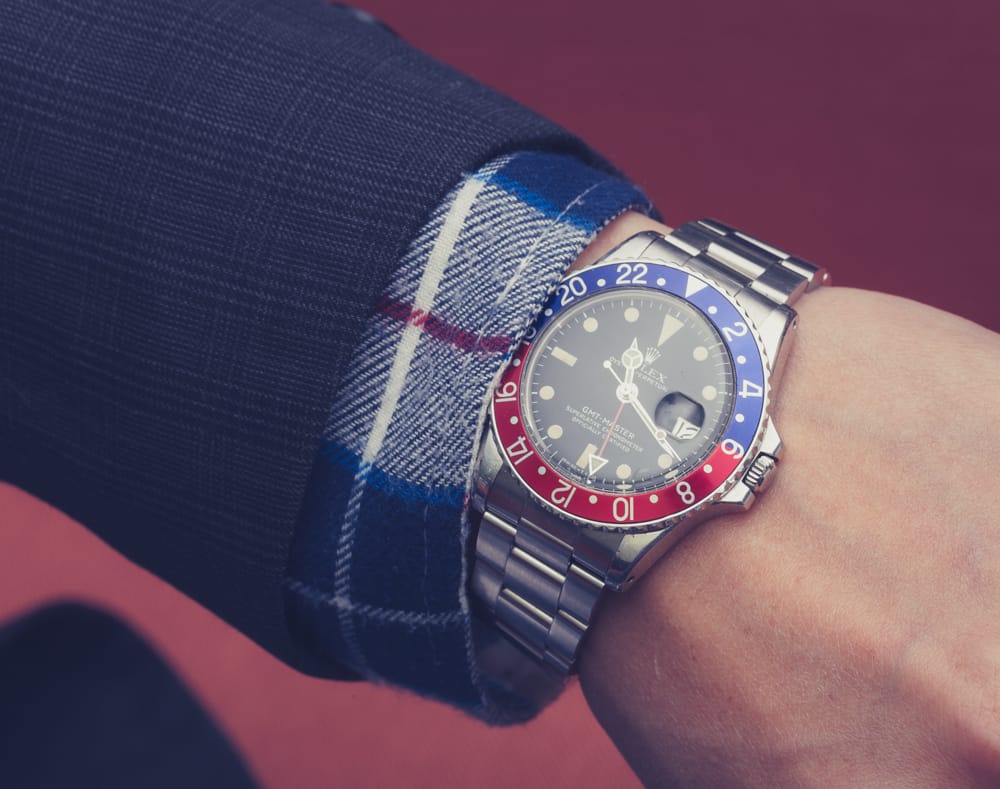
If you spend any time around Rolex GMTs, you’ll quickly realize that collectors rarely call these watches by their reference numbers alone. Instead, a handful of colorful Rolex nicknames have become part of the language, and most of them are surprisingly easy to remember.
- Pepsi: This classic has a blue-and-red bezel, found on both GMT-Master and GMT-Master II references
- Coke: With its black-and-red bezel, the Coke name belongs exclusively to the GMT-Master II
- Batman: This brought a more modern look to the collection, pairing a black-and-blue Cerachrom bezel with the GMT-Master II only
- Root Beer: A little more complicated, vintage GMT-Masters can have a brown-and-beige bezel, while the modern GMT-Master II interpretation uses black and brown Cerachrom
- Sprite: Green-and-black Cerachrom bezel on the left-handed GMT-Master II ref. 126720VTNR
- Blueberry: Refers to rare vintage GMT-Master examples fitted with an all-blue aluminum bezel
- Pussy Galore: The ref. 6542, named for its association with the character in the James Bond film Goldfinger
- Fat Lady (aka Sophia Loren): The ref. 16760, named for the thicker case that houses its more complex movement
Which One Holds Its Value Better for Collectors?
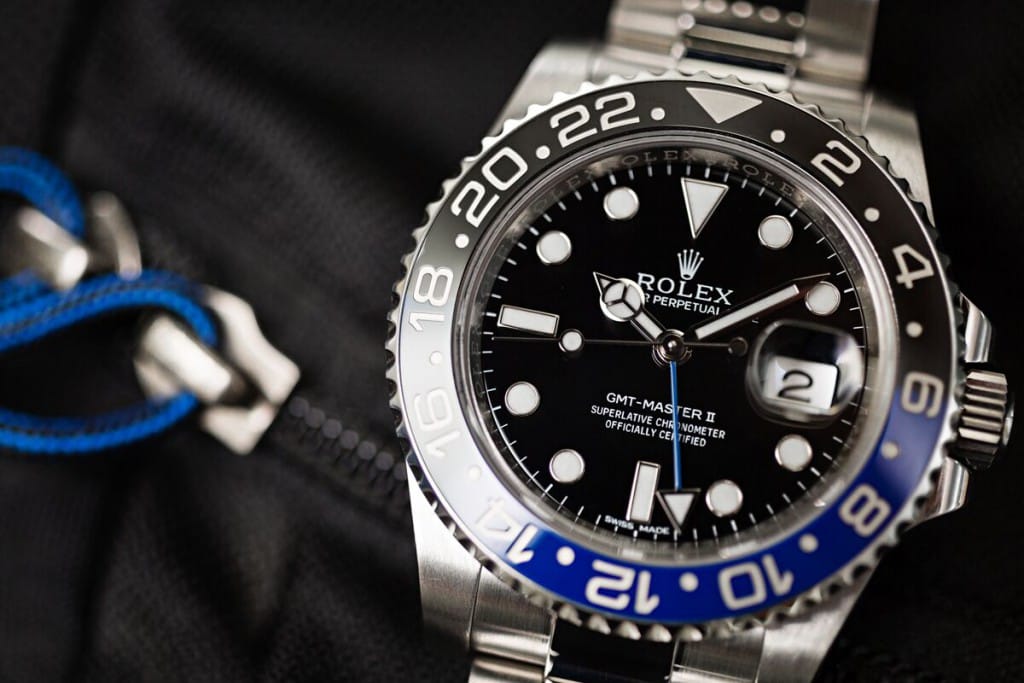
The GMT-Master and GMT-Master II are both generally considered strong value holders on the pre-owned market, but they appeal to different buyers and behave differently as collectibles.
Ripley Sellers, Contributing Editor for Bob’s Watches, points to an overlooked value play:
“Two-tone GMT-Master and GMT-Master II watches from the five-digit reference number era are consistently some of the least expensive Rolex GMTs available. For those who want more of a vintage flavor, the ref. 16753 can be purchased for just slightly over $10k, while its more contemporary GMT-Master II sibling, the ref. 16713, can be found for a couple grand more, which makes these models less expensive than the current retail price for a new two-tone GMT-Master II.”
Ripley Sellers, Contributing Editor for Bob’s Watches
Vintage GMT-Master references, particularly the ref. 6542 and early ref. 1675 examples, draw collectors who prize originality: unpolished cases, matching tritium patina, correct bezel inserts, and box and papers. Condition and provenance drive outcomes far more than the model name does, and not every example guarantees a profit.
Modern GMT-Master II references, especially the Pepsi ref. 126710BLRO and Batman ref. 126710BLNR, have historically commanded premiums over their retail prices on the secondary market, though premiums fluctuate with broader market conditions and certain references can soften.
GMT-Master II references sold at a median of roughly $18,000 in our data, and the Pepsi ref. 126710BLRO has been the standout performer: its average sold price climbed from about $20,900 in 2025 to about $25,300 in 2026 year to date, an increase of roughly 20 percent. It is also our fastest-moving GMT, selling in a median of 6 days from listing, compared with 11 days for the GMT-Master II collection overall and 15 days for vintage GMT-Master references.
My personal take: if you are buying purely as a store of value, the scarce vintage references may hold appeal, but if you are buying a watch to actually wear while it can hold value, the modern GMT-Master II models on the pre-owned market are the more livable choice. A watch you are afraid to wear is a bad investment in enjoyment, whatever it does in price.
Choosing Between the GMT-Master and GMT-Master II

Choosing between the GMT-Master and GMT-Master II is really a choice between two ownership experiences. The GMT-Master is a vintage-only proposition: aluminum bezels, aging tritium, acrylic crystals on most references, and the kind of history you can feel on the wrist. The GMT-Master II is the modern tool: an independent jumping hour hand, ceramic bezels, Chromalight lume, and a 70-hour power reserve in current references. If you travel constantly, I would point you to the GMT-Master II without hesitation. If you want a Rolex watch with a story, the GMT-Master is one of the most rewarding vintage Rolex purchases you can make.
Whichever direction you lean, buy from a source that inspects and certifies every watch it sells. At Bob’s Watches, our watchmakers authenticate every GMT-Master and GMT-Master II that crosses our bench, from the caliber inside to the bezel insert’s originality, and our sold data keeps our pricing anchored to the real market rather than to asking prices. And if you already own one of these watches and the numbers above have you curious, you can sell your Rolex to us directly for a quote grounded in that same sold data. That is the difference between trading on a reference number and trading on a watch’s real market.