Rolex watches from the 1960s are where a lot of the modern lineup really takes shape. This was the decade when the brand shifted from producing specialized professional instruments to creating the global luxury icons we know today. The Submariner became sharper, the GMT-Master grew more refined, and 1963 brought us the Cosmograph Daytona. It’s hard to get into vintage Rolex watches without circling back to the 1960s.
What makes this decade so significant is the technical progress and real-world purpose these watches embraced. These watches went to the bottom of the ocean, into the cockpits of commercial aircraft, and onto the wrists of racing drivers. The design decisions made during this period were not cosmetic. They were functional. That history is exactly why 1960s Rolexes continue to hold a special place in the collector market today.
Key Takeaways:
- The 1960s marked a shift from glossy “gilt” dials to matte dials, a transition that collectors track closely by reference and serial number.
- 1963 saw the launch of the Cosmograph Daytona, one of the most sought-after chronographs in the history of watchmaking.
- Rolex introduced the Caliber 1500 series movements during this period, improving beat rate consistency and long-term reliability.
- Vintage 1960s Rolex models have consistently outperformed many modern references in terms of value appreciation over time.
There’s a reason collectors keep coming back to the 1960s. It’s where the technical side of Rolex aligns with the brand’s history in a way that feels very tangible. Modern watches are objectively better in a lot of ways, but they don’t carry the same backstory. That’s really what drives the vintage market, and why this decade sits right at the center of it.
The History and Evolution of Rolex in the 1960s
The years between 1953 and 1967 were defined by exploration. The Rolex Submariner had already proven itself in deep-sea diving, and the Rolex GMT-Master had been developed in partnership with Pan American World Airways for transatlantic navigation. By the time the 1960s came around, Rolex was no longer just a watchmaker. It was a supplier to professionals who depended on accuracy in genuinely demanding conditions.
That professional credibility shaped every design decision made during the decade. Rolex was improving its watches based on feedback from the people actually wearing them at depth, at altitude, and at speed. The result was a series of incremental but meaningful changes that collectors now study in detail. From the shape of the crown guards to the texture of the dial surface.
Mechanical Milestones of the Sixties
Several specific technical transitions took place during the 1960s that define how collectors identify and value watches from this period:
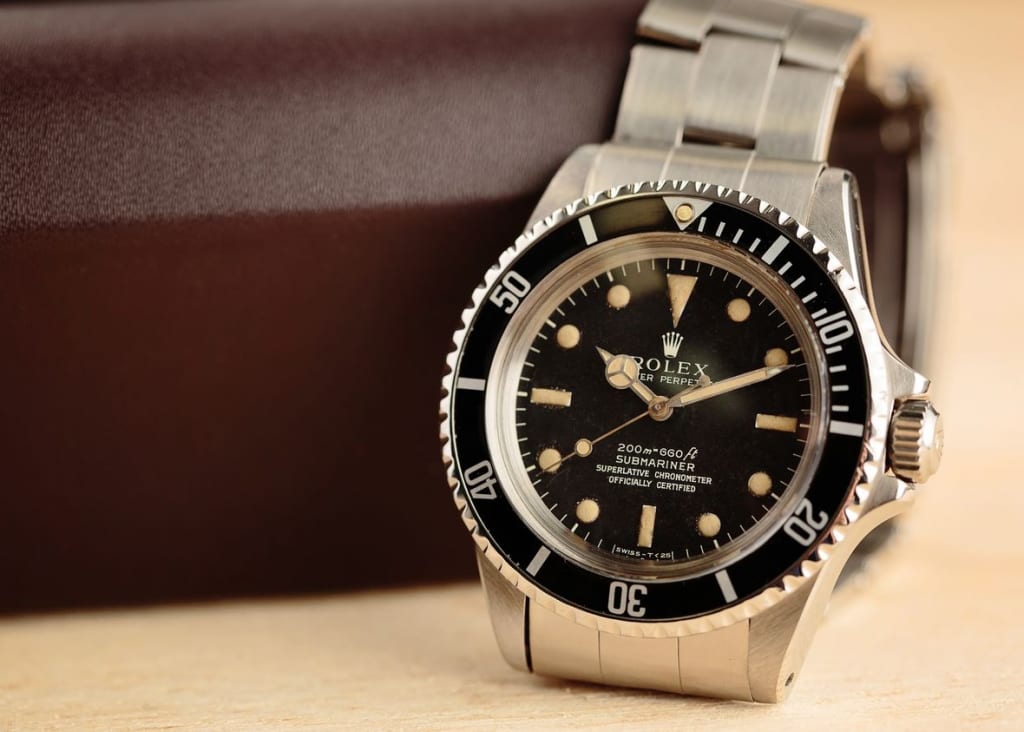
- Radium to Tritium: Earlier Rolex dials used Radium for luminous indices and hands. During the 1960s, the brand moved to Tritium, a safer alternative. Dials from this transitional period are marked “Swiss-T < 25,” indicating Tritium content below 25 microcuries.
- Gilt to Matte Dials: Through the early to mid-1960s, Rolex produced dials with a warm, golden-toned print on glossy lacquer surfaces, commonly referred to as “gilt” dials. Around 1966, the brand began transitioning to matte dials with white printing. Both variations are highly collectible, but gilt dials from earlier in the decade tend to command a premium.
- Twinlock Winding Crown: Rolex refined its crown sealing system during this period, using the Twinlock crown invented in the 1950s on several professional references. This improvement increased water resistance and became standard across the tool watch lineup.
Top Rolex 1960s Models to Collect
The 1960s produced some of the most recognizable references when looking back at vintage Rolex watch history. Each model served a specific professional purpose, and each went through meaningful design changes over the course of the decade. Collectors who focus on this era tend to follow individual references closely, tracking the transition from one dial configuration or case detail to the next. Below is a breakdown of the key models from this period.
1960s Rolex Submariner (Ref. 5512 and 5513)
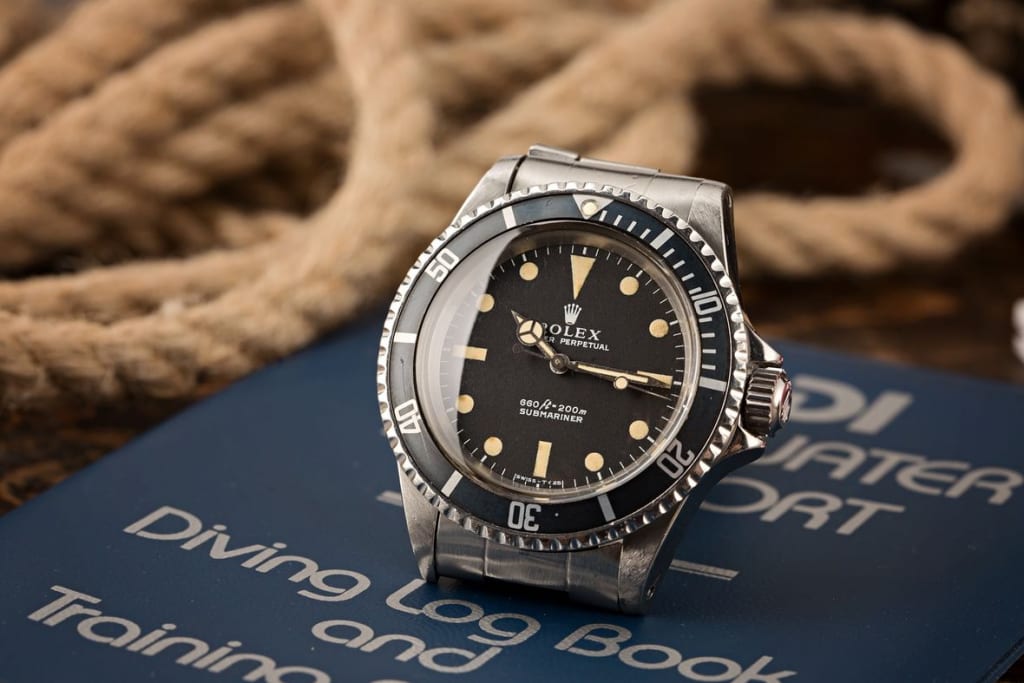
The Rolex 5512 was introduced in the late 1950s and continued into the 1970s as the crown guard variant of the original no-crown-guard design. Those protective extensions on either side of the winding crown were added to reduce the risk of accidental crown damage during dives. Early examples from the first years of the decade featured what collectors call “Pointed Crown Guards,” a sharper, more angular shape that was later softened in subsequent production runs.
The Rolex 5513 followed closely and became one of the most produced Submariner references of the era. Unlike the 5512, which used a chronometer-certified movement, the 5513 used a non-certified movement, making it the more accessible option at the time. Today, both Rolexes are heavily sought after. Dial condition and originality are the primary factors that separate a good example from a great one.
1960s Rolex GMT-Master (Ref. 1675)

The GMT-Master Ref. 1675 was introduced in 1959 and produced until around 1980, making it one of the defining references of the 1960s market. Originally developed for airline pilots who needed to track multiple time zones simultaneously, the Rolex 1675 featured a 24-hour rotating bezel that allowed the wearer to read a second time zone at a glance.
The iconic red and blue “Rolex Pepsi” color combination on the bezel is among the most recognized in vintage collecting. Some examples from this period show a color shift toward a more “fuchsia” tone on the red section of the bezel, a natural result of aging that collectors have come to appreciate rather than avoid.
1960s Rolex Daytona (Ref. 6239 and 6241)
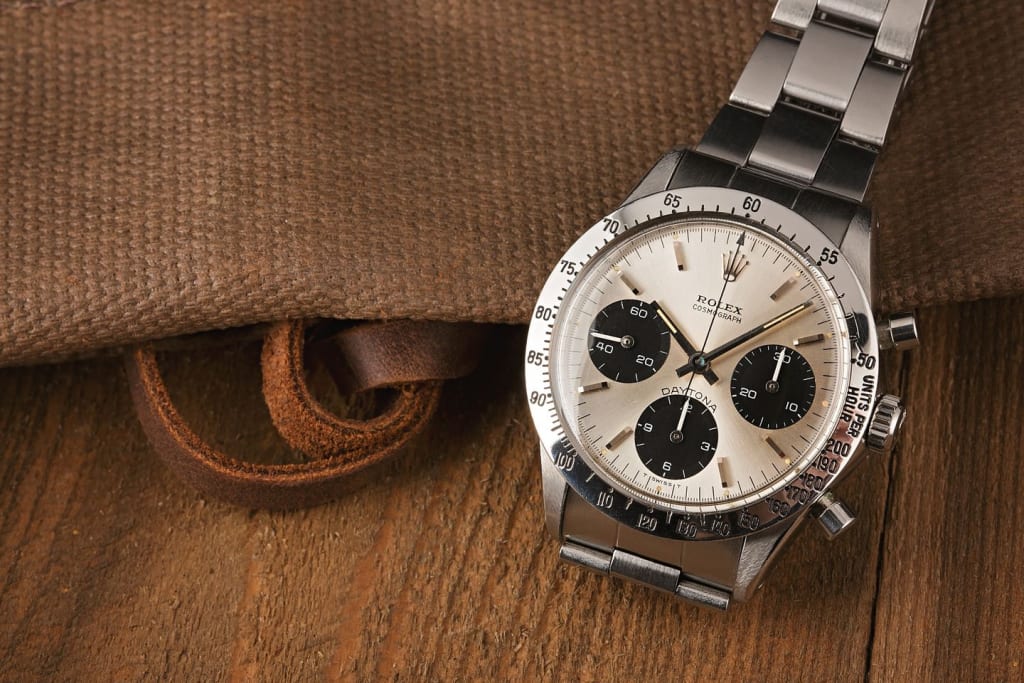
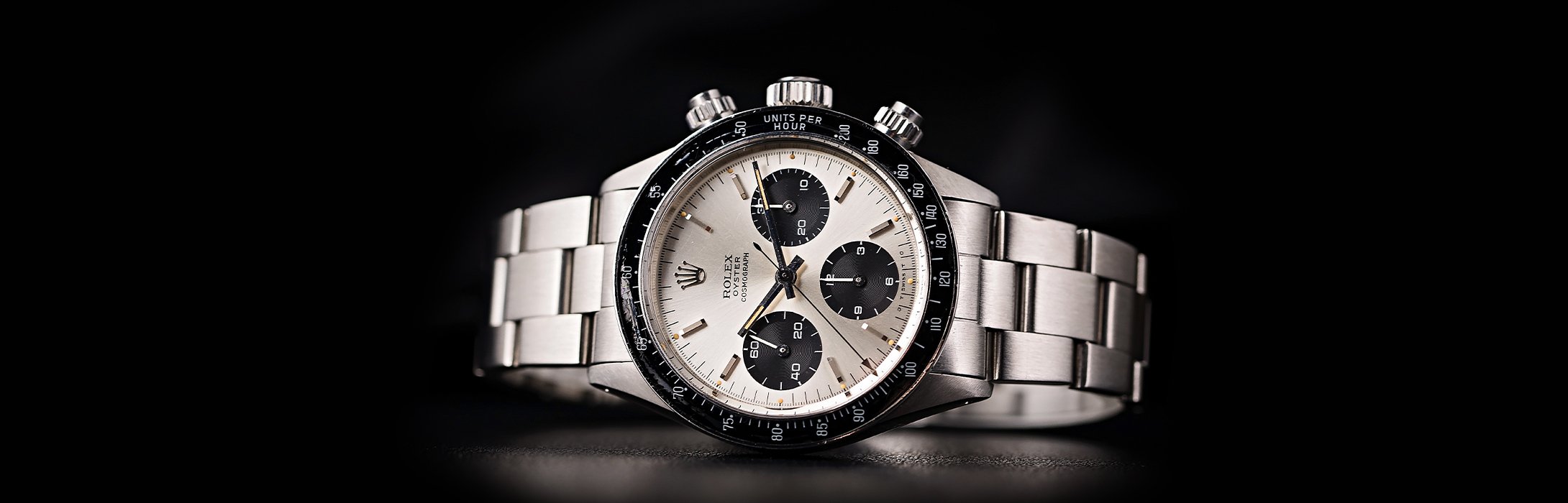
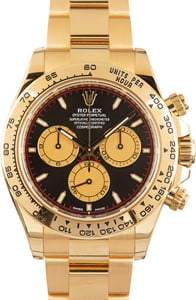
The Cosmograph Daytona made its debut in 1963, and its introduction marked a turning point for Rolex in the sports and racing world. The reference 6239 was the first to carry the Daytona name on the dial. The Rolex 6241 followed shortly after, distinguished by a black acrylic bezel instead of steel.
Early Daytonas from this decade used Valjoux-based manual-wind movements, and the pushers for the chronograph function were integrated into the case in a way that remains visually distinctive. These are not the high-complication, vertically clutched movements found in modern Daytona references, but that simplicity is part of the appeal. A well-preserved Rolex 6239 with an original “exotic” or “Rolex Paul Newman” dial is among the most valuable vintage Rolex references on the market today.
1960s Rolex Datejust and Day-Date (Ref. 1601 and 1803)

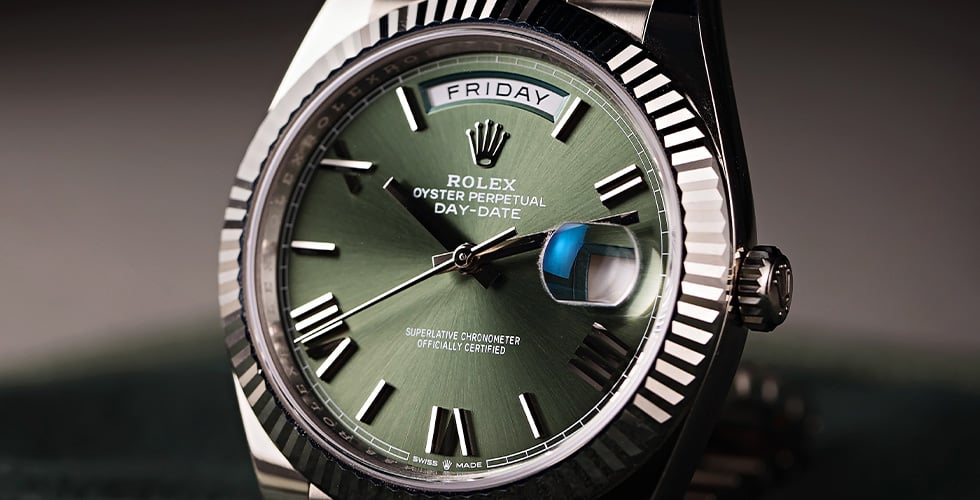
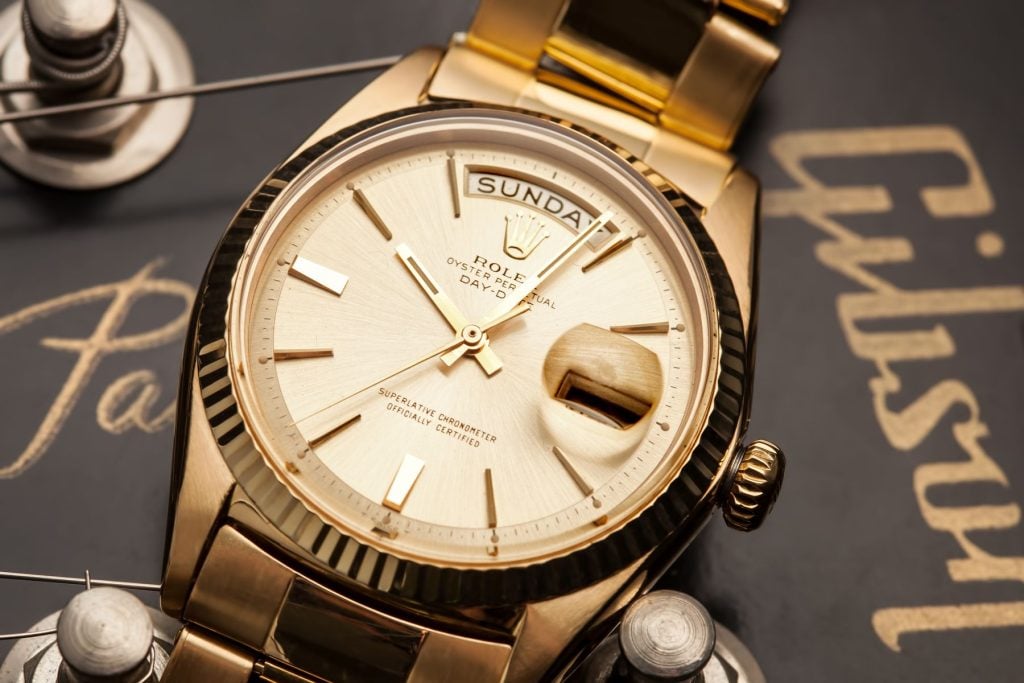
While the sports references often dominate collector conversations, the Datejust and Day-Date from the 1960s tell an equally important part of the decade’s story. The Rolex 1601 Datejust was made in steel and precious metal variations while the ref. 1803 was solely in gold. They feature what is widely known as the “Pie Pan” dial, a slightly domed, concave dial surface with a raised outer chapter ring that resembles, as the name suggests, an inverted pie dish.
The Rolex Day-Date in particular became a symbol of status and achievement during this period. It was the first watch to display the day of the week spelled out in full, and it was only ever offered in precious metals, either gold or platinum. Wearing one in the 1960s communicated something specific about who you were. That association has not faded. These watches remain among the most recognized dress watches in the vintage market, with original dials in good condition being the key driver of value.
1960s Rolex Specifications and Technical Data
| Feature | 1960s Standard | Notable Transition |
| Crystal | Acrylic / Plexiglass | Introduction of the Cyclops lens in the 1950s as standard on date models |
| Lume | Tritium | Move away from hazardous Radium, marked “Swiss-T < 25” |
| Movement | Caliber 1560 / 1570 | Higher beat rates and improved long-term reliability |
| Case Size | 34mm to 40mm | Standardization of the 40mm case across professional references |
A lot of the changes in the 1960s came from real-world use. Acrylic crystals replaced mineral glass because they handled impact better. And this is when the Cyclops lens really becomes standard on date models, a detail Rolex still hasn’t moved away from
The Rolex calibers from this era (especially the 1560 and 1570) have a strong reputation for a reason. They’re straightforward to service, and parts are still out there, which makes a big difference long term. Rolex developed these as tool watches, and you can feel that in how the movements were designed. When they’re properly serviced, they just keep going. That’s part of why a good 1960s Rolex isn’t only about nostalgia. It’s still a practical watch to own.
Market Report: Rolex 1960s Price Trends
The appreciation of 1960s Rolex references over the past two decades has been well documented. A steel Submariner that originally retailed for around $170 to $200 in 1964, which would be roughly $1,800 in today’s dollars when adjusted for inflation, now trades for anywhere between $15,000 and $50,000 depending on the reference, condition, and originality of the components. That is not simply inflation. That is a shift in how the market values provenance, rarity, and historical significance.
Sports watches from the 1960s, particularly the Submariner, Rolex GMT-Master, and early Daytona, have what market analysts describe as “alpha” growth relative to the broader watch market. This means they have consistently outperformed broader investment benchmarks over comparable time periods. The key drivers are condition, dial originality, and whether the watch retains its matching case back and period-correct components. A watch that checks all of those boxes commands a meaningful premium over one that does not.
Buying Vintage: What to Look For

Buying a 1960s Rolex isn’t quite the same as buying a modern one. Condition matters more, and the small details tell you how the watch has been treated over the years. Here’s what to look at before you decide.
- Dial Condition: The dial is the most important part. Look for original printing with consistent aging across the surface. Patina, the natural discoloration that develops on vintage dials over time, is not a defect. It’s evidence of originality. A dial that has been re-printed or refinished will show under close inspection and will significantly reduce the watch’s value.
- Case Integrity: Over-polishing is one of the most common ways value is lost on vintage Rolex watches. Original cases have crisp lug edges and a mix of brushed and polished surfaces that remain visually sharp. A heavily polished case will have rounded lugs and a uniform reflective surface that looks out of place on a watch from this era. Learn to spot the difference before you buy.
- Period-Correct Components: A 1960s Rolex should have parts from that era. The movement caliber, case back, crown, and bracelet should all align with the serial number range of the watch. Mismatched parts are not uncommon in the vintage market, but they affect both authenticity and resale value. Cross-referencing serial numbers against known production data is a standard step in any credible authentication process.
Beyond the Sixties: The Legacy of Vintage Luxury Watches
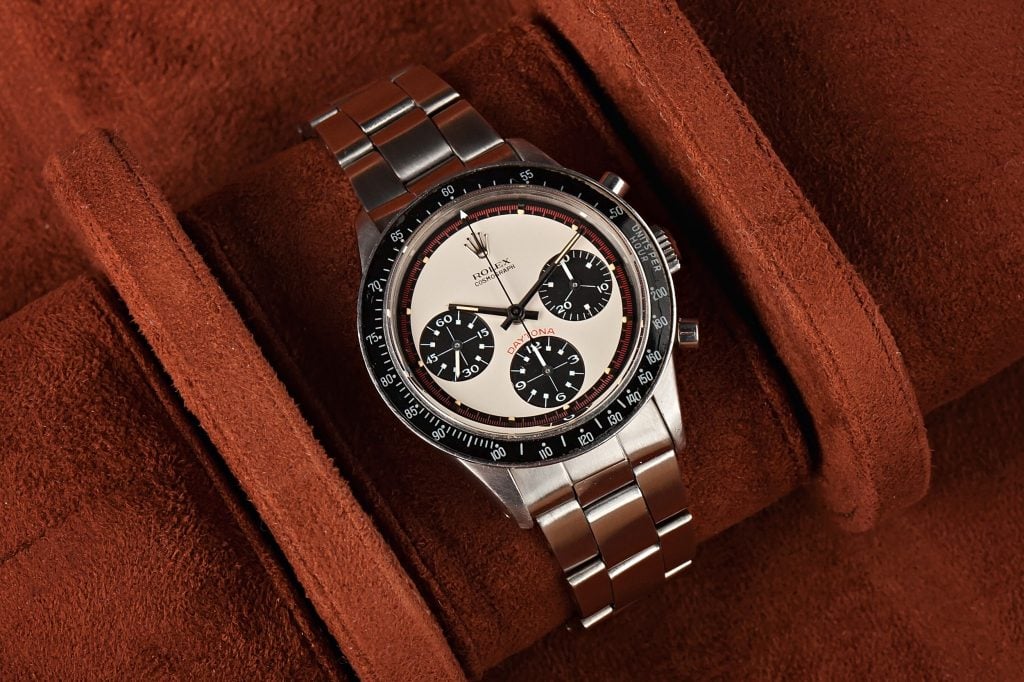
Owning a 1960s watch feels different. They weren’t made as accessories. They were tools. Pilots used them on long-haul flights, divers relied on them underwater, and drivers wore them on the track. The design came from real use, and you can still see that in the watch today.
The vintage Rolex market has shifted quite a bit. More people understand what 1960s watches actually represent, and not just as watches, either, but as part of the brand’s history. That also means the details matter more. Condition, originality, and correct parts can make a big difference, so it’s worth working with someone who knows what to look for. That’s where we come in. We handle these watches every day and focus on getting the details right, so you know exactly what you’re buying.