Rolex began its historic sponsorship of the Daytona International Speedway in the late 1950s, with the race transitioning from its original, shorter format into today’s 24-hour contest 60 years ago this year in 1966. Much has happened in these years between Rolex and Daytona, which is worth taking a more detailed look at.
Rolex and Sports Marketing: Perhaps The First

But first, let’s take a little side trip to the concept of sports marketing, which is not unimportant to examine in this context since Rolex was an early – if not the earliest – practitioner in the watch industry. The term “sports marketing” would not be coined until the magazine Advertising Age did so in an article published in 1978, but even so Rolex was already busy with just that when it took on sponsorship of the Daytona International Speedway about 20 years earlier.
Thus, at a time when large sporting events were still in their medial baby shoes, Rolex took a plunge into the relative unknown – which, seen through the lens of today, is pretty surprising since Rolex is not the type of company to generally lead the pack in terms of newness. Rolex’s motto often seems to be slow and steady wins the race.
Though Rolex did not begin a sports marketing “program” in 1978 – and certainly not in 1959 – it is true that the watch industry’s first sports testimonial can also attributed to Rolex when its founder Hans Wilsdorf developed and patented the first water-resistant watch in the world and christened it the Oyster. That same year, 1926, he engaged the testimonial support of the woman who is likely the most famous in watch history: Mercedes Gleitze, the first female to swim across the English Channel. Gleitze swam the body of water separating England from France in 15 hours and 15 minutes wearing a Rolex Oyster on her wrist for the entire journey.
Rolex Cosmograph Daytona

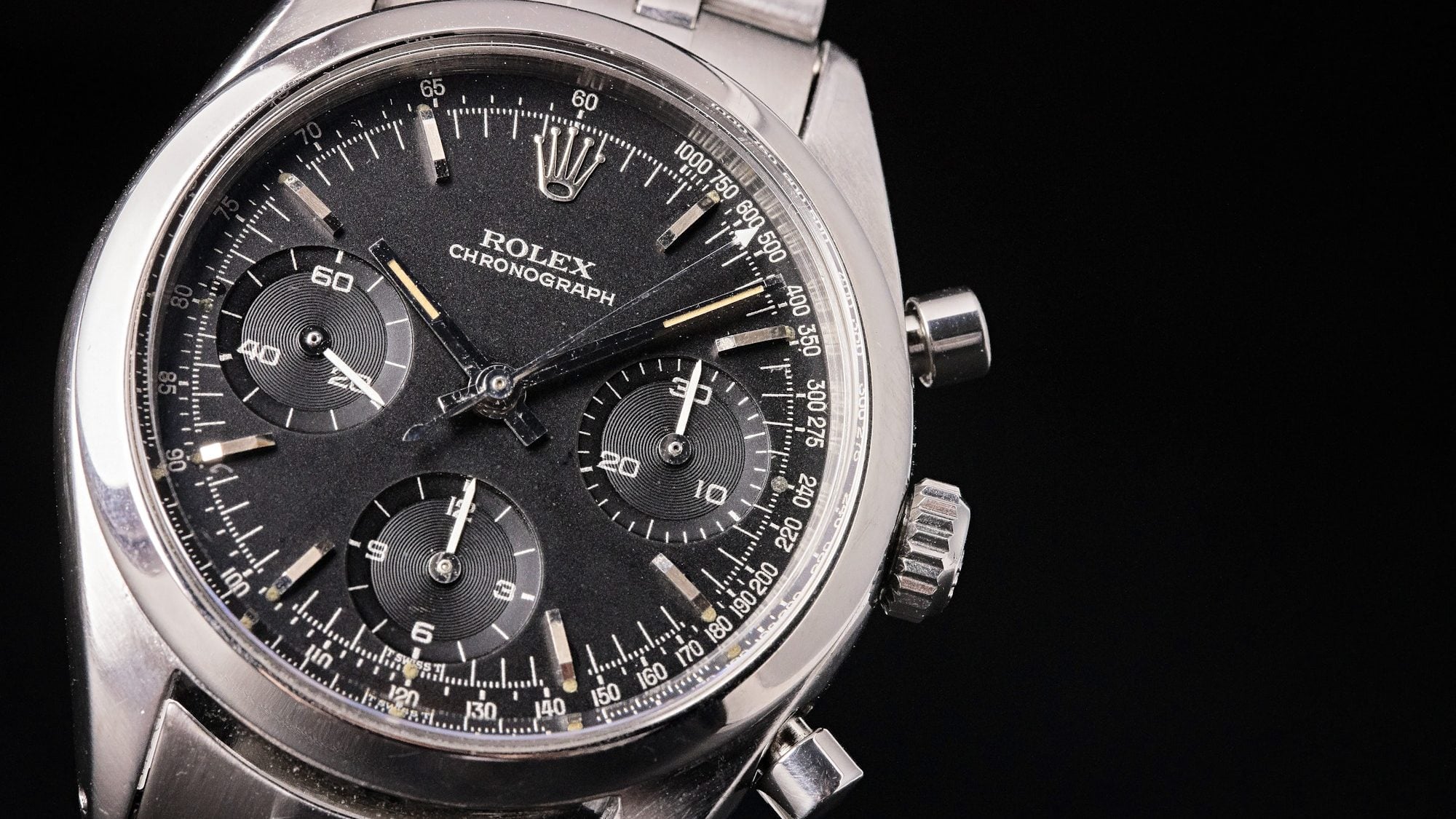
In 1963 Rolex launched the Cosmograph Daytona, the first Rolex chronograph with a tachymeter bezel. The tachymeter scale is much more than a design element; it has real-life functional purpose – and one particularly suited to a watch dedicated to auto racing. The tachymeter allows its owner to determine the speed of a vehicle by simply starting the chronograph at the beginning of a one-mile or one-kilometer marker and stopping it at the end of the chosen distance. The second hand will then indicate the average speed over that one mile or kilometer. For many years, the Rolex Daytona tachymeter scale could only display speeds up to 200 km/h (or mph), but over the years this was changed to 400 to reflect the abilities of some modern automobiles.
The classic use of a chronograph is, however, to measure elapsed time – whether it’s the time your car is parked at a parking meter, or whether you need to know how long your egg has boiled, or in case you are timing a car race for yourself. Elapsed time is measured on a Cosmograph Daytona in hours (counter at 9 o’clock) up to 12 hours, minutes (counter at 3 o’clock) up to 30 minutes, and the seconds on the sweep chronograph second hand. The subdial at 6 o’clock is part of the time display showing running seconds.
The word Daytona was a nickname that only officially appeared on the dials of these watches around 1965, which is when the watch started to be called the Cosmograph Daytona. “Cosmograph” is a Rolex-invented word combining the Greek cosmo (“world”) and “graph” (from the Greek for “to write”). Its design was from the get-go so classic that Rolex has never felt the need to change it substantially – at least on the outside. With its three contrasting counters, muscular crown guards, and screw-in pushers consumers wouldn’t have it any other way.
In 1988, the Cosmograph Daytona evolved from a manual wind on a Valjoux base movement to an automatic, when Rolex introduced Caliber 4030 with its Zenith base chronograph movement. In 2000, Rolex introduced its first in-house automatic chronograph movement, Caliber 4130.
The 60th Anniversary of the Rolex Cosmograph Daytona
In 2023, the Cosmograph Daytona celebrated its sixtieth anniversary. At this time, Rolex updated the Daytona range with subtle refinements that are barely visible to the casual observer such as color combinations and a slight redesign of the Oyster case.
The big change came inside the Cosmograph Daytona, as from then on it was powered by automatic Caliber 4131, which includes the efficient Chronergy escapement and aesthetic changes to the movement. Entirely developed and manufactured by Rolex, this movement also contains a reduced number of chronograph components meant to enhance reliability, while keeping the classic column wheel and vertical clutch. Naturally, every Cosmograph Daytona continues to be delivered with chronometer certification.
Daytona, Florida
Motor racing took place on Daytona’s beach from 1903 thanks to hard-packed sand that feels much like concrete to tires. Though racing now takes place on the nearby purpose-built track, Daytona International Speedway, this beach historically remains in the minds of both watch and racing fans for that reason.
In 1966, the 24 Hours of Daytona – officially called the Rolex 24 at Daytona since 1992 – was born, often described as the American equivalent to the 24 Hours of Le Mans. It is a grueling round-the-clock race that is a test of both endurance and speed as the more than 900 laps are run on a 3.56-mile (5.73 kilometer) track – with at least half of that spent driving in the dark – to cover a distance totaling 2,672 miles or 4,300 kilometers, or close to what one needs to drive from Los Angeles to New York.
The winning drivers in each class each receive a Cosmograph Daytona watch from Rolex, a tradition that started in 1964. Coveted by every entrant, this special watch is engraved on the back with the race’s logo and the word “winner” along with the year.
What is truly remarkable about the Rolex Cosmograph Daytona is that its design has hardly changed over the years, making it a true classic that is forever linked to the world of motor sports. I guess that early sports marketing paid off.