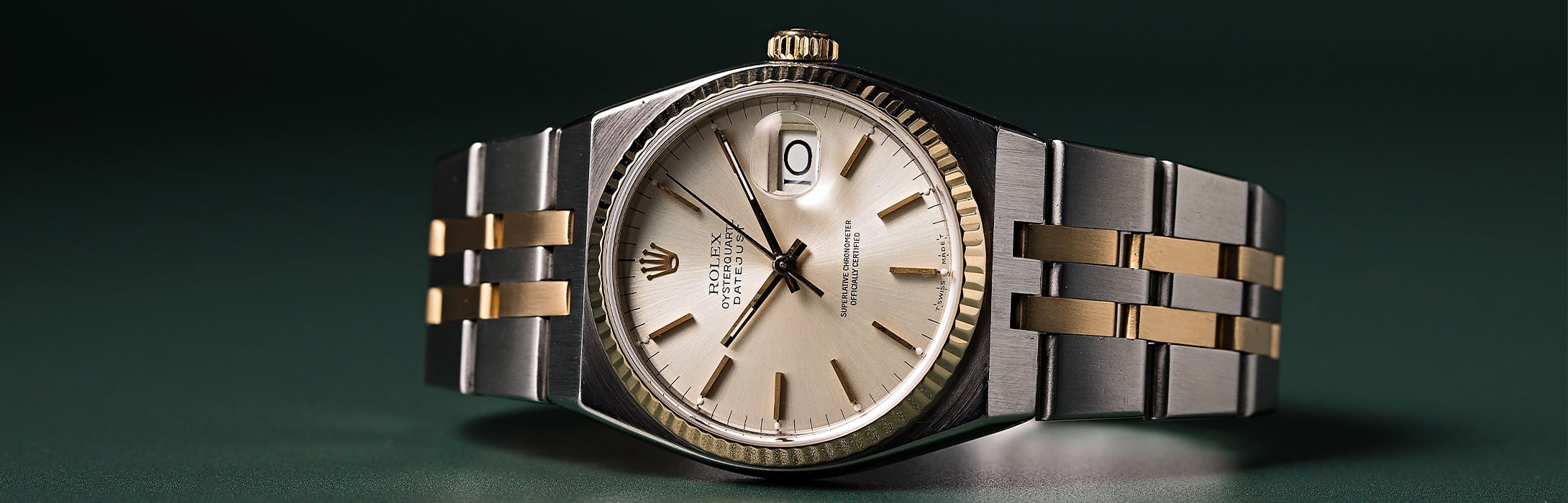

This Rolex Oysterquartz review begins with a paradox: it’s one of those watches that shouldn’t exist, and yet it does. Produced between 1977 and the early 2000s, it was Rolex’s direct response to the wave of Japanese quartz movements that had thrown the entire Swiss watch industry into a panic. What the industry called the “Quartz Crisis” was nothing short of an identity crisis for Swiss watchmaking. Rolex handled it in the most Rolex way imaginable: they built a quartz watch that still felt like a proper Swiss timepiece. The result is a sharp, angular watch with an integrated bracelet and a surprisingly loud tick that has divided opinions for almost five decades. Fewer than 25,000 were ever made over a roughly 25-year production run, which puts it among the rarest modern Rolex families you’ll come across.
Key Takeaways:
- Exceptional Rarity: Fewer than 25,000 units produced over 25 years.
- Design Icon: Features a Gerald Genta-inspired sharp, angular case.
- Mechanical Hybrid: The movements are hand-finished with traditional Swiss watchmaking techniques, unlike modern mass-produced quartz.
- Chronometer Certified: Most models (Mark II) are COSC-certified for extreme accuracy.
But the Oysterquartz isn’t just a curiosity because of its looks. Crack one open and you’ll find movements that were hand-finished using old-school Swiss techniques, which is about as far from a throwaway Japanese quartz caliber as you can get. From the Mark II generation onward, most of these watches carry COSC chronometer certification. That means they’ve passed the same rigorous accuracy tests applied to Switzerland’s finest timepieces. And then there’s the case itself, which you’ll probably notice borrows heavily from the design vocabulary of Gerald Genta, the legendary designer behind the Audemars Piguet Royal Oak and the Patek Philippe Nautilus. The Oysterquartz was Rolex saying, in no uncertain terms, that they could play the quartz game better than anyone while still building a watch the old-fashioned way.
The History of the Rolex Oysterquartz: Surviving the Crisis

By the late 1960s, the Swiss watch industry was staring down a genuine existential threat. Japanese manufacturers, Seiko chief among them, had figured out how to produce affordable, highly accurate quartz movements that made traditional mechanical watches look outdated practically overnight. In response, a group of Swiss companies banded together under the name Centre Electronique Horloger (CEH) to develop their own quartz caliber. The result was the Beta 21. Rolex jumped in and used the Beta 21 in a limited run of about 1,000 watches, sold as the reference 5100.
Ref. 5100: “The Texan”
The Ref. 5100 picked up the nickname “The Texan” because American buyers, particularly those in Texas, loved it. But depending on who you ask, the moniker could also be because of its larger 40mm size. This was Rolex’s first quartz wristwatch, and it also happened to be one of the first Rolexes fitted with a sapphire crystal after the King Midas, a feature that would later become standard across the entire lineup. The watch was big for its time and came in a tonneau-shaped case that looked nothing like the angular Oysterquartz that would follow. The Beta 21 inside was accurate enough, but Rolex reportedly wasn’t happy about relying on a caliber built by committee. They wanted full ownership of their quartz technology, the same way they controlled every aspect of their mechanical movements.
So Rolex got to work developing its own quartz movement, one that took 5 years to perfect. The calibres 5035 for the Datejust and 5055 for the Day-Date were released in 1977. They weren’t just any old quartz movement with a Rolex logo on it, either. They were carefully developed and hand-assembled Rolex movements. Thermo-compensated oscillators deliver unmatched accuracy. Rolex’s point was clear. They were going to do things their own way, even when the rules of the game had changed.
Defining Design: The Genta Aesthetic and Integrated Bracelet
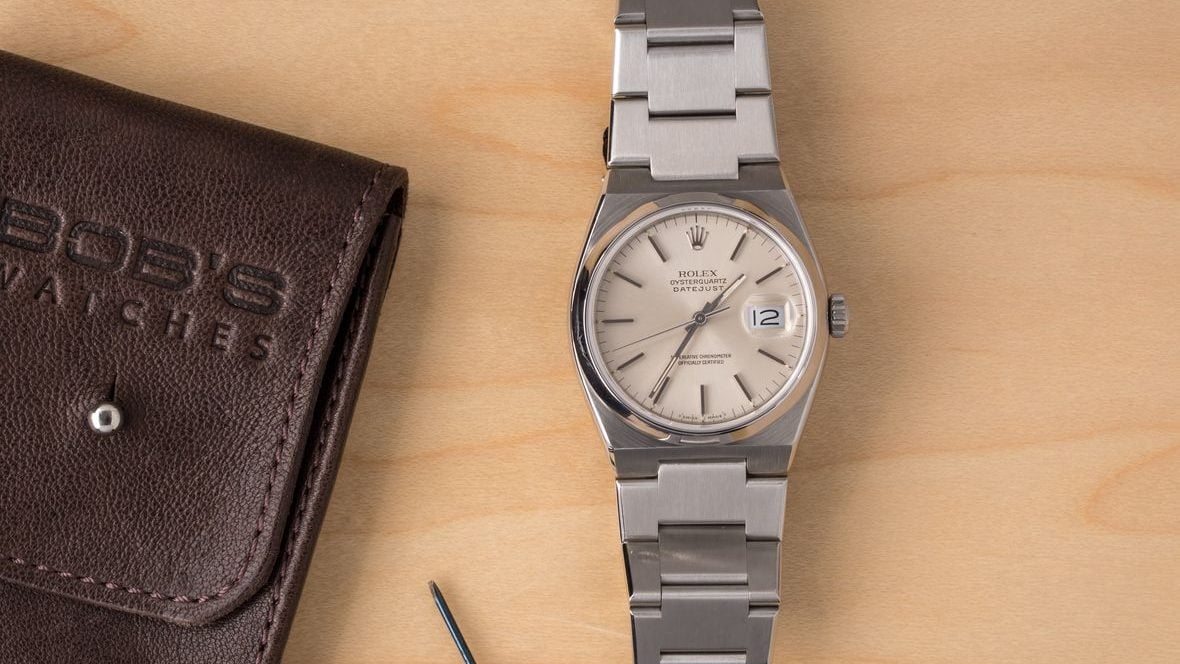
The 1970s were a wild time for watchmaking. A new look was taking hold, one defined by integrated bracelets that flowed directly from the case without visible lugs. The guy at the center of this shift was Gerald Genta, the Swiss designer who’d already created the Audemars Piguet Royal Oak in 1972 and would go on to draw the Patek Philippe Nautilus in 1976. Rolex has never officially confirmed that Genta had a hand in the Oysterquartz. Still, you only have to look at it for about three seconds to see the family resemblance. The sharp, slab-sided case and the way the bracelet locks into the case are pure 1970s Genta DNA.
What really makes the Oysterquartz stand out is the crispness of those flat edges. Where most Rolex models have rounded, organic profiles, the Oysterquartz is all straight lines and hard angles. Almost like a piece of architecture shrunk down to wrist size. That’s also why condition is such a big deal on the secondary market. When these watches get over-polished during servicing, those razor-sharp edges start to soften, and the watch loses the single design element that defines it. Collectors routinely pay a hefty premium for examples that still have their original, unpolished edges intact. One quick note: Rolex did produce mechanical versions in the same angular case shape (references 1530 and 1630), but those are automatic watches and shouldn’t be confused with the quartz-powered Oysterquartz.
Rolex Oysterquartz Model and Reference Guide

There’s two main OysterQuartz families: the Datejust and the Day-Date. The Datejust is the more accessible collection, with stainless steel and two-tone options, while the Day-Date is exclusively made in 18k gold. Here are the key references for each line.
Oysterquartz Datejust Models
| Reference | Material | Bezel Style |
| 17000 | Stainless Steel | Smooth |
| 17013 | Steel & Gold | Fluted |
| 17014 | Steel & White Gold | Fluted |
Oysterquartz Day-Date Models
| Reference | Material | Special Feature |
| 19018 | 18k Yellow Gold | Fluted Bezel |
| 19019 | 18k White Gold | Fluted Bezel |
| 19028 | 18k Yellow Gold | Pyramid Bezel |
The Ref. 17000 in full stainless steel is the most common Oysterquartz and the natural starting point for collectors dipping their toes into this family. Step up in materials and you’ve got the two-tone 17013 and the steel-and-white-gold 17014. On the Day-Date side, the 19018 in yellow gold is the one you’ll see most often, while the 19019 in white gold is noticeably harder to track down. The 19028, with its textured pyramid bezel, sits at the top of most collectors’ wish lists and is one of the rarest references in the entire Oysterquartz range.
Under the Hood: Calibers 5035 and 5055
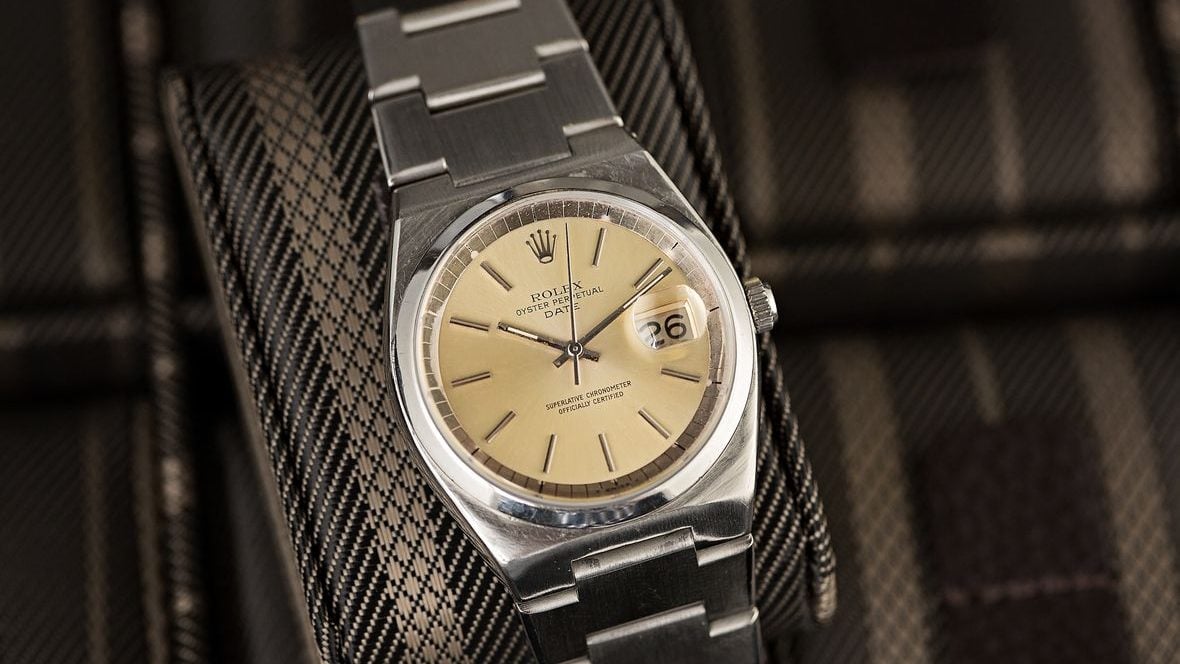
The real magic of the Oysterquartz lives inside the case. Rolex developed two dedicated movements for this line: the Caliber 5035 for the Datejust models and the Caliber 5055 for the Day-Date. Both are 11-jewel movements made entirely in-house, and both use a thermo-compensated quartz oscillator. In plain English, that means the movement can sense and adjust for temperature changes, which is one of the biggest sources of drift in ordinary quartz watches. The end result is accuracy that’s well beyond what your average quartz watch can manage.
These weren’t assembly-line calibers, either. Each one was put together and finished by hand, with the same attention to detail Rolex gave its mechanical movements. Every unit was individually adjusted and tested before it left the factory. Most also carried a COSC chronometer certification, officially confirming their precision. That kind of craftsmanship in a quartz movement was almost unheard of at the time, and honestly, it’s still rare today.
The Loud Tick

No Rolex Oysterquartz review would be complete without discussing the tick. If you’ve ever been near an Oysterquartz in a quiet room, you already know about it. Unlike most quartz watches, which are practically silent, the Oysterquartz makes a clearly audible ticking sound. This comes from a pallet fork mechanism inside the movement, a component you’d normally associate with mechanical watches. The pallet fork physically snaps with each second, creating a sound that catches most people off guard the first time they hear it. Some owners find it endearing; others need a bit of time to warm up to it. Either way, it’s one of the fastest ways to identify an Oysterquartz without even looking at the dial.
Mark I vs. Mark II Dials
There’s a bit of a curious distinction between the Mark I and Mark II dials. While the caliber 5055 powering the Day-Date model was always chronometer rated, the caliber 5035 for the Datejust was not initially sent off for COSC testing. Therefore, all OysterQuartz Day-Date watches have the “Superlative Chronometer Officially Certified” text on the dial. Early versions of the Datejust did not, and those were the Mark I dials. Later OysterQuartz Datejusts sent for testing near the end of the 1970s with the extra COSC text on the dial are the Mark II versions.
Rare Dial Variations: From Buckley to Wood

Like most Rolex families, the Oysterquartz came in more dial variations than you might expect. Some of these are rare enough to seriously move the needle on a watch’s resale value. Knowing what to look for can be the difference between picking up a standard Oysterquartz and finding something truly special.
Buckley Dials
The Rolex Buckley dial gets its name from a well-known Rolex retailer and features printed Roman numerals in place of the more typical applied stick markers. The effect is a dressier, more classical look that plays nicely against the watch’s modern, angular case. Buckley dials aren’t the rarest things in the world, but they’re still a favorite among collectors who enjoy that contrast between old and new.
Wood and Burl Dials
The most visually striking Oysterquartz dials, by a wide margin, are the wood variants found only on Day-Date models. Think mahogany, walnut, and burl wood finishes. The same kinds of exotic dials Rolex used on its mechanical Day-Date references during the same period. A wood-dial Oysterquartz Day-Date is one of the rarest configurations in the entire lineup, and clean examples can pull serious money at auction. There’s something about the warmth of natural wood set against a sharp gold case that’s completely unlike anything else in the Rolex catalog.
Pyramid Bezels and Center Links

On a handful of Day-Date references, most notably the Ref. 19028, Rolex used a pyramid-textured bezel in place of the standard fluted design. Some of these watches also came with matching pyramid-textured center links on the bracelet, tying the whole look together. These pyramid variants are among the most collectible Oysterquartz models around, and they don’t come up for sale very often.
Buying and Investing: Rolex Oysterquartz Price and Value
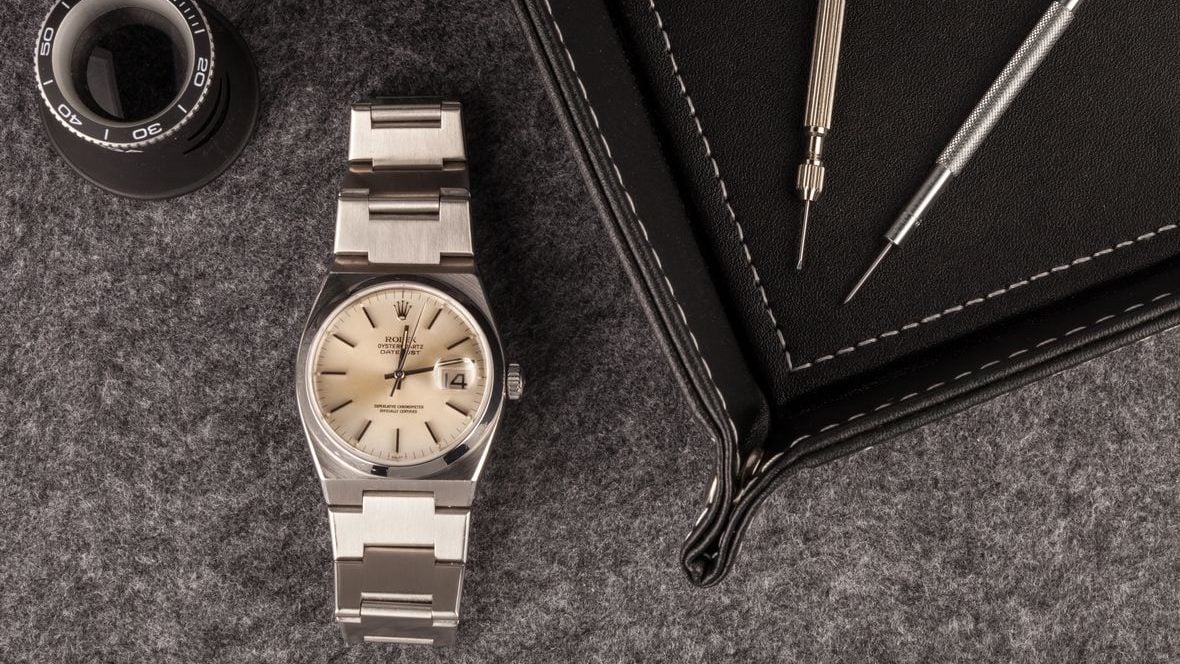
For a long time, the Oysterquartz was the black sheep of the Rolex catalog. Traditional collectors, the ones who cared mainly about mechanical movements, didn’t give it much thought. That attitude has changed dramatically in recent years. The price analysis below draws from our dataset of sales recorded between 2011 and 2025, and it tells a clear story: the Oysterquartz has gone from being a quirky footnote to a genuine investment watch.
Market Trends: 15-Year Price Analysis (2011 to 2025)
The Oysterquartz market has been on a strong upward climb over the last decade and a half. Average sale prices across all models went from $2,495 in 2011 to a peak above $9,100 in 2024, a total increase of roughly 266%. Between 2011 and 2024, that translates to a compound annual growth rate (CAGR) of 10.49%, which handily outpaces many traditional savings vehicles and even some corners of the broader luxury watch market.
The biggest surge came between 2020 and 2022, right in step with the global mania for integrated-bracelet sports watches. Average prices jumped from about $5,760 in 2020 to over $9,070 in 2022, roughly a 57% increase in just two years. The market cooled off slightly in 2023, dipping to around $8,025, but prices bounced back to new highs in 2024. Early 2025 data, based on completed sales, shows averages hovering near $8,470, which suggests the market has found a higher floor rather than pulling back.
Price Breakdown by Model Line

The Oysterquartz market splits neatly between the steel and two-tone Datejust references and the precious-metal Day-Date references. The two lines have traced different growth curves, with the Datejust offering steady, reliable appreciation and the Day-Date delivering bigger absolute returns.
| Year | Datejust (Avg) | Day-Date (Avg) |
| 2011 | $2,495 | N/A |
| 2015 | $2,838 | $8,198 |
| 2018 | $3,715 | $9,128 |
| 2020 | $4,062 | $9,835 |
| 2022 | $5,768 | $13,365 |
| 2024 | $5,680 | $14,720 |
| 2025 | $6,534 | $15,737 |
Oysterquartz Datejust: The Collector’s Entry Point
The Datejust models (Ref. 17000, 17013, and 17014) are where most Oysterquartz collectors start. They’ve maintained a steady 6.53% CAGR since 2011, with averages climbing from $2,495 to $5,680 by 2024. The two-tone Rolex 17013 is the most frequently traded model in the dataset. Meanwhile, the full-steel 17000 has been picking up steam thanks to its clean, Genta-influenced aesthetic, with average prices now sitting around $4,100 and top examples pushing past $6,300.
Oysterquartz Day-Date: The Gold Standard

The Day-Date models, all 18k gold, occupy the top end of the market. Since 2014 (the earliest year with Day-Date data in this set), they’ve delivered a 6.19% CAGR, with average prices rising from $8,070 to $14,720 by 2024. The Ref. 19018 in yellow gold is the most common Day-Date variant, carrying an overall average sale price of $10,906. The rarest reference in the dataset is the Ref. 19028 with the pyramid bezel, which posted the highest single sale at $19,995 in 2021. Uncommon dial finishes like pyramid or wood push prices even higher.
Investment Takeaway for Collectors
The numbers paint a pretty clear picture: the supply of high-quality, unpolished Oysterquartz examples is getting thinner. With total production capped at fewer than 25,000 units and a 10.49% overall CAGR across 13 years, the Oysterquartz is one of the more compelling value stories in the vintage Rolex market right now. Case sharpness is the single biggest factor in pricing. An unpolished watch with crisp, well-defined edges will always be worth significantly more than one that’s been rounded down through aggressive polishing. If you’re shopping for one, keep an eye out for one that’s been gently worn and properly stored over one that’s been buffed to a mirror finish.
Maintenance: Battery Replacement
The Oysterquartz runs on a standard watch battery that lasts roughly two to three years. When it dies, the watch just stops, and you’ll need a replacement. This is a routine job for any competent watchmaker and doesn’t really require sending the watch back to Rolex.
The Ultimate Expression of Vintage Rolex Accuracy

In this Rolex Oysterquartz review, one thing is clear: the Rolex Oysterquartz is special. It came out of a specific, high-pressure moment when the entire Swiss industry was scrambling to survive, and Rolex chose to meet the threat head-on by building a quartz watch to mechanical standards. The angular 1970s case, the hand-finished in-house movement, the tiny production numbers. It all adds up to a watch that feels both futuristic and deeply traditional at the same time. After spending years as an underappreciated oddity, the Oysterquartz is finally getting the recognition it deserves as one of the most interesting and collectible Rolex watches ever made.
Bob’s Watches is the world’s most trusted marketplace for authenticated pre-owned Rolex watches. It doesn’t matter if it’s a rare 19028 with a pyramid bezel or a classic stainless steel 17000 to kick off your collection, our team of experts verifies every watch in inventory for authenticity and condition. Every Oysterquartz we sell is ready for the next generation of collectors.