Patek Philippe leads the high-end luxury market in cultural recognition, brand prestige, and resale value, while Vacheron Constantin stands for artistic, understated watchmaking backed by the longest unbroken history in the industry. This guide covers the heritage, design codes, flagship collections, and market realities of both of these luxury watch options, so you can decide which one deserves a place on your wrist.
Key takeaways:
- Heritage: Vacheron Constantin is the oldest watchmaker in continuous operation, founded in 1755. Patek Philippe arrived later, in 1839.
- Market dynamics: Patek Philippe carries steep secondary market premiums and multi-year waitlists. Vacheron Constantin offers easier boutique access and steady long term value.
- Design language: Patek favors balanced, classic proportions. Vacheron leans into bolder case shapes, detailed textures, and artistic finishing.
Choosing between these two members of watchmaking’s “Holy Trinity” is about more than telling time. It is a choice between two different ideas of what luxury should be. Here is how they compare side by side.
Patek Philippe vs Vacheron Constantin at a Glance
| Feature | Patek Philippe | Vacheron Constantin |
|---|---|---|
| Founded | 1839 | 1755 (oldest continuous manufacturer) |
| Design core | Balanced, classic, timeless proportions | Adventurous shapes, textured dials, artistic |
| Flagship sports | Nautilus, Aquanaut | Overseas collection |
| Flagship dress | Calatrava | Patrimony, Traditionnelle |
| Resale value | Very high; commands heavy premiums | Stable; softer initial depreciation |
| Availability | Multi-year waitlists; highly restrictive | More accessible at retail boutiques |
Brand Heritage and Horological Significance

Both brands belong to the “Holy Trinity” of watchmaking alongside Audemars Piguet, a group recognized for centuries of skill, independence, and mastery of complicated movements. Their histories explain a great deal about how each house presents itself today, and why collectors hold them in such high regard. The story of each brand sets the stage for the design and market differences that follow.
Vacheron Constantin: Centuries of Uninterrupted Mastery

Jean-Marc Vacheron set up his workshop in Geneva in 1755, which makes Vacheron Constantin the oldest watchmaker that has never stopped production. The word that matters most here is “uninterrupted.” The company kept its doors open through the French Revolution, two world wars, and the Quartz Crisis of the 1970s and 1980s, an era that shut down many famous Swiss names for good.
That long run came with an equally serious client list. Figures such as Napoleon Bonaparte and U.S. President Harry Truman owned Vacheron timepieces, and the brand built its reputation on bespoke, highly technical commissions. The most striking recent example is the Berkley Grand Complication of 2024, a pocket watch with 63 complications that currently holds the title of the most complicated mechanical watch ever made. It surpassed the brand’s own Reference 57260 from 2015, showing how Vacheron continues to push the limits of what a single movement can do.
Patek Philippe: The Architects of Modern Prestige

Patek Philippe was founded in 1839 by Antoni Patek and, a few years later, Adrien Philippe, the watchmaker who invented the keyless winding mechanism that freed owners from carrying a separate winding key. That single innovation helped shape the modern watch as we know it. From the start, the company aimed its work at the top of the market and rarely strayed from that focus.
The brand’s legacy rests on a string of technical firsts, including some of the earliest perpetual calendar wristwatches and split seconds chronographs. Over time, Patek Philippe became a fixture among royalty, business leaders, and cultural icons, which helped turn the name into shorthand for the highest tier of watchmaking. That reputation is a large part of why the brand commands the prices it does today.
Design Philosophy and Craftsmanship

Patek Philippe builds its identity around balance and restraint. The house pursues clean dials, careful symmetry, and proportions meant to look correct in any decade rather than tied to a trend. Quality control runs through the Patek Philippe Seal, an in house standard that regulates every component of the Patek Philippe movement and case, covering accuracy, finishing, and long term serviceability.
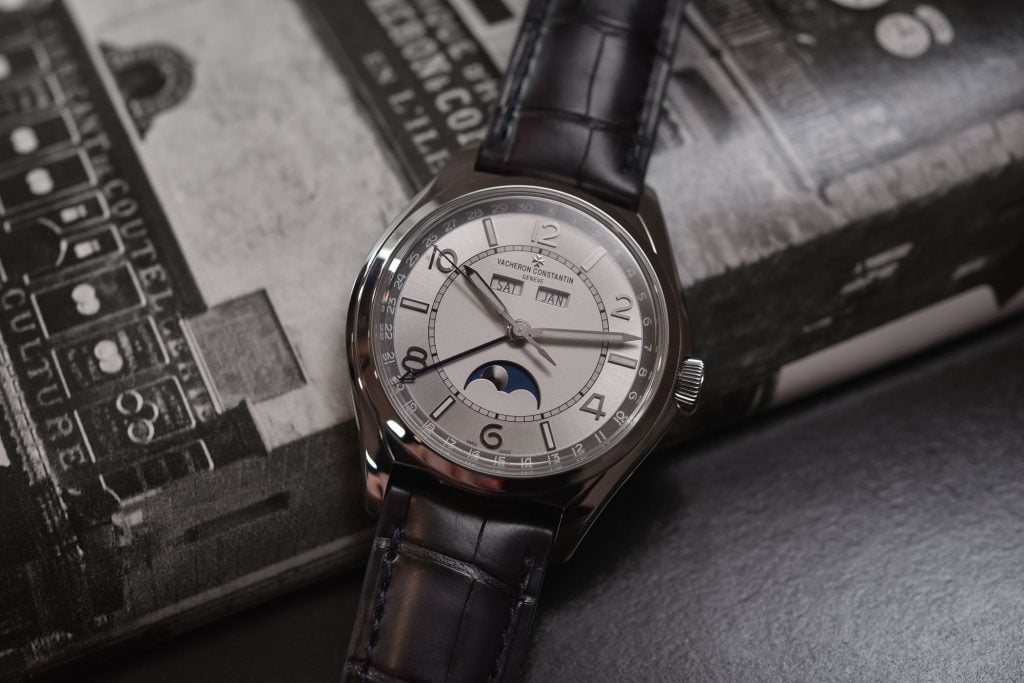
Vacheron Constantin takes a more expressive route. The brand is comfortable with asymmetrical cases, richly textured dials, and openworked Vacheron Constantin movements that show off the mechanics inside. Many of its pieces carry the Hallmark of Geneva, also called the Poinçon de Genève, an independent certification that confirms both the geographic origin of the work and a high level of finishing.
A few of the artistic techniques that set these watches apart:
- Guilloché: repeating decorative patterns cut into the dial by an engine turning machine, often guided by hand.
- Skeletonization: removing material from the movement so the gears and bridges become part of the visual design.
- Hand finishing: polishing, beveling, and graining of internal parts, much of which is hidden behind the caseback yet done to the same standard as the visible surfaces.
The Battle of the Icons: Flagship Collections Compared
Most buyers weighing these two brands start with a handful of signature collections rather than the full catalog. Online communities and longtime collectors tend to cross-shop the same models, so it helps to see how the headline pieces line up against one another. The comparison usually breaks down along two lines: sports watches and dress watches.
Luxury Sports Watches: Overseas vs Nautilus and Aquanaut

As a sports watch, the Patek Philippe Nautilus carries the design pedigree of Gérald Genta, the celebrated designer behind its 1976 debut, and it has become one of the most talked about watches in the world. The Aquanaut builds on that same sporty language with a more casual, rubber strap personality. Both models are known for strong cultural currency and for being nearly impossible to buy at retail.
The Vacheron Constantin Overseas answers with its own distinct look, anchored by a bezel shaped after the brand’s Maltese Cross emblem. Its standout practical feature is versatility, since each watch ships with a tool free interchangeable strap system that lets owners swap between steel, rubber, and leather in seconds. For buyers who want one sports watch that adapts to many settings, the Overseas makes a strong case.
Dress Watches: Patrimony and Traditionnelle vs Calatrava

The Patek Philippe Calatrava has served as the blueprint for the modern dress watch since 1932. Its appeal comes from circular minimalism: a clean dial, a slim case, and almost nothing in the way of distraction. Decades of consistency have made it a reference point that other brands measure themselves against.
The Vacheron answers the dress watch market with the Patrimony and Traditionnelle lines, which share that classic round profile while adding their own character. These models often feature slightly more dramatic dial textures and very thin mechanical movements, giving them a quietly distinctive presence on the wrist. They cover much the same dress watch territory as the Calatrava, with a touch more visual detail.
Market Value, Accessibility, and Investment Potential

Patek Philippe commands large premiums on the secondary market, and the reason is straightforward. Production stays deliberately low while global demand keeps climbing, which turns models like the Nautilus into objects that trade well above their retail price. The flip side is access. Buying these watches new is tightly gatekept, and many buyers spend years on a waitlist with no guarantee of an allocation.
Vacheron Constantin holds excellent long term value as well, though it tends to show a softer initial depreciation curve when bought new. For many collectors, the bigger draw is the buying experience itself. It is realistic to walk into a Vacheron boutique, build a relationship with the staff, and purchase a watch finished to the highest standard without waiting for years. That accessibility does not come at the cost of pedigree.
If your priority is immediate resale value and broad brand recognition, Patek Philippe remains the market leader. If your priority is movement finishing, artistic variety, and a rewarding purchasing experience, Vacheron Constantin is hard to beat.
Choosing Your Masterpiece: Which Brand Fits Your Wrist?

Buy a Patek Philippe if you want the clearest symbol of watchmaking prestige money can buy. This is the brand for collectors who value strong auction results, prefer classic and proportioned design, and have either the budget for secondary market premiums or the patience to work through an authorized dealer waitlist. It rewards those who see a watch as both an heirloom and a recognizable status piece.
Buy a Vacheron Constantin if you think of yourself as a student of finishing and craft. This is the brand for buyers who enjoy owning something few others in the room will recognize, who place a high value on continuous history, and who want a serious luxury sports watch they can wear every day without drawing a crowd. It rewards quiet confidence over obvious flash.
Where Elite Watch Collecting Goes From Here

The line between Vacheron Constantin and Patek Philippe comes down to intention rather than quality. Both brands sit at the very top of the watchmaking world, which means any choice between them starts from a position of technical excellence. There is no wrong answer when both options represent the best the industry produces.
What separates them is what you value most. Patek offers cultural reach and market momentum that few names can match, while Vacheron offers quiet artistry and an unbroken history stretching back more than 265 years. Each one represents a peak of human craft, and either choice is one that should last for generations.