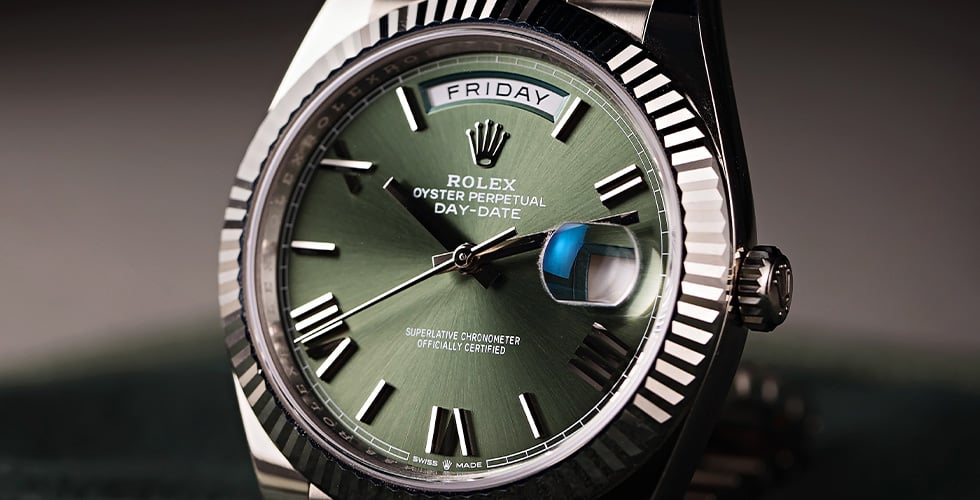
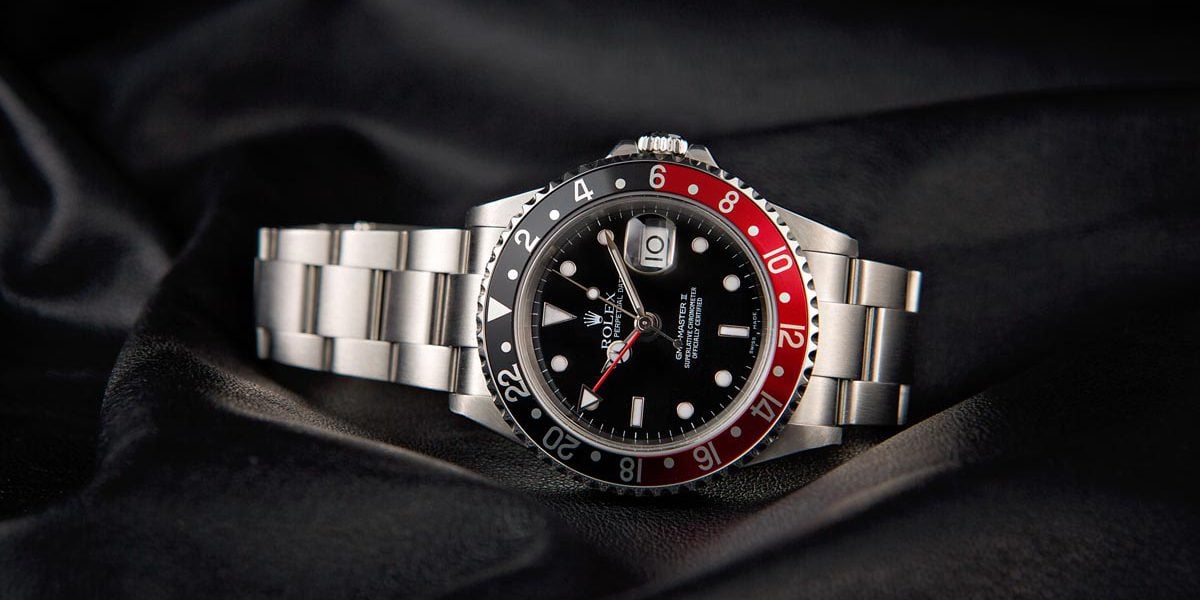
It’s natural to feel the urge to customize your Rolex watch, but there’s an important catch: Customization is permanent, costly, and usually an unqualified disaster. Short answer: You should almost never customize your Rolex, if you care about its value, authenticity, or warranty. It will be more “yours” but you will not be able to claim it as a true, serviceable Rolex by the manufacturer or any serious collector. Let’s go over the different types of customization out there, the risks, when it might make sense to customize your watch, and some better ways to make your watch unique.
Key Takeaways:
- Value Destruction: Aftermarket customization (adding gems, coatings, or custom dials) almost always destroys the watch’s resale and investment value.
- Voided Warranty: Any non-Rolex modification will immediately void the watch’s official warranty.
- Service Refusal: Rolex Service Centers will refuse to service a watch with any aftermarket parts, compromising its long-term function.
- Loss of Authenticity: A customized Rolex is no longer considered “factory original” and loses its status among collectors and reputable resellers.
- “Safe” Customization: The only “safe” and reversible customization is changing the strap while preserving the original bracelet.
A one-off watch is an extremely seductive idea. The thought of a watch as unique as you are is an intoxicating one, but before you let someone “ice out” your Submariner or PVD coat your Datejust it’s important to know what you’re getting into. Let’s take a closer look at what “customization” really means, and where you should absolutely not cross the line.
What Does “Customizing a Rolex” Actually Mean?
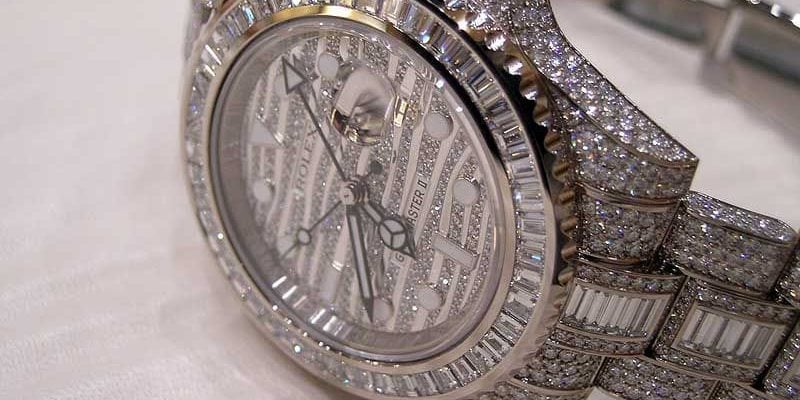
There’s two different types of customization when it comes to Rolexes: factory customization and aftermarket modification. Let’s break down the differences between each.
Aftermarket vs. Factory Customization: A Critical Distinction
A factory original “Rainbow Daytona” is a “true” while a third-party jeweler’s “iced-out” Datejust is a “false”. The market, and Rolex itself, treat these two items as polar opposites. One upholds the brand, the other degrades it.
| Feature | Rolex Factory-Original (e.g., Factory-Set Gems) | Aftermarket Customization (e.g., Third-Party Gems) |
| Authenticity | 100% Genuine Rolex parts and craftsmanship. | Contains non-genuine parts. |
| Value | Retains or significantly increases value; highly collectible. | Drastically decreases value; considered “damaged.” |
| Warranty | Fully covered by the official Rolex warranty. | Immediately voids the Rolex warranty. |
| Service | Can be serviced at any official Rolex Service Center. | Will be refused service by Rolex. |
| Quality | Flawless gem setting and materials, guaranteed by Rolex. | Varies wildly; often compromises the watch’s integrity. |
Rolex’s Official Stance on Modifications
Rolex staunchly believes in protecting the integrity, performance, and, most importantly, the authenticity of all its watches. That’s why it will never sell parts to third-party customizers. It’s a policy that’s strictly enforced at Rolex. A watch sent for service containing aftermarket parts will either be returned ‘as is’ or, if the owner is willing to replace all of the custom parts with genuine Rolex parts at an exorbitant price, the watch may be offered a service. In many cases, Rolex Service Centers simply refuse to work on modified watches, no matter the owner’s ability or willingness to pay for the restoration.
This position exemplifies Rolex’s dedication to the standards and values that have established the brand as a hallmark of excellence for over 100 years. Purchasing a Rolex is not simply acquiring a watch, but rather investing in the unrivaled precision engineering and quality control that third party modifiers cannot and should not replicate.
The Unspoken Truth: Why a Custom Rolex is a Bad Investment

Personal preference is one thing but fact is fact. The fact is that customizing a Rolex has a direct negative effect on its value. By the time you read this, you’ll know why and can avoid ruining your Rolex, wasting thousands of dollars and years of regret.
The Immediate Impact on Resale Value
The collector’s market is one of originality. A watch is bought and sold as a “complete set”, with every element of the watch from case to bracelet to dial required to be factory original. If the dial, bezel or case is changed, the watch is no longer a “Rolex”, but a “Rolex-based” custom project. Reputable dealers like Bob’s Watches cannot and will not buy or sell these watches as they cannot be certified to be authentic.
This immediately disqualifies you from the largest and most lucrative secondary market, and leaves you with a tiny fraction of buyers for a fraction of value. A standard stainless steel Submariner could sell for $10,000-15,000 on the pre-owned market. The same watch with aftermarket diamond setting would have a hard time even bringing $5,000, if you could find a buyer at all. You’ve just paid for customization work that deleted thousands of dollars in value.
Voiding the Warranty & Permanent Service Refusal
A Rolex is an intricate mechanical device built to function for a lifetime with the owner. However, like a car, it requires occasional servicing and maintenance every 5-10 years or so. As soon as Rolex finds a non-Rolex part during inspection, the 5-year warranty is void. Worse yet, they will no longer perform service of any kind on that watch. Once you need a professional overhaul, it is a death sentence for the long term function of your watch.
Sometimes independent watchmakers may refuse to work on highly modified watches. When working on a timepiece, watchmakers have no idea what the quality of the custom parts is. The Rolex movement works within certain tolerances. Aftermarket modifications can have variables that could make servicing almost impossible. If you don’t have authorized service, your watch is a ticking time bomb… Literally and figuratively.
The Authenticity Problem: It’s No Longer a “Real” Rolex
This is exactly my point, however, that is why people collect Rolex – the name. A name that comes with certain standards. A name that can only be transferred from a watch made by the Crown. An aftermarket PVD case, or a dial with loosely set stones cheapens the brand. It’s fake and altered.
Collectors and enthusiasts look at reference numbers, dial variations, factory specifications, and more for decades. They can see a non-original part a mile away. If a watch fails the authentication test, it has no place in that community. You may have a timepiece, but you no longer have a Rolex in the sense that matters to those who truly know and love the brand.
The Most Popular Types of Customization (And Their Risks)
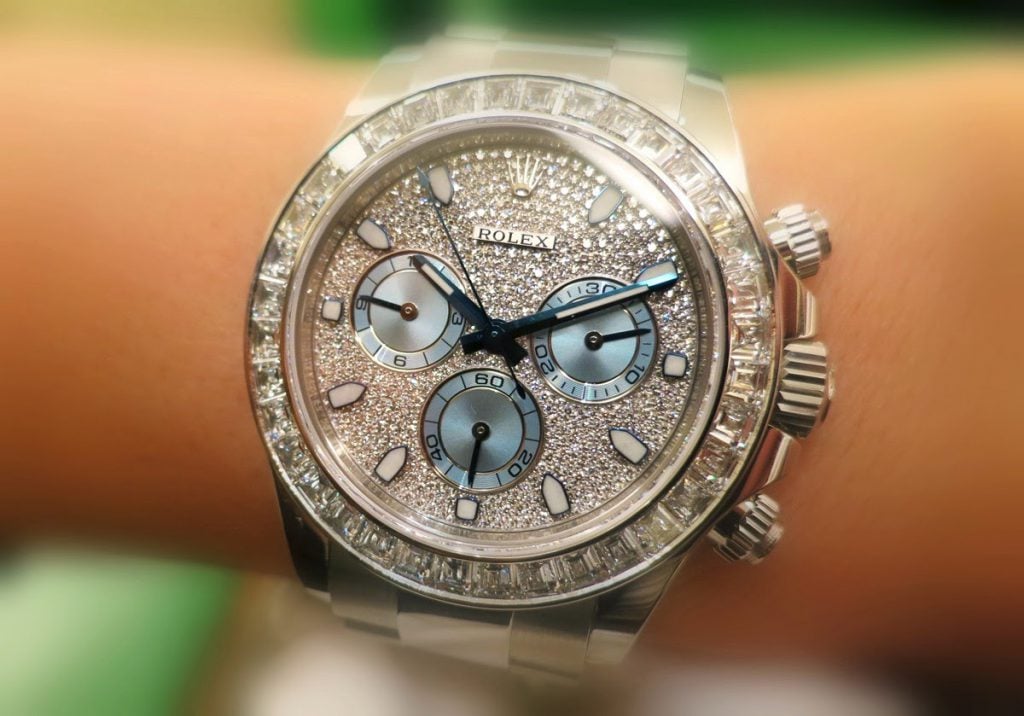
There are some modifications that people still do even when there are apparent cons to it, and it’s no secret that each of them comes with specific risks and dangers. Knowing the type of modification that you are looking at and its pitfalls can help you steer clear of all of them.
Custom “Iced-Out” Dials and Bezels (Aftermarket Gems)
This is by far the most prevalent and the most destructive customization. It’s the addition of diamonds (or other jewels) to the dial, bezel, case or bracelet by an outside jeweler. The effect is dramatic but the results can be fairly catastrophic.
Risks:
- Irreversible Damage: The case and bezel are often drilled to set the stones, permanently compromising the watch’s structural integrity.
- Unknown Quality: Gems are not Rolex-grade and often poorly set, with visible glue, uneven spacing, or stones that fall out over time.
- Water Resistance: Custom bezels almost always compromise the watch’s water resistance, defeating one of the core features of models like the Submariner.
- Total Value Loss: A factory-set gem Rolex from the official catalog is a treasure that appreciates in value. An aftermarket-set Rolex is considered by most collectors to be worthless from an investment standpoint.
PVD/DLC Coating (Blacking Out a Rolex)
The chemical coating process leaves a black or gunmetal gray surface on the stainless steel. It’s become a popular aftermarket treatment for watches such as the Submariner, GMT-Master II, and Daytona, as it is thought to have a more aggressive and tactical aesthetic that appeals to a stealthier look.
Risks:
- 100% Irreversible: This coating cannot be removed to restore the original steel finish without damaging the case.
- Chips and Scratches: The coating, unlike the original steel, can chip or scratch with daily wear, and it’s impossible to repair these imperfections without recoating the entire case.
- Automatic Service Refusal: Rolex won’t touch a PVD-coated watch under any circumstances.
- Finish Degradation: Over time, the coating can wear unevenly, creating a patchy, unprofessional appearance that can’t be fixed.
Custom/Refinished Dials
This is the process of changing the color of the dial (custom dials such as a “Tiffany” blue), adding text or logos to the dial, or re-silvering/painting/re-coloring/refinishing an old, oxidized dial to appear new. Although it may sound like a simple process, the dial is the most noticeable part of the watch.
Risks:
- Dial is the “Face”: The dial is one of the most important elements of a watch’s identity and authenticity. A non-original dial makes the entire watch inauthentic.
- Devalues Original: You lose the original, valuable Rolex-made dial, which may have had unique characteristics or patina that collectors prize.
- Immediate Red Flag: Any potential buyer or service center will spot a non-original dial immediately, raising questions about the watch’s entire history.
- No Path Back: Once the original dial is removed and replaced, finding an authentic replacement dial is nearly impossible and very expensive.
Popular Models for Customization (Datejust, Submariner)
Some used Rolex models are more often customized than others. The Datejust, as one of the most manufactured Rolex models ever, is frequently thought of as a “safer” model to customize since there are so many in existence. The Submariner, as a tool watch design icon, is frequently modified with “blackout” PVD coatings to make it look more edgy, military-like. The Daytona, as the “ultimate status symbol”, is often customized as an “iced-out” statement by those who want to stand out even more.
But customizing any of them results in the same loss of value. A hacked Datejust loses the same percentage of value as a hacked Daytona. The market doesn’t care which model you decided to customize, it just cares that you customized it. Even the most ubiquitous references deserve to remain in-spec from an investment and a service standpoint.
Are There Any “Safe” Rolex Customizations?
Of course, almost all of these modifications should be avoided at all costs. However, there are 2 exceptions that you can use to make your Rolex more personal while keeping its value and authenticity intact. They also offer flexibility while maintaining respect for the watch itself.
The Exception: Rolex Factory Engraving
A basic caseback engraving, done at the point of purchase (especially if from an Authorized Dealer), is widely accepted in the community. A special engraving like “To Dad, 2025” or “20 Years of Service” on the caseback is acceptable because it does not alter the watch mechanics, appearance, or authenticity. The watch still runs, is under warranty, and can still be serviced by Rolex.
However, do keep in mind that extremely personal engravings can slightly decrease the appeal of the watch on the resale market, as the next person may not have the same attachment to your sentiment. General or tasteful engravings have little to no effect, and more specific messages can slightly lower the marketability of the piece.
The Reversible Mod: Changing the Strap
This is one custom that both collectors and dealers as well as Rolex fans in general wholeheartedly agree on. Replacing the original Oyster or Jubilee bracelet with a good leather, rubber (Everest, Rubber B, etc.) or NATO strap is a great way to completely transform the watch’s appearance without actually changing the watch itself.
Rule of Gold: Store the original bracelet and end links in a safe place. The value is in the full, original set. You can always re-clasp the bracelet before you sell, and the watch itself is unchanged. Lots of collectors have multiple straps for their Rolex watches, and wear them for an occasion, outfit or season. This strategy gives you infinite style options, and keeps every dollar of your investment.
The Final Verdict on Rolex Modifications
So, should you customize your Rolex then? Well, our answer is that if you care about the integrity, quality and value of a Rolex, then the answer is a resounding no. The temptation can be there, but the potential damage you can do to the watch, from losing all value, to not being able to take it in for servicing again, is just too great. The art of collecting watches is in enjoying the watch as it was, in the form that the craftsmen at Rolex put together in the first place. If it’s something truly unique that you are after, there are other brands out there that do lots of complex pieces, like the highly desirable Patek Philippe Nautilus, and rare, factory-original Rolex watches with one-off dials.
When you buy from Bob’s Watches, you can trust that you are getting 100% genuine, certified pre-owned watches. We do not accept or sell modified or customized watches, because we believe all watches should be authentic, and modifications decrease the value of a watch, instead of building upon its original value. If you’re looking for a timepiece with a great track record and a long history that you can wear every day, we frequently suggest checking out our selection of Tudor watches. Tudor is a brand that was founded by the same person as Rolex, and offers outstanding quality and style at a great value, without the temptation to modify or customize.