Rolex Bezels: Types, Materials, and What an Original Bezel Is Worth
HomeBlogEditorialRolex Bezels: Types, Materials, and What an Original Bezel Is Worth
Written By: Carol AltieriReviewed By: Bob's Watches
Rolex bezels are the rings that surround the crystal on every Rolex watch, and they do far more than frame the dial. A Rolex bezel can time a dive, track a second time zone, or calculate average speed. In the watches that move through our business, the bezel does something quieter as well: more than any other exterior part, it sets the price.
Key Takeaways
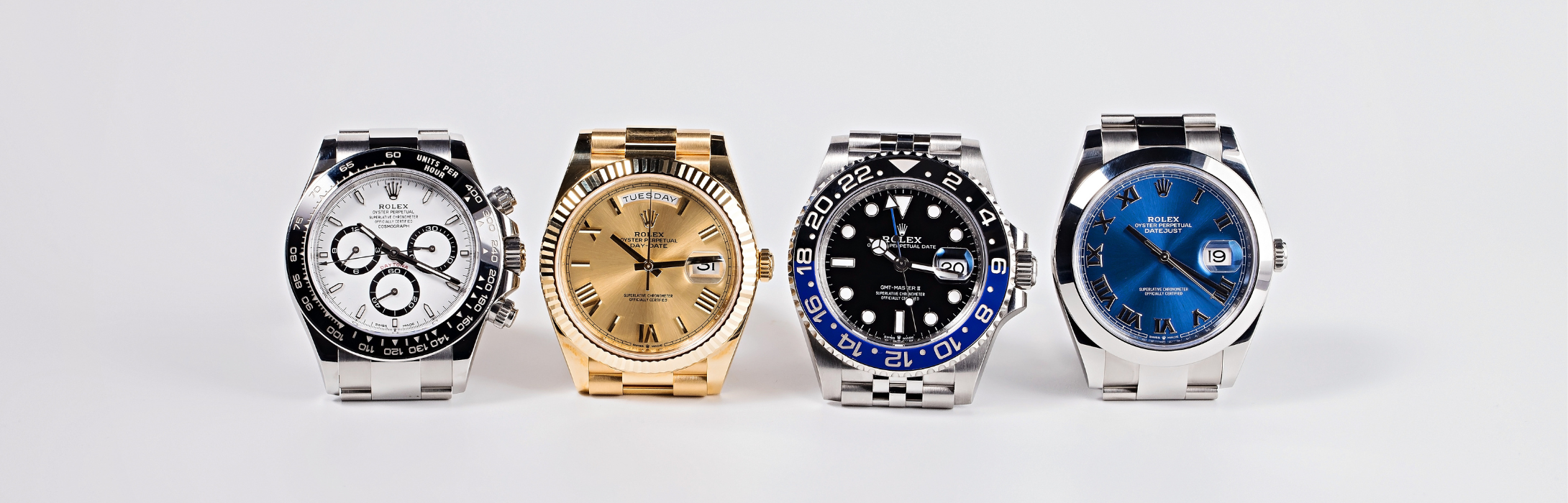
A Rolex bezel is the ring surrounding the crystal, produced in ten principal forms including smooth, domed, fluted, engine turned, unidirectional dive, bidirectional 24 hour, bidirectional regatta, tachymeter, Ring Command, and gem set.
Rolex introduced its proprietary Cerachrom ceramic bezel insert in 2005 on the GMT-Master II, replacing the anodized aluminum inserts used since the late 1950s.
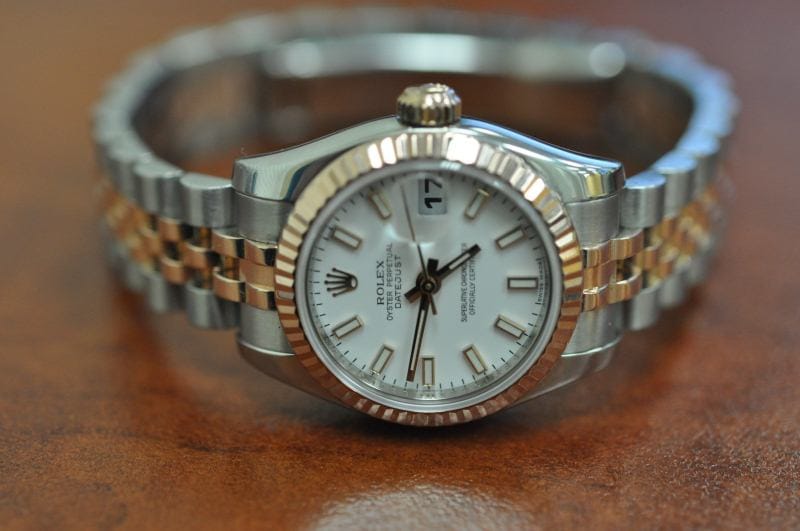
A fluted bezel is machined from solid gold or platinum rather than steel, which is why a steel Datejust carries its fluting on a white gold bezel.
In our sold data, the fluted bezel premium on the steel Datejust 36 has widened with every generation, reaching about 38 percent on the current 126 series.
I regularly see untouched original aluminum inserts carry more value on a vintage reference than a correct factory service replacement.
Bezel details expose a counterfeit faster than almost any other exterior component, which is why our authentication starts at the bezel edge.
I have spent my career on the operations side of the pre-owned Rolex market, which means I see the same watch twice: once when it arrives for intake and authentication, and again when it sells. That vantage point makes one thing obvious. Two Submariners with the same case, dial, and bracelet can sit thousands of dollars apart, and the difference is often nothing more than one wearing a sun faded aluminum insert and the other a colorfast Cerachrom ring. What follows is what our transaction data and our watchmakers have taught me about reading that ring correctly.
What Is a Rolex Bezel?
A Rolex bezel is the ring that surrounds the crystal and secures it to the Oyster case. Rolex produces bezels in ten principal forms: smooth, domed, fluted, engine turned, unidirectional rotating dive, bidirectional 24 hour, bidirectional 60 minute regatta, tachymeter, Ring Command, and gem set, with each form matched to the function of the model it sits on. The bezel is also a structural component, absorbing the first impact in a knock and holding the crystal in its waterproof seat.
Rolex attaches those bezels in two ways, and the distinction decides what a repair costs. Fixed bezels on models such as the Datejust and Day-Date are threaded or pressure fitted onto the case and do not move, so damage to one is damage to a case component. Rotating bezels on the Submariner, GMT-Master II, and Yacht-Master sit on a spring loaded click mechanism, with a separate insert of aluminum, ceramic, or precious metal carrying the graduations. When a watch comes to us with bezel damage, that is the first question our team answers, because a replaceable insert and a compromised case are very different conversations with a seller.
Rolex Bezel Types at a Glance
Bezel Type
Function
Models That Carry It
Smooth
Fixed, undecorated ring that frames the dial and protects the crystal
Oyster Perpetual, Explorer, Air-King, Milgauss, Submariner 124060 and 114060
Domed
Fixed ring with a raised curved profile, softening the case silhouette
Oyster Perpetual, Lady-Datejust, vintage Oyster and Date references
Fluted
Fixed ring with machined grooves, originally cut to grip a tool for waterproof sealing
Datejust, Day-Date, Sky-Dweller, Datejust 41 white and Everose Rolesor
Engine turned
Fixed ring with fine radial lines between polished indices, a mid century alternative to fluting
Vintage Datejust ref. 1603 and Air-King, discontinued in the modern catalog
Unidirectional rotating dive
60 minute graduated ring that turns counterclockwise only, so elapsed dive time can never read short
Submariner, Sea-Dweller, Deepsea
Bidirectional 24 hour
Graduated ring read against an independent 24 hour hand to track a second and third time zone
GMT-Master II
Bidirectional 60 minute regatta
Raised, knurled ring with a matte graduated scale against polished numerals, for nautical timing
Yacht-Master 37, 40, and 42
Tachymeter
Fixed scale that converts elapsed seconds into average speed over a known distance
Cosmograph Daytona
Ring Command
Rotating bezel mechanically linked to the movement, acting as a setting selector
Sky-Dweller, Yacht-Master II
Gem set
Fixed ring set with factory diamonds, sapphires, or other stones
Datejust, Day-Date, Yacht-Master, Daytona gem set references
Rolex Bezel Materials, From Bakelite to Cerachrom
Rolex bezel materials have moved through four distinct eras: Bakelite, anodized aluminum, precious metal, and Cerachrom ceramic. Each material solved a problem its predecessor could not, and each ages in a way that is legible at a glance. Material is the shortcut I use most, because it places an unknown bezel in its decade before I have looked at a single serial number.
Rolex first introduced its Cerachrom ceramic bezel insert in 2005, on the yellow gold GMT-Master II reference 116718LN released for the 50th anniversary of the GMT-Master watch collection. The material reached the stainless steel GMT-Master II reference 116710LN in 2007, and Rolex produced the first two color monobloc Cerachrom insert, in blue and black, in 2013, followed by the red and blue version in 2014.
Cerachrom is a monobloc ceramic pressed from zirconium or aluminum oxide powder with a binding agent and pigment, then fired at roughly 1,600 degrees Celsius. The component contracts by around a quarter during firing, so every insert is machined to final dimension afterward and the graduations are filled with PVD deposited platinum or gold. The practical result is a bezel that does not scratch in normal wear and does not fade under ultraviolet light, which is exactly where aluminum failed.
Precious metal bezels follow different rules. Rolex machines fluted bezels only from 18 carat gold or 950 platinum, never from steel, because the crisp facets require a softer metal that takes and holds a mirror polish. That constraint is why a steel Datejust wears a white gold fluted bezel rather than a steel one, a point worth understanding before anyone assumes a two tone premium is decorative. Rolex continues to develop the category, and the 2026 Cosmograph Daytona in Rolesium, reference 126502, pairs a platinum bezel ring with an anthracite Cerachrom insert enriched with tungsten carbide.
Rolex Bezel Insert Materials and How They Age
Material
Era of Use
How It Ages
Bakelite
1955 to 1959, GMT-Master ref. 6542
Brittle phenolic resin prone to cracking, with radium filled numerals. Rolex withdrew and replaced most examples with metal, making surviving originals exceptionally rare
Anodized aluminum
Late 1950s to the mid 2000s
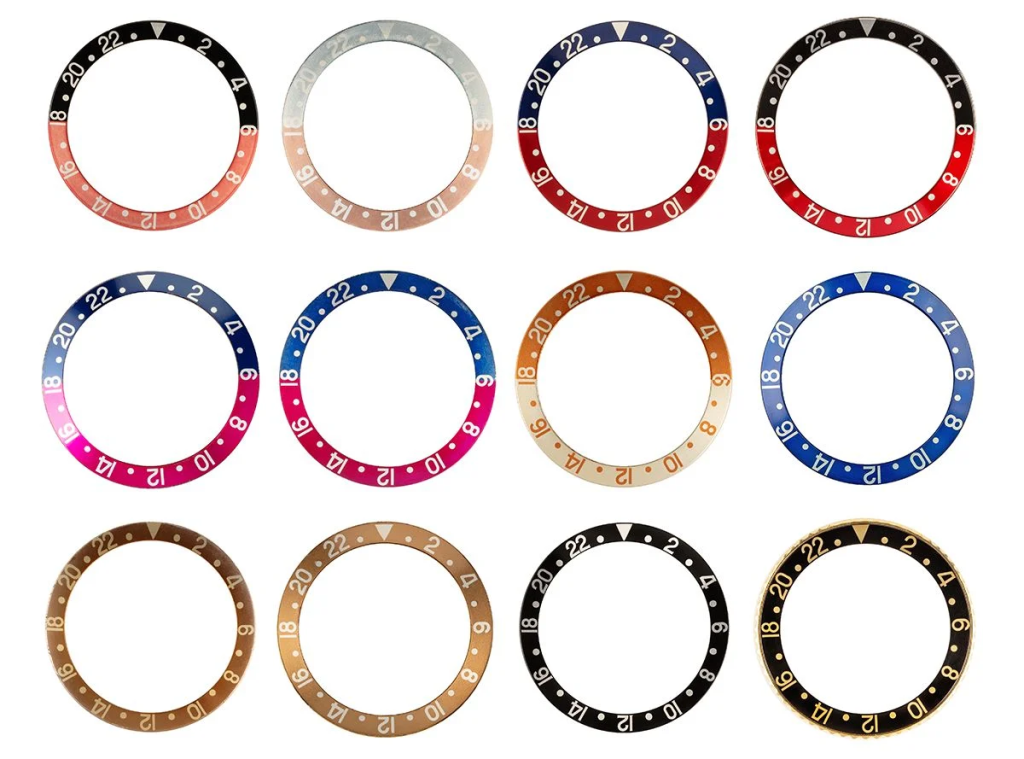
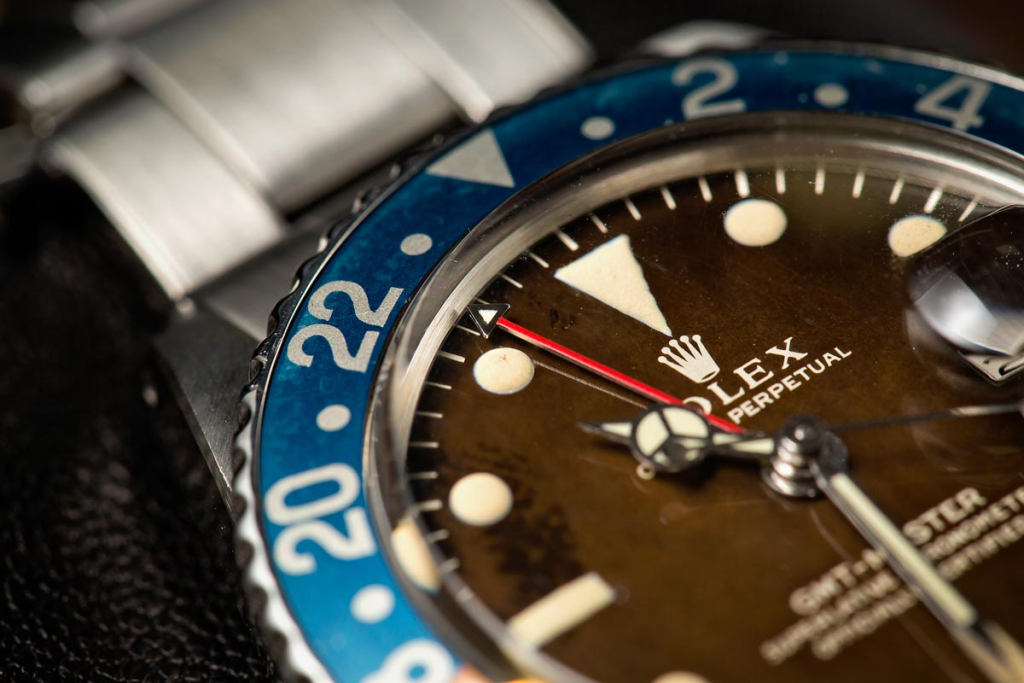
Scratches, dents, and fades. Black turns gray or brown, Pepsi red fades to pink and blue to violet, and prolonged sun exposure produces the ghost bezel collectors pay for
Cerachrom ceramic
2005 to present
Effectively scratchproof and colorfast under ultraviolet light. It does not patina, so a Cerachrom bezel dates a watch to the modern era on sight
18 carat gold and 950 platinum
1950s to present
Softer than steel and shows hairlines and polishing wear at the flute peaks. Over polished flutes lose their sharp edges, which is one of the most common tells on a refinished Datejust
Gem set
1970s to present
Factory settings stay tight and evenly matched. Loose stones, mismatched color, and irregular spacing usually indicate aftermarket work
Rolex Bezels by Collection
Rolex assigns bezels by function, so each collection carries the bezel that serves the job the watch was designed to do. The five collections below are the ones where bezel choice most affects both usability and the price a watch achieves on the pre-owned market.
Submariner and Sea-Dweller
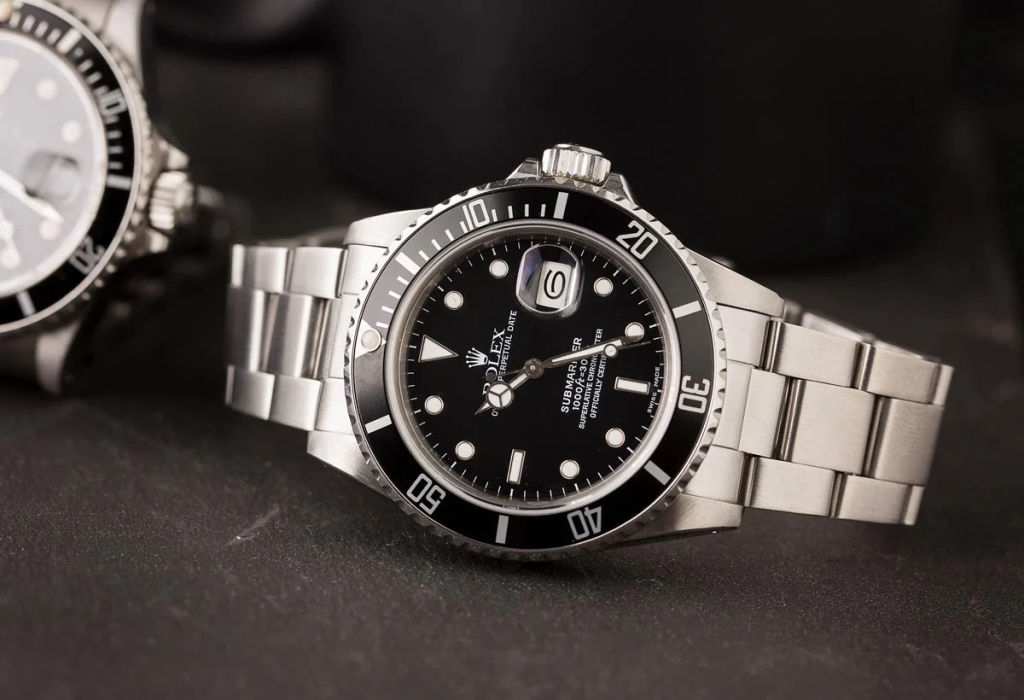
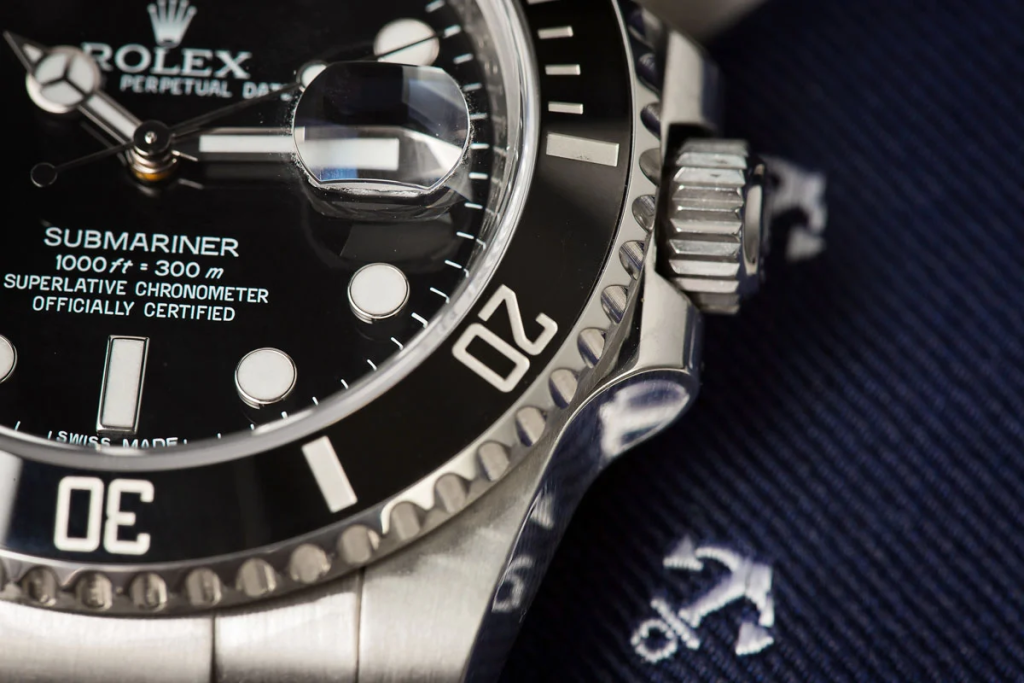
The Rolex Submariner line is a professional dive watch introduced in 1953 with a unidirectional rotating 60 minute bezel. The ring turns counterclockwise only, a safety design that guarantees an accidental knock can only shorten the elapsed time a diver reads, never lengthen it. Early references carried anodized aluminum inserts, and the modern references 126610LN, 126610LV, and 124060 carry black or green Cerachrom.
The Sea-Dweller and Deepsea apply the same unidirectional principle in a thicker case built for saturation diving. The Submariner references 114060 and 124060 pair the rotating dive bezel with no date and no Cyclops, which remains the configuration our most experienced buyers ask for by name.
I’ve handled hundreds of Submariners, Sea-Dweller, and Deepsea watches over the years, and the bezel action is still the first thing I check. On a clean reference, that unidirectional ratchet has a crisp, confident click. Between the modern Cerachrom and a well-aged aluminum insert on a vintage reference, I actually find myself reaching for the cleaner ceramic bezels more often. I will admit that a faded aluminum bezel is tempting though, it tells you a story about the watch that many of the modern watches no longer do.
GMT-Master II
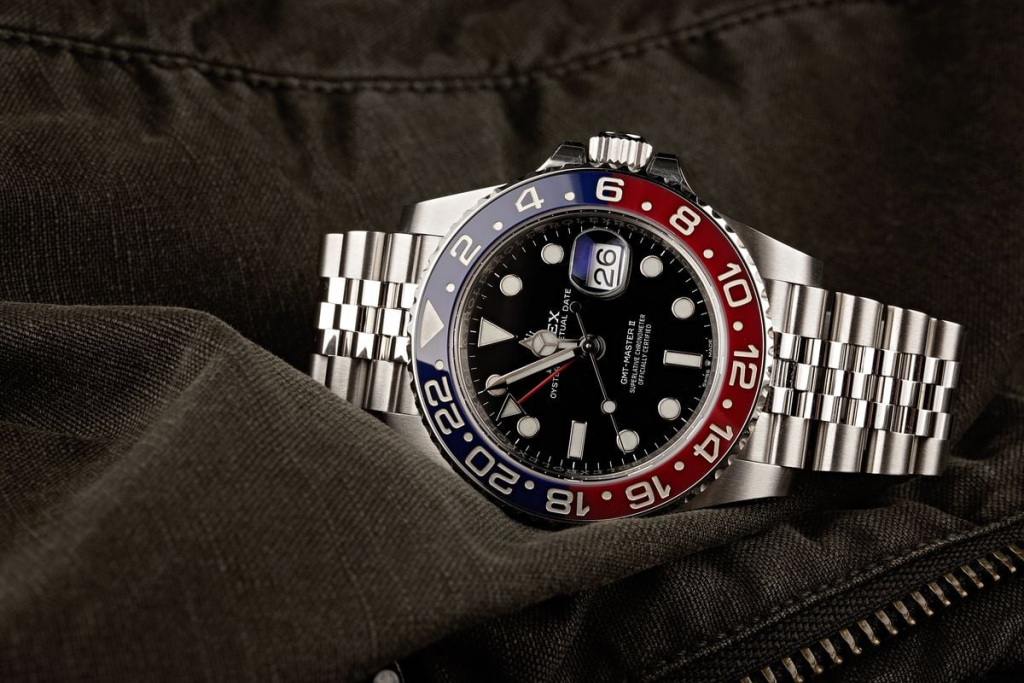
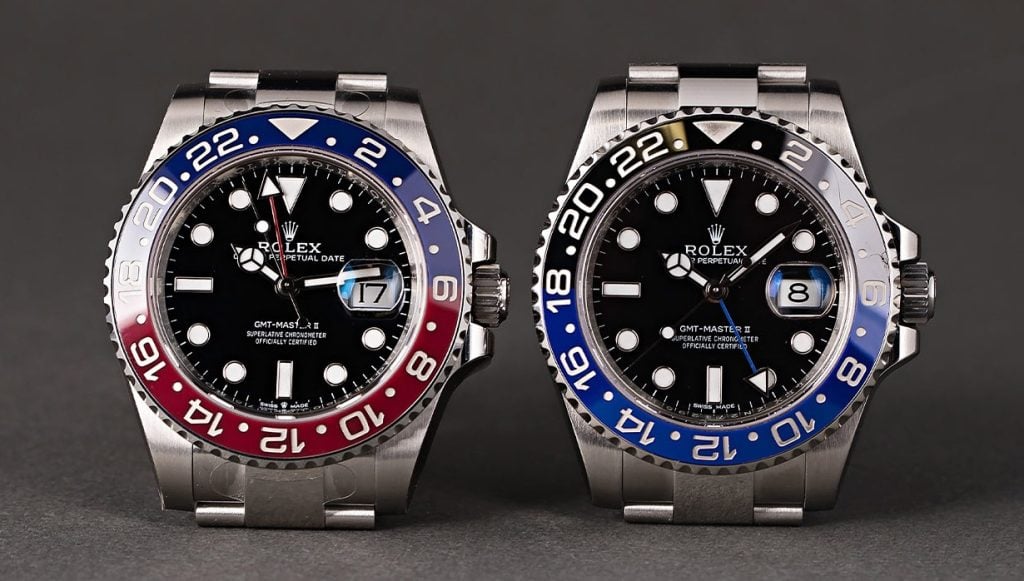
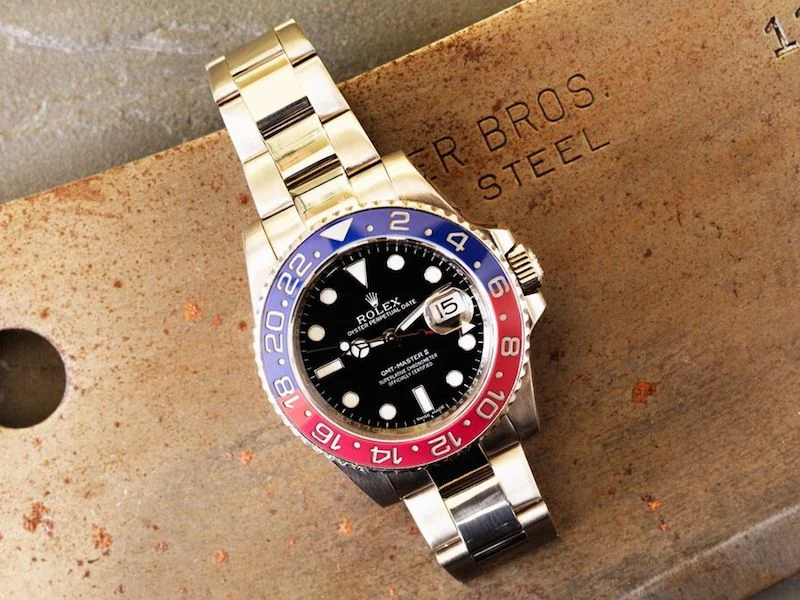
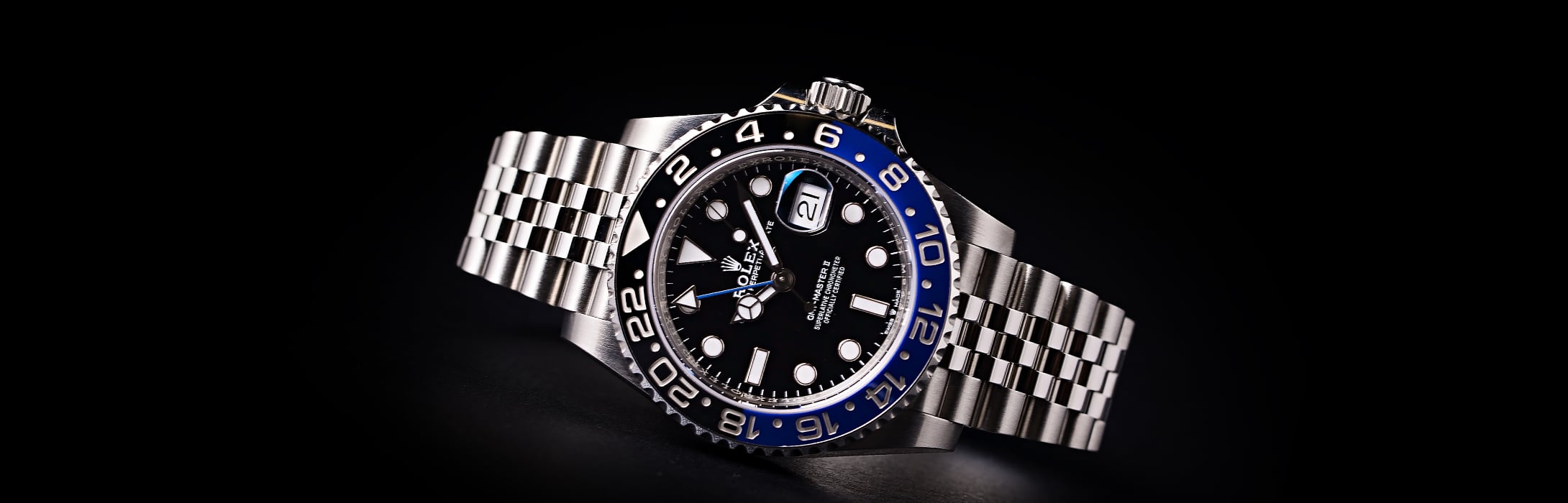
The Rolex GMT-Master II collection is a dual time zone watch whose bidirectional 24 hour bezel is read against an independent 24 hour hand to display a second time zone, and can be rotated to derive a third. Bezel color drives the collection’s nickname culture, with Pepsi, Batman, Batgirl, Root Beer, Sprite, and Coke all naming the insert rather than the watch. When a customer calls us about a Batman, they are naming a bezel. The full generational sequence, from Bakelite through aluminum to two color Cerachrom, is covered in our GMT-Master bezel reference guide.
I’ve had a Pepsi, a Batman, and a Root Beer cross my wrist, and I’ll say what most collectors won’t: the two-color Cerachrom on the Batman is one of the best-executed bezel Rolex currently makes. When customers call asking for “a Batman,” I know exactly what they mean, because the bezel is the personality of this watch. The rest of the case could belong to any sports Rolex; the insert is the whole conversation.
Cosmograph Daytona
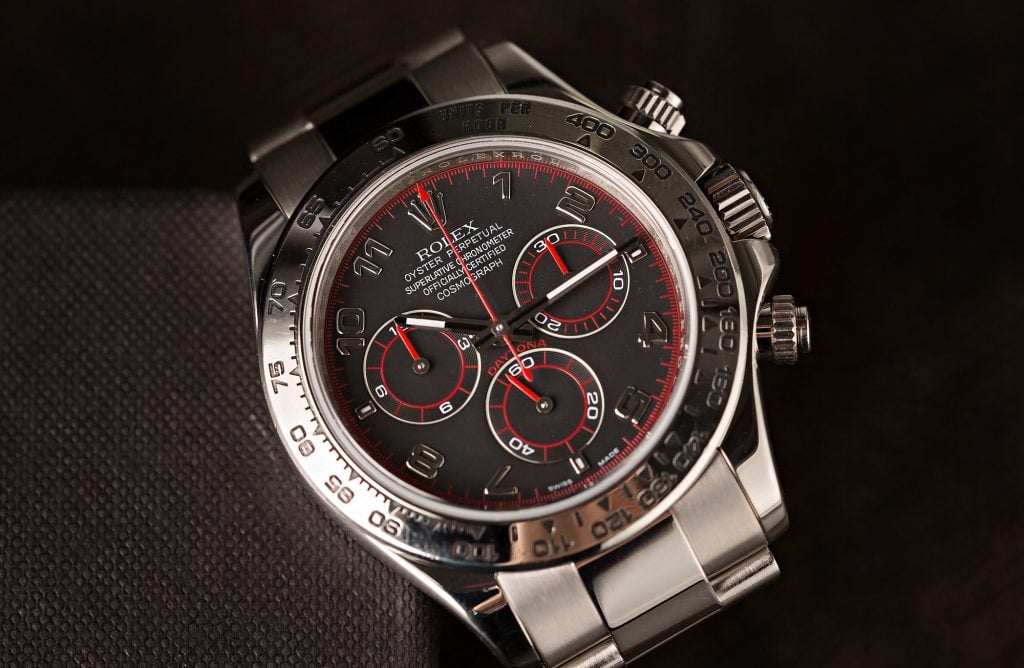
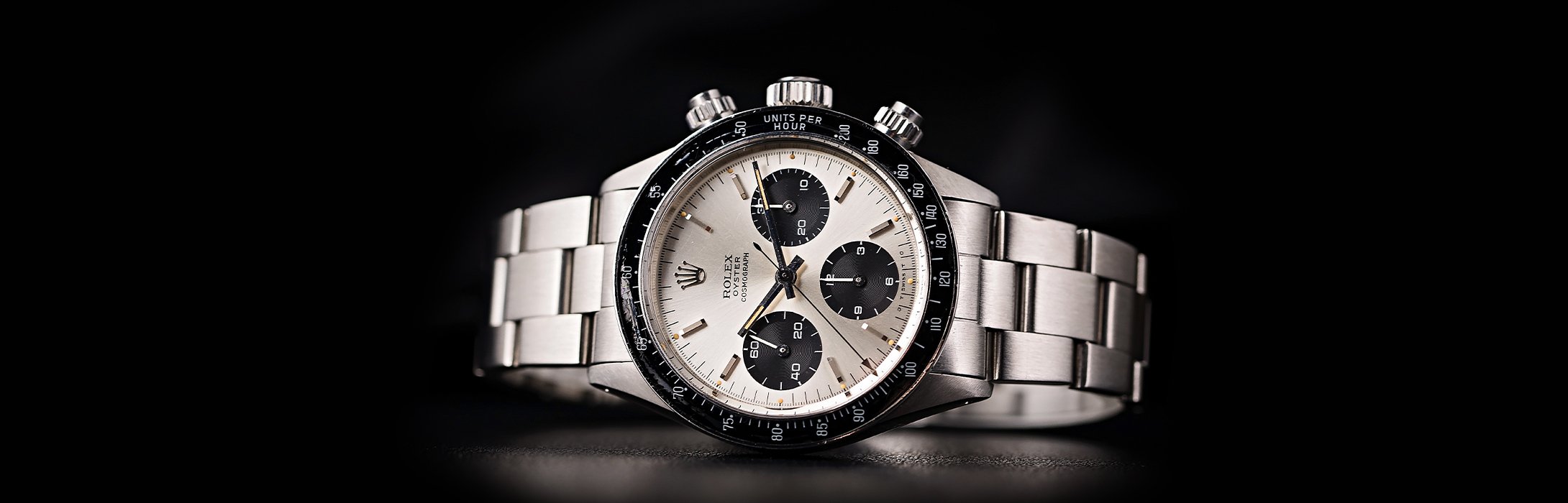
The Rolex Cosmograph Daytona is a chronograph introduced in 1963 with a fixed tachymeter bezel that converts elapsed seconds into average speed over a measured distance. Early references printed the scale on the acrylic crystal or engraved it into a steel bezel, and Rolex moved the steel Daytona to a black Cerachrom tachymeter bezel with the reference 116500LN in 2016. The 2026 Rolesium reference 126502 introduces an anthracite Cerachrom scale with horizontally aligned engravings that echo the vintage references.
The 116500LN’s black Cerachrom against a white dial is, to my eye, the best-looking steel Daytona since the Paul Newman era, it visually shrinks the dial and sharpens the panda contrast. I got time with the new Rolesium 126502 recently, and the anthracite Cerachrom with those horizontally aligned engravings genuinely reads vintage from arm’s length; it’s the first modern Daytona bezel that made me think of acrylic-crystal references rather than a showroom.
Datejust and Day-Date
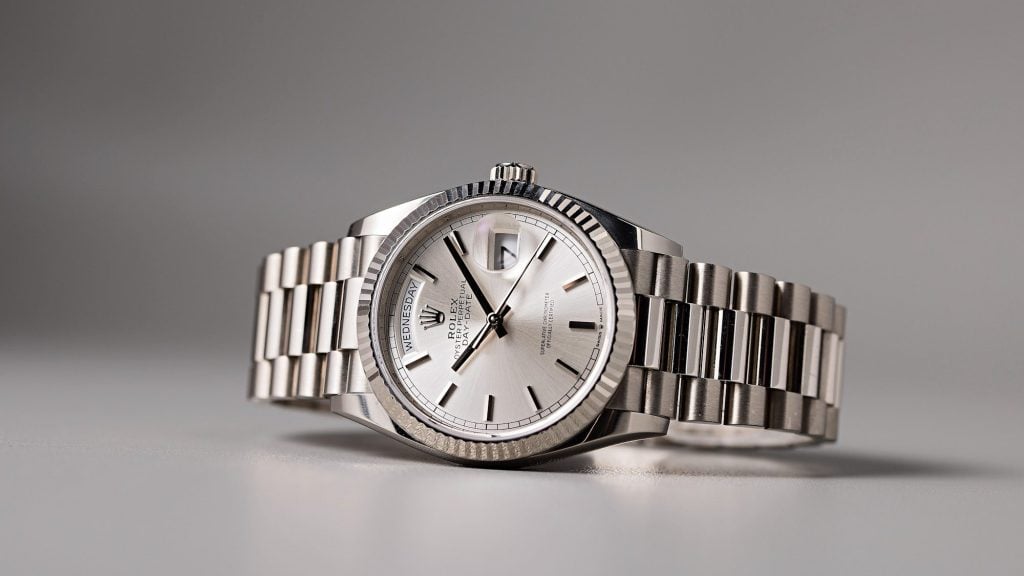
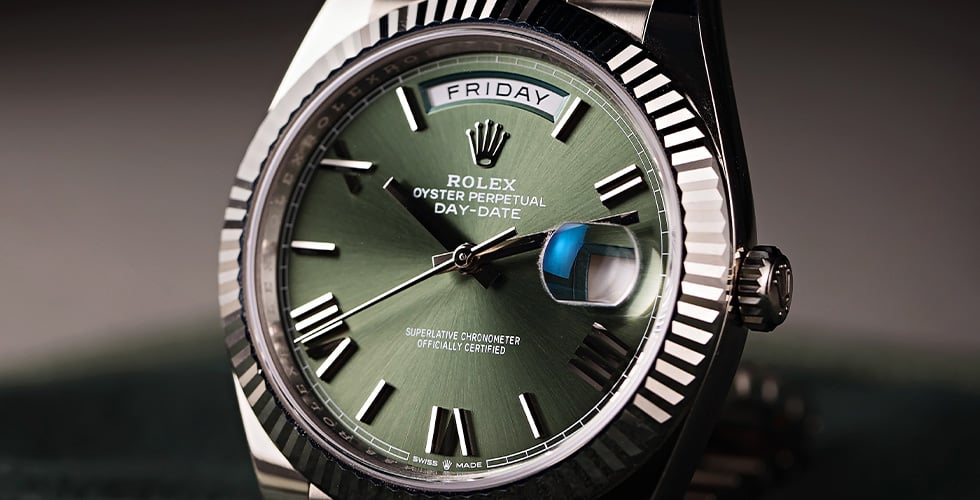
The Rolex Datejust models and Day-Date models carry the fluted bezel that has become the brand’s most recognizable dress signature. The flutes began as a functional feature, machined so a tool could thread the bezel down onto the case and seal it, and Rolex kept the look long after the sealing method changed. Steel Datejust references also appear with smooth and domed bezels, and mid century models used the finely machined alternative documented in our guide to Rolex engine turned bezels.
The flutes on these models do something no photo captures: they catch light in moving slivers as your wrist turns, and on a Day-Date in yellow gold the effect is almost kinetic. That said, I steer plenty of first-time buyers toward the smooth-bezel steel Datejust, it’s the more versatile watch, and it disappears under a cuff in a way the flutes never will.
Yacht-Master and Sky-Dweller
The Rolex Yacht-Master selection offers a nautical model whose bidirectional 60 minute bezel is raised and knurled, with a sandblasted matte scale set against polished raised numerals in platinum, gold, or Cerachrom. The Sky-Dweller uses the Ring Command bezel, a rotating ring mechanically coupled to the movement that selects which function the crown adjusts, turning the bezel into a setting interface rather than a timing scale.
The Yacht-Master’s bezel is the most tactile in the catalog. That raised, knurled ring with sandblasted matte valleys and polished raised numerals begs to be touched, and because it’s bidirectional and friction-set rather than ratcheted, it turns with a smooth, weighty glide instead of a click.
When I look at the Sky-Dweller, it is the exact opposite philosophy entirely: its Ring Command bezel doesn’t time anything, it’s a mechanical selector switch. Turn it one notch and the crown sets local time; another, the date; another, the reference time. The first time I set one, the coupling felt almost impossibly clever, like the bezel and movement were finishing each other’s sentences. It’s the least glamorous bezel Rolex makes and, mechanically, probably the most impressive.
How to Identify and Date a Rolex Bezel Insert
A Rolex bezel insert can be dated by four physical traits: the material, the numeral font, the finish of the printing or engraving, and the luminous pearl at 12 o’clock. Read together, these place an insert inside a production window and reveal whether it is original to the watch or a later service replacement. This is the check I ask our team to run first on any vintage intake, because a bezel that looks too clean for the case beside it changes what the watch is worth.
The luminous pearl at 12 o’clock dates a Rolex dive or GMT bezel as reliably as the dial does. Inserts made before Rolex moved away from tritium carry pearls that oxidize toward cream or amber and read warm against a white light source, while later Luminova and Super-LumiNova pearls stay bright white and lose almost nothing over decades. A cream toned dial sitting beneath a stark white pearl tells you the insert has been replaced.
Font and index geometry narrow the window further. Rolex changed numeral weight and index length across insert generations, and collectors track those variants closely, including the heavier numerals the market calls fat font inserts.
Material first: aluminum places an insert before roughly 2005, Cerachrom places it after.
Fade pattern: genuine aluminum fades unevenly, with the heaviest change in the quadrant most people wear toward the sun. Uniform, flat color across an aged bezel suggests a reproduction.
Printing versus engraving: original aluminum graduations are printed and anodized, sitting flush. Aftermarket inserts often show engraved troughs filled with paint that catches a fingernail.
Pearl seat: check whether the pearl sits in a metal surround, sits flush, or is recessed, and whether that construction matches the reference.
The click and the gap: an original bezel assembly turns with even resistance and sits parallel to the case, with a consistent gap all the way around.
None of that is abstract to the people who handle these watches daily. Brandon F. put the principle to me this way:
“Being in the pre-owned space, I view the bezel as a watch’s structural signature. Dials can be swapped and bracelets can be replaced, but the bezel is the frontline protector of the watch face. It bears the brunt of daily life, and how it handles that wear tells you everything you need to know before wiring your hard-earned money.”
Brandon F., Vintage Expert at Bob’s Watches
That is why we treat wear as evidence rather than as a defect to be polished away. An honest bezel and an honest case should tell the same story about the same watch.
What an Original Rolex Bezel Is Worth
Rolex bezel type and originality separate the value of otherwise comparable references by thousands of dollars, and our own transaction record shows it clearly. The figures in this section are median sold prices I pulled from Bob’s Watches transactions between July 1, 2025 and July 31, 2026. They describe the pre-owned market only. They are not current retail prices from an authorized dealer, and I have kept the two strictly apart throughout.
The cleanest example is the steel Datejust 36, because Rolex offers the same watch with either a smooth steel bezel or a fluted white gold one. The fluted premium shows up in every generation, and it has widened sharply in the current one.
Steel Datejust 36 Median Sold Price by Bezel, July 2025 to July 2026
Generation
Fluted White Gold Bezel
Smooth Bezel
Five digit references (16234, 16220)
$6,770
$6,595
116 series (116234, 116200)
$8,595
$7,582
Current 126 series (126234, 126200)
$13,895
$10,070
The fluted premium runs near 3 percent on five digit references, widens to roughly 13 percent across the 116 series, and reaches about 38 percent on the current 126 series. The case, movement, and bracelet are the same watch. Buyers are paying progressively more for the bezel.
Bezel color produces a comparable spread inside a single reference family. Across our stainless steel GMT-Master II sales in the same period, median sold prices separated by roughly $7,500 between the strongest and weakest bezel colors, with no difference in case material or movement family driving the gap.
Bruce Wayne, gray and black Cerachrom: $22,570 median
Pepsi, red and blue: $21,295 median, and the most requested nicknamed steel GMT bezel of the period
Batgirl, blue and black on Jubilee: $19,895 median
Sprite, green and black: $17,995 median
Batman, blue and black on Oyster: $16,995 median
Coke, red and black aluminum: $14,995 median
The Submariner shows the same effect in green. The Hulk, reference 116610LV with a green Cerachrom bezel and green dial, carried a $22,070 median, while the Starbucks, reference 126610LV with the same green bezel against a black dial, sat at $16,155 and the aluminum bezel Kermit, reference 16610LV, at $15,795. Bezel and dial in combination, not bezel color alone, set the ceiling.
Originality can outweigh modernity outright, which is the finding I would most want a first time vintage buyer to understand. The vintage Submariner reference 5512, with its original aluminum insert, returned a $17,495 median over the period, above every modern steel Submariner in our sold data including the current 126610 at $15,995. The references 1680 and 5513 followed at $13,395 and $13,495, well ahead of the later aluminum bezel 16610 at $10,995. Collectors are paying for an untouched insert with honest fade, and the Rolex Service Centre policy of replacing worn inserts makes those originals scarcer every year.
Medians describe a category, not a particular watch. A faded original insert, a correct service replacement, and an aftermarket part on the same reference will each land in a different place, which is why our team prices a bezel on the watch in front of them rather than from a chart. If you want a current figure on your own piece, you can sell your Rolex through us, and the bezel is one of the first things we look at when the quote is prepared.
Material transitions register just as clearly. The steel Daytona moved from an engraved steel tachymeter bezel on the reference 116520, at a $22,995 median, to the Cerachrom reference 116500LN at $30,595 and the current 126500LN at $36,320. The Yacht-Master 40 traced a similar path across its platinum bezel generations, from $10,295 on the 16622 to $12,995 on the 116622 and $15,495 on the 126622. Not every reference appreciates, and condition, completeness, and provenance still govern any individual result.
Rolex Bezel Care, Repair, and Replacement
A Rolex bezel can be serviced, and in most cases the insert can be replaced without touching the case. Rotating bezels collect grit under the ring, which is the usual cause of a bezel that turns stiffly, skips clicks, or spins with no resistance at all. Rinsing a screwed down Oyster case under warm running water and drying it with a soft cloth clears most of it. A bezel that still binds afterward needs the assembly removed and cleaned properly.
Replacement is a decision rather than an obvious repair, and it is the question we field most often. A Rolex Service Centre will fit a current specification insert, which restores legibility and looks correct, but on a vintage reference it removes the exact component a collector is paying for. My working rule is to preserve a faded but intact original on a vintage watch, and to replace an insert that is cracked, missing its pearl, or illegible on a watch that is worn daily. Aftermarket inserts are a separate matter, and we advise against them without exception, because they alter the watch permanently, rarely match Rolex font geometry, and cost more value than the damaged original ever did.
Our watchmakers see the consequences of that choice more directly than I do. Joe Alessindrini mentioned the following on what a service replacement actually does to a vintage bezel:
“When a vintage Submariner or GMT comes in with a faded but intact original insert, I immediatly look to confirm that it is original before inspecting the condition.”
Joe Alessindrini, CFO of Bob’s Watches
Bezel Details That Reveal a Counterfeit Rolex
Rolex bezels expose a counterfeit faster than almost any other exterior component, because the tolerances are difficult and expensive to fake. Our authentication process starts at the bezel edge for that reason, before the dial, the bracelet, or the caseback is examined.
Click count and feel: a genuine rotating bezel indexes with firm, evenly spaced clicks and no lateral play. Gritty, uneven, or silent rotation is a warning.
Numeral geometry: Rolex font weight, spacing, and the exact shape of the triangle at 12 stay consistent within a reference. Counterfeit inserts show thin, crowded, or subtly misaligned numerals under a loupe.
Fluting quality: genuine flutes are cut with sharp, uniform peaks and identical spacing all the way around. Stamped or cast reproductions look softened and irregular.
Pearl construction: the luminous pearl should sit cleanly in its seat and glow evenly. Glue residue, a proud pearl, or a pearl that does not luminesce is a strong tell.
Those four checks screen out most fakes, and I would not rely on any one of them alone. Bezel evidence belongs inside a full authentication process that also covers the movement, the inside caseback engravings, the bracelet, and the serial and reference numbers. [VERIFY: internal link URL for the fake versus real Rolex authentication guide, per the cluster plan]
Choosing a Rolex Bezel That Holds Its Character
Rolex bezel choice is the most consequential decision a buyer makes after the reference itself. A fluted white gold bezel changes what a steel Datejust says on the wrist and, on the current generation, what it costs. A Cerachrom insert buys decades of colorfast, scratch resistant service. An original aluminum insert buys the opposite, a component that will keep changing, and for a certain kind of collector that is precisely the point. Neither approach is more correct, and our sold data shows real premiums attaching to both.
My advice is to judge the bezel before the paperwork. Look at how the ring turns, how the numerals are formed, how the color has moved, and whether the wear on the bezel matches the wear on the case and bracelet. At Bob’s Watches, every watch passes through in house watchmakers who inspect the bezel assembly and insert alongside the movement, which is why the bezel you evaluate in our photographs is the bezel that arrives at your door. In my experience, the details on that ring give the most honest account a Rolex offers of the life it has already lived.
Frequently Asked Questions
Rolex bezels come in ten principal types: smooth, domed, fluted, engine turned, unidirectional rotating dive, bidirectional 24 hour, bidirectional 60 minute regatta, tachymeter, Ring Command, and gem set. Fixed bezels appear on models such as the Datejust, Day-Date, and Oyster Perpetual, while rotating bezels appear on the Submariner, GMT-Master II, Yacht-Master, and Sea-Dweller. The bezel type follows the function the model was designed to perform.The Rolex bezel secures the crystal to the Oyster case and protects it from impact. On professional models it also performs a timing function: a Submariner bezel measures elapsed dive time, a GMT-Master II bezel tracks a second and third time zone, and a Daytona bezel calculates average speed. On dress models such as the Day-Date, the bezel is decorative and structural rather than functional.A fluted bezel is a Rolex bezel machined with evenly spaced grooves around its circumference, cut from 18 carat gold or 950 platinum rather than steel. Rolex originally fluted the bezel so a tool could thread it down onto the case and seal the watch, and the design was retained as a signature after sealing methods changed. Fluted bezels appear on the Datejust, Day-Date, and Sky-Dweller.The cost of a Rolex bezel depends on whether the insert alone or the full bezel assembly needs replacing and on the material involved. An aluminum insert on a discontinued reference and a Cerachrom insert on a current model sit at very different price points, and precious metal and gem set bezels are higher again. Rolex supplies parts through its Service Centres and authorized service partners rather than to consumers directly, so pricing is quoted per watch after inspection.A Rolex bezel can be replaced, and a Rolex Service Centre will fit a current specification insert or bezel assembly during service. Replacement is the right call when an insert is cracked, illegible, or missing its luminous pearl on a watch worn regularly. On a vintage reference, replacing an intact original insert removes a component that carries value, so preservation is usually the better decision. Aftermarket inserts should be avoided in all cases.Not all Rolex bezels rotate. Fixed bezels appear on the Datejust, Day-Date, Oyster Perpetual, Explorer, Air-King, and Cosmograph Daytona, where the ring is threaded or pressure fitted to the case. Rotating bezels appear on the Submariner, Sea-Dweller, Deepsea, GMT-Master II, Yacht-Master, and Sky-Dweller, turning either unidirectionally for dive timing or bidirectionally for time zone and setting functions.A Rolex bezel insert is judged original by matching its material, font, finish, and luminous pearl to the reference and production period of the watch. Aluminum inserts belong on references produced before the Cerachrom transition, original aluminum fades unevenly toward the most sun exposed quadrant, and a bright white pearl above a cream toned tritium dial indicates a later replacement. Original graduations sit flush and anodized rather than engraved and paint filled.
About Carol Altieri
Carol Altieri is the co-owner and Chief Operating Officer of Bob's Watches, bringing over 15 years of specialized expertise in the luxury watch market. Her extensive hands-on experience evaluating, authenticating, and trading high-value timepieces has positioned her as a trusted authority on watch collecting, market dynamics, and investment value.
Carol's deep knowledge spans everything from vintage Rolex and Patek Philippe to contemporary complications, allowing her to guide both seasoned collectors and first-time buyers through the complexities of the secondary market. She has personally handled thousands of luxury timepieces, developing an expert eye for the subtle details that distinguish exceptional quality and authentic craftsmanship from lesser alternatives.
At Bob's Watches, Carol has been instrumental in establishing industry-leading standards for transparency, authentication processes, and client education. Her commitment to building long-term relationships based on trust and expertise has helped shape the company's reputation as a reliable resource in the luxury watch community.
As an active collector herself, Carol brings genuine passion and firsthand insight to her work, making her uniquely qualified to understand both the emotional and financial aspects of watch collecting.
Bob's Watches Blog Updates
Sign up and be the first to read exclusive articles and the latest horological news.