When you compare the JLC Reverso vs the Cartier Tank, there is no single winner, because each watch was built to answer a different question. The Cartier Tank is the slimmer, design-first icon that costs less to get into, while the Jaeger-LeCoultre Reverso is the watchmaker’s choice, carrying an in-house mechanical movement in every model along with a case that flips over. This guide compares the two on history, design, fit, movements, price, resale, and the kind of statement each one makes, so you can decide which belongs on your wrist.
Key takeaways:
- The Tank wears flatter and slips under a shirt cuff with ease, while the Reverso sits a little taller because of its flip case and can carry a second dial on Duoface models.
- Jaeger-LeCoultre is known as the watchmaker’s watchmaker and once supplied movements to brands like Patek Philippe, Audemars Piguet, and even Cartier, which gives the Reverso the edge on pure watchmaking.
- The Tank holds the cultural spotlight, worn by Jacqueline Kennedy, Princess Diana, and Andy Warhol, while the Reverso is more of a quiet, in the know pick.
- Both watches tend to keep roughly 50 to 70 percent of their retail price on the pre-owned market, so neither should be bought as an investment.
These two often land on the same shortlist for one simple reason. They are the two great rectangular watches, the pair that every other shaped dress watch gets measured against. Look past the silhouette, though, and they stand for two different ideas about what a watch should be. Here is how they compare, point by point.
JLC Reverso vs Cartier Tank at a Glance
Before getting into the details, here is a side by side look at how the two icons stack up. The figures below are approximate and reflect early 2026 retail pricing.
| Feature | Cartier Tank | Jaeger-LeCoultre Reverso |
| Introduced | 1917 (public release 1919) | 1931 |
| Design origin | Renault FT-17 tank treads from World War I | Reversible case to protect the dial during polo |
| Signature trait | Brancard case, Roman numerals, blued sword hands | Flip over case, with two dials on Duoface models |
| Movements | Quartz (Tank Must), automatic 1847 MC, some hand-wound | All in-house JLC, manual and automatic calibers |
| Case profile | Slimmer and flatter, sits flush under a cuff | Taller, due to the swiveling carriage |
| Complications | Mostly time only | Time only up to tourbillon, moon phase, dual time |
| Entry price (approx.) | Around $3,800+ | Around $6,500+ |
| Water resistance | 30m, not for swimming | 30m to 50m, not for active water use |
| Best for | Slim, design first, easy elegance | Mechanical depth, versatility, watchmaking credibility |
The short version is that the Tank leads on slim proportions, price, and instant recognition, while the Reverso leads on movements, complications, and that clever flipping case. The rest of this guide explains how those differences play out in real ownership.
A Tale of Two Origins
Both watches were born early in the history of the wristwatch, when the rules of the category were still being written. They came from different places and answered different needs, and that split shows up in nearly everything they became. Understanding where each one started makes the modern choice between them much clearer.
The Cartier Tank (1917)
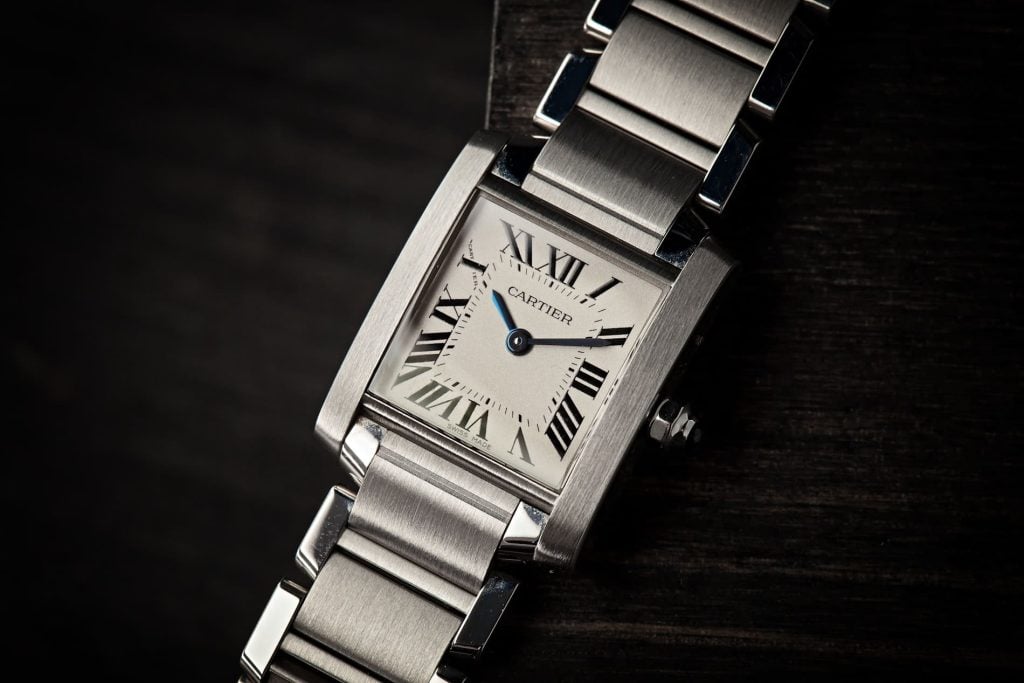
The history of Cartier Tank traces back to 1917, when Louis Cartier designed a watch inspired by the overhead view of the Renault FT-17 tanks used in World War I. The two straight bars running down the sides of the case, known in French as brancards, echo the treads of those armored vehicles. The first example was presented to General John Pershing, and the model reached the public in 1919 with only a handful of pieces produced.
The design has changed very little in more than a century, and that consistency is the whole point. The Tank did not simply follow the rise of the wristwatch, it helped define what a dress watch could look like. Over the decades it grew into a full family of models, including the Tank Louis Cartier, the Tank Française, and the Tank Américaine, each one a slightly different take on the same clean rectangular shape.
The Jaeger-LeCoultre Reverso (1931)

The history of the JCL Reverso dates back to 1931, and its origin is tied directly to its design. British army officers playing polo in India needed a watch that could survive a rough match, so Jaeger-LeCoultre created a case that slides and flips over to hide the dial behind a solid metal back. That single idea, wrapped in clean Art Deco lines, gave the Reverso its name and its character, and turned a sports watch into one of the most respected dress watches in the world.
Although we covered this in our JLC Reverso buying guide, it’s worth noting that the early Cartier Tank watches ran on movements supplied through the European Watch and Clock Company, and a number of those calibers were built by Jaeger-LeCoultre. In other words, the two names were partners in watchmaking long before buyers started lining them up against each other.
Design and Case: Where the Two Icons Split

Both watches are rectangular, and that is close to where the similarities end. Each case is shaped and finished with enough care to read as a small piece of design on its own, yet they go about it in opposite ways. The differences are easy to see once you know where to look.
- Proportions: The Tank is wider in relation to its height. The Reverso looks longer because of the extra distance between the top of the dial and the lugs.
- Corners and lines: The Tank has softer, more rounded corners. The Reverso is sharper and more architectural, framed by the cradle that holds the flipping case, with fine fluted lines at each end.
- The dial: The Tank keeps Roman numerals, a railroad style minute track, and blued steel sword hands. The Reverso often uses guilloché and satin finishing, and many models add a second face on the reverse.
- The flip: Only the Reverso turns over, whether to protect the dial, show a second time zone on Duoface models, or reveal an engraved or enameled back.
- Thickness: The Tank sits flatter on the wrist. The Reverso carries more height because of the carriage that lets the case swivel.
In plain terms, the Tank is the cleaner, quieter shape, and the Reverso is the more detailed and more mechanical one. Neither approach is better than the other, but they appeal to different eyes, and most people lean clearly toward one as soon as they see them next to each other.
On the Wrist: Size, Fit, and Comfort
Rectangular watches wear differently than round ones, so the numbers on paper do not tell the whole story. As a general rule, the Tank sits flatter and suits slimmer wrists, while the Reverso wears a little larger and heavier than its width would suggest.
| Model (representative) | Approximate dimensions |
| Cartier Tank Must or Louis | About 22mm to 34mm wide, up to roughly 41mm in extra large versions, very slim |
| Reverso Classic (small to medium) | About 36mm case length, wears larger than the width implies |
| Reverso Tribute | About 45.6mm case length, can feel large on an average wrist |
A few points are worth keeping in mind when you judge the fit:
- Case length matters more than width on a rectangular watch, so measure from lug to lug rather than focusing on the dial.
- The Reverso feels solid and sporty in the hand, closer to a piece of equipment than a delicate dress watch.
- Owners in online communities sometimes note that the Reverso’s flat back can sit high and pick up scratches, while the Tank’s proportions are often described as feeling instinctively right.
- Both watches are genuinely unisex unless you choose a version with diamonds or a strongly styled dial.
The best advice here is also the oldest advice. Try both on before you decide, because a watch that looks ideal in photos can feel very different once it is on your wrist. Watch size matters and sizing across both collections runs from small and classic to large and modern, so there is almost always a version that fits well.
Movements and Watchmaking: The Real Divide

If there is one area where these two clearly separate, it is what happens inside the case. Both brands carry real history, but they built their reputations in different ways, and that shapes how each watch feels to own over the long run.
Jaeger-LeCoultre, the Watchmaker’s Watchmaker
Jaeger-LeCoultre has long carried the nickname the watchmaker’s watchmaker, and the Reverso shows why. Every Reverso runs an in-house JLC movement, from clean hand-wound calibers in the Classic to automatic, dual time setups in the Duoface. The company has created well over a thousand calibers across its history and once supplied movements to respected names like Patek Philippe and Audemars Piguet.
That depth reaches the top of the watchmaking world. Over the years the Reverso has housed tourbillons, minute repeaters, and other high complications inside its slim rectangular case. For a buyer who cares about how a watch is made and what it can do, this is where Jaeger-LeCoultre makes its case.
Cartier, the Design House That Became a Serious Watchmaker
Cartier built its name on design first, and for many years the movements came second. The accessible Tank Must uses a reliable quartz movement, mid range models often use calibers shared within Cartier’s parent group, and only the higher tier pieces carry fully in-house work. None of this held the Tank back, because it was always meant to look great and wear easily.
The picture has shifted, though. Higher end models such as the Tank Louis and the Tank Américaine now use Cartier’s 1847 MC automatic movement, a clear sign the brand is leaning harder into watchmaking than it once did. The verdict on movements goes to the Reverso, since every model is mechanical and in-house, but the quartz Tank Must is easy to live with, and for many buyers that simplicity is a feature rather than a drawback.
Price and Value: What You Pay and Why

The Reverso usually costs about double a comparable Tank, but the gap narrows once you compare like for like. The fairest comparison is a hand-wound Tank Louis against a hand-wound Reverso Classic, since both are mechanical dress watches built in the same spirit. Seen that way, the Reverso premium pays for an in-house movement, the swiveling case, and deeper watchmaking credentials. It is also worth noting that Jaeger-LeCoultre has raised prices steadily in recent years, so the spread between the two has shifted over time. The figures here are approximate and reflect early 2026 retail, so always check current pricing before you buy.
Resale Value and Collectibility
Both watches hold their value reasonably well, with most examples keeping somewhere between 50 and 70 percent of retail on the pre-owned market. The way they behave once they leave the boutique, though, is a little different, and that is worth understanding before you commit.
The Cartier Tank on the Pre-Owned Market

Cartier produces the Tank in large numbers, which means plenty of choice and steady demand, along with a fair amount of competition among sellers. Vintage pieces carry real interest, especially gold Tank Louis and Cintrée models from the 1970s and 1980s. Specific details, such as an original dial signature, can lift prices for the right example, and the Tank’s broad fame keeps a steady stream of buyers in the market.
The JLC Reverso on the Pre-Owned Market

The Reverso plays a quieter game. Production is lower, the range of complications is wider, and the Reverso movement credibility is strong, which appeals to collectors who like to dig a layer deeper. Limited runs, enamel dials, and Duoface models tend to hold their value well, and the best examples can climb over time. As with the Tank, the smart approach is to buy the one you love rather than treat it as a financial play.
Style and Identity: What Each Watch Says About You
A watch is a personal choice, and these two send different signals. Wearing a Tank reads as easy, confident taste. It is recognized almost everywhere, comfortable in any setting, and tied to a long line of style figures, from Jacqueline Kennedy and Princess Diana to Andy Warhol, who once said he wore his Tank not to tell the time but because it was the watch to wear.
The Reverso speaks more softly. It says you care about how a watch is made, that you value history and engineering, and that you like an object with a story to tell. Both dress up and down with ease, moving from a suit to jeans without missing a step. A Tank on a bracelet leans a touch more casual, while a Reverso on a leather strap brings a little more formality. Either way, you are wearing a genuine icon.
Servicing and Ownership: Living With Each Watch
Owning either watch is straightforward, but the day to day care differs depending on the movement and the case. Knowing what to expect helps you plan for the long term.
- A quartz Tank Must needs little more than a battery change every few years.
- A mechanical Tank or any Reverso should be serviced roughly every five to eight years.
- A Reverso service often costs a bit more, since the flipping case adds complexity.
- Both brands have wide service networks, and swapping a strap is simple, helped by the quick change spring bars on many Tanks.
- One point raised in online communities is that Cartier after-sales service can vary by location, so it helps to know where your nearest service center is.
None of this should put anyone off. Both watches are built to last, and a little routine care is simply part of owning a fine timepiece. Bought well and maintained on schedule, either one can stay on your wrist for decades.
Which Should You Buy, Tank or Reverso?

The right choice comes down to what you value most in a watch. Use the quick guide below to point yourself in the right direction.
Choose the Cartier Tank if you:
- Want a slim, flat watch that slides easily under a cuff
- Like instant recognition and a design that has barely changed in a century
- Prefer a lower entry price or the convenience of quartz
- Have a slimmer wrist
- Care more about timeless style than mechanical complication
Choose the JLC Reverso if you:
- Want an in-house mechanical movement in every model
- Enjoy the flipping case or a second dial on Duoface versions
- Value watchmaking depth and a wide range of complications
- Like a watch that flies a little under the radar
- Enjoy the ritual of winding a hand-wound watch
There is no wrong answer here, and plenty of collectors solve the debate by owning both, often starting with the Reverso for the movement and adding a Tank later for the everyday wear.
The Final Verdict: Two Rectangular Legends, One Personal Choice

In the end, the Cartier Tank and the Jaeger-LeCoultre Reverso are less rivals than two answers to the same question. The Tank is design distilled into a shape that helped define the last hundred years of watchmaking. The Reverso is engineering turned into art, with a movement and a flipping case to match. Which one wins depends entirely on which of those ideas speaks to you, not on any ranking either of them could win on paper.
Both are lifetime pieces that will outlast trends and look just as right decades from now. If you can, handle both before you commit, because the wrist often decides what a spec sheet cannot. When you are ready to buy, Bob’s Watches carries authenticated pre-owned Cartier and Jaeger-LeCoultre models, so you can find the right rectangular icon with confidence.