The GMT-Master II and the Submariner may look related, but they were created for very different jobs. The GMT was designed for travelers, letting you track multiple time zones with its 24-hour bezel and extra hand. The Submariner is a dive watch through and through, with 300 meters of water resistance and a timing bezel for use underwater. Both have Rolex’s familiar Oyster design, but the way they’re meant to be used is quite different.
The Rolex Submariner embraces the classic tool-watch look. Its mostly brushed finish is very understated and practical. The Rolex GMT-Master II has always had a little more personality, thanks to polished center links, Jubilee bracelets, and the colorful bezels that collectors call “Pepsi” and “Batman”, among others. Deciding between the two usually comes down to how you plan to wear the watch.
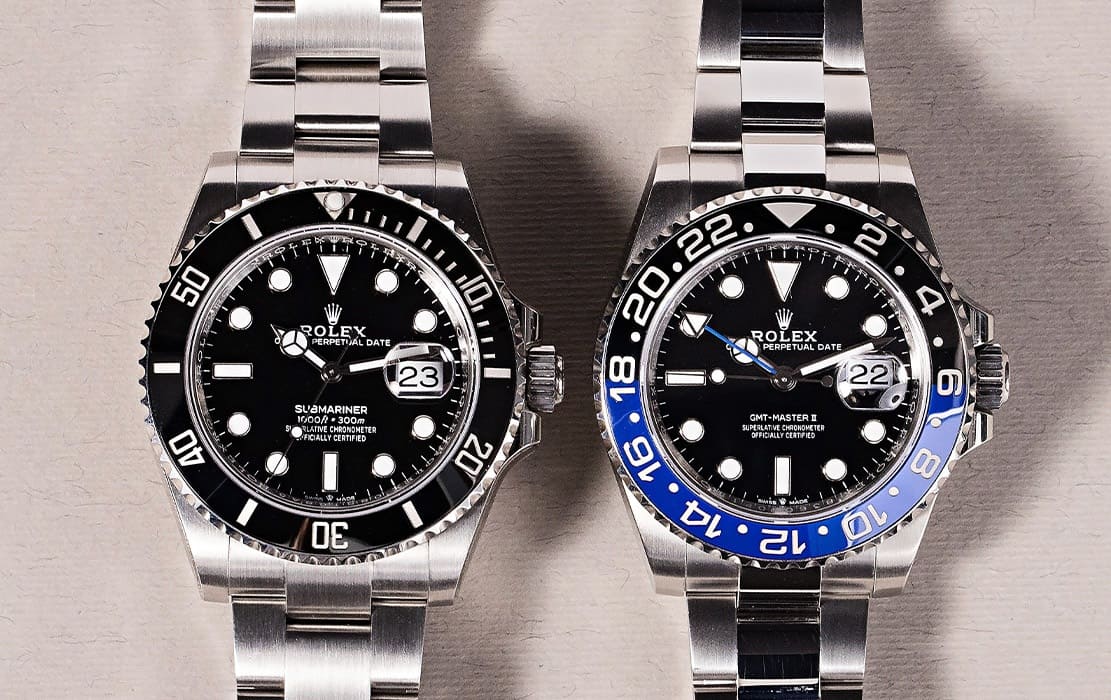
- Function: GMT tracks multiple time zones; Submariner times diving intervals.
- Water Resistance: 100m (GMT-Master II) vs. 300m (Submariner).
- Bracelet: Polished center links or Jubilee (GMT) vs. fully brushed Oyster (Submariner).
- Clasp: Glidelock with 20mm adjustability (Submariner) vs. Easylink with 5mm (GMT-Master II).
- Case Size: Modern Submariners measure 41mm; the GMT-Master II is 40mm.
- Movement: Caliber 3285 (GMT) vs. Caliber 3235 or 3230 (Submariner).
The differences between these two references go beyond what you see on a specification sheet. Case details, movement design, and even market availability all play a role in deciding which one makes the most sense for you.
Historical Origins: Two Legends Built for Different Elements

The Rolex Submariner debuted in 1953 as the first watch Rolex certified as water-resistant to 100m, a landmark achievement at the time. It was designed with professional divers in mind to withstand the pressures of deep-sea exploration. Over the following decades, it earned a reputation as the definitive tool watch, appearing on the wrists of Navy divers and gaining cultural status when it became synonymous with James Bond. What started as equipment as a dive watch quite impressively became an icon.
A year later, in 1954, Rolex introduced the GMT-Master in collaboration with Pan American World Airways. Transatlantic aviation was expanding very quickly, and pilots needed a reliable way to track multiple time zones simultaneously, particularly UTC, during long-haul flights. The original two-tone red and blue bezel allowed pilots to distinguish AM from PM at a glance across time zones. Over time, the GMT-Master evolved into the GMT-Master II, gaining an independently adjustable hour hand on this pilot watch that made it a true dual-time watch rather than a simple GMT.
Technical Specifications and Design Details
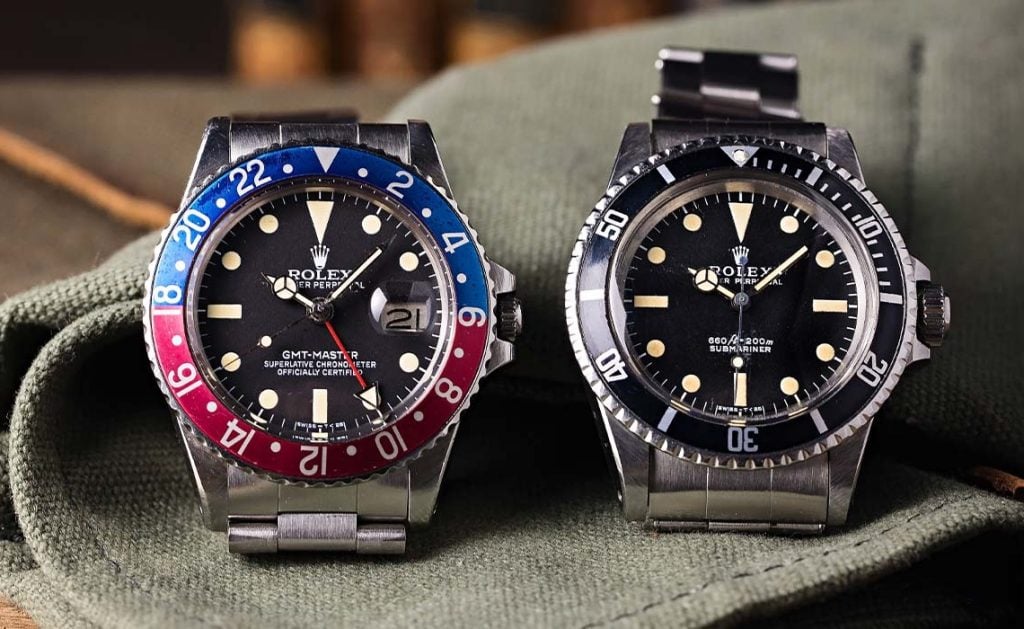
Looking at the core specifications side by side makes the differences easier to understand. Both watches share Rolex’s Oyster case and in-house movements, but the smaller details start to separate them once you consider how they’re intended to be worn.
| Spec | GMT-Master II | Submariner (Date) | Submariner (No-Date) | Notes |
| Reference | 126710BLRO / 126710BLNR/ 126710GRNR | 126610LN / 126610LV | 124060 | |
| Case Size | 40mm | 41mm | 41mm | GMT feels smaller on the wrist |
| Water Resistance | 100m / 330ft | 300m / 1,000ft | 300m / 1,000ft | Submariner is the diver |
| Bezel Type | 24-hour bi-directional | 60-min unidirectional | 60-min unidirectional | Different functions entirely |
| Movement | Cal. 3285 | Cal. 3235 | Cal. 3230 | All in-house, COSC-rated |
| Clasp | Easylink (+5mm) | Glidelock (+20mm) | Glidelock (+20mm) | Glidelock is more versatile |
| Bracelet Options | Oyster or Jubilee | Oyster only | Oyster only | GMT has dressier Jubilee option |
| Date Window | Yes (always) | Yes | No | No-Date Sub preferred by collectors |
Case Proportions and Wearability
At 40mm, the GMT-Master II is technically the smaller of the two, but the comparison is not straightforward. The current Submariner is 41mm with a refined lug design that sits tightly against the wrist. The GMT has a 40mm case.
Wrist presence matters in a watch when examining the best Rolex watches at this price level. The Submariner’s slimmer profile and slightly tighter lug-to-lug measurement make it easier to wear under a shirt cuff, while the GMT-Master II’s broader case makes a stronger visual statement. Neither is wrong, but it is worth trying both on before committing.
Bezel Functionality: Bi-Directional vs. Unidirectional
The bezels on these two watches serve completely different purposes, and that distinction reflects the core function of each model. The Submariner’s 120-click unidirectional bezel is a safety feature. When a diver sets the bezel to track elapsed time underwater, any accidental movement can only rotate the bezel counterclockwise, which would overestimate the time spent below the surface rather than underestimate it. That design choice has kept divers safe for decades.
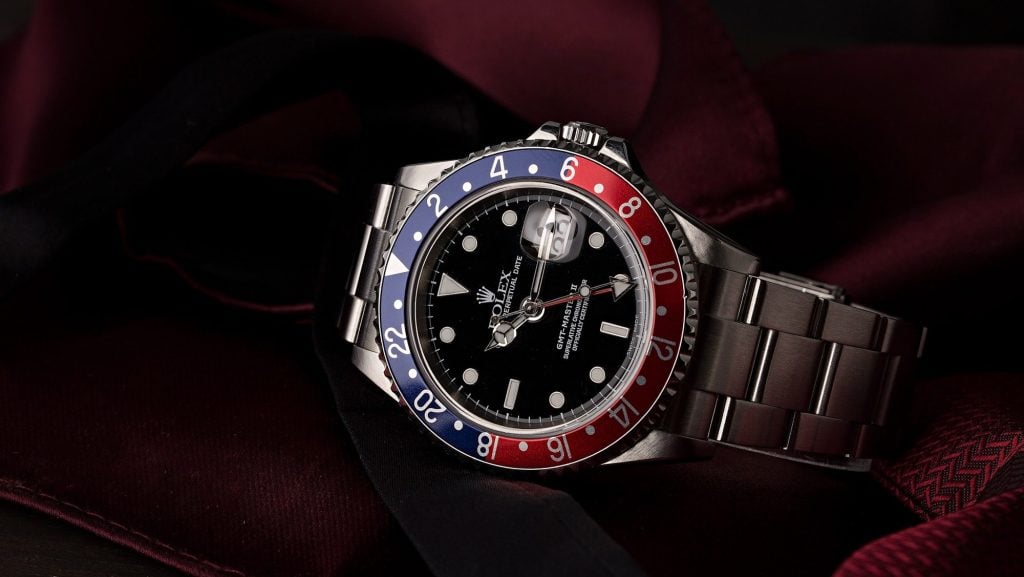
The GMT-Master II uses a 24-click bi-directional bezel marked with a 24-hour scale, allowing the wearer to track a second time zone against the 24-hour hand. It turns freely in both directions because there is no safety concern tied to its rotation. The two bezels look similar at a glance but represent fundamentally different engineering priorities. You can read more details about this feature on my previous article about Rolex bezels.
Bracelet and Clasp: Glidelock vs. Easylink
Both watches ship on Rolex’s Oyster bracelet, but the clasp systems differ in meaningful ways. The Submariner uses the Glidelock extension system, which allows the wearer to adjust the bracelet length by up to 20mm in 2mm increments without any tools. That range of adjustability makes the Submariner well-suited for wearing over a wetsuit and equally comfortable through daily temperature fluctuations that cause the wrist to expand and contract slightly.
The GMT-Master II uses the Easylink system on a Rolex bracelet, with 5mm of clasp extension with a single click. It’s convenient for minor adjustments but has far less range than Glidelock. Where the GMT-Master II has an advantage is bracelet variety. It’s available on the Jubilee bracelet, a five-link design with polished center links that gives the watch a noticeably dressier feel compared to the three-link Oyster. The Submariner does not offer a Jubilee option.
The Movement: Caliber 3235 vs. Caliber 3285
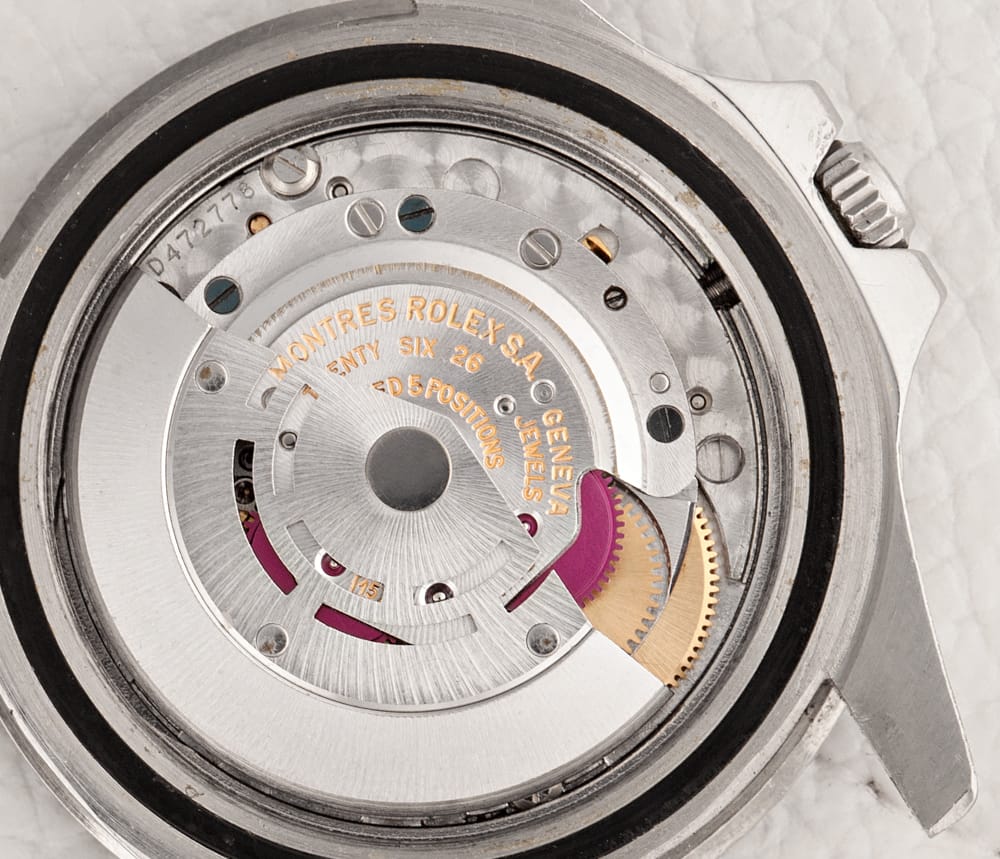
Both movements sit at the top of Rolex’s in-house lineup and share a number of technical similarities, including the Chronergy escapement, which improves efficiency by about 15 percent compared to traditional lever escapements, and Parachrom hairsprings that perform consistently in magnetic fields. Both are certified by the Controle Officiel Suisse des Chronometres (COSC) and carry Rolex’s own Superlative Chronometer rating, which holds them to an accuracy standard of plus or minus 2 seconds per day.
The key difference is what the GMT complication requires. Caliber 3285, used in the GMT-Master II, drives an independent fourth hand that can be set to any hour independently of the main hour hand. That means a traveler can set the 24-hour hand to home time, adjust the local hour hand upon landing, and read a third time zone off the bezel, all without disturbing the other functions. This is what watchmakers refer to as a true GMT, and it is the gold standard for a traveler’s watch. The Submariner’s Caliber 3235 (date version) and Caliber 3230 (no-date version) do not have this complication. Their dial layouts are cleaner but limit their functionality to a single time zone.
Aesthetics and Iconic References

The Submariner and GMT-Master II are both instantly recognizable today, though their designs evolved in different ways. The Submariner has stayed fairly restrained, featuring a mostly monochromatic look for decades. The GMT-Master II, meanwhile, has colorful bezels, many of which collectors now recognize by nickname.
The Color Factor: Pepsi, Batman, Hulk, and Starbucks
The GMT-Master II is the more expressive of the two. The red and blue “Pepsi” bezel (Ref. 126710BLRO) is arguably the most recognized Rolexes in the world after the Submariner, and it commands significant attention in both new and pre-owned markets. The black and blue “Batman” (Ref. 126710BLNR) is a more subdued alternative that has developed a strong following of its own. Both use Rolex’s Cerachrom ceramic bezel material, which is highly resistant to scratching and UV fading.
The Submariner has a tighter palette. The standard model comes in black with a black bezel, while the “Hulk” (Ref. 116610LV) and its successor, the “Kermit” (Ref. 126610LV), add a green bezel to the lineup. Among enthusiasts and online communities, the Hulk is the one that causes the most chatter, partly because it was discontinued in 2020 when the current generation launched, driving strong pre-owned demand. The color conversation on the Submariner is quieter, but no less passionate among its fans.
The No-Date Submariner vs. The Cyclops Lens
One ongoing debate among collectors of Rolex watches is the no-date Submariner (Ref. 124060) versus the date-equipped versions of both models. The 124060 features a perfectly symmetrical dial with no date Submariner window and no Cyclops magnifying lens over the crystal. Collectors who appreciate clean dial design of the Rolex Submariner no date often favor this reference precisely because there is nothing to interrupt the balance of the layout.
The GMT-Master II always includes a date complication, which means the Cyclops lens and the crown at 3 o’clock are permanent features. Some buyers don’t mind the Cyclops lens and may even prefer it. For collectors who prioritize dial symmetry, though, the no-date Submariner has the more balanced dial.
Market Performance and Availability

Both the GMT-Master II and Submariner have held their value exceptionally well over time, and both regularly trade at or above retail in the pre-owned market. That said, market conditions shift, and knowing where each model stands today matters when making a purchase decision.
The GMT-Master II, particularly the Rolex Pepsi (126710BLRO), is currently considered one of the harder Rolex references to obtain at an authorized dealer. Demand consistently outpaces supply, and many buyers report waitlists stretching years, if they are offered a waitlist at all. The Submariner Date tends to be slightly more attainable in comparison, though it remains far from easy to acquire. As mentioned in a Rolex 124060 review I previously wrote, the ref. 124060 no-date Sub sits in an interesting position: lower retail price point, strong collector demand, and a cleaner profile that tends to retain value steadily.
From a pure investment standpoint, both watches have historically appreciated or held value in the pre-owned market. The Pepsi GMT and the now-discontinued Hulk Submariner are outliers in terms of appreciation. Standard references have been more stable, which is generally a sign of a mature and healthy secondary market rather than speculation.
GMT-Master II vs. Submariner: Which One Should You Buy?
Both watches are excellent choices. The real question is which one fits your lifestyle and preferences better.
The Submariner is the right choice if:
- You want a single, versatile watch that works in every setting.
- The Glidelock clasp and 300m water resistance matter to you in daily use.
- You prefer a fully brushed, stealth aesthetic with no polished surfaces.
- The no-date option appeals to you for its clean, symmetrical dial.
- You are buying your first Rolex sport watch and want the most universally accepted reference.
The GMT-Master II is the right choice if:
- You travel frequently and genuinely use the dual-time or three-timezone functionality.
- You want a watch with more visual character, whether that’s the Pepsi bezel or the Batman.
- The Jubilee bracelet appeals to you as a dressier alternative to the Oyster.
- You are looking for a second Rolex that offers something different from a Submariner you already own.
- You are drawn to the history of the watch’s connection to aviation and the original Pan Am pilots.
Final Verdict: Choosing Your Rolex
There is no wrong answer between the two models. The Submariner is one of the most recognized watches ever made, a tool watch that became a cultural institution. The GMT-Master II has its own legacy as the watch that helped connect the world during the early era of commercial aviation. Both are made to the same Rolex standard, powered by in-house Rolex movements, and designed to last a lifetime.
If you can’t really decide, the Submariner is the safer starting point. It’s the more versatile daily wearer, requires less thought about which time zone to track, and works just as well at a board meeting as it does on a dive boat. The GMT-Master II tends to make the most sense for people who travel across time zones or for collectors who already own a Submariner and want something different. Either way, you are not making a mistake.