
The vintage Rolex Oyster Perpetual is a foundational timepiece in the brand’s history, defined by its waterproof Oyster case and self-winding Perpetual movement. Rolex Oyster Perpetual collectors prize the vintage iterations for its minimalist dial configurations, historic calibers, and enduring design.
Key Takeaways
- A watch qualifies as vintage once it passes roughly 30 years of age, which currently covers Oyster Perpetual production from the bubbleback era through the mid 1990s.
- The collection runs on mechanical workhorses including Caliber 1030, Caliber 1560, and Caliber 1570.
- Pre-owned market values vary based on condition, reference rarity, dial originality, and the presence of box and papers.
- Authentication requires careful inspection of case edges, dial typography, and bracelet stamps that match the production era.
- Clean time-only dials and slim 34mm to 36mm cases suit modern wrists seeking restrained luxury.
Understanding the history of the Oyster Perpetual, mechanical variations, and valuation metrics of these vintage models ensures a confident acquisition. Reference numbers, caliber generation, and dial originality are the three variables that determine both authenticity and price.
What Defines a Vintage Rolex Oyster Perpetual?
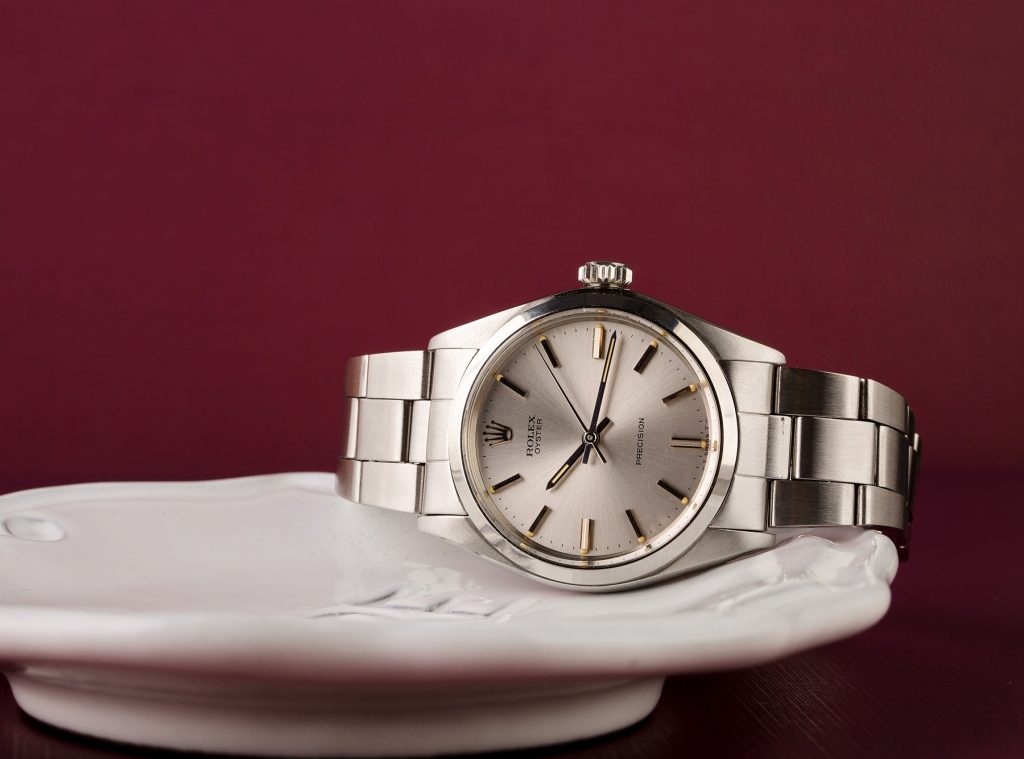
A vintage Rolex Oyster Perpetual is a mechanical wristwatch built on three architectural pillars: the waterproof Oyster case, the screw-down winding crown, and the self-winding Perpetual rotor. The reference family represents the purest expression of the brand’s functional philosophy because it omits complications entirely, including the date window that defines the Datejust. The name describes those two engineering achievements directly, since Oyster refers to the hermetically sealed case and Perpetual refers to the rotor that winds the mainspring through the motion of the wearer’s wrist.
A vintage Rolex Oyster Perpetual is produced during the mid-to-late 20th century that features a water-resistant Oyster case and a self-winding perpetual movement without a date complication. These vintage Rolex models are defined by their clean dials, historical calibers, and timeless proportions, making them highly sought after by collectors seeking understated horological heritage.
I’ve always felt that a watch becomes vintage once it passes roughly 30 years of age, which today places production from the 1930s through the mid 1990s inside the category. That window captures a dramatic shift in case design. Early models carried the deep, rounded caseback known to collectors as the bubbleback, a profile dictated by the height of the first automatic winding mechanisms and typically measuring 32mm to 34mm across. As movement architecture grew thinner through the 1960s, the cases followed, producing the flatter silhouettes that most buyers picture when they think of a classic Oyster Perpetual.
Evolution and Key Vintage References to Know

Vintage Oyster Perpetual models evolved significantly across decades, introducing more reliable Rolex movements and refined case shapes with each generation. Reference numbers, stamped between the lugs at the 12 o’clock position, are the fastest way to place a watch in its correct era.
Crystals stayed acrylic for most of the vintage window and only shifted to scratch resistant sapphire at the very end of it, which makes crystal material a quick dating clue on its own.
- Ref. 6564 (mid 1950s): This 34mm reference runs the automatic Caliber 1030 under an acrylic crystal, and it appears in stainless steel, gold-capped, and solid gold cases. Examples reward buyers who value original dial finishes over case sharpness, since many surviving pieces have been refinished.
- Ref. 1018 (mid to late 1960s): This scarce reference offers an oversized 36mm case, roughly the same footprint as the Explorer ref. 1016, paired with the chronometer certified Caliber 1570. It was never mass-produced, and examples frequently surface with service dials or evidence of water ingress, so originality carries unusual weight here. Buyers weighing case diameter across the era can compare it against vintage Rolex Datejust models for alternative vintage sizing.
- Ref. 14200 (1990s onward): This reference bridges vintage aesthetics and modern durability, pairing a sapphire crystal and a 3000 series movement with the familiar 34mm Oyster case. Rolex cataloged it under the Air-King name rather than the Oyster Perpetual name, and the two lines share the same case, bracelet, and dial signature, which is why vintage Air-King watches are routinely searched and sold as Oyster Perpetuals. Only the earliest examples currently fall inside the 30 year vintage window.
That naming overlap is worth understanding before you shop. Because Oyster describes the case and Perpetual describes the self-winding movement, both words print on Air-King dials as well, and the long-running Air-King ref. 5500 shares its 34mm case dimensions with the Oyster Perpetual ref. 1002. The practical difference is chronometer certification: references such as the 1002 and 1018 carry COSC certified calibers, while the 5500 was fitted with the uncertified Caliber 1520 or 1530.
Mechanical Mastery and Calibers Behind the Dial
The mechanical integrity of a vintage Rolex Oyster Perpetual depends heavily on the robustness of its internal caliber, and the movement inside a given watch tells a buyer more about long-term serviceability than the condition of the case. Rolex built these automatic calibers for decades of daily use, which is why so many survive in running condition today. The three generations below cover the majority of collectible references.
- Caliber 1030: The automatic caliber fitted to 1950s references including the 6564, identifiable by its butterfly shaped oscillating weight and 25 jewel construction.
- Caliber 1560: Introduced in 1959 and running at 18,000 vibrations per hour with 26 jewels, this caliber established the architecture the family kept for two decades: a free-sprung balance with Microstella screws, a Breguet overcoil hairspring, and KIF shock protection.
- Caliber 1570: Introduced in 1965 and used into the 1970s, this caliber retained the 1560 architecture while raising the frequency to 19,800 vibrations per hour. It is COSC certified and powers the reference 1018 among others.
The Caliber 1570 regulates timekeeping through a free-sprung balance adjusted by Microstella screws rather than a traditional regulator index. That design removes the positional error a regulator pin introduces, and combined with the Breguet overcoil hairspring and KIF shock protection, it explains why chronometer certified examples of this caliber can still hold close rates decades after leaving the factory.
Secondary Market Value and Pricing Frameworks
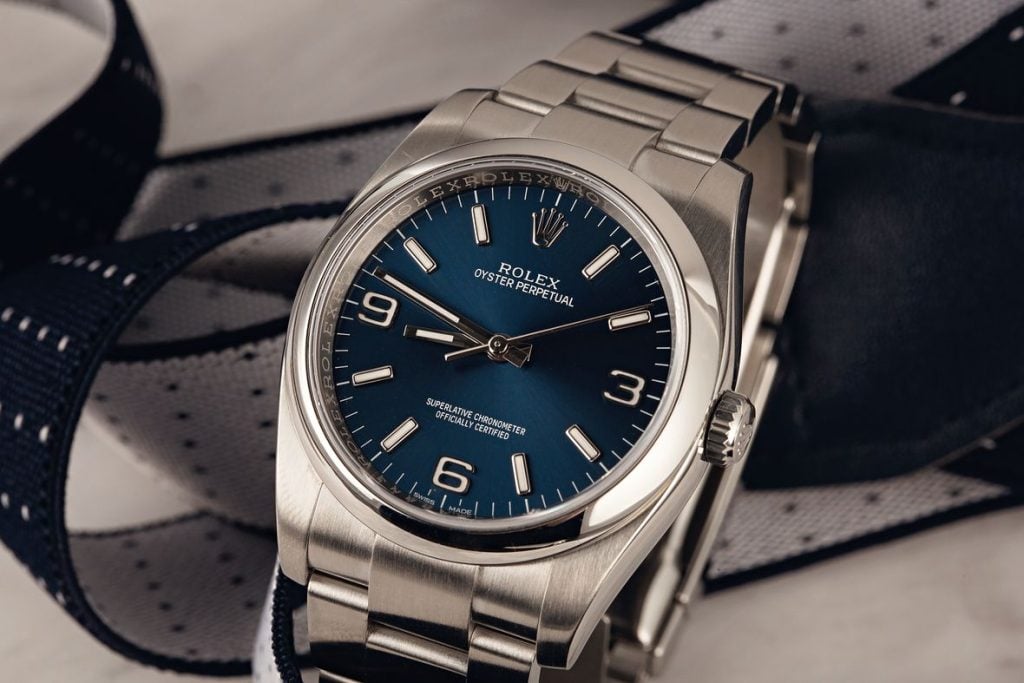
Vintage Rolex Oyster Perpetual value is determined by four variables: reference rarity, dial originality, case condition, and whether the watch retains its original box and papers. Pre-owned market pricing for a vintage Rolex Oyster Perpetual is set entirely by secondary market sold data rather than original retail MSRP, since none of these references remain available at an authorized dealer. Values move with condition, reference rarity, and originality rather than with age alone, which means a well preserved 1960s example can trade above a rougher piece from the same decade.
When shopping for a vintage Rolex OP, you can expect to pay between $3,000 to $10,000. Two variables move the needle more than any other across all three tiers. The first is dial originality, since a refinished dial can reduce the value of an otherwise strong example considerably. The second is completeness, because original box and papers confirm provenance and consistently command a premium over a watch head sold on its own. Both variables work in reverse for owners who decide to sell Rolex watches from a vintage collection, where an untouched dial and complete set raise the value of a watch. Certain references are generally considered stronger long-term holds than others, though condition and market timing mean no vintage purchase guarantees a profit.
Heritage, Everyday Wearability, and Design Philosophy

The enduring appeal of the vintage Rolex Oyster Perpetual stems from its refusal to chase fleeting trends. Case diameters across the vintage catalog run from 32mm on early bubbleback models to 36mm on the scarce ref. 1018, with 34mm serving as the long-running standard. Those proportions sit comfortably on a wide range of wrists and slide easily under a shirt cuff, and the restraint has become an asset rather than a limitation as buyers increasingly seek smaller, quieter watches.
The slim case profile does the rest of the work. A vintage Oyster Perpetual sits far lower on the wrist than a modern sports model, and dial color separates one example from another more than any other single factor, with silver, black, and champagne finishes reading as the most conservative and rarer tones drawing the strongest collector interest.
“The Rolex Oyster Perpetual collection can be held in high regard for its perfect balance of simplicity and sophistication. Each Oyster Perpetual watch embodies Rolex’s commitment to precision and reliability, offering a timepiece that seamlessly transitions from casual to formal settings. Our discerning clientele appreciates the Oyster Perpetual for its understated elegance and robust construction. The Oyster Perpetual’s enduring design and mechanical prowess make it not just a purchase, but an investment in horological heritage.“
– Paul Altieri, Founder and CEO of Bob’s Watches
How to Authenticate and Inspect a Vintage Rolex Oyster Perpetual

Authenticating a vintage Rolex requires meticulous inspection of physical components to confirm originality against aftermarket alterations. Decades of servicing mean that many surviving examples carry at least one replaced part, and the goal of inspection is to identify which components match the production era and which do not. A 10x loupe and strong, angled light are the only tools required for a first pass.
- Case Integrity: Inspect the bevels, lug holes, and engravings between the lugs. Sharp, defined lug edges indicate a case that has not been heavily polished, and you can verify the production year through the Rolex serial number stamped between the lugs at the 6 o’clock position.
- Dial Evaluation: Look for correct typography, the Swiss signature at the base of the dial, and even aging across the hour markers and hands. Rolex used radium before the mid 1960s and tritium after it, so a 1950s dial should not show tritium markings, and dials marked T SWISS T or Swiss T <25 belong to the later period. Uniform patina across all markers suggests an untouched dial, while mismatched tones often indicate replaced hands or relumed markers.
- Bracelet Matching: Ensure the clasp codes and end links correspond to the production era of the watch head. A correct bracelet adds meaningful value, and a mismatched one is among the most common substitutions on the secondary market.
We’ve authored a detailed guide on how to spot a fake Rolex for those that want a to learn more.
Caring for and Maintaining Your Vintage Timepiece

Owning a vintage Rolex Oyster Perpetual requires specialized care habits that differ from those for current production watches. The rubber gaskets sealing the caseback and crown degrade over decades, which means the water resistance a watch carried when it left the factory no longer applies. Older models should avoid heavy water exposure unless a qualified watchmaker has pressure tested the case and replaced the seals, and even then, treating a vintage Oyster as splash resistant rather than swim ready is the safer standard.
Servicing intervals of every three to five years keep these calibers running within specification. A watchmaker experienced with vintage Rolex movements will use lubrication appropriate to the era of the caliber and will preserve original components wherever possible, since replacing a dial, hands, or bezel with current parts can reduce collector value even when the work improves function. Storage matters as well: keeping the watch away from magnetic sources and strong temperature swings protects both the movement and the dial finish.
Rolex introduced the waterproof Oyster case in 1926 following the invention of the screw-down crown and bezel system, a foundational milestone that permanently transformed wristwatch durability and enabled the creation of the self-winding Perpetual collection decades later.