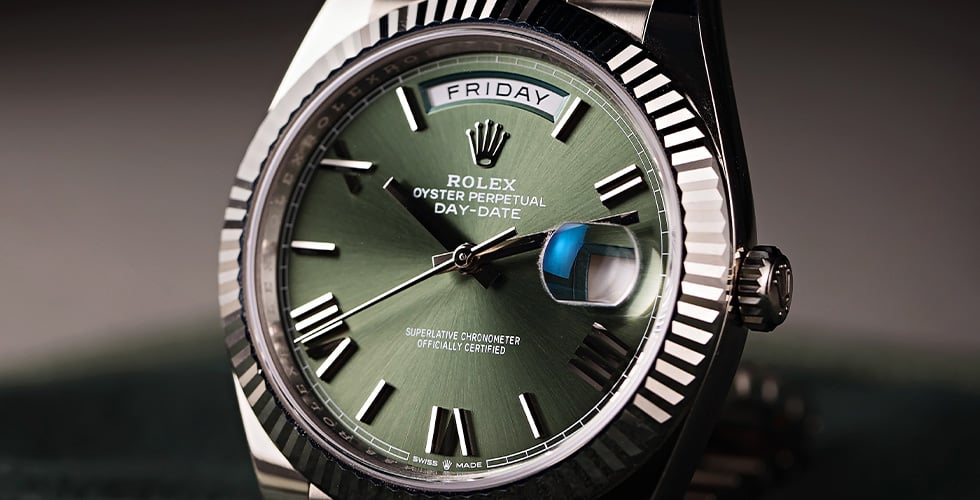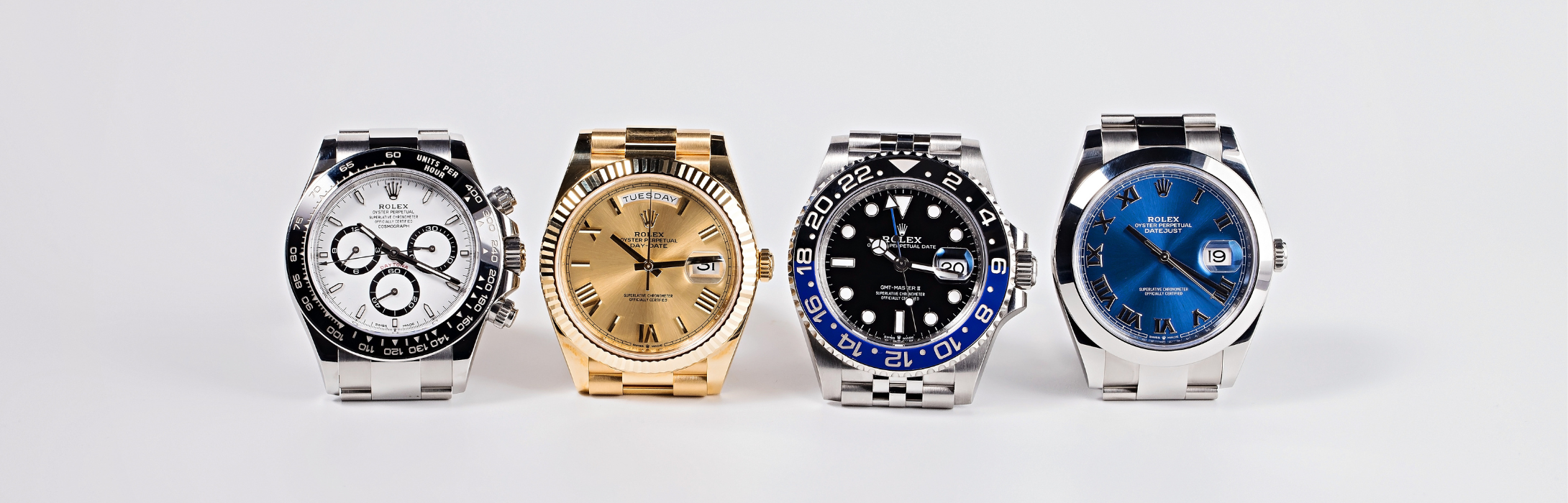

Are watch winders worth it? For most people, no. If you own one or two standard time-and-date automatics, a winder is a nice-looking box that solves a problem you do not have. If you own a calendar complication or rotate through a real collection, a good programmable winder is worth every dollar. I have spent years around the service bench at Bob’s Watches, and I have watched hundreds of Luxury Watches come through on winders, in drawers, and in safes. Here is my honest take, current picks worth buying, and the Rolex caliber settings people keep asking about.
Key Takeaways
- A watch winder is not necessary for a standard time-and-date Rolex like a Submariner, Datejust, or Oyster Perpetual. Setting the watch takes seconds.
- A winder earns its keep on annual and perpetual calendars, moon phases, and collections of four or more automatics in rotation.
- A quality winder does not damage a healthy, serviced movement. A cheap, unshielded winder can.
- Most modern Rolex calibers are happy at 650 turns per day, bidirectional. Confirm your caliber in the table below.
- Leaving a Rolex on a winder permanently is fine for the movement, but the watch still needs service on its normal schedule, winder or not.
- Buy for motor quality and programmability first. Leather and lighting are last.
The rest of this article is built for three people: the skeptic who thinks winders are a gimmick, the shopper who wants a short list, and the Rolex owner who wants to know what to set the dial to. I will take them in that order.
My Verdict on Watch Winders

Watch winders are worth it for a minority of owners and unnecessary for everyone else, and I have no problem saying that plainly even though half the internet sells them. A watch winder is a motorized cradle that rotates an automatic watch so the oscillating weight keeps the mainspring wound while the watch sits unworn. That is all it does. It does not improve accuracy, and it likely won’t make a watch more valuable.
The “worth it” debate is real. Some publications argue winders are unnecessary at best and harmful at worst. From the bench, here is how I settle it.
What winding actually does to a movement. An automatic movement is designed to run. When it runs, the oils sit where they were applied, the balance oscillates at its designed amplitude, and the mainspring cycles between wound and partially unwound within the slipping bridle’s normal range. A winder that applies a sensible number of turns per day keeps the watch in exactly the state Rolex designed it for: on a wrist that moves. A winder that runs constantly at 1,800 turns per day with no rest phases is not what the watch was designed for, and that is where the wear stories come from.
The wear myth. People worry that a winder “adds miles” to the watch. Technically, a running watch accumulates more balance oscillations than a stopped one. Practically, the service interval on a modern Rolex is governed by lubricant age as much as by running time, and a watch that has sat stopped for two years still needs the same service as one that ran on a winder for two years. I have opened plenty of both. From what i’ve experienced, the stopped watches are not in better shape.
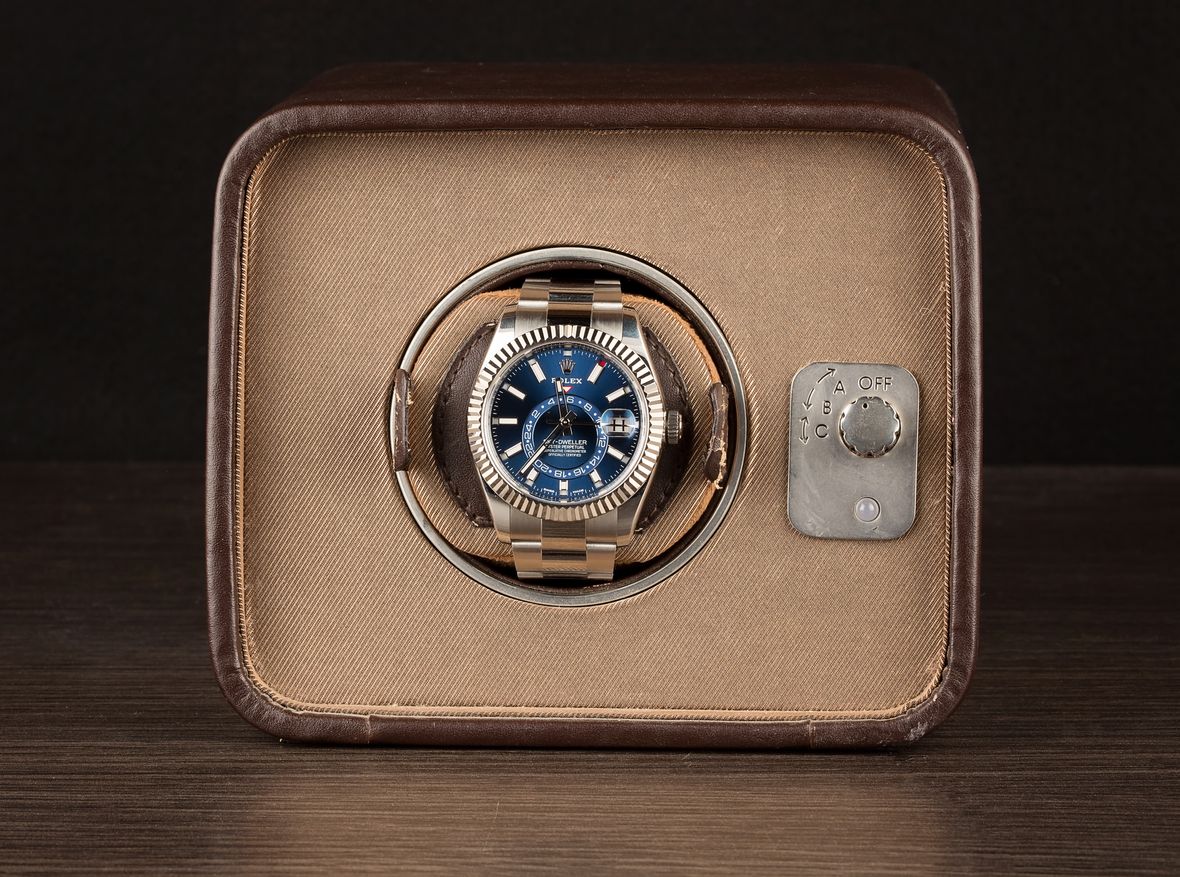
The honest cases for a winder. An annual calendar, a perpetual calendar, a moon phase, or a Sky-Dweller with its month and reference-time display is annoying to reset after a week in a drawer. If you own one of those, buy a winder. A collector who rotates four or five automatics and wants each one on the wrist in ten seconds also gets real value. Everyone else is buying decoration, and decoration is fine as long as you know that is what you are paying for.
Here is how our CFO, Joe, puts it to customers who ask him:
“If you own a single standard time-and-date watch like a Rolex Submariner or a Datejust, don’t waste your money on a winder. Just set it when you wear it. But if you have a massive collection or owna highly complex calendar complication, buy a high-quality, programmable winder to save yourself the headache of resetting them.”
Joe Alessindrini, CFO of Bob’s Watches
I agree with every word, and I would add one thing. If a winder gets you to wear the watches you already own instead of leaving them stopped in a safe, that is a point in its favor that has nothing to do with mechanics.
When a Winder Is Not the Answer
A winder does nothing for a quartz watch, nothing for a manual-wind watch, and nothing useful for a watch that is overdue for service. If your Rolex is gaining forty seconds a day or the rotor sounds gritty, a winder will keep it running badly around the clock. Get it serviced first. Our team explains what that involves in our guide to Rolex service and maintenance.
My Personal Preferences
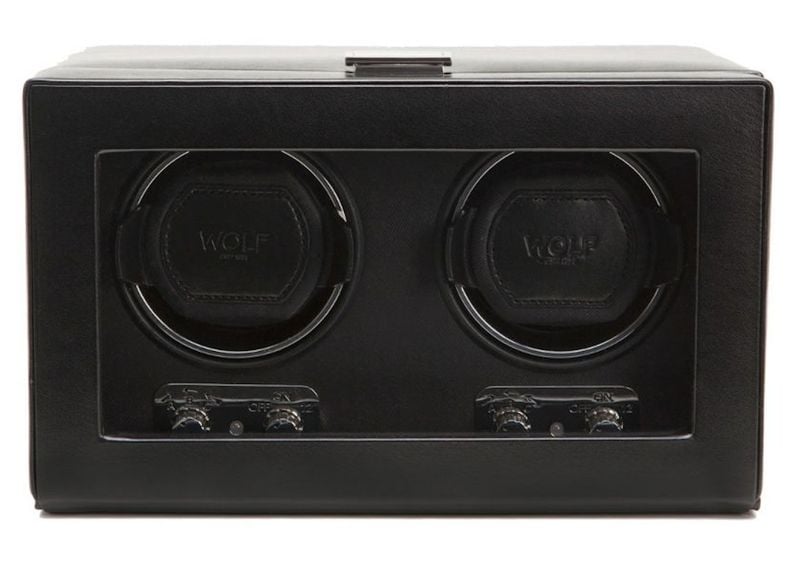
As a collector myself, I have a few favorites, and over the year’s my watchmakers have helped me come to my current preferences. That is the most honest thing I can tell a skeptic: a business whose watchmakers could easily argue against winders have preferences on which ones to use, because resetting a large collection of watch by hand every morning would be absurd.
My recommendation is simple:
- Run multi-unit winders with independently programmable modules, so a Day-Date, a Daytona, and a Sky-Dweller can each get its own setting side by side.
- Set Rolex calibers to 650 turns per day, bidirectional, unless the manufacture says otherwise.
- Use programs with rest phases rather than continuous rotation. A watch that winds for a short cycle and then sits still for a longer one behaves more like a watch on a wrist.
- Keep winders away from speakers, laptops, and anything with a strong magnet. Magnetism is a bigger practical risk to a Rolex than winding is.
- Do not wind a watch that is going to the bench. A watch scheduled for service rests until the watchmaker opens it.
I asked Carol our COO what she tells owners who are nervous about leaving a watch on a winder for months at a time:
“I’ve alway felt that the winder is not the thing that wears a Rolex out. Old lubricant is. I would rather see a Submariner come in after two years on a good winder than after two years forgotten in a drawer. Set it to 650 turns a day, bidirectional, and then forget about it until its service date.”
Carol Altieri, COO of Bob’s Watches
Rolex Caliber Winder Settings Table
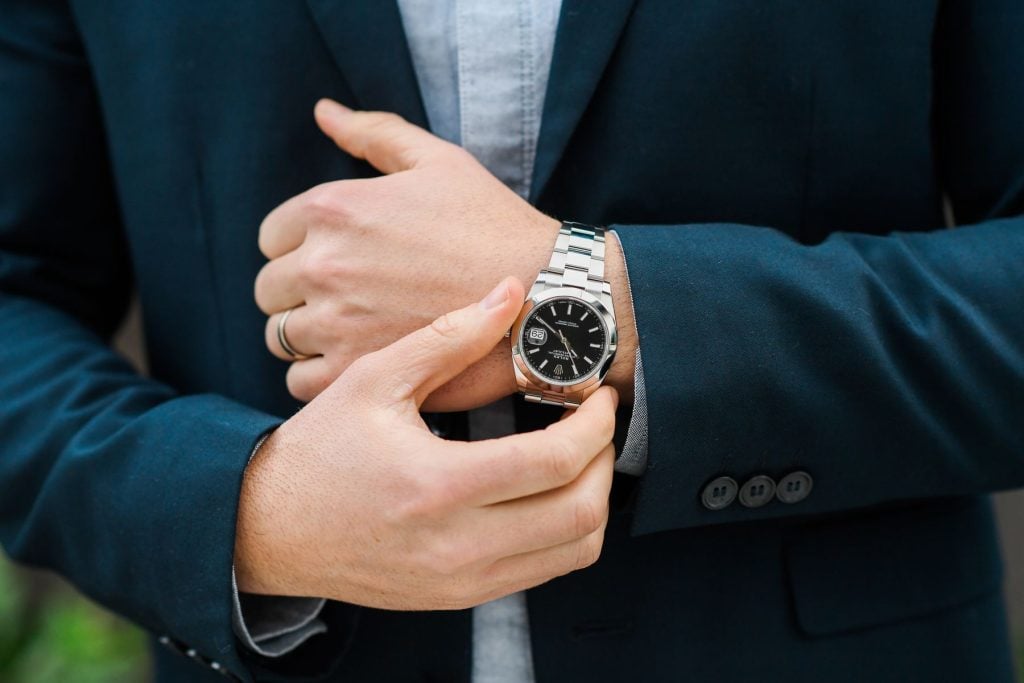
Rolex caliber winder settings are almost always 650 turns per day, bidirectional, and the table below is the one I use. Rolex itself publishes no official winder recommendation that I know of, so this table reflects what our watchmakers recommend.
| Rolex caliber | Found in (examples) | TPD / direction |
| 3135 | Submariner Date, Datejust, Sea-Dweller (pre-2015 era) | 650 / bidirectional |
| 3235 | Submariner Date, Datejust 41, Sea-Dweller, Yacht-Master (current) | 650 / bidirectional |
| 3230 | Submariner no-date, Oyster Perpetual, Explorer, Air-King | 650 / bidirectional |
| 3186 / 3285 | GMT-Master II, Explorer II | 650 / bidirectional |
| 2235 / 2236 | Lady-Datejust, Datejust 31 | 650 / bidirectional |
| 3255 | Day-Date 36 and 40 | 650 / bidirectional |
| 4130 / 4131 | Daytona | 650 / bidirectional |
| 9001 / 9002 | Sky-Dweller | 650 / bidirectional |
A few practical notes. If your winder only offers 650 or 800 turns per day, I would personally pick 650 for any Rolex in this table. If your winder only offers clockwise or counterclockwise, either will likely work on these calibers because the Rolex Perpetual rotor winds in both directions, but bidirectional is the correct setting when available. If you see the watch losing power on a winder, check that the case is seated properly in the cuff before changing the program. Nine times out of ten the watch is sitting loose.
Best Watch Winders for Automatic Watches
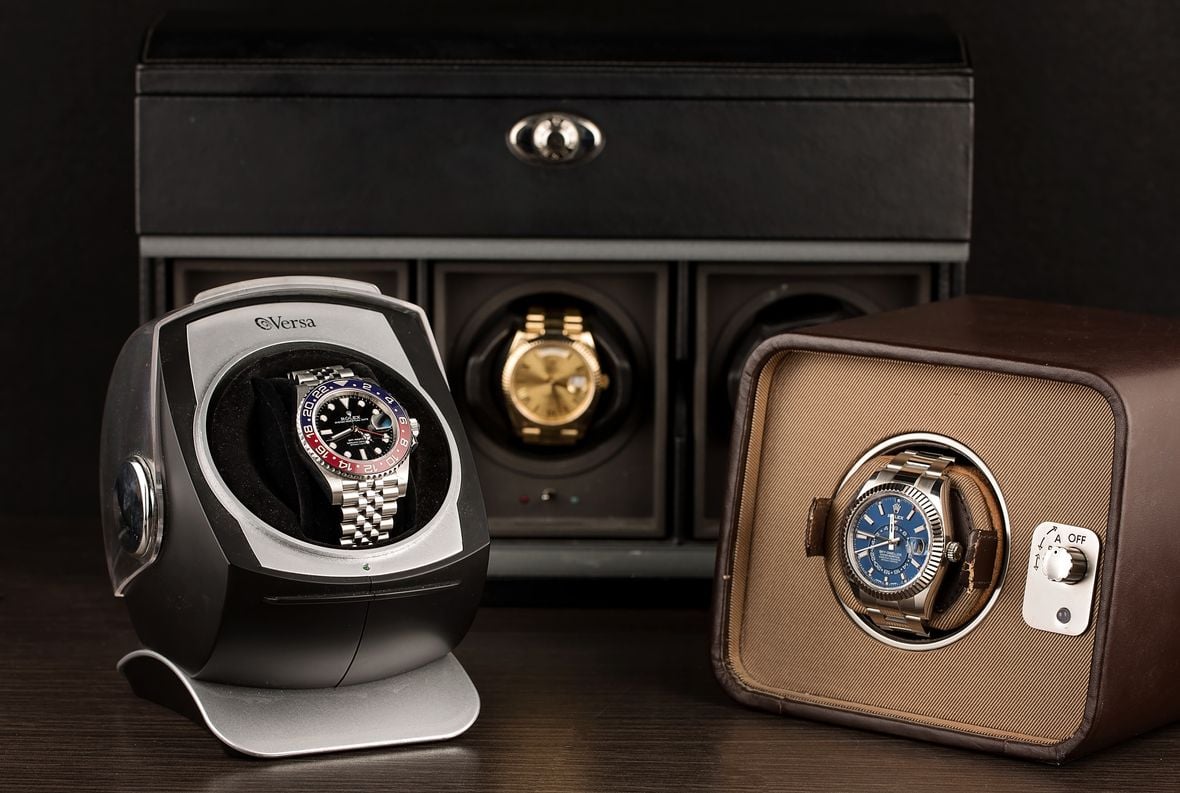
The best watch winder for automatic watches is a quiet, programmable unit from a brand that has been making motors for years Every pick below was checked against current buyer guides as of summer 2026. Re-verify model names, prices, and stock on the maker’s site before publishing. Bob’s Watches does not sell winders.
Budget: Barrington Single Winder
Barrington’s single winder is the one I point first-time buyers to. It is compact, it is quiet, and it offers adjustable turns per day and direction, which is rare at this price. The finish is acrylic rather than lacquered wood, and the cuff is a little snug for very large cases, but the motor is the part that matters and Barrington got it right.
Mid-range: Wolf Cub or Wolf Roadster
Wolf has been making winders for a long time and its mid-range single and double units count actual rotations rather than estimating them, which is why its programs are accurate. The Cub is the plain version; the Roadster adds a glass window and a nicer finish. Both run quietly on a nightstand and both let you set turns per day, direction, and a delayed start. For one or two watches this is where I would spend.
Premium: Orbita Sparta or Siena
Orbita builds winders in North Carolina with ironless core motors and a long track record. The Sparta is a single-watch unit with a simple rotation program; the Siena multi-unit adds independent modules and a glass front. If you want something that will still be running in fifteen years, Orbita is the safe answer.
Multi-watch cabinet: Orbita or Wolf 1834 multi-unit
For a collector running four or more automatics, buy a cabinet with independently programmable modules rather than one motor driving several cuffs. Orbita’s Siena and Wolf’s 1834 multi-unit lines both do this, both lock, and both let you set a Daytona and a Sky-Dweller differently in adjacent slots. This is the same principle we follow in our facility.
Best Watch Winders for Rolex
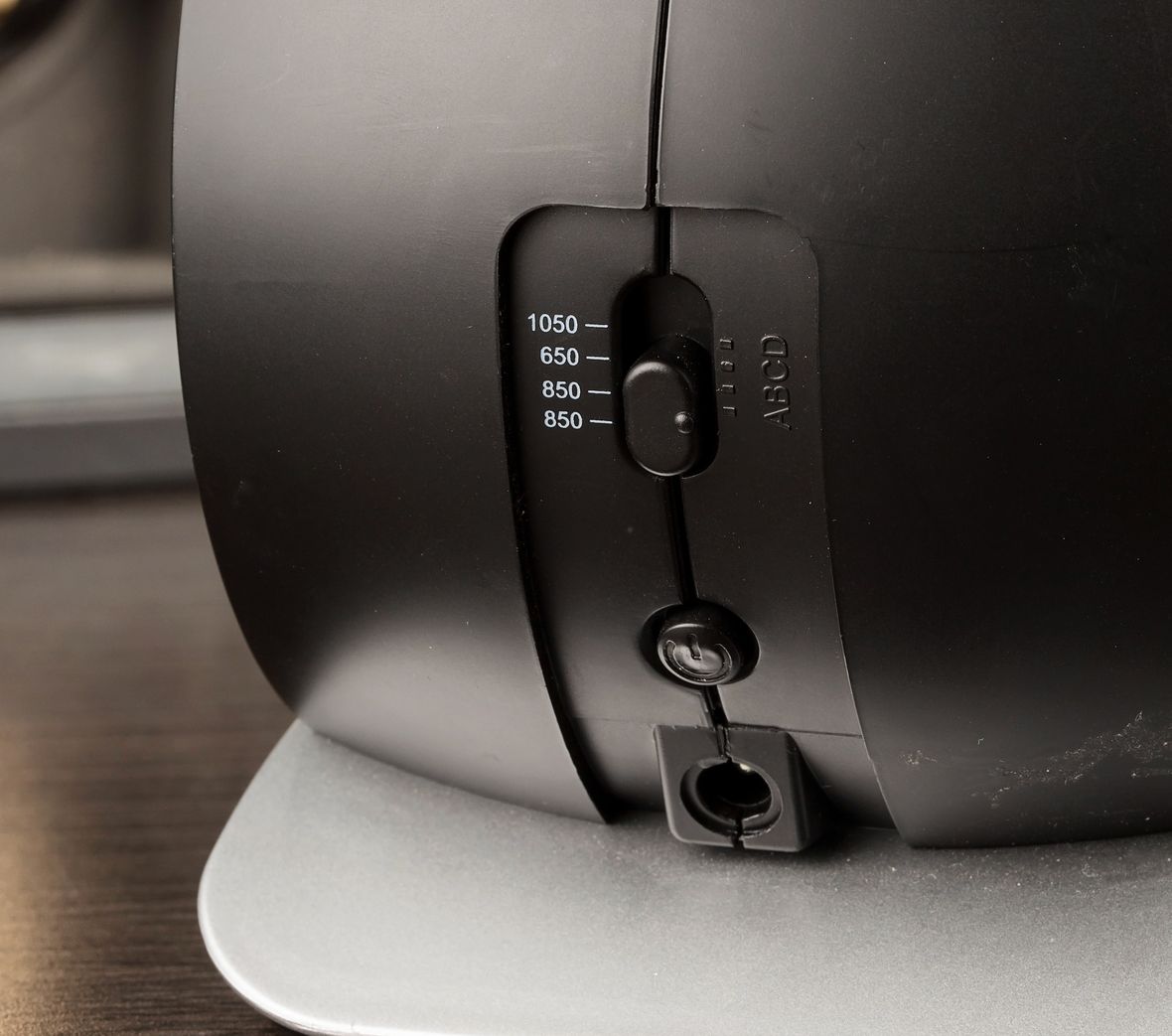
The best watch winder for a Rolex watch collection is any winder that can be set to 650 turns per day, bidirectional, and that does not leak magnetism into the movement. Rolex does not need a special winder. It needs a good one. Here are the two I would put a Rolex on without thinking twice.
SwissKubik Masterbox
SwissKubik’s Masterbox is a Swiss-made cube that runs on batteries or USB, rotates in programmable cycles, and is small enough to sit inside a safe, which is where a lot of Rolex owners actually keep their watches. It is not cheap for a single-watch winder, and it does not make a show of itself. That is the point. It is the closest thing to a professional tool in this category.
Wolf Axis or Roadster Double
For an owner with a Datejust and a Submariner who wants both ready every morning, a Wolf double winder with rotation counting and a lockable door is the practical choice. Set both modules to 650, bidirectional, and close the door.
What to skip
Skip any winder under roughly fifty dollars with an unbranded motor, any winder that does not list turns per day, and any winder marketed as “for Rolex” at a premium price with no spec sheet. The Rolex branding on a winder box is marketing. The motor spec is the product. If you travel with your watch instead of winding it, a simple leather watch pouch protects it better than a cheap travel winder ever will.
How to Choose a Watch Winder
Choosing a watch winder comes down to four questions, in this order:
- Does the watch need it? Time-and-date only: no. Calendar complication or rotating collection: yes.
- Can I set turns per day and direction? If the answer is no, put the winder down.
- Does it have rest phases? Good winders wind for a few minutes and rest for longer. Continuous rotation is a red flag.
- Is the motor shielded and branded? Japanese Mabuchi motors and Swiss motors are the standard. Unnamed motors are where magnetism problems start.
Capacity, lighting, leather, and locking doors come after those four. A beautiful box with a bad motor is a bad winder.
Do I Need a Watch Winder for My Rolex?
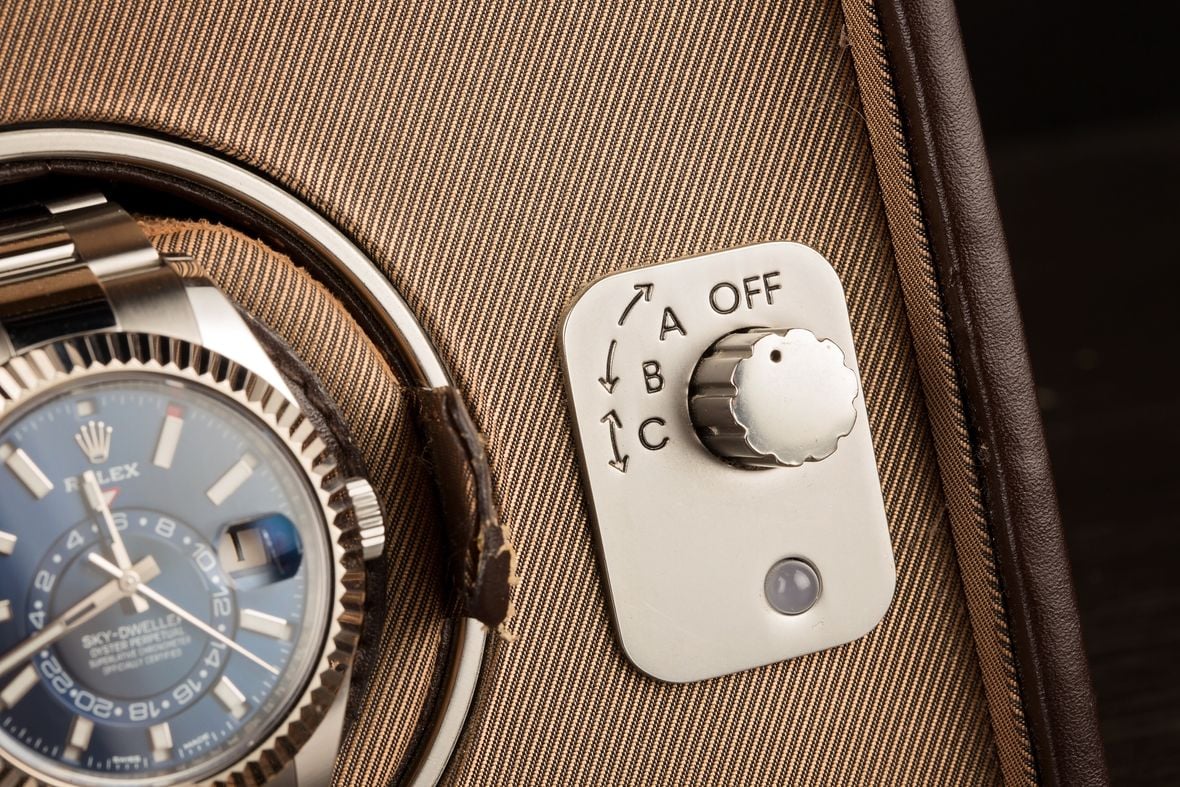
Do you need a watch winder for your Rolex? If it is a Submariner, Datejust, Explorer, GMT-Master II, or any other time-and-date model, you do not. Wear it, set it, enjoy it, and put the winder money toward its next service. If it is a Day-Date, a Sky-Dweller, or part of a collection you rotate, a programmable winder set to 650 turns per day, bidirectional, will keep every watch ready. If you are maintaining a watch you plan to part with, keeping it running and correctly set is a small courtesy to the next owner. Our team can walk you through what to expect when you sell your Rolex watch.