If you want to buy a Rolex Daytona in 2026, let me give you the same answer I give friends who call me asking for advice: the pre-owned market is the fastest way to obtain a Rolex, and you will almost certainly not get one at retail. Authorized dealer waitlists for the steel models stretch years, so most buyers, including plenty of seasoned collectors I know, purchase pre-owned. That makes your real decision a choice between four generations and a handful of metals, starting at roughly $19,000 for a two-tone reference and around $26,000 for a modern steel model in our pre-owned Rolex Daytona collection. I have spent more than two decades buying, selling, and collecting Daytonas, and in this guide I will walk you through every generation, what each costs today based on our own sales data, and which one I would point you toward given your budget and goals.
Key Takeaways
- The Daytona has four generations: manual wind (1963 to 1988), Zenith powered (1988 to 2000), the in-house caliber 4130 era (2000 to 2023), and the current caliber 4131 generation (2023 to present).
- Retail is effectively closed for most references, so I consider the pre-owned market the practical route for nearly every buyer.
- As of August 2026, a modern steel ceramic Daytona typically sells for $30,000 to $40,000 pre-owned, roughly double its $16,900 retail price.
- Two-tone and gold references are the value plays right now, often selling near or even below their 2026 retail prices.
- Rolex raised Daytona retail prices in January 2026, and I watched pre-owned steel prices move up alongside them.
- Condition and completeness matter: a full set with box and papers commands a real premium and is far easier to resell.
As mentioned in our Rolex buying guide, the Daytona is the most requested watch we deal in at Bob’s Watches, and also the one buyers have the most questions about. I get why: it is a serious amount of money, and everyone has heard a story about someone overpaying. The sections below give you the model landscape first, then my recommendations, current pricing, and the practical steps for getting one on your wrist.
The Rolex Daytona at a Glance
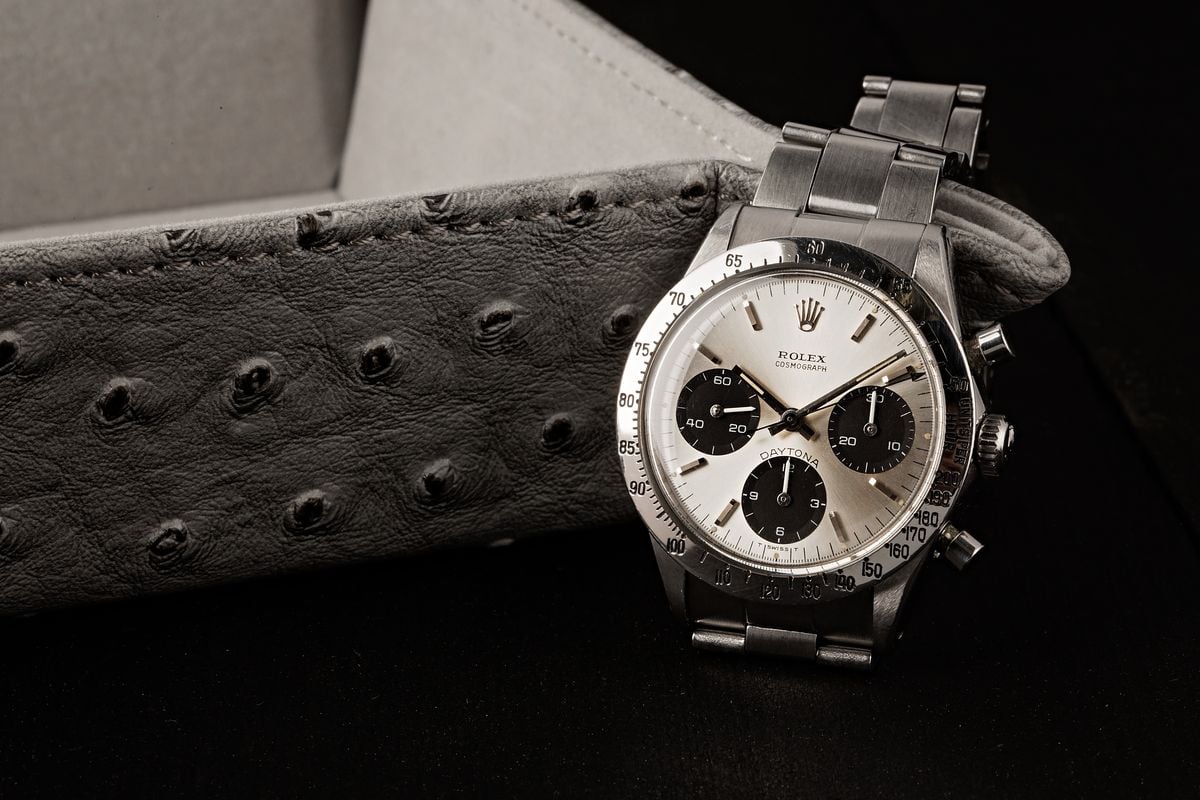
Rolex introduced the Cosmograph Daytona in 1963 as a driver’s chronograph, and for its first two decades it was a slow seller dealers struggled to move. I find that almost funny now, because today it is the most in-demand luxury chronograph in the world, and the references that once collected dust are auction stars. If you want the full story of how that happened, from the speedway origins to the Newman effect, we cover it in our complete history of the Rolex Daytona.
When someone asks me where to start, I always say the same thing: learn the generations first, because the generation determines the movement, the case, and the price bracket. Here is the map I keep in my head.
| Generation | Years | How to Identify |
| First (manual wind) | 1963–1988 | 4-digit references (6239, 6263, etc.), Valjoux movement, 37mm case |
| Second (Zenith) | 1988–2000 | 5-digit references (16520, 16523, 16528), caliber 4030, 40mm case |
| Third (in-house 4130) | 2000–2023 | 6-digit 116xxx references, caliber 4130 |
| Fourth (current) | 2023–present | 6-digit 126xxx references, caliber 4131 |
Rolex Daytona Models: The Four Generations
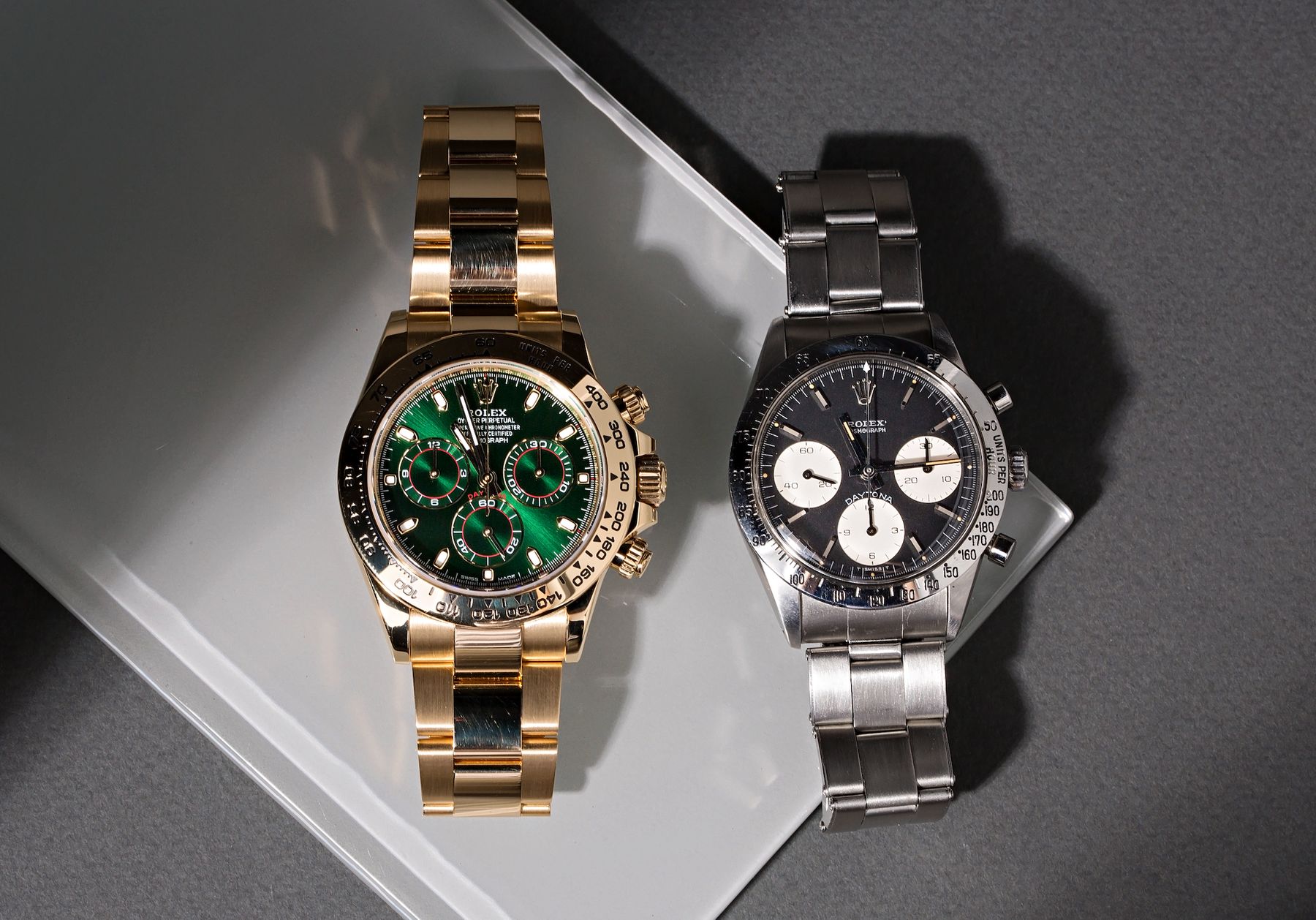
Every Daytona ever made falls into one of four families, and after handling thousands of them I can tell you each has its own personality on the wrist and in the market. Here is how I think about each generation and who I believe it is right for. If you want to go deeper on the calibers themselves, our guide to Rolex Daytona movements covers them in detail.
First Generation: The Manual Wind Era (1963 to 1988)
The original Daytonas are compact 37mm chronographs powered by hand-wound Valjoux movements, first the caliber 722 and later the 727. These are the references that built the legend: the 6239 with its engraved steel bezel, the 6263 with its black acrylic bezel and screw-down pushers, and the exotic dial variants collectors now call Paul Newman Daytonas. To me, these watches are the soul of the model, and honest original examples are scarce enough that prices reflect it.
The Newman story deserves its own paragraph because, in my experience, it still drives this entire market. Joanne Woodward gave Paul Newman a reference 6239 with an exotic dial in the late 1960s, and he wore it for years. When that exact watch crossed the auction block at Phillips in October 2017, it sold for $17.8 million, which at the time made it the most expensive Rolex wristwatch ever sold at auction. I remember exactly where I was when that hammer fell, and I knew the vintage Daytona market would never be the same. Our full guide to the Paul Newman Daytona covers how to identify a genuine exotic dial, which matters enormously, because the difference between a standard dial 6239 and a Newman dial 6239 is measured in hundreds of thousands of dollars. My verdict on this generation: it is for the committed vintage collector who values history over convenience and buys with expert authentication behind them.
Second Generation: The Zenith Era (1988 to 2000)
In 1988 Rolex finally gave the Daytona an automatic movement, but not one of its own. The caliber 4030 was built on the Zenith El Primero, which Rolex modified so heavily that only about half the original parts remained. The case grew to 40mm, sapphire crystal replaced acrylic, and the five-digit references arrived: the steel 16520, two-tone 16523, and yellow gold 16528. This is the generation where the Daytona waitlist was born, and demand has never let up since.
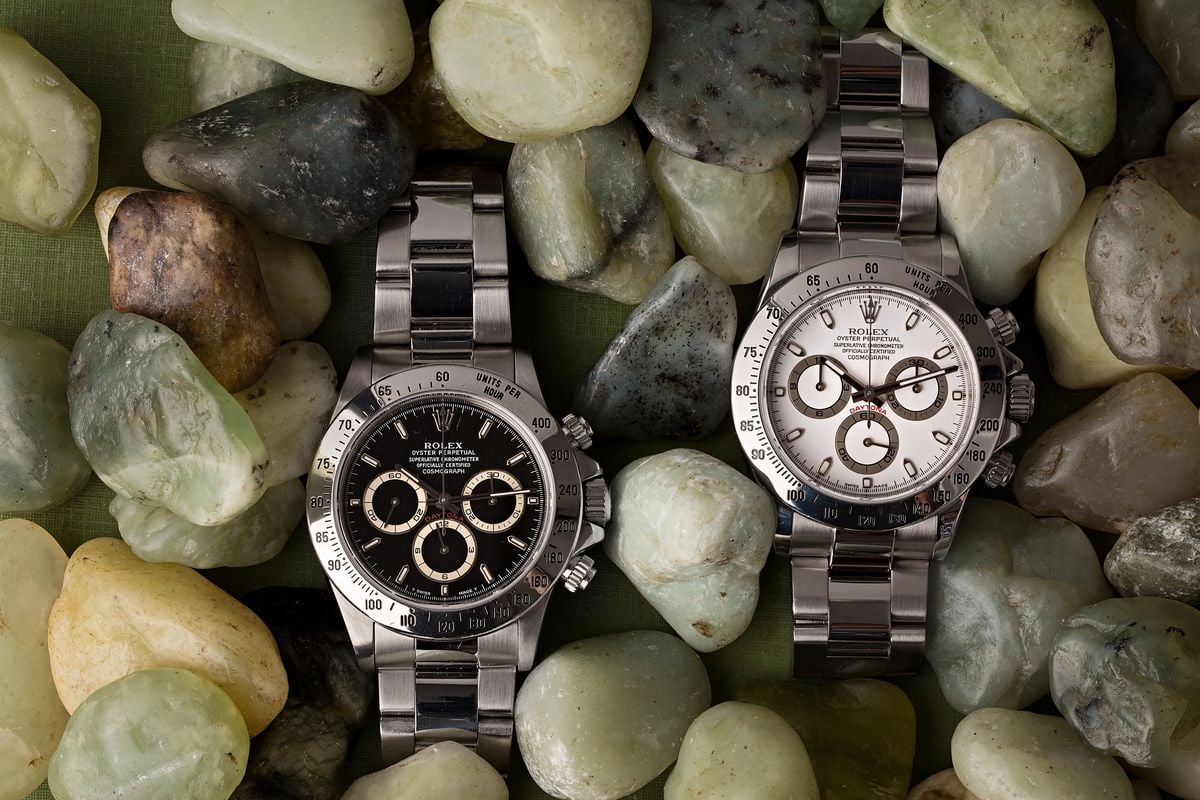
What stands out to me about Zenith Daytonas today is how much identification knowledge matters to the price. Early examples with the so-called floating dial or inverted 6 details carry real premiums, and I have watched two visually similar 16520s sell thousands of dollars apart on dial details alone. We break all of it down in our Zenith Daytona dial guide, which I consider required reading before buying one. My verdict on this generation: it is for the buyer who wants a vintage adjacent Daytona with modern wearability, at prices regularly under $30,000. I think they are still underrated.
Third Generation: The In-House Caliber 4130 Era (2000 to 2023)
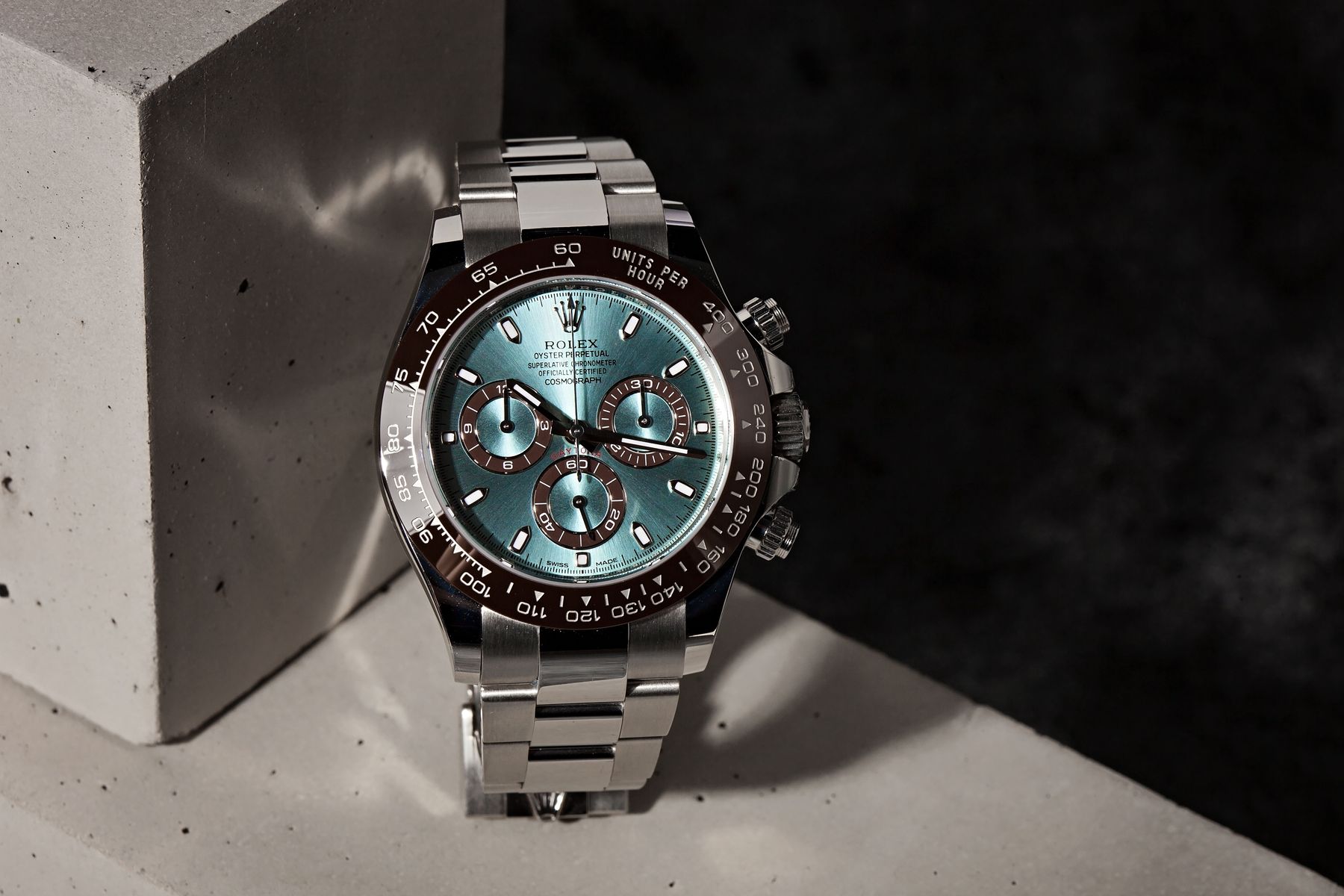
In 2000 Rolex introduced the caliber 4130, its first fully in-house chronograph movement, inside the six-digit 116xxx references. The 4130 used fewer components than the movement it replaced, added a 72-hour power reserve, and proved to be one of the most reliable chronograph calibers I have ever dealt with. This generation also gave us the watches that define the modern Daytona: the steel 116520, the ceramic bezel 116500LN that debuted in 2016 and ignited the panda dial craze, and a full range of gold and platinum models including the 50th anniversary platinum 116506.
This is what I belive to be the sweet spot for most buyers, and it is where most of our Daytona sales happen. The watches are modern in every way that matters, parts and service are straightforward, and the discontinued status means values have found a floor and started climbing again. My verdict on this generation: it is for the first-time Daytona buyer who wants the iconic look at the most sensible price, which is exactly why several of my picks below come from this family.
Fourth Generation: The Caliber 4131 Era (2023 to Present)
At Watches and Wonders 2023, Rolex launched the current Daytona generation, the 126xxx references, for the model’s 60th anniversary. I will admit that like many people, I assumed the 4130 would carry the Daytona for another decade, and an earlier version of this very guide called it the final iteration. Rolex proved us wrong. The new caliber 4131 adds the Chronergy escapement, a redesigned rotor, and refreshed bridge finishing, while the case gained a slimmer profile and a metal ring framing the Cerachrom bezel on steel models. The lineup includes the steel 126500LN, two-tone 126503, yellow gold 126508 and 126518LN, white gold 126509 and 126519LN, Everose 126505, 126515LN, and 126519 variants, and the platinum 126506, which introduced the first exhibition caseback on a production Daytona. Seeing a Daytona movement through sapphire still feels slightly rebellious to me, and I mean that in a good way.
Rolex has kept adding to this generation since. The white gold Le Mans 126529LN arrived in 2023 to mark the 100th running of the 24 Hours of Le Mans, and I consider this Daytona Le Mans model the most instantly collectible modern watch in the line-up. Meteorite dials returned to the gold Oysterflex references in 2025, and at Watches and Wonders 2026 Rolex unveiled the off-catalog Rolesium 126502, pairing an Oystersteel case with platinum elements and a Grand Feu enamel dial. My verdict on this generation: it is for the buyer who wants the newest engineering and the current reference, and who accepts paying the premium that “latest” always carries. Some days I am that buyer.
Which Daytona Should You Buy? My Verdicts
This is the question I get asked most, at dinners, at watch events, and in my inbox, and the answer depends entirely on who is asking. So instead of ranking references, here are my honest recommendations by buyer type, with current pricing from our own sales floor. All figures reflect our data as of August 2026.
The right first Daytona: the 116500LN. In my opinion, the ceramic bezel Daytona 116500LN collection is the smartest entry into modern Daytona ownership, and it is the reference I recommend more than any other. It has the same 40mm presence and panda dial charisma as the current model, the caliber 4130 is bulletproof, and it typically sells with us between $26,000 and $34,000 depending on dial color, versus $30,000 to $40,000 for the newer 126500LN. The white dial carries a premium over the black, a gap I have watched hold steady for years; our Daytona Panda dial guide explains why that configuration became the icon. What I would think twice about: if owning the current reference matters to you, the several-thousand-dollar jump to the 126500LN will nag at you every time you look at your wrist. Buy the one you will not second-guess. I learned that lesson the expensive way, more than once.
The value play: the two-tone 126503 or 116503. Here is what I consider the quiet secret of the Daytona market: while steel trades at double retail, the two-tone references sell close to their retail prices pre-owned. Buying a Daytona 116503 typically runs $19,000 to $24,000 with us, and even the current 126503 sits in the mid to high $20,000s, only modestly above its roughly $22,700 retail price. You get a gold bezel, crown, and pushers, real precious metal on the wrist, for less than any steel ceramic Daytona. I think two-tone is due for a broader comeback, and the Daytona version is the strongest argument for it. What I would think twice about: two-tone is a style commitment, and resale demand, while solid, will never match steel’s liquidity.
The investment case: modern gold on a bracelet. I want to be careful here, because I always tell customers to buy watches they love rather than watches they hope will appreciate. That said, the trend in our own data is clear, and I trust our data over any forum chatter: gold and two-tone Daytonas now make up a growing majority of the Daytonas we sell, and the January 2026 retail increases hit gold references hardest, which lifted the floor under pre-owned examples. White gold 126509 Daytona watches typically sells with us for $49,000 to $61,000, and the yellow gold 116508, especially with a green dial, remains one of the fastest movers we list. What I would think twice about: gold prices are elevated right now, and I suspect some of the current premium rides on that.
The vintage entry point: the Zenith 16520. If vintage character calls to you but a six-figure manual wind Daytona does not, the 16520 is my answer. It typically sells with us in the high $20,000s, it wears like a modern watch, and the collector interest in dial variations gives it genuine upside for the studious buyer. For those priced out of the Daytona entirely, this is where I point people before suggesting alternatives to the Rolex Daytona. What I would think twice about: servicing is more specialized than the in-house calibers, and originality issues, especially swapped bezels and refinished dials, require careful vetting. I have passed on more 16520s than I have bought.
The one I would personally choose: the 6263. If I could only own one Daytona, it would be a vintage Rolex Daytona 6263 with a black bezel and screw-down pushers. I have handled examples that stopped me mid-sentence. It is the reference that, to me, best captures what the Daytona was actually for, and clean examples have benchmark status in the vintage market, typically trading with us from around $70,000 to the mid $90,000s depending on dial and condition. Every serious collection I admire has one. What I would think twice about: at this level, provenance and originality are everything, so buy the seller as much as the watch.
Those are my verdicts for matching a Daytona to a buyer. If you want the ranked breakdown instead, where we compare every current and discontinued reference head to head, we rank them all in our guide to the top Rolex Daytona models.
What You’ll Pay for a Rolex Daytona
Daytona pricing splits into two worlds: the retail prices Rolex publishes, and the pre-owned market where nearly all the actual transactions happen. The table below shows both for the references buyers ask me about most. Retail figures reflect Rolex’s 2026 US list prices; pre-owned ranges come from our own completed sales, data as of August 2026.
| Reference | Retail (2026) | Typical Pre-Owned Range at Bob’s |
| 126500LN (steel) | $16,900 | $30,000–$40,000 |
| 126503 (two-tone) | ~$22,700 | $25,500–$29,000 |
| 126509 (white gold) | ~$59,100 | $49,000–$61,000 |
| 126506 (platinum) | ~$84,600 | $100,000+ |
| 116500LN (steel, disc.) | Discontinued | $26,000–$34,000 |
| 116503 (two-tone, disc.) | Discontinued | $19,000–$24,000 |
| 116508 (yellow gold, disc.) | Discontinued | $40,000–$54,000 |
| 116509 (white gold, disc.) | Discontinued | $41,000–$51,000 |
| 16520 (Zenith steel) | Discontinued | $27,000–$30,000 |
| 6263 (vintage) | Discontinued | $70,000–$95,000 |
Bob’s Market Data (as of August 2026): A few things I am watching in our own numbers. Pre-owned steel prices climbed steadily this past year, with the 126500LN’s typical selling price up roughly 10 to 12 percent over the past 12 months, and I saw a clear step up after Rolex’s January 2026 retail increase raised the steel Daytona from $16,000 to $16,900. Two-tone and gold on bracelet references have been our fastest sellers, with the 126503 and gold 126509 typically finding buyers within about a week of listing, faster than the steel ceramic models, which surprises people every time. And the mix itself is shifting: precious metal and two-tone references now account for a growing majority of the Daytonas we sell. As Joe Alessindrini, our CFO, puts it:
“The steel Daytona premium gets the headlines, but the real movement this year has been in gold. Retail increases in January have reset the floor, gold prices kept climbing, and pre-owned values followed. The two-tone references are the outlier, and for buyers, this might be an opportunity.”
Joe Alessindrini, CFO at Bob’s Watches
For a deeper year-by-year price history, see the market study on our Rolex Daytona collection page.
How to Actually Get One
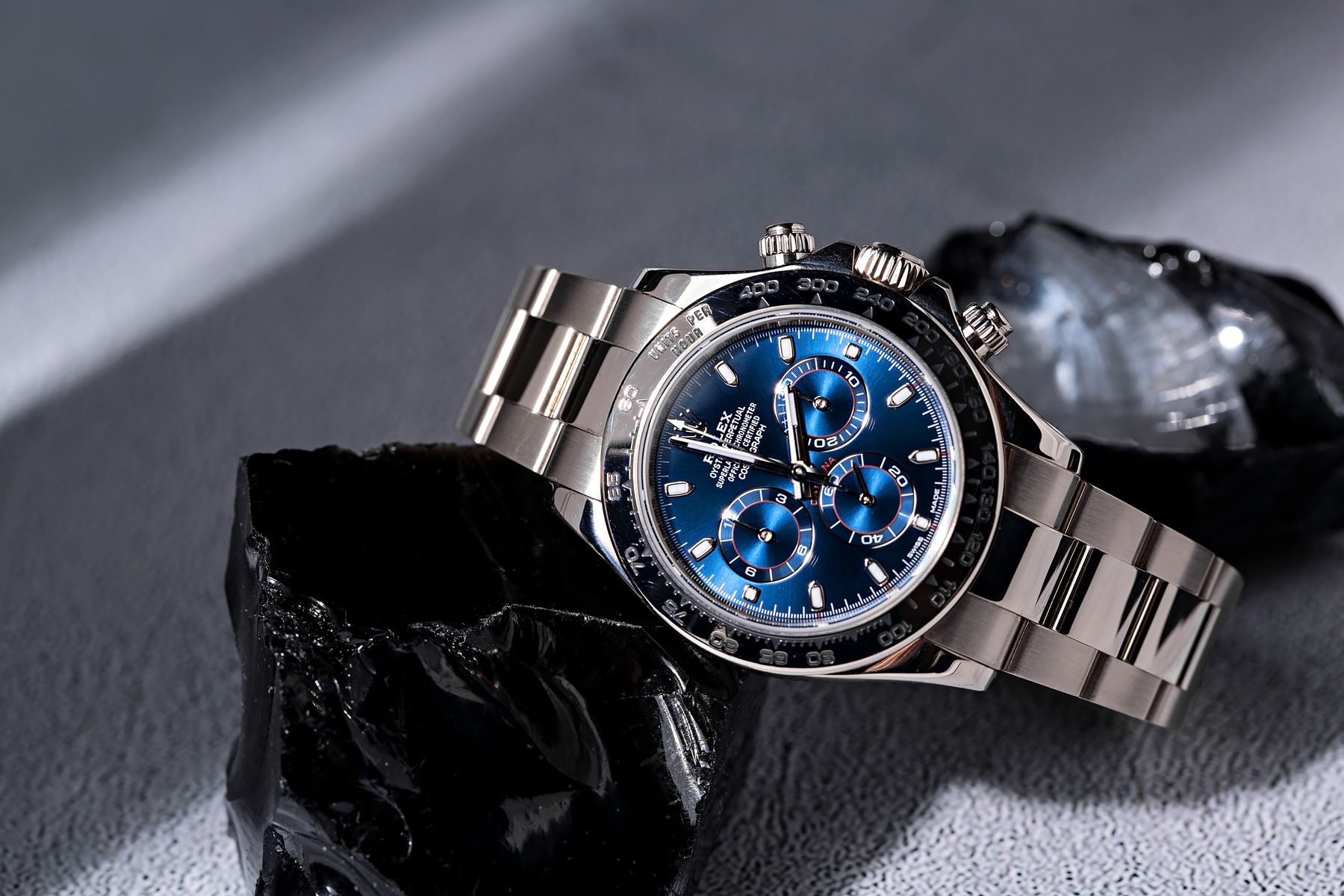
The authorized dealer route is not impossible, but I will not pretend it is realistic for most people. Steel Daytona allocations go overwhelmingly to established clients with purchase history, and even strong candidates wait years. If you walk into a boutique cold and ask for a 126500LN, you will leave with your name on a list and no timeline. That is not a criticism of the dealers; it is simple arithmetic when demand outruns supply by this much.
Pre-owned is the practical route, and after twenty-plus years of doing this, my advice comes down to a few disciplines:
- Buy a full set when you can. Box, papers, and warranty card add real value, typically a couple thousand dollars on modern references, and make the watch far easier to sell later. I always pay up for a full set myself.
- Verify condition honestly. Unpolished or lightly polished cases with crisp lugs command premiums. Heavy polishing permanently costs value, and I can spot it from across a room.
- Match the price to the specific watch. Dial color, production year, and completeness move the number. Two watches with the same reference can fairly differ by thousands.
- Buy from someone who guarantees authenticity. The counterfeits I see today are good enough that this step is not optional. Our guide on how to spot a fake Rolex shows what convincing fakes now look like.
On that last point, let me tell you what our authentication team actually checks on every Daytona that comes through our doors: the pusher threads and feel, because counterfeit chronograph pushers rarely match Rolex’s action; the rehaut engraving alignment; the caseback interior markings; and, always, the movement itself, with extra scrutiny on the Valjoux era pieces where redials and swapped parts are most common. Carol Altieri, our COO, oversees that process, and she puts it plainly:
“No Daytona goes up on the site until it has been opened, inspected, and verified. The movement tells you a lot about a watch. A redialed or pieced-together Daytona almost always gives itself away under the caseback.”
Carol Altieri, COO of Bob’s Watches
Key Terms Worth Knowing
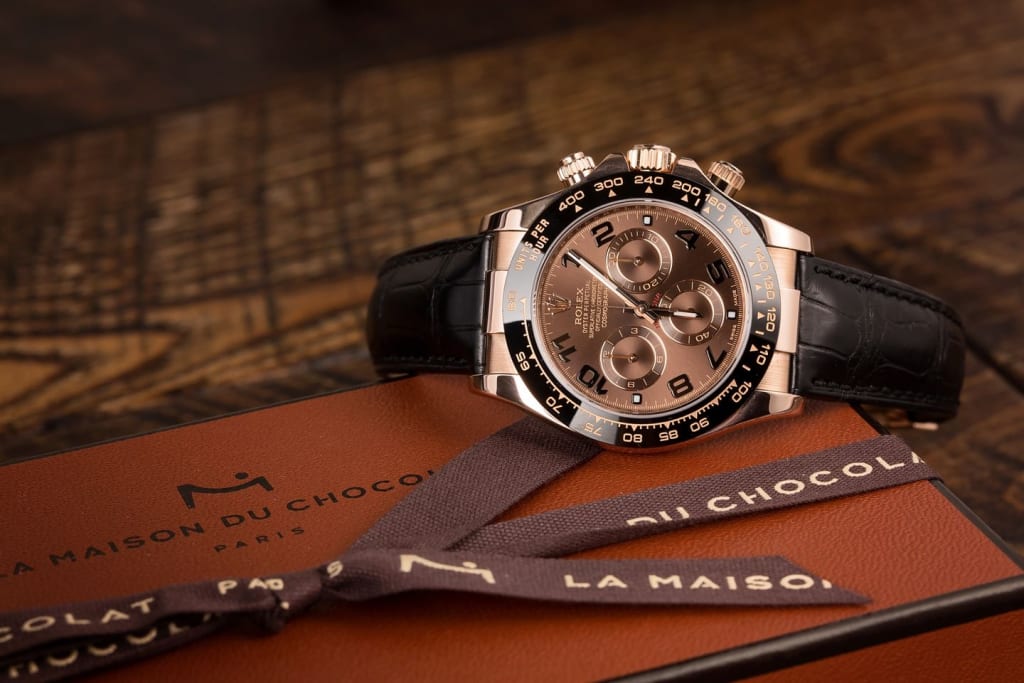
A few terms come up constantly in Daytona listings, and I want you fluent in them before you spend this money. The tachymeter is the scale on the bezel used to calculate speed over a measured distance, the feature that ties the Daytona to motorsport and, to my eye, gives the dial its purpose. Cerachrom is Rolex’s proprietary ceramic, used for the scratchproof black bezels on modern models; I consider it one of the best practical upgrades Rolex ever made. Oysterflex is Rolex’s elastomer bracelet with a metal blade inside, found on the modern gold sport references, and more comfortable than people expect. An exotic dial, known to collectors as a Paul Newman dial, is the Art Deco style dial variant on certain vintage references with square-marked subdials. And Rolesor is Rolex’s name for its two-tone steel and gold construction, the format of the 126503 I praised above.
Buying Your Rolex Daytona with Confidence

After all the references and price tables, I believe the decision framework is simpler than it looks. Decide your generation first, because that sets your budget bracket and your relationship with the watch: vintage for history, Zenith for character, 116xxx for value, 126xxx for the current state of the art. Then choose your metal with honest self-knowledge about what you will actually wear, remembering that steel costs more than gold logic says it should, and that the two-tone references remain, in my opinion, the quiet bargains of the entire lineup. Buy the best condition example you can afford, insist on authentication, and favor a full set. Do those things and it is genuinely hard to go wrong.
And if you already own a Daytona and are weighing an upgrade or a change, you are in a strong position, because the same demand that makes these watches hard to buy makes them easy to sell. You can sell your Rolex Daytona with us and put its current market value toward the next one. However you get there, the Daytona is one of the few watches I recommend with total confidence. In my experience, most people never let them go.