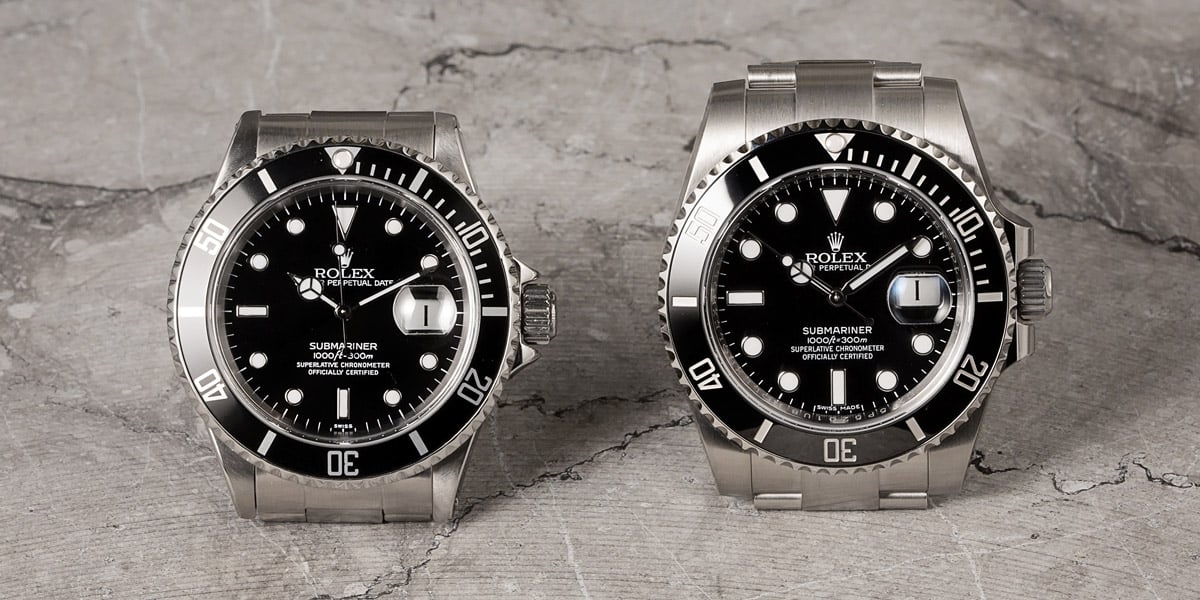
The difference between Rolex Sea-Dweller vs Submariner comes down to factors like size, depth rating and even professional diving features. Both are luxury dive watches. However, the Submariner is the more versatile, everyday choice at 41mm, while the Sea-Dweller is the larger, professional-grade 43mm dive watch. The latter features a Helium Escape Valve for deep saturation diving, enabling it to perform beyond mere recreational diving.
Key Takeaways:
- Case Size: The Submariner measures 41mm. The Sea-Dweller is 43mm, which gives it a noticeably bolder look on the wrist.
- Water Resistance: The Submariner is rated to 300 meters (1,000 feet). The Sea-Dweller goes to 1,220 meters (4,000 feet). That’s more than four times deeper.
- Helium Escape Valve: Only the Sea-Dweller has Rolex’s patented Helium Escape Valve, a critical feature for professional saturation divers.
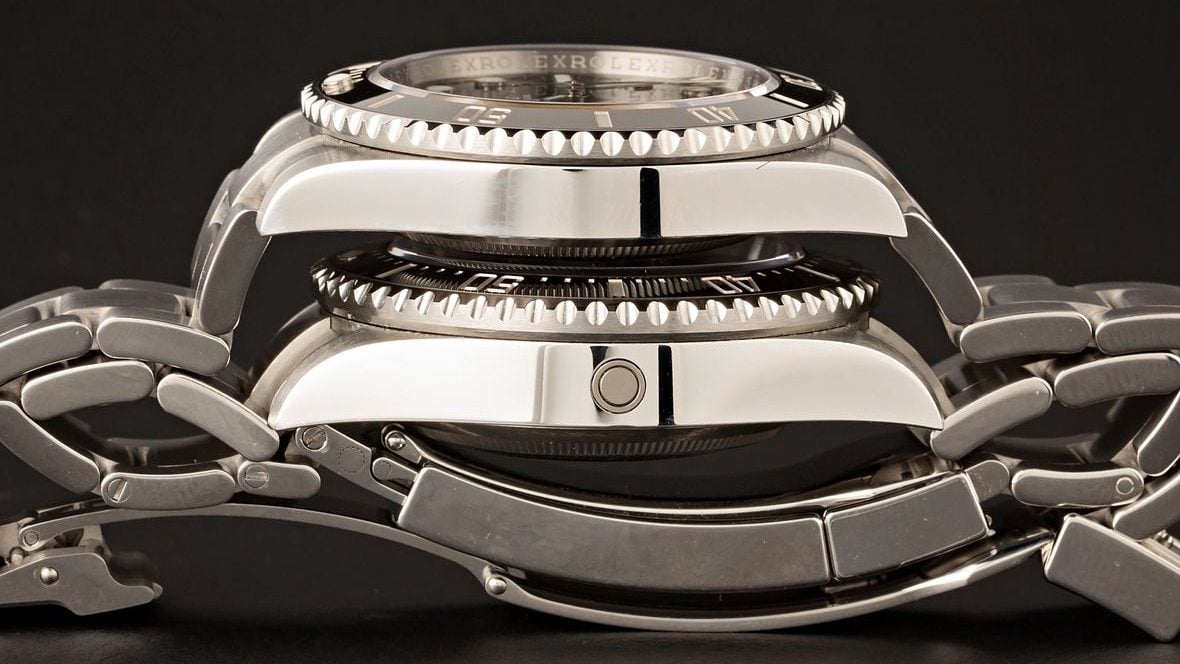
- Wrist Feel: At roughly 12mm thick, the Submariner fits comfortably under a dress shirt cuff. The Sea-Dweller is heavier and commands more wrist real estate at 15mm thick.
Factors like wrist size, lifestyle, and personal preference matter when choosing between the Sea-Dweller and Submariner. Both benefit from Rolex’s rich dive watch heritage. What it really comes down to is their dimensions, overall engineering, and market position. We’ll break it down in this guide by looking at pricing, popularity, long-term value, and even their unique proportions.
Core Differences at a Glance: Sea-Dweller vs Submariner

Before we get too far into it, here’s a side-by-side snapshot of how the modern Submariner (reference 126610) and the modern Sea-Dweller (reference 126600) compare across the specs that matter most.
| Feature | Submariner (126610) | Sea-Dweller (126600) |
| Case Size | 41mm | 43mm |
| Thickness | ~12mm | ~15mm |
| Water Resistance | 300m (1,000 ft) | 1,220m (4,000 ft) |
| Helium Escape Valve | No | Yes |
| Crystal | Sapphire with Cyclops | Sapphire with Cyclops (added in 2017 ref. 126600) |
| Bezel | 60-min, first 15 min graduated | Fully graduated 60-minute scale |
| Movement | Caliber 3235 | Caliber 3235 |
| Power Reserve | ~70 hours | ~70 hours |
| Target Audience | Everyday wearer, recreational diver | Professional diver, collector seeking bold presence |
Both watches are powered by Rolex’s caliber 3235, which gives you about 70 hours of power reserve, so performance-wise they’re on equal footing. It’s more about the case itself. The Submariner is thinner and easier to wear every day. It slides under a cuff and never feels over-the-top. The Sea-Dweller is much thicker, mainly because it has to accommodate the Helium Escape Valve and is developed to handle deeper, more demanding conditions. On the wrist, the Deepsea feels more robust. But that’s exactly why some collectors prefer it over the Sea-Dweller.
History and Purpose: Why Did Rolex Create Both?
Rolex developed the Submariner and Sea-Dweller decades apart, each designed to meet the needs of different types of divers. Taking a look at their origins explains why both models continue to exist in the modern Rolex lineup.
The Birth of the Submariner

Rolex released the Submariner in 1953 as a dedicated diver’s tool watch. It featured a rotating timing bezel and a waterproof Oyster case, providing divers with a reliable instrument for tracking elapsed time underwater.
It came to market during the same era when diving was becoming more mainstream and accessible. The Submariner quickly established itself as the standard across the board for professional dive watches, thanks to its durability and excellent underwater legibility. Its design proved so effective that it became the template for nearly every dive watch that followed.
The Submariner eventually evolved. Its balanced proportions, clean dial, and timeless appearance made it equally suitable for everyday wear, transforming it into one of the most recognizable luxury watches ever produced.
The Sea-Dweller and Saturation Diving

The Sea-Dweller was developed in the 1960s in collaboration with Compagnie Maritime d’Expertises(COMEX), a French company specializing in commercial deep-sea diving. Unlike recreational divers, COMEX divers worked in pressurized environments for extended periods, breathing gas mixtures that included helium.
Helium molecules are small enough to penetrate watch seals during prolonged exposure. When divers returned to normal atmospheric pressure, the trapped helium inside the watch could expand, popping the crystal off the case.
Enter the Helium Escape Valve (HEV). This one-way valve allows trapped helium to escape safely during decompression, preventing damage to the watch. The Sea-Dweller’s thicker case and increased depth rating made it capable of surviving these extreme conditions, positioning it as a true professional dive instrument.
Case Size, Thickness, and On-the-Wrist Feel
Specs are important. But it’s the way a watch feels on the wrist that really matters, and the Sea-Dweller and Submariner have two very different wrist-wearing experiences.
The Submariner: 41mm of Versatility

The modern Submariner (reference 126610) wears like a watch Rolex has spent 70 years perfecting. At 41mm wide and about 12mm thick, it sits flat and balanced on the wrist. When Rolex updated the case in 2020, they slimmed down the lugs and widened the bracelet to 21mm, which gave the whole package a smoother, more tapered feel compared to the boxier “Super Case” of the 116610 generation. The diameter technically grew from 40mm. But the new Sub actually feels a bit more compact because of those proportional changes.
You can slide it under a shirt cuff without a second thought. It works with a suit, a t-shirt, or a wetsuit. That kind of range is hard to find in a 41mm sport watch, and it’s a big part of why the Submariner stays at the top of most people’s list when they’re shopping for one Rolex that can do everything.
The Sea-Dweller: 43mm of Bold Presence

The modern Sea-Dweller (reference 126600) is a different animal entirely. At 43mm wide, roughly 15mm thick, and with a lug-to-lug span around 50mm, you feel it the moment it goes on your wrist. That thickness comes straight from the engineering required for 1,220 meters of water resistance and the Helium Escape Valve. This isn’t a subtle watch, and it’s not trying to be.
Rolex did refine the lug proportions on the 126600 to keep it wearable, though. On average to larger wrists (roughly 7 inches and up), the Sea-Dweller sits well and doesn’t overhang the way some sport watches do. It’s heavier than the Submariner and rides higher off the wrist, which gives it a more industrial, tool-watch feel that a certain type of collector gravitates toward.
Dial, Bezel, and Aesthetic Differences
Although they’re very similar, some features distinguish the Submariner from the Sea-Dweller. For starters, the Sea-Dweller has a bright red “Sea-Dweller” logo on the dial in homage to the vintage “Double Red” Sea-Dweller. The Submariner, on the other hand, has all white text.
Looking at the bezel, the Sea-Dweller features a full set of 60-minute hashes for more precise timekeeping. The Submariner also has a 60-minute bezel but minute hash marks on only the first 15 minutes. Both current production watches have a Cyclops over the date, but this feature was only recently added to the Sea-Dweller in 2017. Earlier Sea-Dweller models lacked it, contributing to their cleaner dial appearance.
Vintage Showdown: Rolex Sea-Dweller 16600 vs Submariner 16610

If you collect vintage Rolex, the matchup between the Sea-Dweller 16600 and the Submariner 16610 is one of the more fun debates in the hobby. Both watches shared a 40mm Oystersteel case and ran on the Caliber 3135 movement, so the size gap that separates the modern versions didn’t exist. On the wrist, they wore almost identically.
The differences were more subtle. The Sea-Dweller 16600 (often called the “Sea-Dweller 4000” after its 4,000-foot depth rating) had a slightly thicker case back for the Helium Escape Valve and, most notably, skipped the Cyclops magnifier over the date window. That gave the 16600 a cleaner, more symmetrical dial that a lot of collectors find more visually balanced. That no-Cyclops look, paired with the model’s deep-sea pedigree, has turned the 16600 into a favorite among enthusiasts who value understated design and Rolex’s tool-watch roots.
The Deepsea Factor: Expanding the Heavyweight Lineup

The difference between the Rolex Deepsea vs Sea-Dweller vs Submariner is three different tiers of dive watch capabilities:
- Submariner (126610): This is the everyday pick. It’s 41mm and with 300 meters of water resistance, so it handles the office, the beach, and everything in between.
- Sea-Dweller (126600): The professional middle ground. At 43mm with 1,220 meters of water resistance and the Helium Escape Valve, it bridges recreational diving and serious deep-water work.
- Deepsea (136660): The heavyweight. At 44mm wide and close to 18mm thick, it uses Rolex’s Ringlock case system and goes to 3,900 meters (12,800 feet). It’s meant for the most extreme diving conditions out there, and the size on your wrist reflects that.
For most people, the real decision is between the Submariner and the Sea-Dweller. The Deepsea appeals to a narrower crowd: collectors who love the heft, or those who simply want the most robust Rolex dive watch money can buy.
Pricing, Popularity, and Resale Value

The Submariner and Sea-Dweller tell two very different stories when you look at how each performs on the market. The Submariner is one of the most popular luxury watches on Earth. Its 41mm case, slim profile, and clean design work for just about everyone, from first-time Rolex buyers to serious collectors. That broad appeal drives huge demand. Over a decade of sales data tracked through Bob’s Watches shows that stainless steel Submariners are more popular than stainless steel Sea-Dwellers by a ratio of over 3.5 to 1. In 2021, at the height of the market boom, Submariner transactions outnumbered Sea-Dweller transactions by more than four to one.
When it comes to resale, the Submariner has historically held a stronger premium relative to its retail price. The Sea-Dweller costs more at MSRP because of its added engineering, but the bigger case narrows its buyer pool. Fewer potential buyers means the Sea-Dweller doesn’t typically see the same level of secondary-market markup that the Submariner pulls. Still, the Sea-Dweller remains a Rolex with solid resale value, and its niche status means it tends to fly under the radar next to its more famous sibling.
Market Trends: A Decade of Pre-Owned Prices
Pre-owned pricing data from Bob’s Watches shows just how much the market has shifted for both watches over the past decade. Back in 2015, the average pre-owned stainless steel Submariner sold for around $6,400, while the average Sea-Dweller went for roughly $8,000, a gap of about $1,600. Both models climbed steadily from there, then took off during the 2020 and 2021 watch market boom.
Prices for both hit their highest price in 2022. The average stainless steel Submariner hit about $14,800, a gain of over 130% from 2015. The Sea-Dweller topped out around $16,000, up roughly 100% from its 2015 average. Both have started to normalize a bit more since then. As of early 2025, the average pre-owned Submariner sits near $13,700, while the average Sea-Dweller hovers around $14,500. The gap between them, which once ran as high as $3,500 in 2018, has narrowed considerably. Buyers today are paying a much smaller premium for the Sea-Dweller’s added engineering on the secondary market than they were just a few years ago.
Average Pre-Owned Price by Year (Stainless Steel Models, Bob’s Watches Data
| Year | Submariner Avg | Sea-Dweller Avg |
| 2015 | $6,374 | $7,954 |
| 2016 | $6,178 | $9,031 |
| 2017 | $6,809 | $9,302 |
| 2018 | $8,151 | $11,214 |
| 2019 | $9,028 | $11,504 |
| 2020 | $11,063 | $12,283 |
| 2021 | $14,103 | $14,420 |
| 2022 | $14,835 | $16,032 |
| 2023 | $13,571 | $14,185 |
| 2024 | $13,344 | $13,706 |
| 2025 | $13,664 | $14,500 |
The Submariner’s percentage growth from 2015 to its 2022 peak (roughly 133%) outpaced the Sea-Dweller’s (about 102%). Those numbers prove the Submariner’s wider demand. At the same time, the narrowing price gap suggests the Sea-Dweller may offer stronger relative value right now. You’re getting more watch, more depth rating, and more case for a comparatively modest premium. It’s also worth noting that both models have held up well since the 2022 correction, leveling out in the $13,500 to $14,500 range instead of continuing to slide. That kind of price stability is unusual in the luxury watch market and says a lot about the lasting demand for Rolex’s core sport models.
Other Alternatives: GMT-Master II and Yacht-Master

If neither the Submariner nor the Sea-Dweller feels like the right fit, two other Rolex sport models deserve a look. The Yacht-Master shares a similar aesthetic with the Submariner but goes heavier on luxury, with options in Rolesor (two-tone steel and gold), Everose gold, and platinum. It’s a nautical watch built for life above the waterline rather than deep diving. If you love the look of a sport Rolex but want something dressier, the Yacht-Master is a natural choice.
Then there’s the GMT-Master II, which is especially appealing if you travel often. It shares the Submariner’s 40 to 41mm case profile and sporty DNA, but adds a dual-time-zone complication with an independently adjustable 24-hour hand and a rotating bezel calibrated for a second time zone. If timekeeping across time zones matters more to you than diving depth, the GMT-Master II is well worth a look.
Deciding Between the Rolex Submariner and Sea-Dweller

Really, it comes down to how the watch feels on the wrist and how you plan to wear it. If it’s versatility you’re after, the Submariner is the safest bet. It’s smaller, at 41mm, and has a slim profile. If you prefer larger watches, the Sea-Dweller is in a league of its own, plus it has serious deep saturation credentials. With the pre-owned price gap between these two narrower than ever before, the choice today is less about budget and more about which watch genuinely fits your wrist and your life.
Some people gravitate toward the Submariner because it’s versatile, while others prefer the Sea-Dweller’s more substantial, tool-watch aesthetics. At Bob’s Watches, every Rolex we sell is fully authenticated, making it easier to find the right dive watch for your wrist. Explore our collection today and discover the dive watch you’ll wear for a lifetime.