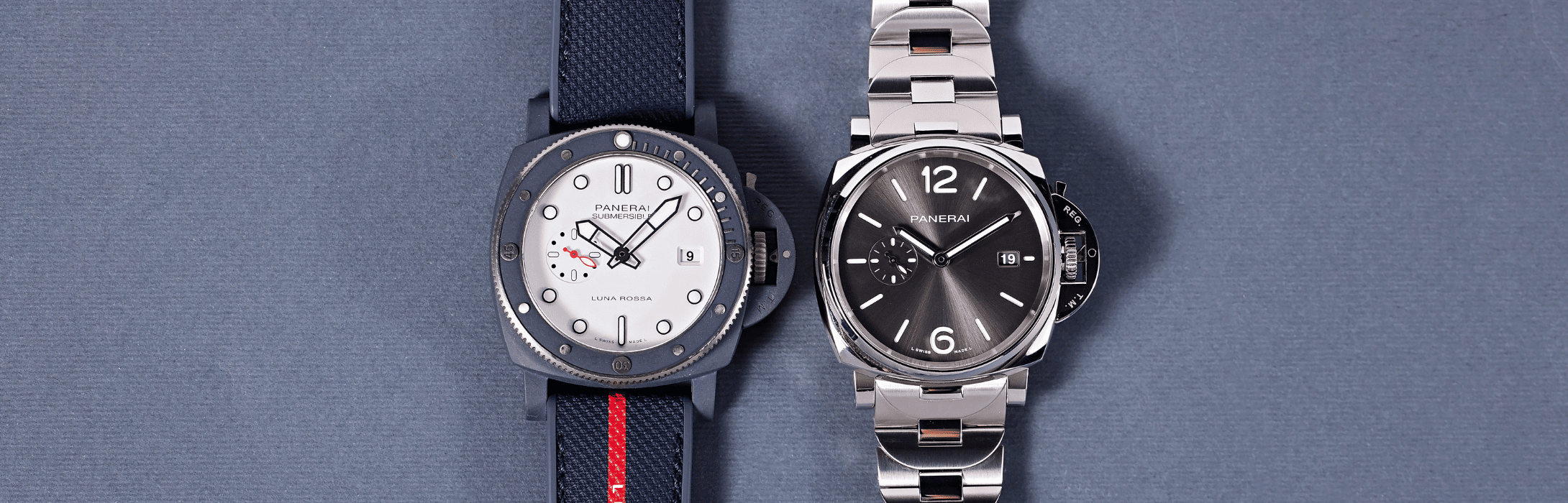

Panerai watches do not hold value as strongly as Rolex or Patek Philippe when comparing retail to pre-owned prices. Buying pre-owned is recommended to avoid first-owned depreciation. When buying a Panerai, keep in mind that modern Panerai watches might lose some of their retail price soon after they leave the boutique. Rare reference numbers, limited editions, and select vintage pieces are a different story, and many of them hold steady or climb in value over the years. This guide walks through the market forces at play, how each model line performs, and the buying habits that protect your money.
Key Takeaways
- Average retention: Standard modern Panerai models keep roughly 60% to 80% of their retail value once they settle on the secondary market.
- The investment outliers: Pre-Vendôme pieces, limited editions such as the Bronzo, and the core Luminor references hold their value the best.
- Secondary market advantage: Buying secondhand skips the steep first drop in value, which puts collectors in a stronger position from the start.
- Core value drivers: Limited production numbers, naval history, and the signature crown protecting bridge keep the brand collectible.
The space between retail pricing for luxury watches and real secondary market prices is where most buyers either gain or lose. Once you understand that gap, the Panerai market becomes far easier to read.
The Financial Reality of Panerai Value Retention

Panerai value works differently from what the retail catalog suggests. The number on the boutique tag is rarely the number a watch holds once it changes hands, and that difference shapes every smart buying decision. The two sections below separate retail performance from secondary market behavior, then place Panerai next to its closest rivals so the data has context.
Retail vs. Secondary Market Performance
A Panerai at retail takes its biggest hit the moment it leaves the authorized dealer. That first drop, often in the range of 20% to 40%, reflects the markup built into retail pricing rather than any weakness in the watch itself. Boutique prices carry the cost of marketing, distribution, and the experience of buying new, none of which transfers to the next owner.
The secondary market is the true baseline of a Panerai’s financial strength. Once a model finds its used price, it tends to settle there with far less movement than that first year of ownership would suggest. A buyer who steps in at this point owns the same watch without paying for the depreciation that the first owner already absorbed. That is the practical reason so many collectors treat the pre-owned market as the starting line rather than a discount aisle.
Key Factors That Determine If a Panerai Holds Its Value

Throughout the history of Panerai watches, a handful of clear factors have decided whether a given Panerai keeps its worth or slides on the secondary market. Knowing them turns guesswork into a checklist you can run before you buy.
- The era of production (Pre-Vendôme vs. Richemont): Watches built before the Vendôme Group, later folded into Richemont, acquired Panerai in 1997 sit in the prized Pre-Vendôme era. These early pieces were made in tiny numbers and carry premium value among serious collectors.
- Production scarcity and limited editions: Panerai leans on numbered, capped runs, sometimes only a few hundred or a thousand pieces. Limiting supply this way keeps secondary market prices healthy and gives certain references real staying power.
- Case material: Stainless steel and standout materials like bronze and Carbotech hold value far better than precious metals. Yellow and white gold models tend to suffer steeper drops, since the buyer pool for a heavy gold Panerai is smaller.
- Condition, box, and papers: The collector base is exacting, so a missing warranty card or original box can cut secondary market value by 15% to 25%. Complete sets sell faster and for more.
Model Analysis: Which Panerai Watches Keep Their Value Best?
Not every Panerai behaves the same way once it hits the used market. Some lines draw a deep, steady pool of buyers, while others appeal to a narrower group and move more slowly. The three sections below break down the main collections by how reliably they hold value.
The Panerai Luminor Series (The Safe Bet)

The Panerai Luminor is the model line that retains value most consistently. Its locking lever over the crown, the bridge that protects the winding crown, is the single most recognizable feature in the catalog, and that identity gives it the broadest demand of any Panerai family. When buyers picture the brand, they picture a Luminor.
Base references carry this line. The PAM 000, the PAM 111, and the PAM 1312 are the kind of clean, classic steel pieces that always find a buyer. Because they sit at the center of what people expect from Panerai, they tend to hold a stable secondary market baseline rather than drifting downward over time.
The Panerai Submersible (The Growing Collector Favorite)

The Panerai Submersible started as part of the Luminor family and grew into its own standalone line, and collector interest has climbed alongside it. The build made for diving and the rotating bezel give it a clear purpose, which helps it hold demand.
The bronze references are the standout case for appreciation. The PAM 382 Bronzo launched in 2011 with a retail price around $11,000 and a run of 1,000 pieces. It was slow to catch on at first, since some buyers were unsure about a case that changes color as it ages. That patina became the draw, and today clean examples regularly trade well above $25,000. Low production and a unique aging effect turned the Bronzo into one of the brand’s clearest value stories.
The Panerai Radiomir & Luminor Due (Steeper Depreciation)

The Panerai Radiomir and the Luminor Due depreciate more sharply than the core lines, each for its own reason. The Radiomir wears its vintage roots openly, with wire lugs and a clean cushion case that echoes the brand’s earliest pieces. That look appeals to a specific audience, so the watches move more slowly on the secondary market even when they are well made.
The Panerai Luminor Due takes the opposite approach. Its slimmer profile and reduced water resistance make it easier to wear, but those same traits push it away from what brand purists expect, and that distance shows up as faster retail depreciation. Both watches can be excellent buys at the right price, but neither holds value the way a standard Luminor does.
Why the “Paneristi” Collector Community Is a Core Value Driver

Few brands have a community as defined as the Paneristi, one of the earliest and most devoted groups to form around a watch on the internet. Long before online forums were common for luxury goods, Panerai owners were gathering to trade knowledge, track references, and debate the smallest details of dial layout and lume. That early start gave the brand a built-in base of informed buyers who still shape the market today.
This community creates a stable, somewhat closed marketplace that keeps prices firm. Their focus on historically correct features, such as sandwich dials, plexiglass crystals, and the warm glow of vintage tritium lume, decides which references stay expensive and which fade. When a group of serious buyers agrees that a specific configuration is the one to own, that agreement becomes a price floor. In practice, the Paneristi act as both the brand’s historians and its most reliable market for resale.
Owning a Panerai Without Losing Money

Buying a Panerai with resale in mind comes down to a short, repeatable process. Follow these three steps and you put yourself in a secure position from the day the watch arrives.
- Prioritize the secondary market first. Look for a mint condition, pre-owned reference from a trusted dealer. This lets the original owner absorb the first 20% to 30% drop in retail value, which puts you in a much stronger spot if you ever decide to sell.
- Demand full box, papers, and accessories. Never settle for incomplete documentation. Check that the serial numbers match across the movement stickers, the warranty card, and the outer boxes, and hold onto the original strap change tools, since collectors pay more for a complete kit.
- Stick to classic steel references. When in doubt, choose a 44mm or 47mm stainless steel model with a black sandwich dial and a manually wound movement. These core traits represent the heart of the brand and draw the largest pool of buyers.
Smart Luxury Watch Ownership Over Time

Protecting your watch over the years is mostly about leaving it alone. Keep it serviced and stored well, but avoid aftermarket polishing, which shaves down the crisp edges of the cushion case. Collectors prize the original geometry of a case far more than a surface free of small scratches, so a watch that wears its honest marks often sells better than one that has been polished too heavily.
The healthiest way to view a Panerai is as an investment in design, wrist presence, and history rather than a pure financial tool. Bought intelligently on the secondhand market and kept complete with its box and papers, a Panerai can deliver a world-class timepiece you actually wear while holding its own across changing market cycles. That balance, real enjoyment with limited downside, is what makes the brand worth owning.