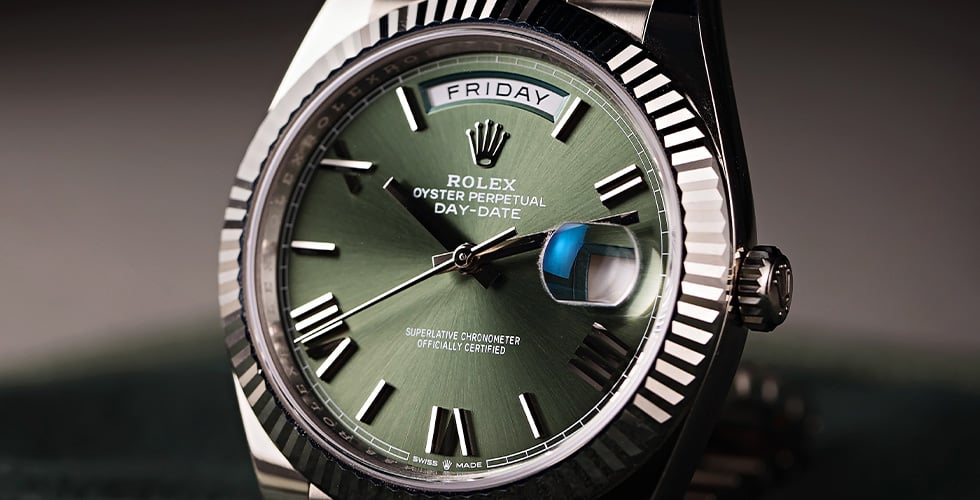
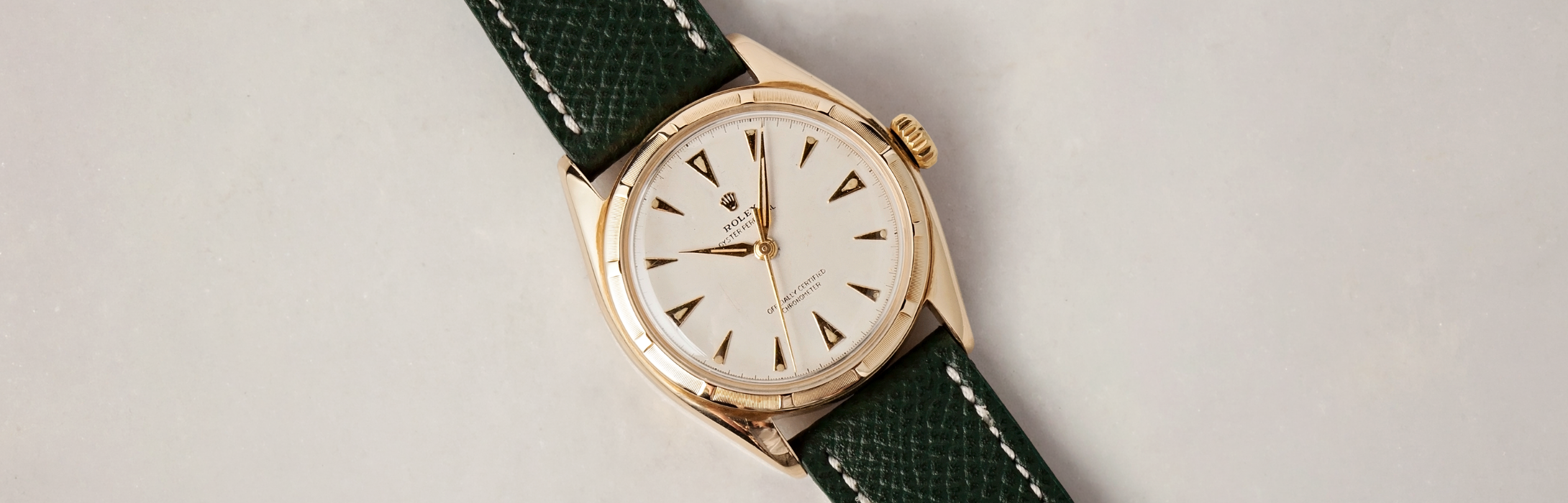
You can tell if a Rolex is real by inspecting a handful of key physical details: the dial printing, the Cyclops lens, the engravings, the movement, the winding feel, the weight and bracelet, and the caseback. On a genuine Rolex, dial text is crisp, opaque, and slightly raised, with flawless spacing. The Cyclops lens magnifies the date 2.5 times so the numeral fills the lens. The serial number is deeply engraved with clean, light-catching edges, never dotted or shallow. The seconds hand sweeps smoothly rather than ticking, and the crown winds with smooth, firm precision, never gritty or loose. An authentic Rolex watch feels heavy and solid, with no rattling bracelet links, because Rolex uses only 904L stainless steel, 18k gold, or 950 platinum. The majority of casebacks is solid metal, not transparent with the exception of two models, and the majority of Rolex models made since 2002 has a tiny crown logo laser-etched into the crystal at 6 o’clock, with the exception of the Milgauss and the Deepsea.
Today’s counterfeits, including “superfakes” capable of deceiving even seasoned collectors, can pass one or two of these tests, so if any doubt remains, verify the serial number against the paperwork and have the watch inspected in person by a trusted expert. In this guide, our team at Bob’s Watches draws on more than 35 years of authenticating pre-owned Rolex watches, from the Submariner to the Datejust and GMT-Master II, to walk you through each of these checks in detail.
So, diving into our curated insights, let’s explore the key indicators of authenticity for a Rolex watch. The journey begins with an essential ingredient that goes beyond the mechanics and the metal: trust.
1. Trust Your Seller

The most reliable way to avoid buying a fake Rolex is to purchase from an established dealer that provides a written authenticity guarantee, a money-back return policy, in-house watchmakers who inspect every watch, and a long, verifiable track record. Regardless of who you buy from, independently verify the watch’s serial number before completing the purchase.
Steering clear of imitation or counterfeit watches starts with a simple yet powerful step: choosing a watch seller with an impeccable reputation. Sure, you’ll come across many who claim the title, but real peace of mind comes from doing a bit of legwork to verify that you’re investing in an authentic Rolex. Turning to Google can lead you to some of the most well-established and trustworthy retailers, creating a first line of defense against the influx of fakes in the market.
But don’t let your vigilance end at a Google search. Go deeper. Consider Bob’s Watches, where every sale is accompanied by an iron-clad assurance of authenticity. Our passionate team of in-house experts doesn’t just inspect every watch that comes through our doors – they pour over every detail, ensuring the integrity of your timepiece. And if your Rolex needs a little TLC, rest assured it’s in the hands of authorized service providers who use nothing less than genuine Rolex parts, maintaining the spirit and standards of the brand. And for true aficionados, seeking out specialists who live and breathe Rolex can add that extra layer of confidence to your purchase.
2. Check For Quality
A genuine Rolex is made exclusively from premium materials: Oystersteel (904L stainless steel), 18k gold, or 950 platinum. Any sign of cheap construction, rough case edges, loose or rattling bracelet links, sharp burrs, dull or uneven finishing, or a flimsy clasp, is an immediate indicator of a counterfeit.
In the world of high-end timepieces, Rolex stands out as a beacon of luxury and unmatched quality. Each watch is a masterpiece, featuring the renowned Oystersteel – a 904L grade stainless steel renowned for its exceptional resistance to rust and corrosion. This isn’t just any steel; it’s a material so robust it’s also used in the aerospace and chemical industries. But Rolex doesn’t stop there. They craft their own exclusive blends of precious metals to guarantee that the look and function of your watch are preserved for a lifetime.
The devil is in the details, and with Rolex, each element is an example of precision engineering. From the lustrous case to the meticulous craftsmanship of the crown, the smooth sweep of the hands, the iconic bezel, the elegant bracelet, and the secure clasp – every aspect is a testament to Rolex’s commitment to excellence. Should you ever encounter a Rolex that doesn’t meet this high standard, with components that seem anything less than top-notch, it’s likely you’re looking at an imposter. A true Rolex doesn’t just tell time; it tells a story of perfection.
3. Serial & Model Number Engravings
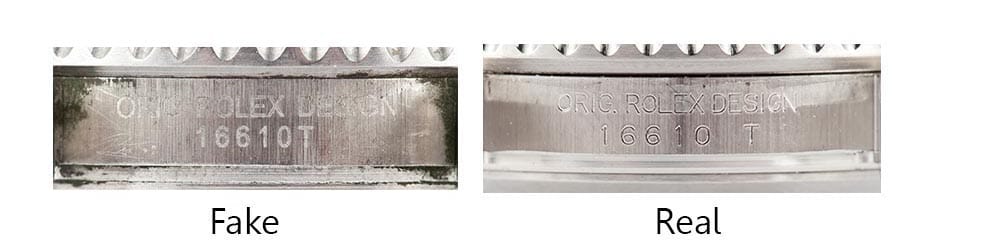
Every genuine Rolex carries a unique serial number, engraved between the lugs at the 6 o’clock position on older models and on the inner rehaut (the ring between the dial and crystal) on models produced from the mid-2000s onward. Authentic engravings are deep, precise, and reflect light like a finely cut diamond edge. Fake serial numbers typically appear dotted, blurred, shallow, or acid-etched with a sandy texture, and counterfeiters frequently reuse the same serial number across many different watches.
Discerning the authenticity of a Rolex can often come down to the subtle art of examining its serial and case reference numbers. When you’re comparing models, the authentic Rolex will reveal its identity through serial and model numbers engraved with laser precision. These markings are so finely cut, they dance and reflect the light, reminiscent of a meticulously carved diamond edge. On the flip side, imitations often betray themselves here. Their numbers may appear dotted or blurred, the result of inferior etching techniques, leaving behind a granular, acid-etched texture that you can spot in our comparison photos.
What’s more, the craft of imitation doesn’t quite match the originality of Rolex – counterfeits may repeat identical serial and reference numbers across a variety of styles, a shortcut that genuine Rolex craftsmanship never takes. Each Rolex watch boasts its own set of unique identifiers, with reference numbers that tell the story of its design and heritage. And for your peace of mind, we’ve provided a specialized Rolex serial number checker tool, an essential ally in verifying the lineage of your timepiece.
4. Markings
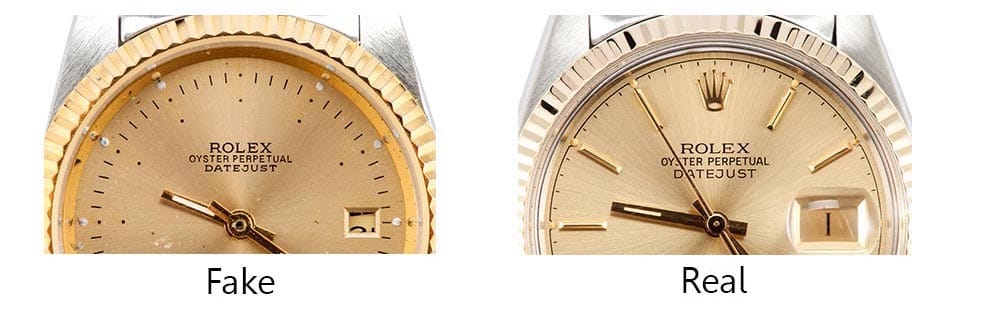
Every genuine Rolex is clearly marked with the Rolex name and the five-point crown (coronet) logo on the dial, crown, clasp, and bracelet. A missing, misshapen, off-center, or poorly finished logo, or any absent brand marking, is a strong sign the watch is counterfeit.
When venturing into the realm of luxury watches, the attention to detail can be the deciding factor between an original and a counterfeit. The crafters of replica watches operate across a spectrum of quality, and often, the less meticulous forgers will forego the very essence of the Rolex brand – its quintessential name and the celebrated crown emblem. A missing logo or the absence of the Rolex moniker is more than an oversight; it’s a telltale hallmark of a watch that won’t measure up to the legacy of quality synonymous with a genuine Rolex.
On closer inspection, if the timepiece is missing these critical brand markings, it’s a strong indicator you’re not holding a piece of the storied Rolex heritage. A true Rolex is not just a timekeeper but a statement, marked clearly with the brand’s distinguished symbols. These symbols are a testament to authenticity and a badge of the craftsmanship and history embodied in every genuine Rolex watch. Without them, a watch not only loses its identity but also its claim to be part of a lineage of the world’s most prestigious timepieces.
5. Movement
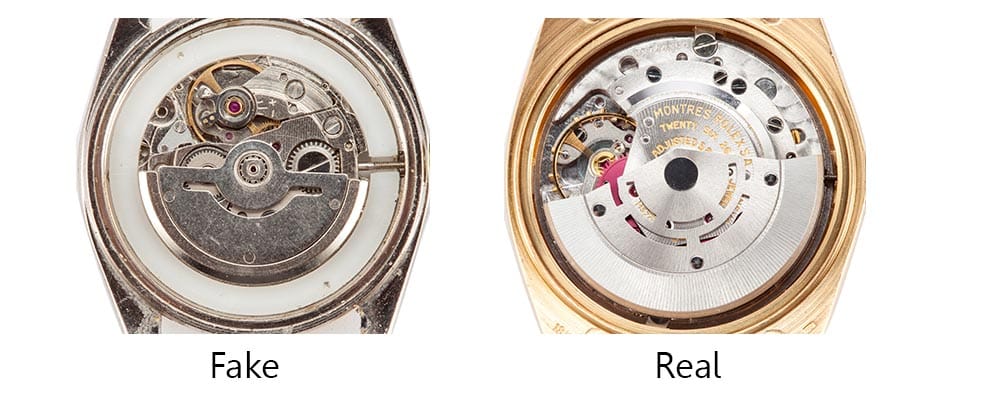
Genuine Rolex watches use mechanical movements: the seconds hand glides in a smooth sweep of roughly eight micro-ticks per second. A seconds hand that ticks once per second indicates a battery-powered quartz movement, which almost always means the watch is fake. Rolex produced only a limited run of quartz Oysterquartz models that were discontinued in the early 2000s, and Cellini quartz models that were available until the late teens. If the caseback is opened, a genuine movement will be finely finished and engraved with the Rolex name.
At the heart of every authentic Rolex watch lies a mechanism that is a testament to superior watchmaking- a movement crafted with an unwavering commitment to precision. The intricate dance of gears and springs inside a real Rolex is meticulously assembled, ensuring each watch bears the Rolex engraving as a seal of authenticity. This level of detail in the finish and function is only visible upon opening up its case, revealing the flawless execution expected from such a prestigious brand.
It’s vital to remember that the essence of Rolex’s horological identity is predominantly mechanical. Encountering a Rolex with a quartz movement should raise immediate concerns. Throughout its illustrious history, Rolex has produced only a handful of quartz timepieces, making them an anomaly rather than the norm. The advent of sophisticated counterfeiting technologies like optical scanning and 3D printing has narrowed the gap, empowering counterfeiters to produce ‘super fakes’ with movements that closely resemble those of a genuine Rolex. These imitations may initially look convincing, but upon meticulous inspection, they fall short. The cloned movements miss the mark on the exquisite finishing touches and the dependable accuracy that Rolex is renowned for -the very attributes that make a Rolex much more than just a timekeeper.
6. Dial, Hands, & Finishing
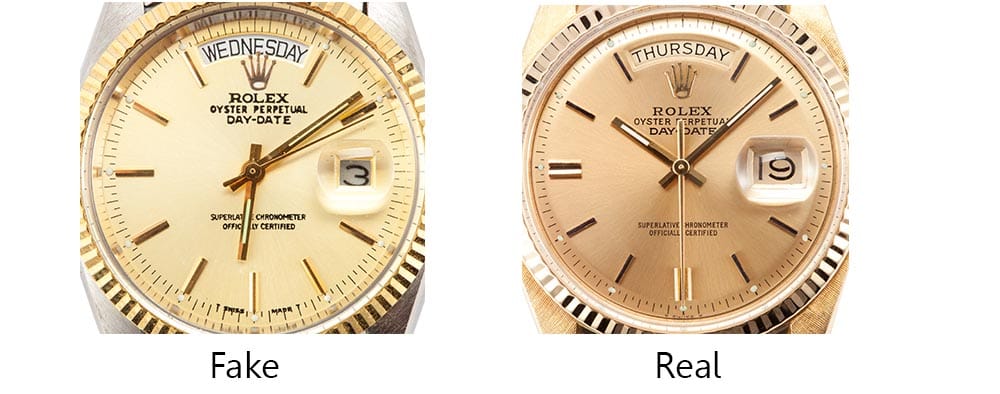
On a genuine Rolex dial, every element is flawless: printing is crisp and evenly spaced, hour markers are perfectly aligned, and the lume is applied cleanly. Any smudged text, misspelling, uneven font spacing, crooked marker, or bubbled paint is a definitive sign of a fake.
The dial of a brand-new Rolex exudes perfection down to the minutest detail. The precision of the fonts, the exacting spaces between letters, and the absolute absence of smudges or misspellings are hallmarks of their storied craftsmanship. Spotting any discrepancy here, such as uneven lettering or blemished finishes, should immediately trigger doubts about the watch’s legitimacy.
The artistry involved in the genuine Rolex dial, hands, and hour markers is nothing short of immaculate, a standard that fakes often fall short of reaching. The printing on the dial, the luster on the hands, the alignment of the hour markers – every component on a genuine Rolex is the result of an elaborate process designed to achieve visual and functional harmony. That’s why it’s crucial to examine the watch against official images from Rolex, ensuring that what you’re considering for purchase aligns with the unparalleled quality the brand is known for. Be aware, on closer examination, counterfeit models may reveal significant variations in the design of the hands, the dial, and even the clasp of the bracelet.
7. Cyclops
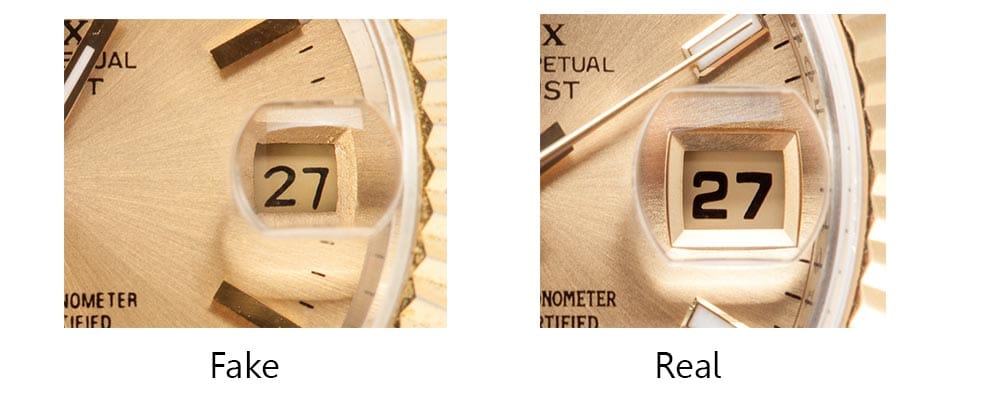
The Cyclops, the magnifying lens over the date window, magnifies the date exactly 2.5 times on a genuine Rolex, so the numeral appears to fill the lens. On most fakes, the lens is too flat and magnifies the date only about 1.5x or not at all, leaving the numeral looking small inside the bubble.
In the lexicon of Rolex aficionados, ‘The Cyclops’ holds a special place – it’s not a mythical creature but the signature magnifying lens that adorns the crystal over the date display. On an authentic Rolex, the Cyclops lens proudly stands above the date window, bulging outward in a convex shape that notably enhances the date numerals with 2.5 times magnification. This feature is not just about aesthetic flourish; it’s a functional design crafted to make reading the date effortless, reflecting the user-centric philosophy of Rolex design.
Should you find the date on your Rolex looking a little shy, the lens lying flat without that characteristic magnification, it’s time for a second glance. This could be a sign that the watch in your hands is masquerading as something it’s not. The art of identifying an authentic Rolex is akin to enjoying fine art; you must absorb and appreciate every detail. The Cyclops is no minor detail – it is a defining trait of a watch that stands out in the crowd, ensuring the date doesn’t just whisper but speaks clearly to the wearer.
8. Water Resistance
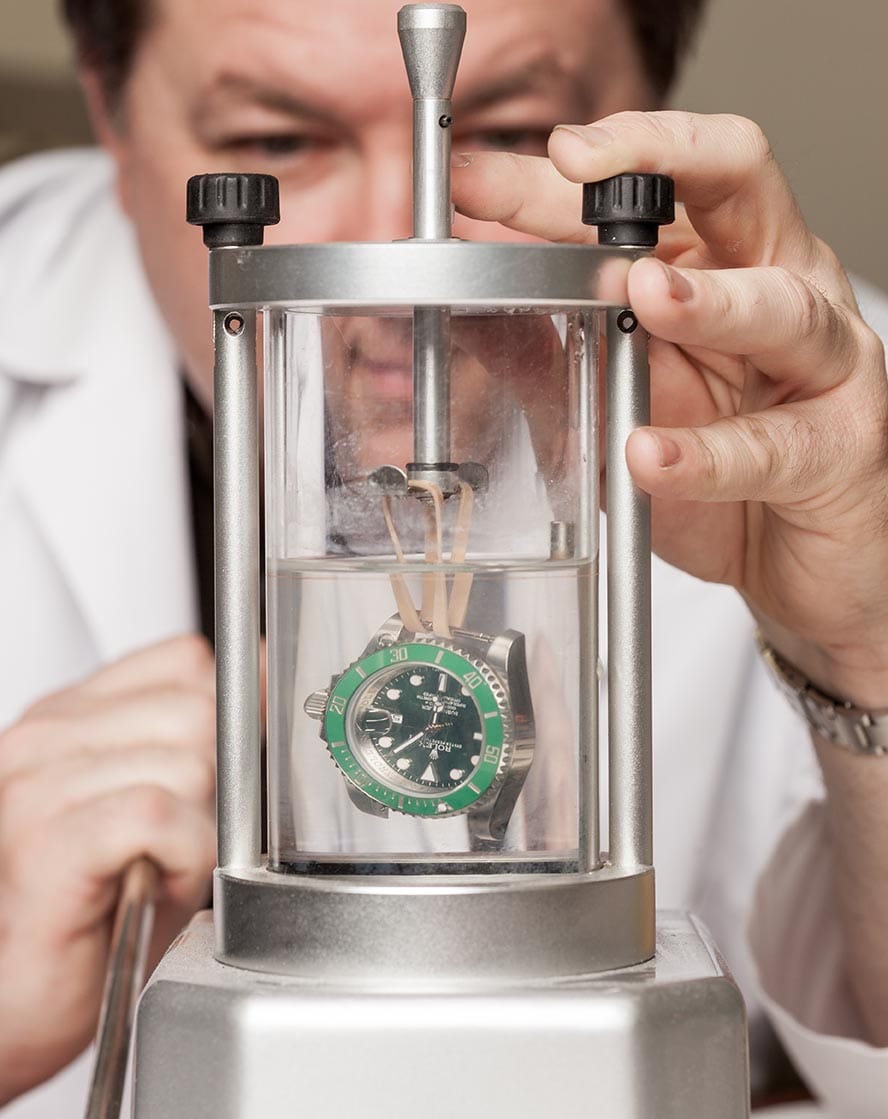
Every modern Rolex Oyster case is water-resistant to at least 330 feet (100 meters), sealed by a screw-down caseback and screw-down winding crown. Counterfeits rarely have functional seals, but never water-test a watch yourself. Have a professional perform a pressure test, since submerging a fake (or an unserviced genuine watch) can cause irreversible damage.
Rolex watches are engineered with an extraordinary focus on water resistance, a testament to their commitment to durability and quality. Authentic Rolex watches boast a construction that seals them against the ingress of water, certified through rigorous water pressure testing. Imitations, however, often falter under such scrutiny, as they lack the sophisticated seals and casings that characterize a true Rolex. It’s this resilience against the elements that not only enhances the value of a Rolex but also stands as a measure of its authenticity.
Despite this, we caution against the DIY approach of water-testing a Rolex at home. The risks outweigh the benefits, especially if the authenticity of your Rolex is in question. Submerging a potentially counterfeit watch could cause irreversible damage, closing the door on any possibility of a return. Moreover, vintage pieces or those requiring service might also fail such tests, despite being genuine. For peace of mind, and to safeguard the intricate craftsmanship of your timepiece, it’s wise to entrust this verification to the seasoned expertise of a professional. Their evaluation will not only confirm authenticity but also ensure the enduring legacy of your Rolex remains uncompromised.
9. Weight
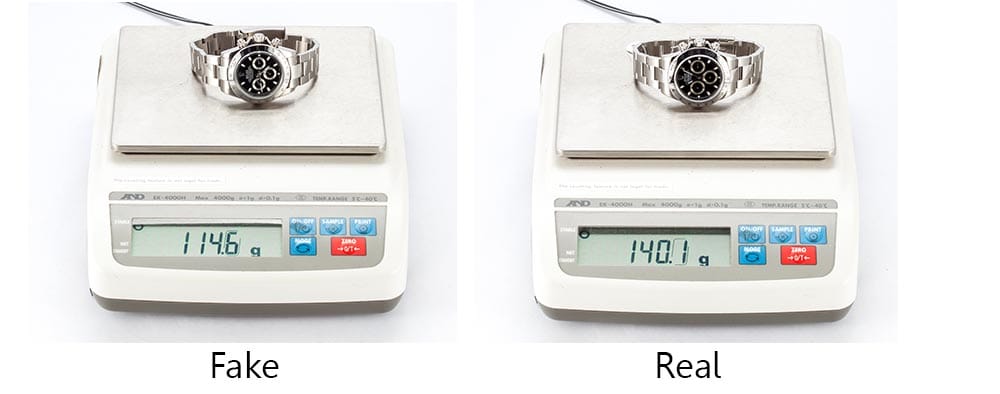
A genuine Rolex feels noticeably heavy for its size because it is built from solid 904L stainless steel, 18k gold, or 950 platinum with solid bracelet links. Counterfeits are usually significantly lighter due to hollow links, thinner cases, and cheap alloys, if a Rolex feels light or tinny in the hand, treat it as a fake.
Holding a genuine Rolex in your hand is an experience of substance in every sense – the weight of the watch is a representation of the premium materials and meticulous assembly that go into its creation. Crafted from only the most exceptional metals and components, each genuine Rolex bears a certain heft, a reassuring reminder of the brand’s commitment to excellence and durability. This substantial feel is the result of an uncompromising approach to quality, where everything from the case to the bracelet is designed to meet the highest standards of luxury watchmaking.
In contrast, a counterfeit Rolex might betray itself the moment it’s picked up. The absence of weight is often the first clue that corners have been cut, signaling the use of inferior materials and a lack of the solid construction that Rolex is known for. If a Rolex feels suspiciously light, or if its materials don’t convey the sturdiness expected from high-end craftsmanship, it’s probable that the watch is an imitation. Trust your senses as much as the aesthetics; a genuine Rolex not only looks the part but feels it too.
10. Clear Caseback
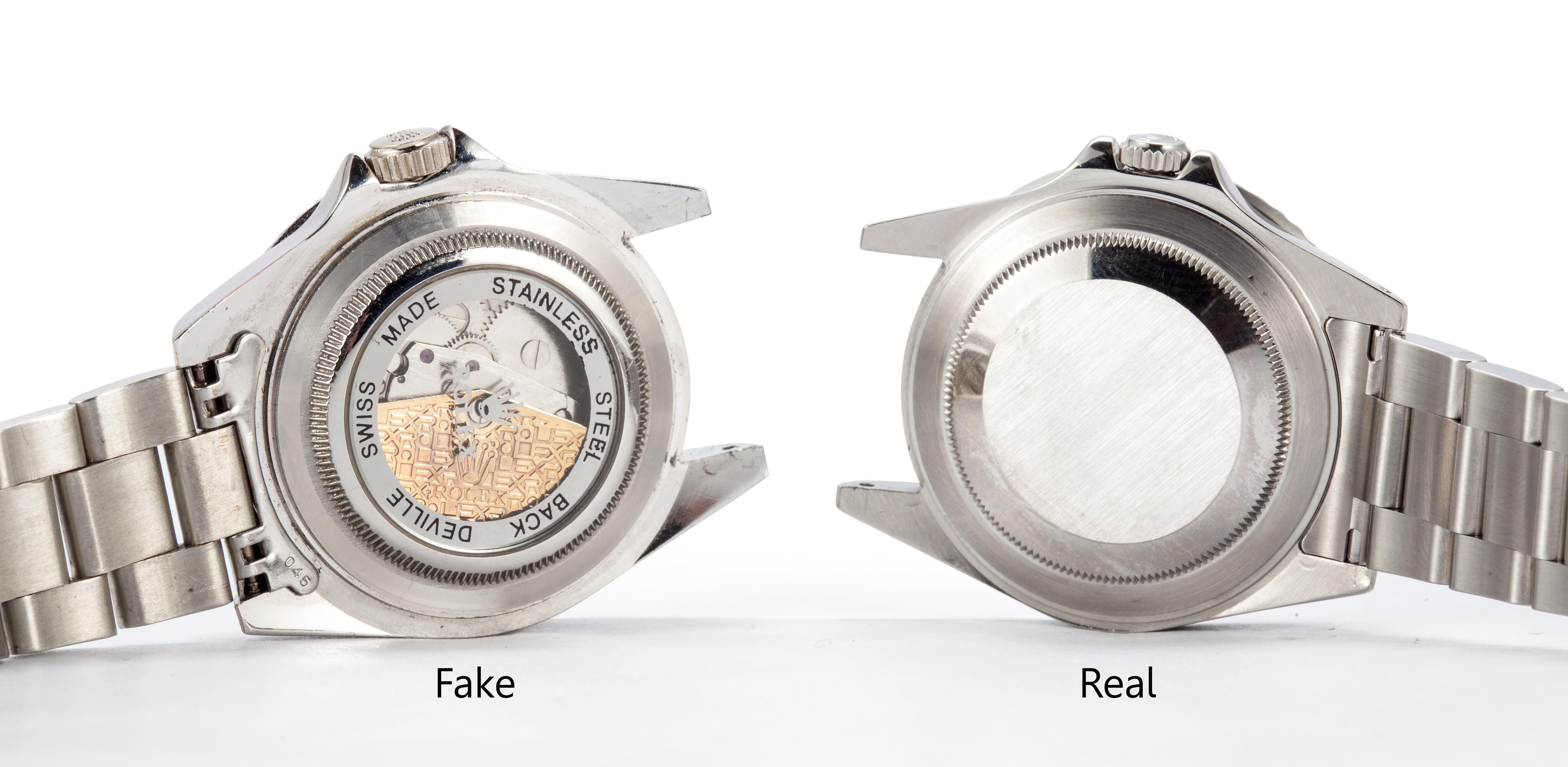
The majority of Rolex references does not make watches with transparent (exhibition) casebacks. Apart from a few exceptions, every genuine Rolex has a solid metal caseback, so a clear caseback that displays the movement is a near-certain indicator of a fake.
One of the hallmarks of a Rolex’s integrity is its solid case back. Excluding a select few pieces of Rolex history – like the exceptional vintage collections from the 1930s and the distinctive 60th-anniversary edition of the platinum Daytona – Rolex has chosen not to reveal their timepieces’ inner workings through the back.
Conversely, a transparent case back on a Rolex might be the lens through which a counterfeit reveals itself. Replica makers often include this feature to entice those who are fascinated by the mechanical spectacle. However, this is not a characteristic of authentic Rolex design, and such transparency should signal caution. A clear back that exposes the watch’s movement is an almost certain indicator of a non-genuine piece, and when you come across such a discrepancy, it’s a strong indication that the watch may not be a true Rolex.
11. Caseback Engravings
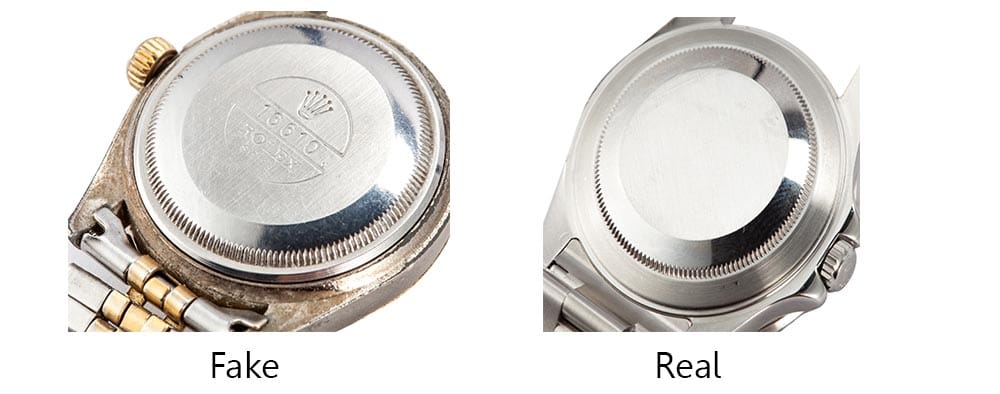
Genuine Rolex casebacks are smooth and free of engravings, logos, or illustrations. The rare exceptions are certain vintage ladies’ Datejust references (6917, 69173, and 69174, marked “Stainless Steel” and “Registered Design”), a few commemorative models, the Sea-Dweller, Deepsea, and Milgauss,, and personal engravings added by previous owners. A caseback decorated with a large Rolex logo, hologram sticker, or artwork should be looked at carefully if it is not one of the exceptions listed above.
Diving deeper into the Rolex archives, there’s an interesting footnote: some vintage ladies’ Datejust models, specifically references 6917, 69173, and 69174, did feature the words “Stainless Steel” and “Registered Design” on their casebacks. These are the outliers in a legacy that typically favors a clean, unmarked backdrop. In most instances, if you’re admiring a Rolex’s caseback and it’s anything but smooth, or worse, transparent, you’re likely looking at a counterfeit. Rolex prides itself on their solid, unsee-through casebacks, a tradition that underscores their luxury craftsmanship.
12. Micro-etched Crystal
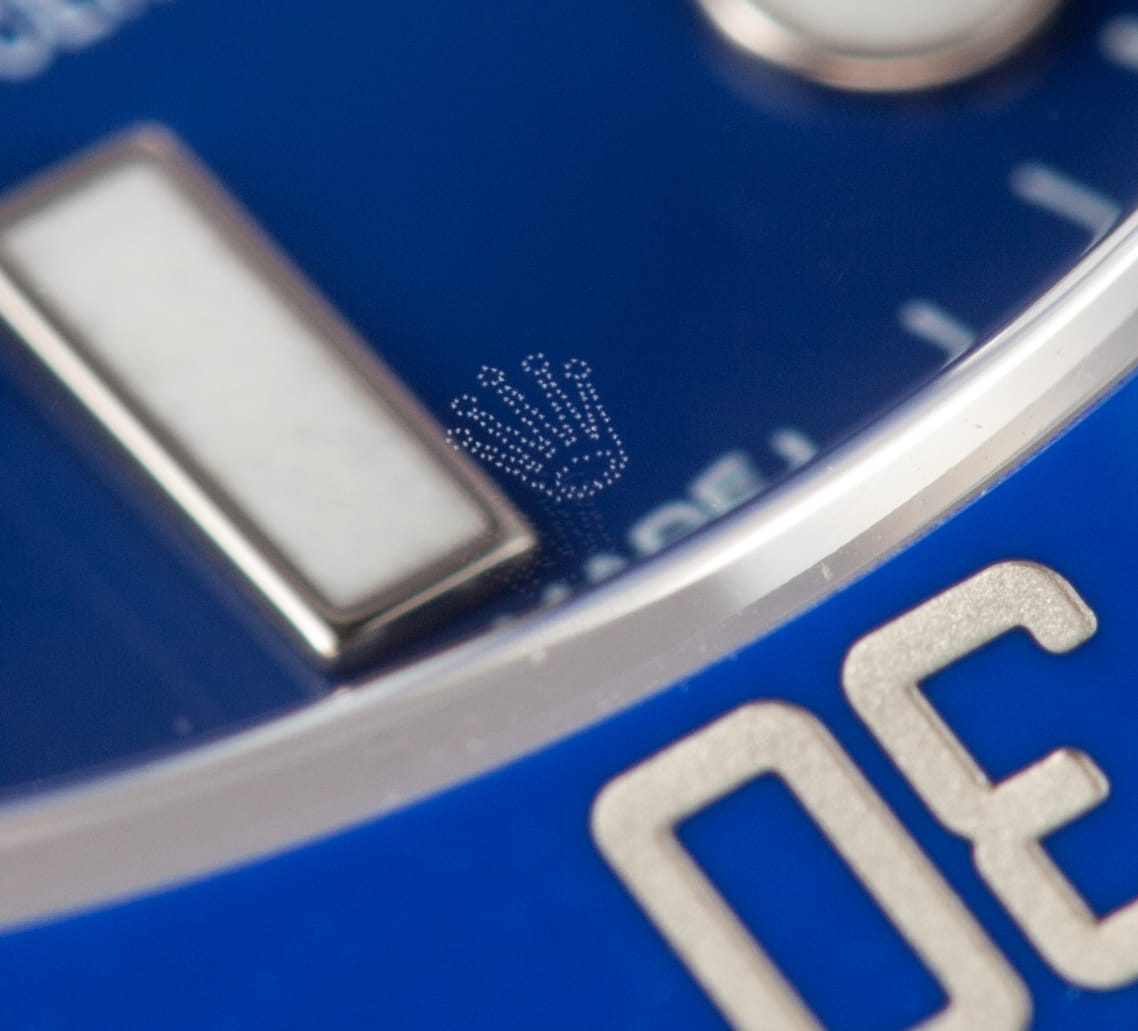
Since 2002, every genuine Rolex has a microscopic crown logo laser-etched into the sapphire crystal at the 6 o’clock position. It is nearly invisible to the naked eye and requires a loupe and angled light to see, a level of precision counterfeiters struggle to reproduce. If a post-2002 Rolex is missing this etching, or if the etching looks large, cloudy, or crude, the watch is likely fake.
This small etching is Rolex’s way of weaving security into the very fabric of their watches. The intricacy involved in creating and placing this micro-logo means that it’s an exceptionally hard feature for counterfeiters to mimic successfully. When in the market for a modern Rolex, make it a point to seek out this elusive crown.
Superfakes in 2026: Why Even Experts Get Fooled
The biggest change in the counterfeit market over the past few years is the rise of “superfakes,” high-grade replicas that copy Rolex case dimensions, bracelet construction, and even clone movements closely enough to fool a casual inspection. Modern superfakes often pass several of the traditional tests: they use heavier materials, include a magnifying Cyclops, and reproduce the rehaut engraving.
What superfakes still cannot replicate is the sum of the details. Under magnification, cloned movements lack the fine finishing, precise regulation, and exact bridge architecture of a genuine Rolex caliber. Dial printing, lume application, and the micro-etched crystal coronet remain the hardest features to copy correctly, and serial numbers will not match Rolex’s production records for that reference. Because no single test is conclusive against a superfake, the safest verification is a physical inspection by an experienced watchmaker or a trusted dealer, including opening the caseback to examine the movement itself.
Watch and Learn: How to Spot a Fake Rolex Video
Discovering a poorly constructed imitation Rolex can be straightforward, often revealing itself through lackluster details that fall short of the genuine article. Yet, as the art of counterfeiting has evolved, so has the complexity of these deceitful creations. The emergence of ‘super fakes’ brings a new level of intricacy, making it challenging to distinguish these impostors from the real treasure. It’s precisely for this reason that we’ve gone the extra mile to craft an informative video for you. At Bob’s Watches, we’ve put these super clones under the microscope, comparing them side-by-side with authentic Rolex watches. Our enlightening video, “How to Tell a Fake Rolex,” is more than just a guide; it’s a window into the meticulous world of Rolex craftsmanship, ensuring you have the confidence and knowledge to spot the differences with ease.
Beware of eBay & Craigslist Reproductions
Peer-to-peer marketplaces like eBay and Craigslist carry the highest counterfeit risk of any place to buy a Rolex, because the platforms act only as intermediaries and do not authenticate the watches sold through them. While platforms like eBay and Craigslist have become household names for online shopping, they function primarily as intermediaries connecting buyers with sellers. This means they don’t take responsibility for the authenticity of the items sold through their sites. The prevalence of counterfeit products, particularly in high-value categories like luxury watches, makes these marketplaces challenging to navigate for those seeking legitimate Rolex vendors. Without in-depth knowledge of Rolex authentication, navigating these sites can be risky.
Therefore, caution is advised when considering a Rolex purchase from these platforms. Given the complexity involved in verifying a real Rolex, and the high stakes of inadvertently purchasing a fake, we suggest steering clear of these marketplaces. For a secure investment in a timepiece, we always recommend consulting with authorized Rolex dealers or trusted watch specialists who provide expertise and assurance in your quest for an authentic Rolex.
Authenticating a Rolex Based on Materials
In addition to the top tips for spotting a fake, it’s also important to keep a few things in mind to ensure you’re buying authentic Rolex watches. While that will never be a concern when buying from Bob’s, it’s still useful to arm yourself with some knowledge. So, we’ve compiled a quick rundown of the anatomy of authentic Rolex watches with some basic guidelines to keep in mind. Please note that these rules are only applicable to Rolex watches made after 2002.
The Metals of Authentic Rolex Watches
As expected, Rolex only uses the finest materials for its watches. For instance, Rolex watches exclusively use 904L stainless steel and 18k gold. Furthermore, Rolex also uses a patented rose gold alloy with some platinum mixed in that the brand calls Everose. For Rolex platinum timepieces, only 950 platinum will do, which is comprised of 95% pure platinum. The term Rolesor refers to the use of both gold and stainless steel on a particular model. On the other hand, Rolesium refers to the use of both platinum and stainless steel on a specific watch.
- 904L Stainless Steel
- 18k gold
- Everose rose gold alloy (18k)
- 950 platinum
- Rolesor: gold and stainless steel (available in all 3 colors of gold)
- Rolesium: platinum and stainless steel
- Good to know: the fluted bezel is only ever in solid gold or platinum
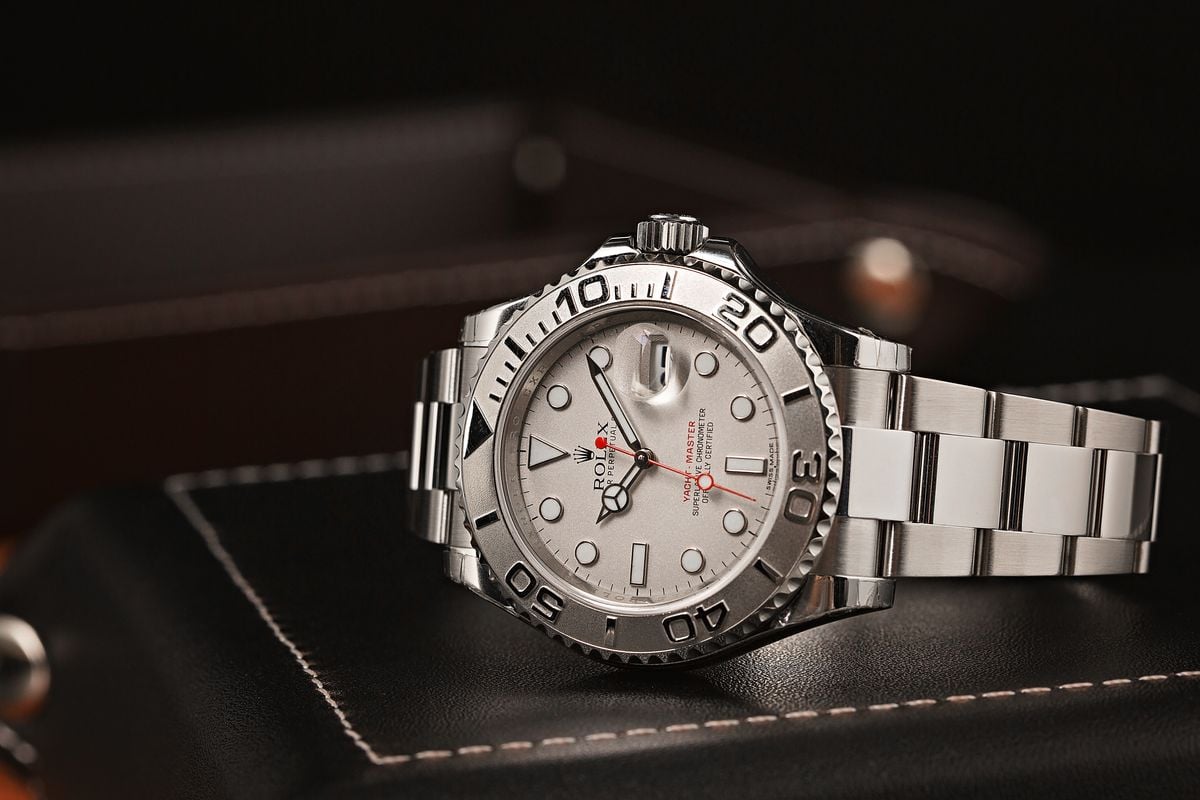
The Oyster Cases of Authentic Rolex Watches
Rolex Oyster Perpetual watches are of course famous for their water resistance. In fact, Rolex made history in 1926 by creating the first waterproof wristwatch. Today, Rolex Oyster Perpetual watches have a minimum water resistance of 330 feet (100 meters). However, Rolex divers’ watches have much deeper water resistance. The Rolex Submariner is water-resistant to 1,000 feet (300 meters) while the Sea-Dweller is water-resistant to 4,000 feet (1,220 meters). Finally, the Rolex Sea-Dweller Deepsea is water-resistant to 12,800 feet (3,900 meters).
- Rolex Oyster Perpetual Minimum Water Resistance: 330 feet
- Submariner Water Resistance: 1,000 feet
- Sea-Dweller Water Resistance: 4,000 feet
- Sea-Dweller Deepsea Water Resistance: 12,800 feet
To achieve this water resistance, the cases of authentic Rolex watches have certain hallmarks. Firstly, they have a solid middle case. Secondly, they have a fluted screw-down case back. Additionally, the cases are equipped with screw-down winding crowns to keep the water out. Depending on the model, there’s the Twinlock or Triplock screw-down winding crown, with two or three sealed areas, respectively.
- Twinlock: Day-Date, Datejust, Oyster Perpetual, Sky-Dweller, Pearl-Master, Explorer II, Milgauss, Air-King, GMT-Master II (pre-2008)
- Triplock: Yacht-Master, Yacht-Master II, Submariner, Sea-Dweller, Daytona, GMT-Master II (post-2008)
The Sapphire Glass of Authentic Rolex Watches
Another telltale sign on how to tell if Rolex is fake is the sapphire crystal, the glass that covers the dial on your watch. Modern authentic Rolex watches are outfitted with a scratchproof sapphire crystal to protect the face of the watch. What’s more, on Rolex date watches, there’s a magnifying lens on top of the date window to amplify the number for greater legibility. This lens, dubbed the Cyclops, is also made from sapphire crystal and it magnifies the date 2.5 times. Up until very recently, the only Rolex date models that did not have a Cyclops lens were the Sea-Dweller and Deepsea. But that changed at Baselworld 2017 when Rolex introduced the new Sea-Dweller with a Cyclops lens. Now, the only Rolex date watch without a Cyclops lens is the Sea-Dweller Deepsea.
As of 2002, Rolex started including a tiny micro-etching of the Rolex crown, aka the “coronet,” on the crystal at the 6 o’clock position. Extremely difficult to see without a loupe and almost impossible to replicate properly, this mini marking is a hallmark of authentic Rolex watches. Another marking of authenticity sits under the sapphire crystal on the rehaut, which is engraved with “ROLEX ROLEX ROLEX” all around, along with the serial number engraving at 6 o’clock.
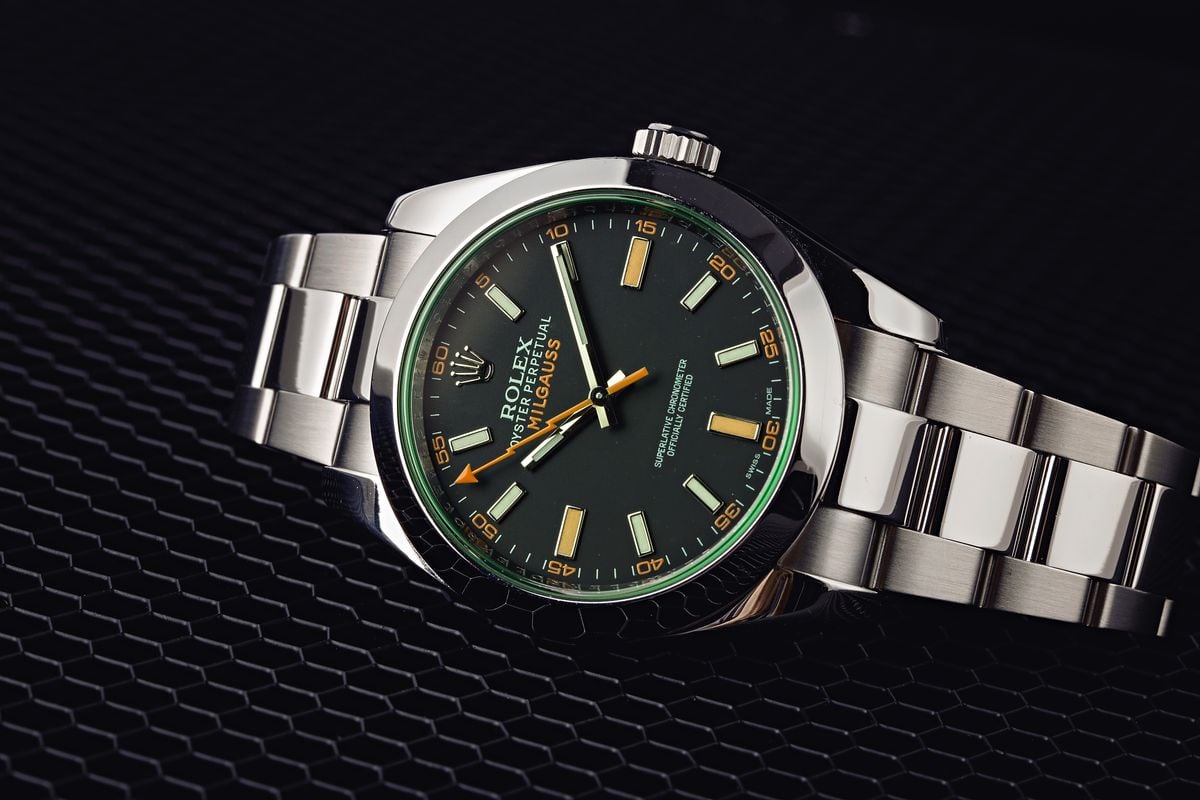
The Bracelets and Straps of Authentic Rolex Watches
As much a part of the overall look of a Rolex watch is the bracelet that it is presented upon. Today, there are many different types of Rolex bracelets and straps to choose from depending on the model. Here’s a quick cheat sheet:
- Oyster bracelet: flat three-piece link construction. Available in steel, gold, platinum, or Rolesor.
- President: semi-circular three-piece link construction. Available in gold or platinum.
- Jubilee: curvy five-piece link construction. Available in steel, gold, or Rolesor.
- Pearlmaster: rounded five-piece links (exclusively on Pearlmaster watches)
- Leather: alligator leather. Available with gold folding clasps.
- Oysterflex: nickel and titanium metal blade coated with black elastomer. Available with gold folding clasps.
The newest Rolex bracelet option is the Oysterflex. It first made its debut in 2015 on the Everose Yacht-Master and later became available on gold Daytona models. We hope that you find this quick guide to the anatomy of authentic Rolex watches to be useful. However, when searching for genuine Rolex timepieces, nothing beats buying from a trustworthy source since all the homework has been done on your behalf.
Eliminate Risks When Buying Authentic Rolex Watches
The joy a Rolex brings to its owner is unparalleled, yet for those looking to change their collection, selling a Rolex can be part of the journey. If you’re contemplating a pre-owned Rolex, the significance of confidence in your purchase cannot be overstated. At Bob’s Watches, we stand as a defender against the uncertainties of the secondary watch market. Here, the fear of counterfeit watches dissolves, thanks to our rigorous authentication process that ensures each watch is the epitome of the genuine craftsmanship Rolex is celebrated for.
Navigating the nuances of luxury timepieces requires more than just a keen eye – it demands expertise. Our dedicated team of specialists verifies every detail, offering you the peace of mind that comes with certainty. Every watch in our curated collection is a testament to authenticity, backed by our commitment to transparency and excellence. For any inquiries or guidance through our selection, we invite you to reach out. Our experts are on hand, ready to assist you in securing not just a watch, but a piece of horological heritage.